The quest for a unipolar world order

Ted Grimsrud—November 4, 2025

The several years following World War II emphatically stamped the United States as an imperial power, not one that would seek to further the ideals of Franklin Roosevelt’s Four Freedoms speech of 1941 (such as self-determination and freedom from war everywhere on earth). As articulated in Harry Truman’s 1947 “Truman Doctrine” speech, instead the US would commit itself to be ready to intervene militarily everywhere on earth in order to defeat its enemies. Though the practices of the American Empire in the quarter century after World War II contradicted the ideals of the Four Freedoms, most Americans embraced an uncritical nationalism that prevented them from a clear-eyed view of their country’s actual way of being in the world.

From the colonial era through World War II, the North American colonies and the US pursued a domination agenda. From the start, the colonies utilized the superior firepower of European weapons to displace indigenous peoples and created an economic system that required coerced unpaid enslaved labor. While the American Empire could have made choices that moved in more humane directions, the odds for such humane choices always remained small. At the end of World War II, American leaders faced perhaps the greatest (and last?) opportunity to choose for the more humane. The US could have actually committed to the ideals of the World War II purpose statements that reflected the long-stated democratic hopes in the American tradition.

A choice of paths

American leaders in late 1945 faced two basic options. One, the US could have pursued a multipolar world order. Such had been hoped for (but not achieved) with the League of Nations after World War I. Then, during World War II, many leaders expressed the hope that this time the great powers might do it right. They hoped for structures that would allow for many different power locations that would find ways to cooperate. These hopes led to the creation of the United Nations. This time, unlike with the League of Nations, the United States embraced its role as a world leader. In fact, this time the world leadership organization would be located in the US.

Or, in contrast, the world order could be based on the dominant power of a single nation and its close allies. World opinion at the end of the War did not allow for an open affirmation of such an approach. The two powers (Germany and Japan) whose open quest for world domination had been so devastating lost the War. No other power would dare advocate such an approach. However, the War ended with a single nation having achieved a dominant global stature that had never before existed. The US could seek dominance without openly claiming to.  

The US found option two to be irresistible and embarked on a 50-year effort to establish and sustain a unipolar world order. However, the US “victory” in the Cold War did not result in American “full spectrum dominance,” an achieved unipolar world order. Rather, the years since the end of the Cold War have seen a steady diminishment of American power. Can the American Empire give up its quest for dominance and affirm the emerging multipolarity?

Continue reading “The quest for a unipolar world order”

How does one step away from warism?

Ted Grimsrud—September 26, 2025

When I began college in the Fall of 1972, I had recently registered for the draft. I knew I’d go willingly if called. I accepted my place in the American warist environment—the willing conscript. By the time I finished college in the Spring of 1976, I rejected warism. I considered myself a pacifist and knew I would never go to war or support war in any way. This post will describe what led to this radical change. In the Fall of 1972 turmoil reigned in the United States. At that point I remained mostly oblivious to the currents that swirled as Richard Nixon wrapped up his presidential campaign and won a landslide victory—and planted the seeds that led to his fall with the Watergate break-in. I knew that the Vietnam War seemed to be winding down, though when I started my freshman year the draft remained a possibility.

I started at Oregon College of Education (OCE) in Monmouth, a small town about 15 miles west of Salem. OCE mainly focused on training schoolteachers, but it had evolved to be a general liberal arts college. About 3,000 students attended, mostly from small Oregon towns. Even though I knew hardly any other students, I felt surrounded by people like me. I found it to be a pleasant place to be, and I enjoyed my two years there. I felt fine with my classes. I could get by pretty easily, though nothing really caught my attention. Sports, not ideas or big questions, provided the connecting point with my new friends. In general, I experienced my first two years in college as a relaxed and congenial time. However, I did feel uneasy about my faith. I only cautiously brought up faith convictions with others. I had no luck in finding a church or fellowship group. I visited a few places but found nothing that seemed interesting or nurturing.

The ironic 1972 presidential election

I had exulted when Richard Nixon won the 1968 election. As far as I remember, I felt positive about Nixon during his first term. I certainly sympathized with him far more than his antiwar opponents. I rejoiced when the law changed to set the voting age at 18. I had long wanted to vote. I delighted that the first presidential election after the law changed would happen when I was 18. I proudly cast my ballot for Nixon and celebrated his resounding victory.

That I would have so unthinkingly supported Nixon indicates that my embedded theology of uncritical nationalism remained operative. I later learned of deeply problematic Nixon warist policies as well as of his many character flaws. Those flaws played out in ways that would have been in tension with the values of my familial embedded theology, but at the time I remained ignorant of them. Ironically, Nixon’s opponent, George McGovern, had more compatibility with most of my values. His integrity, genuine Christian faith, and convictions about helping life be better for vulnerable people should have rung true for me. In relation to the peace convictions I would later embrace, McGovern stands as the most attractive major party candidate in the entire 20th century. The mainstream media did not give McGovern a fair shake, but even if they had, I would not at that time have been attracted to the policies he advocated.

Continue reading “How does one step away from warism?”

American warism

Ted Grimsrud—September 12, 2025

One main characteristic of the US during my lifetime has been the centrality of “warism” to the nation’s sense of itself. By “warism” I mean war as central for the nation’s identity. Signs of the US as a warist society may be seen in all the money that the nation spends on preparing for war and the war-related priorities in the operation of our government. American warism may also be seen in the bipartisan consensus on miliary spending, one area where Democrats and Republicans always agree. Most of our government spending goes for war and war preparation. And the US spends way more on military-related items than anyone else in the rest of the world.

The myth of redemptive violence

What I will call the “myth of redemptive violence” grounds American warism. This myth is the quasi-religious belief that we gain “salvation” (that is, a sense of security and of meaning and purpose) through violence. People throughout history have put tremendous faith in using violence for such “salvation.” The amount of trust people put in such instruments may perhaps be seen most clearly in the amount of resources they devote to the preparation for war.

Theologian Walter Wink described how this myth works. His book Engaging the Powers asserts “violence is the ethos of our times. It is the spirituality of the modern world. It has been accorded the status of a religion, demanding from its devotees an absolute obedience to death.” This myth remains invisible as a myth. We assume violence to be simply part of the nature of things. We accept violence as factual, not based on belief. Thus, we remain unaware of the faith-dimension in accepting violence. We think we know as a fact that violence works, is necessary and inevitable. We do not realize we operate in the realm of belief in accepting violence.

This myth operates on many levels. Americans assume the need for violent state power to sustain order. We willingly subordinate ourselves with few questions to this power and regularly encounter the myth on the level of popular culture. The books we read, the movies and TV we watch reiterate the story of creation as grounded in violence and chaos. Thus, we need military and police violence to subdue chaos and dominate enemies. We must subordinate ourselves to people in authority who exercise this necessary and redemptive violence. We join in the exercise of violence against our nation’s enemies when called upon. We accept one of the world’s most powerful police systems and one of the world’s largest prison systems.

Continue reading “American warism”

On being a proud American

Ted Grimsrud—September 9, 2025

An essential part of the expected disposition that characterizes citizens of the United States, it seems to me, is pride in being an American. This sense of pride characterizes Americans going back to the origins of the country. Perhaps such a sensibility reached its highest peak in the years of my youth in the afterglow of the victory in World War II and prior to the major stressors of the 1960s Civil Rights conflicts, war in Vietnam, and other challenges to the nation’s self-satisfaction. Though the prideful sensibility faced disruptions in the 1960s and ever since, it remains a significant element of many people’s senses of identity: “I am proud to be an American.” Certainly, that feeling of pride shaped my sense of identity during the 1950s, 1960s, and early 1970s. However, I came to see such pride as problematic when I learned more about the actual character of the American Empire.

Pride in America as a factor in warism: The impact of World War II

This sense of pride, I suggest, has fostered a kind of false consciousness among many Americans. We assume (our embedded theology tells us) that we should be proud to be Americans, an assumption that can lead us to believe that we have something to be proud of. That is, we seek to justify the feelings of pride rather than considering that perhaps we should not be so proud. A big part of the hostility that greeted the social change movements of the 1960s surely stemmed from perceiving those movements as threats to the sense of pride.

Along with the push toward false consciousness, the pridefulness also makes people susceptible to being manipulated to support war. One of the main justifications for pride in America, especially for those raised in the afterglow of World War II as I was, is the perceived American record of fighting in just wars and winning them. As a child, I found it important to believe that the US had never lost a war—and never been involved in an unjust war. In a kind of vicious cycle, many Americans uncritically believe that we show our country’s worth by going to war. We tend to recognize the wars by definition as just simply because our country fights in them.

Continue reading “On being a proud American”

Peace in Ukraine? [American Politics #17]

Ted Grimsrud—August 20, 2025

I found what seems to me to be to be a good, short analysis of the current status of the war in Ukraine, an article “The Peace Delusion,” by a political analyst named Thomas Fazi, who writes regularly for the web-based magazine UnHerd. In a nutshell, Fazi suggests that the core issue in the struggle is the question of whether the United States will remain the single global hegemon or if we will transition to what many are calling a multipolar world order, where there will be several great powers that can manage to co-exist in relative peace.

Peace in Ukraine will require Ukraine and its US/NATO backers to acquiesce to Russia’s demands. It’s not simply recognizing Russia’s control over the various parts of eastern Ukraine that they have or will soon have taken over. “It’s about addressing the ‘primary roots of the conflict,’ as Putin repeated in Anchorage: that Ukraine will never join NATO, that the West will not transform it into a de facto military outpost on Russia’s border, and that a broader ‘balance of security in Europe’ be restored.”

Were those demands to be met, Fazi argues, the result would be “a wholesale reconfiguration of the global security order—one that would reduce NATO’s role, end US supremacy, and acknowledge a multipolar world in which other powers can rise without Western interference.” These demands have been stated clearly and consistently by the Russians since before the February 2022 invasion of Ukraine. The reason why peace remains impossible in Ukraine is that such demands (and the resultant “reconfiguration of the global security order”) is simply something that “Trump—and more fundamentally the US imperial establishment, which operates largely independent of whoever occupies the White House—cannot concede to.”

Continue reading “Peace in Ukraine? [American Politics #17]”

A Christian political agenda? The Bible’s radical politics (part four)

Ted Grimsrud—June 16, 2025

In the first three parts of this series on the Bible’s radical politics (part 1; part 2; part 3), I have sought to show the continuity between the Old Testament and the story of Jesus. Throughout the Bible we see a critique of the great powers and the presentation of an alternative to the politics of domination and exploitation. The Bible presents the way of peace and restorative justice as a genuine alternative that it expects the people of the promise to embody.

In this series-concluding post, I offer some brief reflections on how to apply these teachings from the Bible to contemporary American political life. I started this series motivated by a sense of my country—and the wider world—being caught in a spiraling series of social crises. This spiral gets worse as our political system displays an increasing inability to respond to the problems with creative and transformative solutions. Can the Bible help?

The Bible approaches politics in the context of life within empire

From Genesis through Revelation, the Bible reports the people’s efforts to navigate a world dominated by ruthless great empires. These empires offer two distinct challenges to the people—(1) the constant threat of violence and oppression and (2) the constant temptation for the communities of the promise to absorb and embody the ideology of empire.

From the enslavement of the Hebrews in Egypt through the conquering violence of Assyria and Babylon and down to the Romans who executed Jesus as a rebel and destroyed the Jerusalem Temple, the Bible presents empires as God’s enemies, intrinsically hostile toward Torah-guided social justice. Yet empires are also seductive and alluring—either in the sense of seeking to be honored and even worshiped by those within their boundaries (see the book of Revelation) or in the sense of providing the template for the unjust ordering of life within independent kingdoms (as in the Old Testament’s Israel and Judah).

In the contemporary United States, people of faith face a strong pull from our great power to give it our ultimate loyalty. Probably nothing reflects this call to loyalty as much as demands for support for American wars and preparation for wars. Americans, with little dissent, devote their nation’s best energies and almost unlimited resources to this warism.

Continue reading “A Christian political agenda? The Bible’s radical politics (part four)”

It is hard to imagine the United States finding healing

Ted Grimsrud—April 28, 2025

In the fifty plus years that I have been paying attention, I have felt that most Americans have been shielded from much of the brokenness of our society. Domestically, the people who suffer the most have generally been separated from the general population and shunted to unnoticed pockets of poverty and imprisonment. And throughout my lifetime, few Americans have been much aware of the brokenness we have visited on foreign lands through our wars and other interventions.

Now it seems that our political system has been degraded enough that the nation has put into power an administration that does not actually care that much to keep the brokenness hidden. And the future looks troubling for as far ahead as one can imagine. One could say that in light of our long history of causing harm around the world, we have a kind of grim justice being visited upon an ever-wider swath of Americans. However, you can be sure that the people at the top of our social pyramid (the ones most responsible for the suffering of the vulnerable at home and abroad) will themselves manage okay until the entire system collapses.

American delusions of goodness

I read something the other day that underscored my perception of the trouble we are in. David Brooks is a well-known columnist for the New York Times and author of numerous bestselling books on politics and social trends. He wrote an article in the May 2025 issue of The Atlantic called “I should have seen it coming” that various of my Facebook friends have linked to. Brooks is a kind of never-Trump Republican, so it is not surprising that his article focuses on how disastrous the second Trump presidency is for the US. He makes some good points, in criticizing Trump, but it was a different aspect of the article that troubled me more (not that I am not also troubled about Trump).

Continue reading “It is hard to imagine the United States finding healing”

Theater of the absurd [American Politics #15]

Ted Grimsrud—March 3, 2025

As I try to pay attention to the wider world spinning out of control and heading toward who knows what kind of fresh hell, I keep trying to reflect on my peace-oriented core convictions and to learn more about history. My core convictions remind me that the US seems bent on world domination and thus, by definition as long as this is the case, seems unable actually to contribute to world peace. Americans who do care about peace need to question the idea that there is some way in our current world for the US to play a constructive role in peacemaking. It has rarely happened in the past eighty years, and it doesn’t seem likely to be happening any time in the foreseeable future.

Two fantasies

From the questionable idea of the US role as an agent for peace comes the fantasy that the Biden/US/NATO policies in Ukraine were about something other than trying to take down Russia and seeking to further enrich US-based war profiteers through the proxy war. Many liberal pundits and corporate media reporters continue to push the idea that the war is a stalemate that can be turned in Ukraine’s favor rather than recognizing that Russia pretty much controls the situation and will heretofore call the shots with Ukraine on the brink of collapse.

Or, we have the fantasy that Trump is a genuine peacemaker who has a plan in mind that will lead to an end to the war. This second fantasy attractively serves as an alternative to the first. I am not as confident in my critique of it. However, because Trump also seeks US world domination and because he also seems to want to somehow squash China (hence, the motive to leave the Ukraine war to the Europeans and focus US energy on China), I actually see little hope that he genuinely seeks peace. We should also note that at the same time that Trump lectures Zelensky about peace he also approves an “emergency” allotment of $3 billion of weaponry to Israel in apparent support for the Israeli refusal to negotiate in the second phase of the agreed-upon ceasefire with Hamas and instead to plan for more violence.

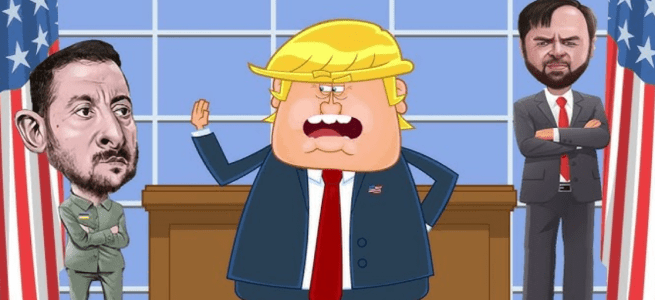
The amazing dustup between Trump (with his faithful sidekick J.D. Vance) and Ukrainian president Zelensky on Friday was shocking theater. As never before we saw a US president being intensely argued with in public—and arguing back. I have no idea what was and is going on in the background and what the fallout will be from this angry display. Reactions I have read seem to show more about the various observers’ predispositions concerning these people than any particular insights about what was actually going on.

Continue reading “Theater of the absurd [American Politics #15]”

Despairing political confusion [American politics #14]

Ted Grimsrud—February 24, 2025

I have believed for a long time that the world will be better off when the American Empire falls from its stature as the most powerful superpower. For a long time, I hoped against hope that this fall would be voluntary, that somehow the US would choose to let go of its drive to dominate the world as the top dog and find ways to be collaborative in a multipolar world.

Is the American Empire falling our only hope for peace?

I now simply cannot imagine that a voluntary giving up of domination will happen. It seems likely that only the American Empire falling apart and involuntarily losing its hold of the world’s reins of power will save the world. And it seems like we are headed toward that outcome perhaps more rapidly than ever. This may be good for the world—though not if the US fights so hard against its demise that it takes the rest of the world down with it.

I don’t understand very well the details of what is going on right now. Obviously, we see a shocking assault on the federal government by the newly installed Trump administration, an assault that seems ill-considered, ill-planned, vicious and destructive for viciousness’s and destructiveness’s sake. At the same time, I do not trust or respect most of the critiques of Trump, et al, that come from Democrats and the mainstream corporate media.

It seems like an extremely important sensibility for me—though I see little evidence of this in most of the discourse on our current situation—to see that both sides in our current political alignment in this country can be, in fundamental ways, wrong. Trump’s (and his acolytes’) horrifically misguided visiting what may be irreversible damage on our country does not negate the Democrats’ own misguided politics.

Continue reading “Despairing political confusion [American politics #14]”

So, what happened? [American Politics #13]

November 6, 2024

I have spent a few hours this morning reading analyses of the election. Hardly anything seems insightful to me. I am discouraged that some commentators I have appreciated for their critiques of American interventions in Ukraine and Israel/Palestine are happy about Trump’s win and seem to think Trump might move things in a different, more peaceful direction—I think there is exactly zero chance of that, though it is also hard to see how he can make things worse in that realm than they have been these past four years. I doubt anyone who was positive about Biden/Harris could hope to have much insightful analysis now—though I will keep looking.

I did find one piece that rang true to me. It is written by someone named Arun Gupta, previously unknown to me.

***********************************

From Arun Gupta, “Harris lost because of Gas, Groceries, and Gaza. But the underlying reason was Ukraine”:

Under Biden-Harris, staggering sums have been spent on the war. Congress has officially approved $175 billion, but I suspect it’s significantly higher given all sorts of other aid and weapons transfers not included in these bills. There are also huge amounts of aid to Taiwan and Israel.

The wars and overseas aid hurt Harris in many different ways, and she avoided them because she is the candidate of war and Wall Street.

Continue reading “So, what happened? [American Politics #13]”