Ted Grimsrud—March 3, 2025
As I try to pay attention to the wider world spinning out of control and heading toward who knows what kind of fresh hell, I keep trying to reflect on my peace-oriented core convictions and to learn more about history. My core convictions remind me that the US seems bent on world domination and thus, by definition as long as this is the case, seems unable actually to contribute to world peace. Americans who do care about peace need to question the idea that there is some way in our current world for the US to play a constructive role in peacemaking. It has rarely happened in the past eighty years, and it doesn’t seem likely to be happening any time in the foreseeable future.
Two fantasies
From the questionable idea of the US role as an agent for peace comes the fantasy that the Biden/US/NATO policies in Ukraine were about something other than trying to take down Russia and seeking to further enrich US-based war profiteers through the proxy war. Many liberal pundits and corporate media reporters continue to push the idea that the war is a stalemate that can be turned in Ukraine’s favor rather than recognizing that Russia pretty much controls the situation and will heretofore call the shots with Ukraine on the brink of collapse.
Or, we have the fantasy that Trump is a genuine peacemaker who has a plan in mind that will lead to an end to the war. This second fantasy attractively serves as an alternative to the first. I am not as confident in my critique of it. However, because Trump also seeks US world domination and because he also seems to want to somehow squash China (hence, the motive to leave the Ukraine war to the Europeans and focus US energy on China), I actually see little hope that he genuinely seeks peace. We should also note that at the same time that Trump lectures Zelensky about peace he also approves an “emergency” allotment of $3 billion of weaponry to Israel in apparent support for the Israeli refusal to negotiate in the second phase of the agreed-upon ceasefire with Hamas and instead to plan for more violence.
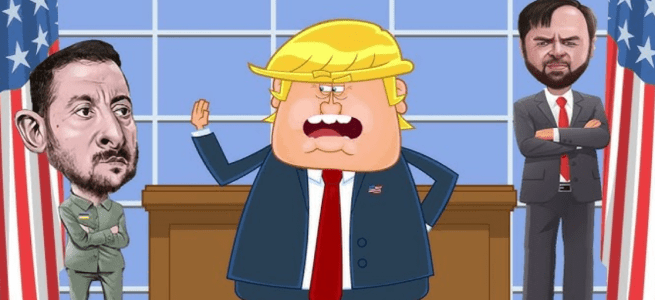
The amazing dustup between Trump (with his faithful sidekick J.D. Vance) and Ukrainian president Zelensky on Friday was shocking theater. As never before we saw a US president being intensely argued with in public—and arguing back. I have no idea what was and is going on in the background and what the fallout will be from this angry display. Reactions I have read seem to show more about the various observers’ predispositions concerning these people than any particular insights about what was actually going on.
The Trump as peacemaker people seem disgusted with Zelensky’s brazen resistance to the truths he was hearing from Vance and Trump and was not willing to face. The heroic Ukraine and demonic Trump people seem disgusted at Trump’s rudeness and debasing the dignity of the American presidential office by such a disrespectful display.
I tend to see truth in both positions. Zelensky does seem to refuse to face realities (at least in his public presentations), and Trump does seem extraordinarily rude. Now, I do think Trump does in fact debase the presidential office but I kind of think that is not all bad. He displays to the world the viciousness of the practices of US presidents that have heretofore been hidden behind facades of gentility. More honesty about the vicious game the American Empire plays might be helpful to generate more resistance to it.
A little bit of history
I am reminded of a couple of important points from the history of US/Russia/Ukraine relationships that led up to our present crisis. This history tells me (I’m trying to be descriptive in what follows; I do not mean to say that I approve of Russia’s response to these aspects of the story) that US policies have done a lot to create the current scenario. Russia, feeling a genuine existential threat to its existence (evoking echoes of the last existential threat that came from the West in 1941), felt it had to mobilize its forces and strike back in face of the NATO expansion. And they did so with great success. We see in the Ukraine war that Russian military prowess exceeds that of the US/NATO forces. The Russian economy has responded to the sanctions, et al, with resilience. And, diplomatically, the Russian/Chinese relationship has become much more positive, and the expansion of BRICS promises to provide major alternatives to the world economic status quo.
I did not pay much attention to the dynamics in Ukraine after the end of the Soviet Union in the early 1990s. Only after the escalation of the long-simmering conflict three years ago with the Russian military action did I try to learn more of what had brought that on. This history has largely been ignored in American discussions about the current conflict. However, the overall story seems to be that the US has displayed ill will toward Russia from the very moment of the new political order after the Soviet Union’s fall and thereby poisoned the relationship between the two countries even though Russia for some time hoped for rapprochement.
Top American diplomats promised anxious Soviet and then Russian leaders that if the Soviets would not oppose the reunification of Germany, the US would commit to NATO not expanding east of Berlin. From that moment down to the present, Russian leaders have begged for that promise to be honored—at least at the point where NATO would not extend to Russia’s very borders (i.e., Ukraine would not be included in NATO). Russia protested as more and more former Warsaw Pact countries were taken into NATO but reluctantly acquiesced with the insistence that Ukraine would be a step too far.
By 2014, this “step too far” was becoming more a possibility. Ukraine was split between forces leaning toward Russia and forces leaning toward the West. The national government of a Russia-leaner was overthrown in a coup with likely strong support of the US. This coup led to anti-Russia policies including threats to the Russians’ one warm water port in Crimea, a part of Ukraine but made up mostly of Russian-speaking people. Russia responded by annexing Crimea following a vote where a high majority of Crimean people supported that act. Russia also intervened in eastern Ukraine in face of hostile acts from the Ukrainian government toward the Russian-speaking majorities in those areas.
So, the actual armed conflict between Ukraine and Russia began in 2014, not in February 2022. In the years in between, Russia and Ukraine took part in negotiations to end the conflict. And, in fact, those negotiations resulted in an actual agreement—the Minsk accords, signed by Russia, Ukraine, Germany, and France (and affirmed by the US as a member of the UN Security Council). Tragically, these accords were never implemented by Ukraine. The top leaders of both Germany and France admitted after they left office that they never intended for the accords to be implemented. They only agreed to them in order to slow Russia down until Ukraine could strengthen its military (a process accelerated in 2021 after Biden’s election by increased US military aid). In the months leading up to the February 2022 escalation, Russia actively sought through negotiations to have their concerns addressed. Ukraine, at the urging of the West, refused to participate in such negotiations.
Russia continued to seek to negotiate, as its invasion initially proceeded slowly with limited damage done to Ukraine. These efforts did push Ukraine to negotiate, and the negotiations in Istanbul neared an agreement that would have ended the fighting in April 2022. At the last minute, though, Britain’s Prime Minister Boris Johnson visited Ukrainian leaders and successfully urged them to walk away from the negotiations and to continue the war. Johnson surely acted on behalf of US/NATO interests. It would appear that, at that moment, the West believed that a continuation of the war would further their hopes of dealing a severe blow to Russia. Russia responded to the brushoff by greatly intensifying its military action and inexorably expanded the war to the point that now Ukraine faces sure defeat.
We could say that Biden, et al, took a mighty swing at doubling down on their world unipolar hegemon goal in order to deal perhaps deadly damage to one of the few nations that has resisted that goal (Russia)—and missed. The war has turned into a terrible disaster for Ukraine, has exposed US/NATO military capabilities as extremely overrated, and in time actually strengthened Russian military and economic capabilities.
Trump and American domination
As hostilely critical as Trump is toward Biden and the “deep state” and as much as the Trump as peacemaker people dream he will provide a genuine alternative to the Bidenist quest to end Russia, I don’t believe Trump will give up on the broader goal of US domination. Like Biden, Trump sees room at the top for only one power. As he pursues that supremacy, he may recognize that pouring good money after bad in Ukraine won’t help. However, the American Empire under Trump still seeks domination—a disastrous and utterly self-defeating agenda.
Continuing with this agenda will likely end the Empire. As current self-defeating efforts of the US hasten its fall, that may or may not be good for the rest of the world. It is terribly scary right now. Increased chaos seems inevitable. I do have a glimmer of hope that neither Russia nor, probably more importantly, China desire to be the one global hegemon (maybe this is just a fantasy, but I want it to be true). It could be that they do not resist the US Empire in order to replace it at the top but because they sincerely to want a multipolar world order where leadership would be shared. Such an outcome could be good for everyone if we can survive to that point—that is, if the collapsing American Empire does not take everything down with it when it goes.


Ted, I appreciate you sharing your ongoing thoughts and readings, even though I don’t always agree on important points. But it challenges my thinking and exposes me to alternative analysis.
I wish others were participating with comments here also.
After your last post, I referred briefly to the Transpartisan movement and deliberative democracy (a well-developed philosophy and methodological approach enabling the release of much wisdom based on the common good… and accordingly anti-empire). Now, in the interest of the best shot we may have, and some encouraging processes for people to look into, I’d like to add some specifics.
A group formed on LinkedIn, recently expanded to FB (smaller there so far) that is at the “eye of the storm” (positively) is “Generate Democracy!”. Their effectiveness and collaborative power has been shown, among other ways, in their formation of an additional, related group and process called “Inter-movement Impact Project” (IMIP).
One aspect of this, as a participating sub-group of sorts, is Better Together America (BTA), recently formed. I’ve been involved in all these a little and likely will be much more with BTA. Similarly, I’ve had at least peripheral involvement with some other larger, and more “grassroots”-oriented orgs that are not entirely political (though transpartisan or bipartisan to the extent they are politically-related). This is the hundreds-of-orgs-large Listen First Coalition and one of its largest participating orgs, Braver Angels.
For those who may like knowing personal names of some people involved, I’ll name a few, in the same general (only) order I’ve mentioned the orgs. (There are key women involved also, though most of the originators and top leaders are men… many of whom, like myself, are very critical of patriarchy principles.)
So… to help a bit with research processes… a few leaders:
Mark Gerson, Walt Roberts, Caleb Christen, Pearce Godwin, David Blankenhorn, Hunter Baker, John Wood, Sterling Speirn, Diana Avive, Jim Rough, Tom Atlee, David Matthews, Norlyn Dimmitt (my colleague/principal), Piper Hendricks, Chris Bui, and many others that should probably be named as among or even “godparents” of this very partial listing.
Some of the above are Christians, and let me add the name of one org overtly Christian, FOR Christians, started by two particularly prominent leaders/writers, and a third less-known pastor/consultant (all of whom are more conservative/orthodox than I am, but whose work I respect and support, generally speaking): The After Party, with Russell Moore, David French and Curtis Chang.
First, a couple spellings to correct from my list, above: Mark Gerzon (not Gerson) and Diana Aviv (not Avive).
I just watched a recorded (YouTube) “Principles First” interview with David French and Russell Moore, with a live audience. (The After Party Ireferenced earlier.)
Excellent analysis and statements as to dynamics behind the blind, irrational fealty to Trump by white Evangelicals. As both white and solidly Evangelical themselves, they speak to the biblical “weighting” of justice, kindness, humility; Sermon on the Mount, etc…. abandoned, overtly shunned, often, by the MAGA mentality; by 40 years of increasingly identifying their form of faith with the Republican Party, and then with Trump.
Ted, here is something you might have written on or can point me to: as a rough parallel to “just war” theory, have you or anyone (not even necessarily Christian) outlined principles for coming to peace from the midst of a stalemated armed conflict? I know, of course, that every situation will be unique, such that general principles and guidelines may not be easily applied to the specifics, the history, the varying perceptions of blame, of legitimate claims, etc. But there might be SOME helpful guidance.
I would think some Christian (or other) diplomats, philosophers, or other deeper thinkers may have addressed this, but it doesn’t seem anyone of prominence ever refers to such recorded wisdom, if it exists. Where might one look?