Ted Grimsrud—November 9, 2026
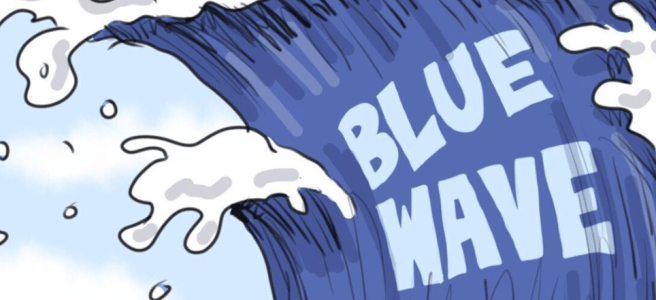
In the runup to the midterm elections of November 3, most predictions I saw suggested widespread Democratic Party success. What actually happened exceeded almost all expectations. Across the country, from Senate seats to state legislatures to county commissioners, the blue wave changed our political world in major ways. Of course, we don’t know yet what the practical effect of this election will be.
What the blue wave likely won’t do
(1) It won’t reverse American warism. A few high-profile Democratic candidates emphasized the need to pull back from the war on Iran and to end the blank check for Israel. It’s hard to say how sincere even these relatively minor concessions to anti-warist public opinion were. The American people obviously want more peaceable policies. Elections are the one time this desire for peace matters. But will it continue to matter when the election is over?
In any case, most Democrats currently in office have supported Israel, have done little to resist the aggression on Iran, are okay with our extraordinarily bloated military budget, and support the proxy war on Russia. It’s hard to imagine the newly elected people will overturn their party’s warist consensus. We may hope for possible good changes concerning domestic policies to stem from the election, but I expect little positive movement on warism (which I believe is our nation’s biggest problem).
(2) It won’t bring peace with Russia. To me, the litmus test for clear-mindedness and authenticity in seeking a more peaceable world among Congress members is denial of support for the US/NATO proxy war on Russia in Ukraine. Tragically, almost every single Democrat in Congress has profoundly failed this test (including progressive heroes such as Bernie and AOC). As long as the US participates in this war on the level we have so far as part of its bigger anti-Russia and China agenda, a reorienting of federal priorities away from the self-destructiveness of warism and toward a government that consistently seeks for human welfare will be impossible.
To the extent that the conflict in Ukraine came up at all in campaigns around the country, it seems that Democrats generally took a position in favor of more war—pushing the myth that Trump and the Republicans have been pro-Russian and in cahoots with Putin. For an antidote for that myth, I have hopes that a new book by Stephen Kinzer, Boiling Point: How America Brought War to Ukraine, will help.
(3) It won’t effectively address the climate crisis. Clearly, having Democrats have more power will be an improvement in relation to climate justice. However, it does not appear that climate was a central issue in many campaigns, so the new people in office will not be starting with a mandate to work at this. Plus, as long as the climate movement and possible legislative allies refuse to make the link between warism and the climate crisis, we have little hope to make genuine progress.
(4) It won’t overturn the corporatocracy. The strangleholds that large corporations and billionaires have fuel warism and the climate crisis. Right now, the best we can hope for is slight movement toward healing on the fringes. There may be a few exceptions, but it would seem that as a rule this election only strengthened corporate power. Most Democrats running high level races received huge amounts of corporate money, if not quite as egregiously as Republicans.
(5) It won’t challenge the police state. I could probably name more examples, but I will end by noting that while many Democratic Party candidates did offer much needed critiques of ICE and the extreme violence of the Trump administration’s anti-immigrant policies, I’m not aware of a much-needed wider and deeper critique by candidates of the extraordinary and still-growing power of the police in our society. Hopefully, ICE will be reined in when the new officeholders gain power, but we have no indication that the bigger and deeper issue of police power will be addressed.
The best-case scenario
Let me end this piece with a brief list of some hopes I do have. These are reasons that I do feel happy, at least for now, about the election.
(1) It will weaken Trump and his followers. Problematic, on the whole, as the national Democratic Party may be with Chuck Shumer and Hakeem Jeffries as its congressional leaders, the Republicans are way worse. To loosen the hold of MAGA meanness and corruption can only make things better.
(2) It will mean less likelihood of nuclear war. It’s true that Democratic Party leaders show little interest in disarmament. And they remain committed to the insanely dangerous war on Russia. However, they are not as unhinged as Trump with his open threats to nuke Iran.
(3) It will mean more humane domestic policies. It’s true that Congress likely will not be able to pass genuinely humane legislation that Trump won’t veto for the next two years. Hopefully, though, they will force Trump to veto many good laws with the promise that they will pass them again with a Democratic Party president. More immediately significant will the various state governments that have turned blue and will institute policies on the state level.
(4) It will bring in what seems to be impressive new blood among Democratic Party leaders. For example, I have a favorable impression of several of the newly elected Senators (Abdul El Sayad, Peggy Flanagan, James Talarico, Adam Hamilton, Sherrod Brown, and Scott Colom [assuming his seat is not stolen at the last minute]). It is fascinating to have the emergence of a “Christian left” in the Democratic Party reflected in the elections of Talarico and Hamilton to the Senate, and two Iowan pastors to the House.
(5) It may lead to an end to the electoral college. This seems unlikely, but the movement for the National Popular Vote Interstate Compact that would bypass the electoral college has gained support from enough states to account for 222 electoral votes. Democratic victories in several states last week bring the total potentially above the needed 270.
Such hopes and changes are more than anyone realistically expected a week ago. We still have a lot to be concerned about, but the darkness seems perhaps a bit less oppressive right now.


