Ted Grimsrud—October 17, 2025
The Bible has a reputation of being pretty pro-violence. Some Christians want the Bible to approve of violence—that helps them justify the violence they currently support. I decided back when I first embraced pacifism that I wanted to try to read the Bible as pro-peace as much as I could. I still do. An early test for me came with trying to understand the book of Revelation. Is it truly about visions of future God-approved warfare and violent judgment?
I had heard because God wants wars in Revelation, God may also want wars in our time. I decided to study Revelation to see what it actually says. I soon discerned Revelation may be read as a book of peace. I also realized that Revelation is not about predicting the future; it is about applying Jesus’s message of peace and healing in our present. A key concern in Revelation has to do with following Jesus while living in the idolatrous Roman Empire. Thus, Revelation becomes for us an essential text for reflection of the relation between Christian faith and empire.
Revelation as part of Jesus’s peace agenda
For Jesus, to resist the Empire means: Love our neighbors, say no to idolatry, give our loyalty to the God of mercy, and recognize the empire as the enemy of God, not God’s servant. Early Christians faced constant temptation to conform to Rome. It could be costly to resist. Many also found the imperial claims to be seductive. This struggle with conformity to the empire had a tragic ending for Christianity; we will see in our next post that it became an empire religion. In the early years, though, the struggle led to a sharp critique of the Empire—see Revelation.
Revelation does not collect predictions about “End Times” but describes the dynamics of imperial seduction. It describes the deep conflict between the ways of empire and the ways of the gospel. This “war of the Lamb” can only be successfully waged in one way. Wage this war with what the New Testament letter to the Ephesians described as the “whole armor of God”: The belt of truth, the breastplate of justice, the gospel of peace, the shield of faith, the helmet of salvation, and sword of the Spirit (which is the word of God) (Eph 6:13-17).
The revelation about Jesus Christ
Revelation identifies itself as a “revelation of Jesus Christ” (1:1) What follows interprets Jesus’s message as applied to the issues facing Christians late in the first century. His followers must place his message at the center of their worldview and refuse to allow the claims of the Empire to diminish the centrality of this message. Revelation interprets life in light of Jesus.
The author of Revelation writes this book to “the seven churches that are in Asia” (1:4). In chapters two and three, John writes direct messages to each of the seven congregations about issues facing these Christians. Give your loyalty to Jesus and his countercultural community, not to the Empire. We follow Jesus because “he has freed us from our sins by his blood and made us to be a kingdom” (a community meant to exist over against the empire; 1:5-6). Echoing Torah’s agenda following the exodus, we read here: God freed you so you may live out Torah.
The liberation from “our sins” frees us from the idolatry that leads to trust in imperial claims. Jesus liberated us with his faithful witness to the point of death, a witness vindicated by resurrection. “Blood” here refers to the totality of Jesus’s life, execution, and resurrection. Revelation emphasizes “blood” as the central element in the healing work of the Lamb (the symbol Revelation uses for Jesus). “Blood” signifies a way of life with Jesus as the model.
Revelation’s Jesus is described in terms of “the pattern of Jesus”: “The faithful witness, the firstborn of the death, and the ruler of the kings of the earth” (Rev 1:3). Jesus witnessed in his life and teaching, suffered, and faced execution by the Roman Empire. He conquers due to God’s raising him from the dead. The Empire could execute Jesus—but not keep God from raising him. Jesus as “ruler of the kings of the earth” emphasizes the profundity of Revelation’s message. The martyr rules! “Kings of the earth” lead human rebellion against God and against the Lamb. Amazingly, though, in the end they find healing and are present in New Jerusalem, “ruled” by the Lamb. This pattern serves as a model for those who follow Jesus—witness faithfully, trust in God’s vindication, and live with authority in relation to the nations and their kings.
Jesus’s peaceable agenda
The Empire offered Christians prosperity in the cities of chapters two and three. Stay away from its festivals with your devotion to Jesus’s way and you will pay. The “synagogue of Satan” alludes to the various centers in each city that hosted public festivals that praised the Empire. Revelation insists on only one way to conquer—the path of love and compassion. John calls to rigorous faithfulness in face of the great power of the seductions of the empire.
The One on the throne (4:2), Jesus’s God, makes the same kind of claims for dominion as does the Roman divinity. However, the dominion of the One on the throne is the power of love, not the of coercion and domination. The difference between these two defines chapters 4 and 5’s vision. The One on the throne is the subject of universal worship. Then, in chapter 5 we have our notions of divine power turned upside down. The One holds a sealed scroll in its right hand, the key to the Big Story. The opening of the scroll will reveal whose truth corresponds to the way the universe is. The scroll opener will be a powerful king, in line with expectations Jews had for a mighty warrior type of Messiah— “Lion of the tribe of Judah and the Root of David” (5:5).
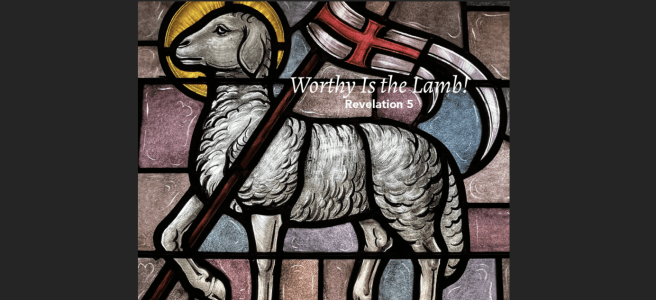
John hears “mighty king.” We need to recognize that indeed the scroll opener is a mighty king who will conquer the Dragon and transform creation. What John sees though, conveys the true character of the king and the means of conquering: “A Lamb standing as if it had been slaughtered” (5:6). The executed and resurrected Jesus who conquers by means of self-giving love that is practiced in resolute resistance to the domination system of the Roman Empire.
What the Lamb’s people are up against
The plague visions beginning Revelation six do not predict future calamities but vividly portray on-going realities. Willful “Powers” fuel the plagues, personified as the Dragon, Beast, and False Prophet that signify ideologies, structures, and traditions organized to defy God’s will for human wellbeing. These dynamics of idolatry—capitalism, nationalism, militarism, white supremacy—infuse our cultures and cause constant plagues. The presence of the Lamb amidst the plagues tells us that God does not abandon the earth. The Lamb remains present, empowering his followers to help free the nations from enslavement to the Powers. These terrible events in human history do not defeat God’s purposes. God’s healing acts amidst the plagues.
In the 12th chapter we have a powerful statement of how the Lamb and the One and their people win. A loud voice in heaven proclaims: “The accuser of our comrades has been thrown down…. They have conquered him by the blood of the Lamb and the word of their testimony, for they did not cling to life even in the face of death” (12:10-11). The comrades play a central role in the drama—they follow Jesus and resist the Powers using only the weapons of the Spirit.
Countering the Beast
Chapter 13 gives us an extended vision of the reality of the Beast. The words here apply to all empires—including our own. The “blasphemous names” used of the Beast probably simply repeat names that we have seen given to the Lamb and the One on the throne: “lord,” “king,” “savior.” The blasphemy has to do with who the names are used for. This vision raises the issue of loyalty and challenges the readers to consider where their operative convictions come from.
The rhetorical expostulation— “Who is like the Beast and who can fight against it? (13:4) — implies that the Beast has so much power that no one can fight against it. Yet at 14:5 we learn that indeed one does fight against and defeats the Beast. The Lamb’s victory makes him worthy of loyalty instead of the Beast. The power given to the Beast most decidedly does not come from God but comes from deception. By giving the Powers consent, humans make them powerful. So, the Beast’s power, like the Dragon’s, actually comes from human beings. Revelation makes the bold argument that we may freely refuse to give consent to the Powers. The Lamb helps us see these Powers not as God’s agents, as they claim, but in reality, as rebels against God. This vision does not finally tell of the Beast’s unmatchable power but of the Lamb’s victory. A multitude joins with the Lamb. We earlier learned in Revelation 7 that the “144,000” that signifies the great multitude in 14:1-5 refers to the countless multitudes that we first met in chapter 5.
We have two cities portrayed in the final section of Revelation, chapters 17 through 22—Babylon and New Jerusalem. As powerful as Babylon may seem, it is doomed to self-destruct. Here is one city, based on violence and doomed to fall; here is the other city, based on love and the site of ultimate healing. Babylon falls (18:2) when she is mixed “a double draught in the cup she mixed” (18:6). In this process, the very acts of violence performed by Babylon become the poison she drinks that makes her fall. This judgment destroyed not the “glory of the nations” (21:24) but the systems of evil. The Powers that have evolved to oppress—the destroyers of the earth—will be destroyed for the sake of the earth. The Beast, False Prophet, and Dragon symbolize structures of injustice. These Powers being thrown into the lake of fire is not revenge against human beings but about God destroying the destroyers of the earth and ending white supremacy, capitalism, warism and exploitation of nature.
God’s city of healing
As “the bride of the Lamb” (21:9), New Jerusalem is made up of the Lamb’s comrades. Revelation often alludes to multitudes from every tribe, nation, people, and language joining together in common celebration. The glory and honor of the nations brought in to New Jerusalem (21:26) fulfill the promise that descendants of Abraham and Sarah would bless “all the families of the earth.” The New Jerusalem vision, 22:1-5, gives clarity about the contents of the scroll opened by the Lamb. The nations will be healed. The evil Powers will be banished. The Lamb’s comrades, the countless multitude, will see God’s face and will reign forever and ever.
The two cities, Babylon and New Jerusalem reflect two ways to interpret the present. Is our world most basically plagues or most basically worship? The New Jerusalem vision answers this: It reveals the one way, the only way, New Jerusalem will come down: Faithful conquering like the Lamb conquers. Revelation tells us what it will take to build New Jerusalem—love provides the only means to a healing outcome.
The Bible’s coda: No to empire
The book of Revelation gives a powerful conclusion to the Big Story the Bible tells. Revelation shows the danger of the lure of empire that we see beginning with Egypt. That system remained alluring to the Hebrews as they struggled in the wilderness. It remains one of the main dangers for the community of faith throughout the Bible. The temptations from the outside, to give loyalty to the great empires that demand obeisance, and the temptations from the inside, to shape the culture of the faith community according to the sensibility of domination, come from the Dragon no matter how much it may be claimed that God intends such responses to empire.
Revelation testifies to the dangers of empire and its values. More importantly, it testifies to the ongoing importance of responding to those dangers by following the Lamb wherever he goes. The way of the Lamb always remains the calling of those with eyes to see and always remains the path to the blessing of all the families of the earth.
[This is the 14th of a long series of blog posts, “A Christian pacifist in the American Empire” (this link takes you to the series homepage). The 13th post in the series, “Jesus’s political alternative,” may be found by clicking on this link. The 15th post, “Christianity’s accommodation to Empire” may be found by clicking on this link.]

 Thinking Pacifism
I’d love to talk (more) about forms the “challenge” takes or has taken— Or could take!- – when “Jesus the Lamb challenges empire”.
I like this approach to Revelation, a book I have shied from given how much of my childhood church experience was marred by dispensationalist-leaning end times preaching. I do think that John the Revelator probably thought he was living in the end times, as did all first/second generation Christians. I’m a bit Schweitzerian in that sense. But I also think you are right when you use a ‘living in empire’ hermeneutic to wrestle meaning from this text. It makes me want to go back and look at Hans Hut’s apocalyptic ideas through that lens as well. Interesting!
The book of Revelation is indeed within a mysterious, complicated genre. As a child and youth, I was exposed to almost exclusively literalist and dispensationalist (heavy on prophetic lit of the Bible) interpretations of it. However, through 30 college units of Bible and theology, followed by a 3-year seminary degree, I don’t recall that I was ever required to do much in-depth study of it. I doubt many seminary courses, liberal or conservative, require that, yet today. It probably seems easier, safer to just “let it lay”.I find that your interpretation and summary makes good sense, and I appreciate the chapter summaries, Ted. We might even analogize that for the NT, the Gospels and Revelation are the anti-empire bread slices and Acts plus the Epistles are the quite different “don’t stir the pot” fillings between.Maybe Paul isn’t that out of step, but my take is that he mostly was advocating believers grasp the “grand vision”… the cosmic Lord, soon to return. His converts and “imitators” were to live compassionately and ethically in this short interim… the “powers” had been defeated, so its o.k. (or best?) to mostly ignore the problem of how to deal with Empire and its oppressive, idolatrous ways.
For us in the USA today, I’m convinced believers can and must operate on two levels: in spiritually-focused communities (generally church ones) AND in civic-governance ones on a “secular” basis… inclusive of all citizens.
In a sense, this is happening now, but both aspects are highly dysfunctional. As to the second area, I’ve become deeply involved and decently informed on the rising momentum of wise and healthy reform efforts, local to national (some coordinated or operating separately internationally as well). It has inspired hope in me, and I know many others.
It may be worth adding that many of the leaders and non-profit groups (non-partisan) are Christians, Catholic, Protestant and Orthodox. To the extent that dynamic processes like participatory budgeting and deliberative town halls expand and increase in influence, as I believe they will, we DO have hope a “politics of love” can be brought to bear. It won’t be specifically Christian but may well be significantly led by Christians and inspired by the teachings of Jesus.