Ted Grimsrud—June 11, 2025
After considering ancient Israel among the great powers, I now want to focus on ancient Israel as what I will call a “territorial kingdom” (i.e., a political community that has boundaries and exercises sovereignty within those boundaries). The Bible’s politics start in enslavement in Egypt. The community coalesced as a people liberated by God, instructed in counter-empire living by Torah, and provided a territory wherein to live out Torah.
The story takes it for granted that the Hebrew people needed a Land where they could establish a permanent home and embody Torah. Between the time of liberation (the exodus) and of entrance to the Land, the people spent decades moving about in the “wilderness.” They struggled to maintain fidelity to Yahweh. In the end, only a handful of the original community that escaped Egypt were allowed to enter the Land with the children and grandchildren of the original community members.
The descendants of the original Hebrews faced the challenge: Overcome the hostility from surrounding nations and remain faithful to Torah in face of temptations to conform to the religious and social practices of those nations. This struggle, sadly, would be so difficult that the territorial kingdom would not be a viable arrangement for the way of Torah. The Bible actually offers a different option. You don’t have to be a territorial kingdom to embody God’s kingdom.
Entering the Land
The establishment of the people in the promised land produced mixed results, success mixed with failure, faithfulness mixed with unfaithfulness, clarity mixed with confusion. The community always lived in the midst of struggle and chaos. Moses led the people to the cusp of the Land. Joshua then guided the transition into the people’s permanent home. Both insisted strongly on the contingent basis of the promise—you will be given this home and sustained in it, if (and only if) you remain faithful to the way of Torah. When the territorial kingdom failed and the people were driven from the promised land, they told this story to explain why.
They told the story, then, not to help future generations learn how to do territorial kingdom right. The story illustrates why territorial kingdoms are actually inherently in tension with Torah faith. A big complication right away was that the promised land was not empty. To establish a home there meant to drive out the people already present. On the surface, the account of entering the land told in the book of Joshua reads like a story of successful conquest and settlement. Looking closer, things get more complicated. The Canaanites were not eliminated.
The complications of the presence of the Canaanites in the land may be seen in their continuing presence, in spite of the impression Joshua gives of total victory. The next book, Judges, indicates that Canaanites remained in the land as a constant temptation to another way of life; this made embodying Torah difficult. The ways that the ancient Israelite territorial kingdom evolved away from Torah that, in part, were due to the need to focus on “national security,” to maintain secure boundaries, centralize power, and otherwise become like “the nations.” Can the Hebrews be a territorial kingdom in the Land and not become unjust?
The book of Judges (not a “golden age”) tells of constant tension, bloody conflict, non-Torah-oriented ambitions, and continual insecurity. The book concludes with unrest and doubts about the future of the community. How would the nation be organized? Would the Hebrews continue with a decentralized structure led in an ad hoc way by charismatic judges? Or would they need to imitate surrounding nations with kings and standing armies?
In the book of Deuteronomy, set during the time just before entering the Land, Moses seemingly anticipated questions about political structure and gave directives about kingship. If you decide to have a king, here is how you can do it and remain faithful and different from the nations. Some of the key ideas mentioned in Deuteronomy 17 include the king himself being a student of Torah and one who does not gather wealth, horses and chariots, and many foreign wives. As the story plays out, the prescriptions in Deuteronomy name the ways the kings did depart from Torah. Most strikingly, King Solomon in 1 Kings 1–11 almost systematically violates the directives of Deuteronomy 17.
The kingly path
The hoped for peace and harmony of being established in the Land never arrived. A few of the judges were effective, but all too many were corrupt, favored the wealthy and powerful, and disregarded Torah’s concern for vulnerable people in the community. And external threats continued. We do have a faithful judge, Samuel. His leadership brings a period of stability. But the community’s elders are not satisfied and demand that Samuel intercede with God to provide the community with a king— “Like the kings of the nations” (1 Samuel 8:4-5).
Speaking on God’s behalf, Samuel argues against the elders. He explains why a human king would be a bad idea. But he doesn’t persuade them. God gives the elders what they want. Samuel, though, details why the territorial kingdom will be incompatible with Torah. These kings will: take your sons to be his soldiers, force them to harvest his crops, and force them to build his weapons of war; take your daughters to work for him; take the best of your fields and vineyards and olive orchards; take one-tenth of your crops and the best of your livestock—and you shall be his slaves (1 Sam 8:11-17).
Kings take and take and take. The kings of the nations are like this. Likely, your kings will be like this. Should you turn to a king who turns out to be mainly a taker, “you will cry out because of your king and the Lord will not answer” (1 Sam 8:18). Perhaps the directives of Deuteronomy could have been followed and the territorial kingdom been a place of genuine justice, a blessing, an alternative to the empire way. But that is not what happened.
For a short time, David—remembered as the greatest king—seemed to do well. He is, initially, faithful to Torah. Then comes a key turning point. David faces strong temptations to use his power in destructive ways—and he gives in. His acquisitive lust toward beautiful Bathsheba, his violent disregard for Bathsheba’s husband Uriah—a loyal officer in David’s army who is purposefully killed, and his dishonesty about the entire incident reveals David to be a taker. Though David repented when confronted by the prophet Nathan, the remainder of his reign is troubled. The next king, Solomon, actually not David’s legitimate heir—that was an older brother, Adonijah—ruthlessly pushed Adonijah out of the way and had him and most of his top supporters killed.
On the one hand, seemingly blessed by God, Solomon had extraordinary power and wealth and exercised great wisdom. Yet, when 1 Kings 1–11 is read alongside Deuteronomy 17 and 1 Samuel 8, we see Solomon’s main impact to have been to set the territorial kingdom on the path that ended with judgment and destruction. He gathered many foreign wives, violating Deut. 17:17 and its warning that foreign wives would turn Hebrew kings toward idolatry (1 Kings 11:2). And Solomon does indeed build “high places” (worship centers) for foreign gods (1 Kings 11:7). Solomon also gathered horses and chariots, accumulated gold and silver, and used forced labor to get Hebrew young people to build his great palace.
Solomon decisively turned ancient Israel toward empire. As part of his efforts to centralize power he created an overarching religious institution—the Temple. The Temple enhanced the impression that God was on the side of the king—even as the king turned away from Torah. Replacing accountability to Torah with Temple worship undermined the potential for critiques of the king’s policies. No challenge to pursue a more just social order could arise without direct access to the teachings of Torah. Whereas David had a voice speaking from Torah in his inner circle, the prophet Nathan, Solomon had no such voice. We have no record that Solomon ever listened to a prophet.
God expresses anger with Solomon and promises that the kingdom would be “torn from Solomon’s hand,” though not during Solomon’s lifetime (1 Kings 11:9-13). The next king, Solomon’s son Rehoboam, faces revolt from those Solomon had been exploiting. Led by the people’s leader, Jeroboam, the exploited ask for respite. Rehoboam responded with scorn: “My father made your yoke heavy, but I will add to your yoke,” I will only push you harder (1 Kings 12:14). So, Jeroboam leads a schism. We now have two kingdoms, the new, northern kingdom of Israel and the remnant, southern kingdom of Judah.
As it turns out, tragically, the northern kingdom quickly conformed to the unjust, top-down power dynamics of the old kingdom. God did not abandon the people altogether. From this time on, various prophets arose to call for a return to the way of Torah. These prophets provide a vision for a return that sustains a connection with Torah that survives the ultimate failure of the territorial kingdom.
The testimony of the prophets
The biblical books of 1st and 2nd Kings contain a litany of one power hungry, corrupt king after another. But we also read of the continual witness of Torah-advocating prophets. We learn even more from the prophetic books, the earliest of which, Amos, zeroed in on Israel’s injustices and the problem of how religious observances can cover up these injustices. “Go to the worship center and sin, pretending that God blesses your prayers when you exploit the vulnerable.” Amos threatens terrible consequences—let justice roll down like waters or the consequence will be death, like when a desert stream goes dry.
The Bible tells of many prophets who, with all their differences, had a common message: God remains aware of what the people of the promise are doing (and not doing). The message of life in Torah remains the norm. The prophets are vindicated. The kings mostly remain corrupt. In the end, both the northern kingdom and, one hundred years later, the southern kingdom are destroyed. However, something remarkable happens. Unlike so many other ancient kingdoms that faced destruction, the ancient peoplehood of the Hebrews did not disappear from history.
The prophets provided a theology that made sense of ancient Israel’s fall and provided for a sense of peoplehood that did not require a territorial kingdom. God made it clear from the beginning that should the kingdoms depart from Torah they would fall. In contrast to so many other notions of peoplehood, the Hebrews could understand their kingdom’s fall not as the failure of their God but as God’s vindication. God remained true, the consequences of turning away from Torah did happen—as God had said. So, what was left in the rubble?
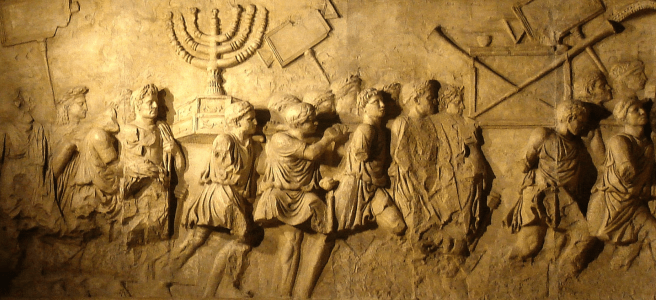
A key incident shortly before the end of Judah made the survival of the peoplehood possible. For generations under the corrupt kings and temple leaders, the teachings of Torah had been disregarded, even forgotten. Then, a worker stumbled across some old scrolls deep in the recesses of the Temple and took them to the king. This king, Josiah, recognized the importance of these scrolls—they were the law codes themselves. He ordered reforms in light of Torah. However, it turned out to be impossible to reform Judah in time. When the Babylonian hammer fell, though, and the territorial kingdom was no more, the recovered words of Torah did survive. They were interpreted to say: Torah is the path God intended for the people. Departing from this path led to destruction. But now we have another chance.
The destruction of the territorial kingdom and the Temple did not mean Israel’s God was nonexistent. Nor did it mean that God had utterly rejected Israel. In fact, these events were to be expected if Yahweh was active in the world. And they did not preclude God’s willingness to be present with the people again. The prophet Jeremiah’s profound grief at the fate of Judah makes clear his love for the community. Jeremiah’s central concern is to point forward as he insists that the people of the promise do have a future, even amidst the rubble of their present. This future was decidedly an anti-territorial kingdom future.
The failure of the kingdom and the temple to sustain the way of Torah did not mean that the way of Torah was ended. You can have Torah and community without a territorial kingdom. They exist before the territorial kingdom and after the territorial kingdom. The main lesson of the story is that the territorial kingdom and the Temple prove to be enemies of the way of Torah.
Jeremiah instructs the people who had been taken into exile when Babylon crushed Judah: “Seek the peace of the city where I have sent you into exile and pray to the Lord on its behalf, for in its peace you will find your peace” (Jeremiah 29:7). This instruction points back to the original call of Abraham and Sarah in Genesis 12 and forward to a new understanding of that call. The call made two main points: God will give Abraham and Sarah descendants, and God will give them the Land so they might bless all the families of the earth. Possessing the Land was incompatible with blessing all the families of the earth. So, God rearticulated the calling. Seek the peace of the city where you are. Bless all the families of the earth by following Torah in the homelands of those families. The politics of the people of God has to do with being a blessing, not with possessing a territorial kingdom that mirrors the power politics of the empires.
Some concluding lessons
(1) For the people to fulfill their vocation as a priestly people mediating God’s blessing to the world, they would—it seemed—need to live as a “territorial kingdom” having sovereignty in a boundaried territory. However, the warnings of the contingent character of this arrangement promised major consequences should the people depart from the way of Torah.
(2) Political leadership among the Hebrews was always fraught, problematic, easily diverted from Torah. It was always a temptation to become empire-like. The state should be Torah-like, held accountable—but the Hebrew territorial kingdom never in practice embodied Torah.
(3) The vocation to bless all the families of the earth must never be subordinated to national self-interest. The story tells us, in essence, that departing from Torah was, in practice, self-defeating. Injustice and social stratification undermine the social harmony necessary for a healthy society.
(4) God’s justice transcends the territorial kingdom. There are “outside criteria” for accountability. The final failure of the kingdom was evidence for God’s involvement, not God’s defeat. This understanding gave a basis to rally around Torah and continue. Such was unprecedented in the ancient near east.
(5) The story begins with a vocation and peoplehood centered on Torah. It ends with a vocation and peoplehood centered on Torah. The territorial kingdom and Temple are rejected, and the vocation remains. The story does affirm politics and social wholeness—but free from nationalism and idolizing the state. Biblical politics centers on consistently loving the neighbor.
More posts on peace and the Bible—The Bible’s radical politics (part 1) (part 3)

 Thinking Pacifism
How about this wording, “territorialized kingdom”?
June 15, 2025
Greetings, Ted Grimsrud –
I find your columns exceedingly helpful, your approach creative, and needed – and I extend deep thanks to you for your ability to relate Christianity to the present time on so many levels.
I enjoyed reading the first three of your current four-part column series and have been pondering about all this ever since – agreeing with your intent, and your detailed explanations in general. However, I wonder how you would fit into your scheme the ideas I am expressing below – my response to a few points within your texts:
It is said that Jesus pulled all his ideas, selectively, from the Old Testament – many of which, however, remained only ideas throughout the Old Testament. This may be true; however, Jesus was the first human, in history, to enact a number of these ideas in practice, beginning a historical movement founded upon these utterly new realities. It is indeed one thing to imagine; it is another thing to proceed upon what one imagines, transforming idea into history.
For example, Jesus more than simply mouthed selected Old Testament ideas. He transformed them into something new – for example, love of neighbor. Jesus was the first to connect – and live out – “love your neighbor” with “love God.” In Leviticus (19:18) “loving neighbor” is specifically within the context of the Jewish nation: “You shall not take vengeance or bear a grudge against the sons of your own people, but you shall love your neighbor as yourself: I am the Lord.” Verses 33-34 do extend the concept of neighbor to include strangers, but only a stranger who “resides with you in your land.” Whereas Jesus universalized this, expanding the definition of neighbor beyond just fellow Jews or other people within their community. He emphasizes and lives out love for all, including enemies, as seen in Matthew 5:43-44.
Furthermore, the possession of land, it seems to me, was a given for all Jews throughout the Old Testament. And land possession, by definition, denotes violence: the possibility of needing defensive warfare to defend “ our land,” to defend “God’s land” – if not the whole Promised Land, at least Jerusalem (see Isaiah 2:2-4; Micah 4:1-3; Zechariah 8:3-5; Jeremiah 33:15-16).
And the violence of defensive warfare is a central part of the Torah, which permits warfare in cases of self-defense or when Israel is threatened by external enemies, prohibiting, however, unjust warfare (see details in Deuteronomy 20).
The nonviolent Jesus, on the other hand, selected carefully from the whole of Torah, and established a Kingdom, unfettered by land, fulfilling the Law and the Prophets (see Luke 16:16, et al.) – the New Covenant metamorphosis, announced by Jesus during the Last Supper (Luke 22:20) See also Hebrews 8:6-13; 9:15.
(N.B. The synagogue movement, beginning during the Babylonian exile (6th Century), being landless, would theoretically allow for nonviolence. Jeremiah 29:7, which you also mention, would fit into the nonviolent category.)
Sum and Substance
Jesus broke into history, establishing for the first time ever a movement founded upon the infinite value of every human being – an essential foundation of nonviolence. Greek philosophers as well as some of the Psalms had hinted at this, but Jesus was the first to initiate a social movement founded upon this vision. (summary from Adolf von Harnack, What is Christianity?, p. 50) Quoting Harnack further, “But Jesus not only taught the infinite value of all humans, and the Great Commandment to love God and neighbor (whether friend or foe) but he lived out this vision, giving humankind the confidence that such a life can actually be lived! He was the first person in history *to have achieved this feat, and probably the only one to have done so with perfect mercy and nonviolent love. But this vision and Example is there for us, too, to comprehend, and to strive to fulfill.” (Harnack, *History of Dogma, I, 70-71).
The point here is that the infinite value of every human being, combined with nonviolent agape love for all – friend and foe – for the first time became foundational in a historical movement, thanks to Jesus!
Indeed, “The early Christians are the earliest known group that renounced warfare in all its forms and rejected all its institutions.” Kurlansy, Nonviolence, the History of a Dangerous Idea, p. 21.
To be sure, there is consequently a radical and essential difference between the substance and spirit of the Old Covenant of Torah, and the New.
Food for thought –
Leonard Gross, Goshen
leonardg@goshen.edu