Ted Grimsrud—November 20, 2023
A big question arises for people who believe that the Bible is a book of peace, especially with how it tells the story of Jesus. The question is this: What about Christianity, which for most of its history in most of its manifestations has scarcely been a religion of peace? This is a complicated question and any possible answer will be contested (as, of course, are my assertions that the Bible is a book of peace, and that Christianity is not a religion of peace). In this post, all I will offer is a sketchy set of over-generalizations! I want to test a few thoughts.
The turns toward doctrine and toward Empire
One obvious place to look is at the changes among the Christian churches in the 4th and 5th centuries after Jesus. In a general sense, the early years of Christianity have been seen by many as an era of Christian pacifism (in the sense of non-participation in war). That was drastically transformed in the 4th and 5th centuries into an era where Christianity became the official religion of the decidedly non-pacifist Roman Empire. While Christianity’s status as an official state-religion has come and largely gone, the general sensibility where Christians with few dissenters support their own country’s wars seems as strong as ever.
At roughly the same time that Christianity became pro-Empire, it also established authoritative creeds and confessions as the core definers of the faith—bases for determining formal membership in Christian churches. Not coincidentally, these creeds and confessions easily lent themselves to non-pacifist interpretations and essentially sidelined the gospel stories about Jesus’s life and teaching (notoriously, for example, summarizing the story of Jesus as “born of a virgin” and “crucified under Pontius Pilate” without a word about his message in between).
The roughly one thousand years after the establishment of creedal Christianity could be characterized as a long period of churches paying little attention to the peace message of the Bible—or to the Bible at all. We may note the continual emergence of small dissenting Christian groups that did place the story of Jesus at the center (for example, the Waldensians, the Franciscans, and the Hussites and Czech Brethren). However, these groups were often treated as heretics and viciously persecuted—or absorbed into the Catholic Church as monastic orders with little impact on the broader church. This dynamic of marginalizing the Bible did change, though, with the Protestant Reformation in the 16th century. Why, then, didn’t the new churches, as a rule, embrace the peace message of the Bible?
But what about the Reformation’s “sola scriptura”?
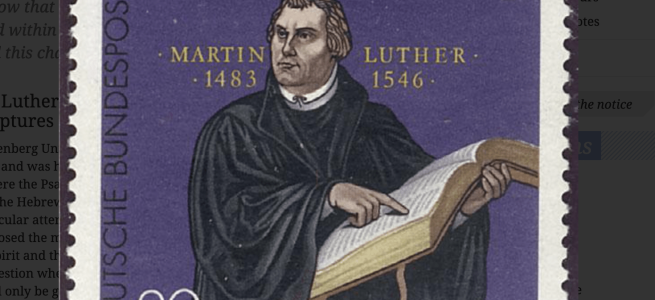
Martin Luther famously established as one of the pillars of his movement to reform Christianity the principle of “sola scriptura:” Scripture alone as the basis for Christian faith. It was not the Bible along with Tradition (that is, official church doctrines and interpretations) as co-equal sources, but Scripture alone. Given the message of the Bible and how it had been marginalized in mainstream Christianity after the 4th century, such a focus should have been good news for people who care about peace.
It was indeed the case that Luther, John Calvin, and various other reformers in the 16th century made an impressive contribution to the work of biblical interpretation. Luther and Calvin’s extensive commentaries and many other writings remain helpful and insightful today. However, as a rule, the churches of the Reformation remained as warist as the Catholic church. One of the main characteristics of the 100+ years that followed Luther’s break with Rome was seemingly never-ending warfare in Christian Europe—a dynamic that many historians see as a root cause for the emergence of atheism and the near death of Christianity in Europe.
What went wrong? I suggest that one of the key problems with Protestant biblical interpretation may be found in the failure of the Protestants to break with the worst characteristic of Catholicism and the legacy of post-4th century Christendom. Catholicism was quite top-heavy organizationally, placed centralized coercive doctrinal enforcement at the center of its faith practices, and affiliated very closely with state power. Let’s call this basic dynamic Big Guy Christianity. The reformers came along and sought to overthrow the Big Guy and took a huge step forward by recovering access to the Bible, the ultimate anti-Big Guy account of faith. However, the Protestants quickly aborted their actual rejection of Big Guy Christianity. They linked closely with state power (just different states), continued using coercive doctrinal enforcement (to the point of literally executing heretics), and established powerful church hierarchies (if somewhat more diffuse than the Catholic hierarchy).
So, what the Reformation came down to was simply replacing one set of authoritarian structures with new authoritarian structures. Though the reformers did provide for more access to the Bible, it was very difficult for early Protestants to appreciate the peaceable message of the Bible. The legacy of Protestantism may be seen in European warism and imperialism that has brought humanity to the brink of self-destruction. One part of that legacy surely must be seen as the failure of the reformers actually to pay attention to the peaceable content of the Bible despite their claims to embrace sola scriptura.
The Anabaptists’ anarchistic sensibility
We must note, though, the one strand of Protestant Christianity that took a different path. Several young radicals in the circle of the influential Swiss Protestant leader, Ulrich Zwingli (who himself, ironically, died on the battlefield fighting to further the Reformation through force), broke with Zwingli in the 1520s over the issue of state involvement in the reforming churches. The presenting issue for them was the forced baptism of infants by the state church. Zwingli actually mostly agreed with these Anabaptists’ reading of the Bible but insisted that the reforming process required remaining closely connected with the state—including, of course, the state’s use of the sword against the Catholics and, in short order, against the Anabaptists themselves. Several of these radicals broke with Zwingli and began a distinct movement.
Way more than the other Protestants, the Anabaptists did do away with Big Guy Christianity. They didn’t simply replace one set of coercive structures with another but sought to embody a kind of Christianity that did away with coercive structures altogether. It would be anachronistic to call this new kind of Christianity an expression of anarchism, since that political movement did not emerge for hundreds of years. But if we think of the key elements of an anarchistic sensibility as a deeply suspicious disposition toward centralized coercive authority (most obviously, state power) and an orientation toward human self-organizing, we may recognize Anabaptism in its early years as a pioneering version of anarchistic Christianity.
We may also consider whether by taking such an approach, the Anabaptists actually captured the heart of the peaceable message of the Bible much more closely than the mainstream magisterial Protestants (and the Catholics, not to mention the Eastern Orthodox). The presence of the Anabaptists in the Reformation era does indicate that the move toward sola scriptura could have produced much more fruit in providing Christians with a peaceable Bible.
The struggle to witness to a peaceable Bible has, of course, been difficult for the Anabaptist/Mennonite tradition. Even in the first generation in the 16th century, the extraordinary, death-dealing violence from the Catholics and mainstream Protestants nearly ended the Anabaptist movement in its infancy. As the Anabaptists struggled for survival, they perhaps inevitably took on many coercive, even authoritarian practices within their own communities. Something of the anti-Big Guy sensibility of the original pioneers did survive though. And, as would be expected given the potency of the Bible’s own content, later Christians have sensed and at time embodied anti-Big Guy elements. We may thank the first reformers for the contribution of their turn toward the Bible, even if they ultimately failed to follow through.

 Thinking Pacifism