Ted Grimsrud—August 28, 2023
I realized at the beginning of the current iteration of the Russia/Ukraine war that I knew very little about Vladimir Putin and present-day Russia. Since then, I have tried a bit to remedy my ignorance. However, I am uncomfortable with popular understandings of Putin in the US, characterized as they are by a tendency (in the words of historian Richard Hofstadter from the Cold War years) to view every enemy as “a perfect model of malice, a kind of amoral superman—sinister, ubiquitous, powerful, cruel who profits from the misery he has produced.” I found that tendency to be widespread in the treatments of Putin I have seen and heard.
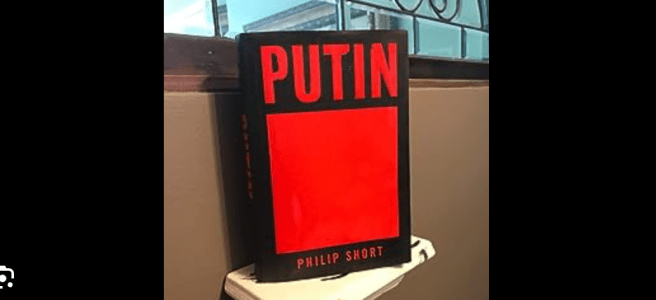
When I recently read a review of several recent biographies of Putin, I noticed one was praised for its relative objectivity. So, I decided to read it. The author is Philip Short, a British journalist who has written biographies of other American “enemies” such as Mao and Pol Pot. The book has a simple title: Putin (no subtitle) and was published by Henry Holt. The manuscript was completed in April 2022, so it does include a discussion of the lead up to and early months of the Russia/Ukraine war.
I would like to share a few thoughts stimulated by my reading. I was glad I read the book. I found it to be pretty carefully researched and reasonably objective. I didn’t love reading it, and it is very long (864 pages total, including 140 pages of end notes)—though the writing is clear and generally irenic. The book helped satisfy my curiosity and provided some useful knowledge and analysis to put the present situation in context.
I appreciate that Short does not treat Putin as “a kind of amoral superman.” Perhaps his relative objectivity will lead those who are US/NATO apologists to criticize him as a Putin defender—but I think that is far from the truth. In fact, I think in the end this book does still give too much of the benefit of the doubt to the US/NATO agenda, but I have no hesitation in recommending it to others who are interested in trying to understand Putin and Russia. It makes a good contribution. Let me share a few observations that follow from my reading.
(1) A traumatic family background. I think it is important to be aware of Putin’s early life and social location. He was a kind of late life “miracle” baby for his parents, who were in their early 40s when he was born in 1952 in Leningrad (now St. Petersburg), Russia’s number two city. They both had suffered profoundly during World War II, including having an infant son starve to death. The father fought in the Red Army, was seriously wounded, and only survived due to the unusual efforts of a comrade who drug him to safety rather than leave him behind. The mother lived through the German siege of Leningrad that may have been the worst ever such siege in human history. During that single extended battle, more Leningrad residents died (ca. 750,000) than Americans from both sides who died during the entirety of the Civil War, the deadliest ever war for Americans Putin’s mother was near starvation when she was found in her apartment, presumed to be dead, and put out on the street with other corpses. Only by chance was she discovered to be still breathing and nursed back to life. So, that Putin (like other Russians of his generation) would have fears of invasions from the West does seem reasonable.
(2) From poverty to the KGB. Putin’s family was poor. He had a hardscrabble childhood where he easily could have joined many of his friends and sunk into a life of petty crime and substance abuse. He appears to have been saved from that in part due to a discovery of the martial arts and devoting himself to the discipline of his practice. He was a mediocre student who decided in the nick of time to commit himself to his education as a means of escaping his circumstances. He performed better in school, decided to see if he could pursue a career in the Soviet secret service, and through a combination of hard work, competence, and good luck eventually found a position with the KGB in East Germany during the 1980s.
(3) A surprising ascent. It seems that Putin ended up as a politician mostly by accident. When he returned to St. Petersburg from Germany as the Soviet Union and Warsaw Pact were disintegrating in the late 1980s, he found a position as a top aid to St. Petersburg’s mayor. As such, he made many connections with Russian and international leaders and eventually gained an appointed in Russian President Boris Yeltsin’s administration. As the end of Yeltsin’s tumultuous term approached in the late 1990s, Putin benefited from not have made many enemies and having displayed a high level of competence. Yeltsin, who realized he could not hope to be re-elected, drew Putin in as a “safe” associate amidst much jockeying for position among various politicians seeking to be Yeltsin’s successor. When Yeltsin designated Putin as his successor, even Putin himself found the choice surprising.
(4) Wanting to join the West. Crucially, as Short tells it, Putin entered into power in 1999 with strong hopes that Russia could have a collegial relationship with the Western political order. This makes a lot of sense. The ending of the Soviet Union in 1991 had been extraordinarily traumatic and chaotic within Russia, and the economic dynamics were especially unsettled and unsettling throughout the 1990s. A stronger connection with the West promised to help alleviate some of those problems. Growing up in Leningrad had placed Putin in the part of the Soviet Union that had the most European sensibilities, and living in East Germany had confirmed to Putin that Russia’s identity was as a European nation.
(5) Disappointment and a spiral to conflict. The story Short proceeds to tell us of Putin’s presidency is, in a nutshell, the story of one disappointment after another for these hopes that Putin and Russia had. The situation was already fraught by the time Yeltsin stepped aside. A key presenting issue was the fate of NATO. As the Soviet Union’s days came to an end in the early 1990s, the George H.W. Bush administration gave powerfully mixed messages concerning NATO’s future. Secretary of State James Baker famously promised Mikhail Gorbachev that NATO would not move to the East. However, this promise was never formalized, and, likely, exceeded that authority Bush had gaven Baker when he made that promise. Many powerful members of Bush’s administration, including Secretary of Defense Dick Cheney, insisted that NATO should be expanded and that this was America’s chance to once and for all exert its dominance over Russia and establish its “full-spectrum dominance” over the entire world. Bush left office without clearly deciding between Baker and Cheney. The same ambivalence characterized the early years of the Clinton administration before the president resolved it by choosing NATO expansion. From that point on, Short implies, the die was cast and something like our current conflict was likely inevitable.
(6) Russia’s turn toward resistance. Putin perceived the US/NATO military interventions in Yugoslavia and Kosovo, and then in Afghanistan, and then in Libya, as increasingly problematic indications of the reality that NATO was actually not mainly about defense but more so about the expansion of American power. By 2007, expressed in a famous speech that Putin made that articulated deep frustration with US/NATO disregard of Russian interests, it became clear that Putin was doubting that his hopes of Russia being welcomed as a part of the western world order would be realized. From that point on, Russia has intensified its efforts to heighten its military capabilities (including its nuclear arsenal) as a means of resisting American efforts.
(7) The consequences of US expansionism. Short does not explicitly state it this way, but his story does point to the likelihood that the current war and the broader crises rippling out from it are due mainly to the 30+ years of US/NATO expansionism and quest for world domination. Russia has not been willing passively to accept that dynamic. Clearly, as Putin’s leadership of Russia has evolved during his many years of power, Russia has become less democratic, more nationalistic, and more repressive. But that evolution may be a consequence of the West rebuffing Putin’s hopes for a more positive relationship.
(8) Where is the Russia/Ukraine going? Short seems to accept the story told by US/NATO leaders and the corporate media of the West as April 2022 that Russia’s military was failing to achieve its goals in Ukraine and that in general the war was going poorly for the invaders. Today, other observers are interpreting the conflict in ways that point to a much more positive experience for the Russians. It is clear that the rest of the world has not rallied around the West in this conflict, and the relationship between Russia and China has become much closer. It seems possible that the decision back 30+ years ago by America’s leaders to pursue dominance rather than a kind of leadership that could involve mutual respect will end up being the choice that ultimately will lead to the *end* of America’s world leadership.

 Thinking Pacifism
I’m glad to have this additional perspective on Putin, Ted.
If you’d like to further flesh out the picture, I’d recommend Putin’s People by journalist Catherine Belton. It’s an exhaustively researched and meticulously documented account of Putin’s rise to power with a focus on his longstanding ties to the criminal underworld and how racketeering and corruption have been at the foundation of his power base since the beginning.
If you can find Oliver Stone’s The Putin Interviews, you might also find it interesting. Of course, you have to allow for the fact that (i) Putin is almost certainly playing to the camera to some extent, so what we see is what he allows us to see, and (ii) Oliver Stone is not necessarily a completely unbiased observer. But even allowing for those things, I found it informative and worthwhile.
Thanks for the tips, Rob.
There are many sources which document Putin’s initial desire to make peace with the West initially met with oral promises (including from the NATO Secretary General and the leaders of several NATO countries) that NATO would not expand to the East. There is also much documentation about the U.S. and NATO deliberately blocking agreement between Russia and Ukraine before and shortly after the Russian invasion. It is a proxy war – yes, now embraced by the government and much of the population of Ukraine, but initially they wanted to prevent wider war and it was the U.S. & NATO hellbent on full-scale war with the idea of weakening Russia.
Like so many of our wars, this drive to war not only had far-from-innocent motives, it was also not well thought out. The U.S. military was not eager for this because it understood that militarily Ukraine could never win over Russia in an outright war. The only public voices in the U.S. Administration articulating doubts about war prospects and the need for negotiations for some time were from military officials, who have a history of being much more realistic than our fanatic foreign policy establishment. Now those doubts are growing as it is becoming obvious even to hardcore hawks that there is no path to victory for Ukraine.
If we had not stopped agreement between Russia and Ukraine before the war, Ukraine would not have had to make the kind of concessions they now probably will have to. The two things Ukraine needed to do were to promise neutrality (not joining NATO) and not to disturb Russia’s control of the Crimea for a fixed period of time (they were not required to formally renounce Crimea being part of Ukraine). This would not have brought about peace. The conflict in the Donbas, basically a civil war with Russians aiding the opponents of the Ukrainian government, would have continued as it had been since 2014. But it seemed that the kind of large-scale operation that Russia launched on February 24, 2022 could have been avoided.
If there is a Russian/Ukrainian history expert reading, maybe they can speak to a particular question your comment raises, Bill: How do we, at a distance, sort out the chicken/egg – which came first? – issues, particularly on the supposed threats felt by Putin (whether he’s really representative of majority opinion or positions in Russia is certainly in question).
As an example, and this may be over simplified or naive, but isn’t NATO expressly a defensive alliance? Has it held true to that, at least in their border areas with Russia? (Maybe not… I’m honestly asking.) Has it engaged in overt aggressive actions or even provocative, unilateral border military buildups in relation to Russia (or even in relation to Soviet satellite states before 1991)? Perhaps so, but I don’t recall such right off.
Given Ukraine had more to fear militarily from Russia than vice-versa (and assuming they are legitimately a sovereign state, as I do), wouldn’t a promise by Ukraine to never join NATO leave them in a more vulnerable position and be an unreasonable request or expectation by Russia? Especially if they knew and took seriously Putin’s apparent conviction, with emotion, that Ukraine was NOT a separate sovereign state?
This isn’t actually about Russia versus the US.
It is about Finland, Estonia, Latavia, Lithuania, Poland, Belarus, Czechia, Slovakia, Hungary, Romania, Moldova, and Ukraine, and more importantly, the people who live in those countries.
Those are the people we are actually talking about here. To erase their voices is imperialism of the worst kind. Or apologia for the same. What right to any other imperialist powers have to determine their fate? What do they want? What kind of lives and governments do they wish to lead? What kind of economic alliances and connections do they wish to make?
Here is one hint: https://youtu.be/4njksFKyycY?si=ZKeRtaumnypRWpad
I appreciate hearing about the biography of Putin, and it summarized.
It appears the situation of the leadup to the Feb, 2022, invasion (preceded, of course, by what I still see as unjustified invasion/occupation of Crimea as well as eastern portions of Ukraine, even IF pro-Russian, Russian speaking Ukrainians “invited” or requested their help in perhaps breaking away) is too complex for me to deeply grasp or understand. However, I do still doubt that the Biden administration OR our military wanted a major war to happen in order to weaken Russia. From what I do think is pretty solid information and even a skeptical perspective, it just doesn’t seem to add up. (And I have previously listened to a bit of the “other” perspective in people like Scott Ritter.)
Also, even supposing Putin/Russia had valid basis for fear of it being invaded or otherwise seriously oppressed (which I’m not convinced of), I don’t see how it justifies the further and very aggressive invasion that began in Feb., 2022. Further, supposing THAT is even justifiable, it in no way justifies their massive and almost continual attacks on civilian targets and other atrocities well documented (and not excused by anything outside of “international rules” of war done by Ukraine in response).
I can certainly understand why the majority of Ukrainians (if that is the case, as it seems to be) would want Russia now driven out of all captured territories, at least since the major invasion, if not from the earlier civil strife regions and Crimea. That sentiment seems certainly to have been ginned up more by Russian actions than any internal or Western-led manipulation or propaganda, etc. I just don’t see how a pacifist position can make excuses (if that’s a fair description, and tell me if it’s not) for either the invasion or many of the subsequent actions by Russia, almost certainly provoked and promoted centrally by Putin himself.
Thanks for sharing your challenging thoughts, Howard. You stimulated a response from me—too long for the comments section. So I wrote and posted my response as a new piece just now.