Ted Grimsrud—August 24, 2023
[Early in 2022, after Russia greatly accelerated its military engagement with Ukraine, I wrote several blog posts and then some shorter posts on Facebook with my reflections. After all these months, I decided to re-engage these issues as the war continues unabated. Here are several recent Facebook posts.]
War, what is it good for? Absolutely nothing! (August 3, 2023)
War almost always ends up way worse than those who initiate it expect. Classic examples are the American Civil War and World War I, in both cases famously entered into by all sides with the expectation the war would be quick and victorious. What followed were the two worst bloodbaths in human history up to the time with indecisive results. American history in the past 75 years is full of case after case of this dynamic (e.g., Korea, Vietnam, Iraq, Afghanistan).
Almost certainly, Russia expected its direct military intervention in the Ukrainian civil war to end quickly back a year and a half ago. There is a chance it might have had the negotiations of the Spring of 2022 managed to reach a conclusion. However, Ukraine pulled back, and the current devastating war of attrition accelerated with no happy ending in sight.
More controversially, some observers are suggesting that the US/NATO side of this conflict was also a miscalculation that is leading to profoundly negative unanticipated consequences for that side. One of these observers is the American political scientist John Mearsheimer, a professor at the University of Chicago. Mearsheimer is often categorized as a “realist” who, it could be said, believes in the American Empire but believes many of the past and current actions of the empire are ill-considered and self-defeating.
In a recent interview, he reemphasizes his perception that the Ukrainian counteroffensive against Russian forces in eastern Ukraine right now is essentially a hopeless operation and has been from the start. The West pushed Ukraine into this operation, but to Mearsheimer, it was “like encouraging them to launch a suicidal offensive that is completely counterproductive.” Why the push? “The West is very fearful that time is running out, that if the Ukrainians don’t show some significant success on the battlefield in the year 2023, public support for the war will dry up and the Ukrainians will lose—and the West will lose.”
The Ukrainians and the US/NATO will indeed lose; Mearsheimer is pretty confident of that result. He thinks the most likely outcome is what he calls a “cold peace,” where Russia subdues Ukraine, gains control of the areas that are predominantly Russian-speaking and leaves the rest of Ukraine as a “dysfunctional rump state”—but one that continues to resist the Russians and results in on-going unrest.
Mearsheimer places the blame for this state of affairs mainly on US/NATO. The big problem has been their “stupidity.” “I think you can’t underestimate just how foolish the West is when it comes to the whole question of Ukraine—and all sorts of other issues as well. I think that the West believed—and here we’re talking mainly about the United States—that if a war did break out between Ukraine and Russia, that the West plus Ukraine would prevail, that the Russians would be defeated.” This is why in the run-up to the war in early 2022, “the United States and the West more generally did virtually nothing to prevent the war.” They thought that on the battlefield the Ukrainians could hold their own and that US/NATO sanctions would devastate Russia. They were wrong in both cases. “This is worse than a crime. This is a blunder, to put in [French diplomat] Talleyrand’s famous rhetoric.”
The miscalculation with the sanctions had a lot to do with not accounting for Russia’s wealth in natural resources and the large number of possible trading partners who could replace those from the US/NATO. Another miscalculation was the idea, still popular in the US/NATO, that Russia’s intent from the start was, to quote US Secretary of State Blinken, “to erase Ukraine from the map.” That this hasn’t happened leads Blinken to claim Russia has already lost. Mearsheimer insists that there is no evidence that Russia ever wanted to do this.
Russia did not want to have an expanded war in 2022 and sought actively to find ways to avert a war. The main issue was ensuring Ukraine remained neutral and did not join NATO. Their attempts to negotiate were rebuffed because the US/NATO saw the situation as an opportunity to deal Russia a devastating defeat. Now, 1½ years later, Russia is committed to making “sure that Ukraine ends up as a dysfunctional rump state and cannot become a viable member of NATO at any time in the future.” Paradoxically, US/NATO has made it clear that Ukraine will not be joining NATO in the foreseeable future but also is still rejecting the idea that Ukraine could become genuinely neutral. So, Russia at this point will not give up the territory it now controls and will probably seek to add most of the remaining predominantly Russian-speaking areas of Ukraine, leaving the “rump” behind. The future possibility of Ukraine possibly joining NATO only incentivizes Russia to sustain its military gains.
Mearsheimer concludes, “the Ukrainians are in deep trouble. We have led them down the primrose path, and there is nothing we can do at this point in time to rectify that situation…. The end result is that Ukraine is going to get wrecked.”
Can war be used to further democracy? (August 9, 2023)
I have struggled throughout the destructive conflict in Ukraine these past 18 months with a claim that is widespread in this country: It is that furthering democracy is one of the main justifications for the US/NATO to flood Ukraine with weapons of war and other war-making resources. This claim has raised many questions for me.
(1) How accurate of a descriptor for Ukraine is “democracy”? Many assumptions have been made about this, though I am unaware of any careful accounts of recent history that provide clear evidence that Ukraine has been very democratic. It seems that the politics of Ukraine going way back, and certainly since it split from the Soviet Union in the early 1990s, have consistently been corrupt. The country did have some elections along the way, and the elected government was overthrown in a US-backed coup in 2014. How “democratic” have the post-2014 elections been? What about the recent banning of opposition parties?
(2) Isn’t war itself about the most anti-democratic force human beings have? Between 2014 and 2022, the Ukrainian government was engaged in a civil war in the eastern part of the country with the largely Russian-speaking population of that area. Then Russia intervened to escalate that conflict. Perhaps an argument may be made that Russian involvement required that US/NATO support Ukraine. However, it is difficult to see how that support has in any sense furthered the democratic dynamics in Ukraine. The influx of war-making materials and support empowers anti-democratic forces in the country and heightens the polarization among the people that makes a genuinely democratic future for Ukraine very difficult to imagine.
(3) What has been the history of the US in relation to furthering democracy around the world in the years since 1945? Not good. One key aspect to democracy is the practice of self-determination by people of a country. Self-determination was one of the core ideals that were emphasized as central for the US joining World War II. However, the years since have seen numerous well-known interventions by the US (and surely many not so well-known) to thwart self-determination around the world. Just a few examples of occasions where the US opposed self-determination efforts and supported authoritarian options—with disastrous consequences: Greece in the 1940s; Iran, Guatemala, and Vietnam in the 1950s; Indonesia in the 1960s; Chile in the 1970s; and Nicaragua in the 1980s). Based on that history, it is difficult to expect that this time in Ukraine would be different and the US would be motivated by a genuine concern for actual Ukrainian self-determination and democracy.
In fact, the ideal of “democracy” seems to have been used as a justification to further some very anti-democratic interests among the elite of US/NATO. A recent blog post by Sri Lankan political thinker Indrajit Samarajiva (“Indie”) offers some significant insights.
The term “democracy” is used for many nation states that are far from allowing their people self-determination. In many cases it mainly has to do with voting every few years and little else. In reality, as a rule the corporations that actually exercise most of the power in “democratic” countries remain in control regardless of who wins the elections. Indie suggests that representative democracy actually tends to lead to oligarchy (the rule of the many by the few, with little accountability). He links such “democracy” with “a religious belief” that justifies the use of military violence to further the oligarchy’s interests, demanding “patriotic sacrifices” from many citizens, people who don’t actually benefit from the “democracy.”
A huge problem with our “democracy,” Indie suggests, is that it has allowed the separation of governance and the economy into two different spheres. The sphere of governance does have some meager democratic elements. The economy is basically a playground for the very rich where they operate without accountability to the broader population. The mass media (themselves simply more corporate run for-profit businesses) educate the populace in the (false) myth of the efficiency of the “private sector” and necessity of privatizing healthcare, education, housing, criminal justice, and many other parts of our lives. “We’ve been philosophically lobotomized into siding with our oppressors against each other in so many ways.”
Indie argues that “democracy” has simply become a circus where we debate all the different elements of “the culture wars” while the “most substantive issues are off limits” (most obviously the economy, but also militarism and the corporatocracy in general). The “professionals” running the economy remain in control of the things that matter regardless of which party is in power and no matter how inept they might be in addressing the true needs of the populace. As a result, we end up being mainly angry with and fearing those on the other side of the culture wars and ignoring “the people in skyscrapers” who are the ones who are truly undermining our wellbeing.
“The latest show in the Circus Without Bread is ‘democracy vs. authoritarianism’ and it’s another trillion-dollar production (like the last one, the ‘war on terror’).” Even critics of the American empire have tended to accept the latest call to back the US/NATO involvement in support of “democratic” Ukraine. The reality, though, Indie asserts, is that US/NATO has utterly failed Ukraine. The American involvement in Ukraine has not been for the sake of authentic democracy nor for the wellbeing of the Ukrainian people. To the contrary, it has helped ensure Ukraine’s profound devastation.
The Empire marches on—but to what end? (August 12, 2023)
Perhaps we may see signs that things are becoming gradually clearer to more people in this country about what is going with our involvement in the Russia/Ukraine conflict. About a week ago, for the first time, most Americans who were polled by CNN stated they oppose additional funding to Ukraine. In spite of the poll numbers, the Biden administration went ahead and asked Congress for $24 billion more to send to Ukraine, over half of that military aid.
Aaron Maté suggests, in a recent blog post, that due to its commitment to “ensuring a Russian quagmire in Ukraine,” the White House considers public opinion to be of secondary importance. One of the issues in the days to come might be whether there will be a tipping point where the importance of public opinion will matter more to the decision-makers. Because it seems doubtful that the situation in Ukraine will be improving any time soon.
Some “senior western diplomats,” congresspeople, and mainstream journalists are noting that the ballyhooed Ukrainian counteroffensive is failing. As a result, Maté reports, some in NATO are pushing Ukraine to join with Russia in peace negotiations. However, “there is no sign that the US is among those Western states applying for peace.” This is because “the stated US aim is not to defend Ukraine and its long-term future” but to “weaken Russia” (Defense Secretary Austin) and ensure “a strategic failure for Putin” that will severely undermine Russia’s “national power” (National Security Advisor Sullivan).
According to Maté, the US/NATO’s optimism at the start of the counteroffensive was not simply overly optimistic. It was dishonest. “US officials were well aware that Ukraine was not prepared to take on Russia’s heavily fortified defenses, but kept that assessment under wraps.” That is, while indeed Ukraine’s losses are “sobering,” that “the Biden administration both anticipated and encouraged them” is even more so.
An American leader not known for being friendly to Biden, Mitch McConnell, actually states quite succinctly what seems to be going on for the Americans, as reported in the New York Times. The best aspects of the US involvement are (1) The US hasn’t “lost a single American in this war,” and (2) “most of the money that we spend related to Ukraine is actually spent in the US.” That is, as Maté summarizes: “The US must continue to fund a war that will sacrifice many more Ukrainian lives, all so that domestic war profiteers can reap taxpayer largesse for ‘replenishing weapons,’ and so that the US—not having its soldiers die in Ukraine—can use the opportunity for ‘improving our own military’.”
Maté cites a Biden administration official who argues that the US must continue fueling the carnage in Ukraine because the US “is in an investment trap in Ukraine with no clear way out. Chances of a military breakthrough or a diplomatic solution are slim to none; and slim may have already left town. We’re in deep and lack the ability to do much more than react to events.” That is to say, since we have invested so much in this war with the purpose of hurting Russia, we have the obligation to continue it. Pouring more good money after bad, we could say.
Maté offers a grim conclusion: “So long as keeping the conflict alive comes predominantly at the cost of Ukrainian lives, then Washington’s bipartisan proxy warriors clearly have no qualms about forcing a war-weary public to foot the bill.” And, I would add, remember that to pay this “bill” mainly means to transfer money from American taxpayers to the American corporations that make the weapons of war Ukraine is buying.
The Empire strikes out (August 19, 2023)
Back in June, American advocates for the war against Russia trumpeted the potential for the Ukrainian counteroffensive to take back territory that the Russians had occupied. At the time, some analysts (e.g., American political scientist John Mearsheimer) argued that the Ukrainian action actually had little chance of success. As it turns out, these folks likely have been correct.
The impending failure of the Ukrainian counteroffensive seems to be bringing out some of the worst in American empire advocates. In a recent blogpost, “Big brave western proxy warriors keep whining that Ukrainian troops are cowards,” Australian blogger Caitlin Johnstone points out the callous cynicism of many such advocates. She cites a recent New York Times report on how the Ukrainian military, after suffering heavy casualties due to “plunging into minefields under fire,” has switched tactics to using “artillery and long-range missiles.” Such a switch, American officials worry, will use up valuable ammunition and make Ukraine more vulnerable in a war of attrition with Russia. “American officials say they fear that Ukraine has become casualty averse,” the Times reports—as if such aversion reflects poorly on the Ukrainians.
This is the problem, Johnstone asks, that Ukrainians are starting to care too much about the lives of their people? Strikingly, according to a Washington Post report, US and Western officials actually anticipated the massive losses based on their war games ahead of time, but they pressed on. These officials “envisioned Kyiv accepting the casualties as the cost of piercing through Russia’s main defense line.” As the deaths piled up, “senior US officials” began to express frustration that the Ukraine military leadership, “fearing increased casualties among their ranks,” were backing off from “the Western tactics of pressing harder to breach the Russian defenses.”
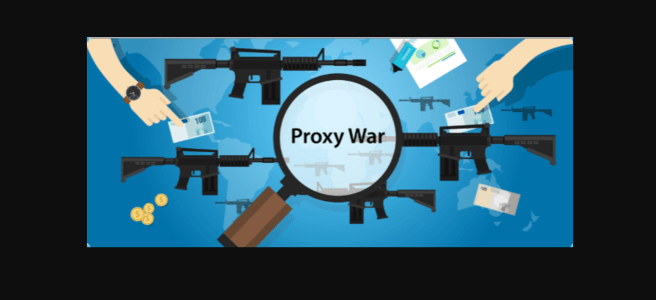
That is, what we are seeing is proxy war where US/NATO is pushing the Ukrainians to pay an overwhelming cost to further the West’s hopes to damage Russia—regardless of this cost the Ukrainians bear. Weeks ago, western military officials “knew Kyiv didn’t have all the training or weapons” needed to dislodge Russia, but they had “hoped Ukrainian courage and resourcefulness would carry the day” anyway. Of course, as one American military leader admitted, America itself “would never attempt to defeat a prepared defense without air superiority”—noting that Ukrainians “don’t have air superiority.”
Ironically, as this counteroffensive falters, American officials are also starting to admit that “we may have missed a window to push for earlier talks.” That is, it might not have been so smart to reject any talk about diplomacy beforehand. Johnstone points out, “this whole war could have been avoided with a little diplomacy and a few mild concessions to Moscow. It could have been stopped in the early weeks of the conflict back when a tentative peace agreement had been struck. It could have been stopped back in November before this catastrophic counteroffensive.” Instead, “the US had an agenda to lock Moscow into a costly military quagmire with the goal of weakening Russia” and has insisted on pursuing it.
And a lot of empire advocates *still* think it is a good idea to push the conflict. Johnstone quotes one: “For the United States and its NATO allies, these 18 months of war have been a strategic windfall, at relatively low cost (other than for the Ukrainians).” Other than for the Ukrainians! This parenthesis raises questions about whether all these tens of billions of dollars in war-making aid the US has sent to Ukraine ever have the wellbeing the Ukrainians as their intent.

 Thinking Pacifism
Just a quick note to ask why you consider Korean war to be indecisive considering the overwhelmingly obvious benefits it brought to the people defended by the US? The North vs. South differences are staggering and inappropriately discounted.
I was just thinking th
Ted, thanks for this thoughtful piece. There is so much here I’d enjoy discussing, as it is of high importance and there is a lot of complexity involved, as you seem to allude to yourself. But I’m going to forego that for brevity sake and so I can “plug” what I think best addresses the very problems you point out, although it will first be probably more applicable to domestic policy (local to national).
Here is just one quote that I think is important to note (among others), and which my “solution” (not really mine) addresses substantially, with real positive effects:
“A huge problem with our “democracy,” Indie suggests, is that it has allowed the separation of governance and the economy into two different spheres. The sphere of governance does have some meager democratic elements. The economy is basically a playground for the very rich where they operate without accountability to the broader population. The mass media (themselves simply more corporate run for-profit businesses) educate the populace in the (false) myth of the efficiency of the “private sector” and necessity of privatizing healthcare, education, housing, criminal justice, and many other parts of our lives.”…
The well-developed set of principles and practices in the “solution” is sometimes called “deliberative democracy”. That overlaps with similar approaches and contains sub-sets of processes that are more in public consciousness than this particular term. Some of them are being variously applied and actively worked toward.
One key example here is ranked-choice voting. (When combined with open primaries, it alone would get us a good start toward broader deliberative democracy, with the particular power of the latter to advance common ground, common sense solutions, avoiding the extremes of polarization we now have.)
Another sub-set is “participatory budgeting” (already practiced here and there in America, especially on the municipal level). That addresses the issue of economy and governance being largely (way too much) separated.
Principles of “Asset Based Community Development” relate closely here, too. And there are a lot of local community applications of these principles, secular and faith-based, with at least two substantial Christian orgs involved: Parish Collective (not Catholic, as it may sound), and Christian Community Development Association (co-founded by Black civil rights activist and Christian leader, John Perkins).
I may have given this link before, but if I did and you (or other readers) haven’t gone to it to read a pretty succinct layout of major electoral and governance reform, with lots of linked organizations to overview, you/they may well be surprised to see what a broad, wholistic vision in this realm looks like. And that it IS DOABLE, in the relatively near future! The URL is https://CompassionateCitizens.us
John Mearsheimer, Aaron Mate, Caitlin Johnstone?
Perhaps you would improve your understanding of the Ukraine war if you paid more attention to actual Ukrainian voices rather than ridiculous performative leftists like Aaron Mate who is nothing more than an apologist for Russian, Syrian, and Chinese oppression.
Have you asked what Ukrainians think about the war and their struggle for democracy? Do THEY think the effort is worth it? Do THEY favor capitulation to Russia and the dismemberment of their country? Aaron Mate and Caitlin Johnstone are not the ones facing a genocidal Russian occupation.
We live in a global world. Ukrainian voices are out there in legion. They are easy to find. And you might find that people living under constant Russian bombardment and threat of genocide might be informative than Canadian leftists, Australian bloggers, and American academics who have proven they know little about Ukraine. Or, in the case of Mearsheimer, is so wedded to his ‘NATO caused the war” theory that he has turned himself into an apologist for Russian aggression and genocide.
You might also learn more about Russia by exploring Russian voices. They are also out there in legion. Starting with Putin himself. What they say about Ukraine and the Ukraine war is also informative.
Excellent points, Kent. I only happen to know one Ukrainian personally and haven’t been in touch since before the full scale invasion. But after the Maidan (sp?) Revolution and during earlier stages of Russia’s incursion, though she was from the eastern region, I know she was against Russia’s approach…. She visited home (there) and supported the resistance.
I just read an article suggesting, probably correctly, that the Wagner mercenaries and quasi-independent Russian conscripts, were many (or all?) of the soldiers in green, but with no IDs, often noted by journalists in E. Ukraine coming in from Russia in 2014.
Bad as our CIA has been in clandestine operations, what the large Warner group has done in many countries makes it pale by comparison. But again, the key is the reactions by the vast majority of Ukrainians and the “regular people” of neighboring countries, and the Baltic states, Finland (previously invaded by Russia), etc. Russia does not have a history that can reassure them, though it has been victimized itself, for sure.