Peace in Ukraine? [American Politics #17]

Ted Grimsrud—August 20, 2025

I found what seems to me to be to be a good, short analysis of the current status of the war in Ukraine, an article “The Peace Delusion,” by a political analyst named Thomas Fazi, who writes regularly for the web-based magazine UnHerd. In a nutshell, Fazi suggests that the core issue in the struggle is the question of whether the United States will remain the single global hegemon or if we will transition to what many are calling a multipolar world order, where there will be several great powers that can manage to co-exist in relative peace.

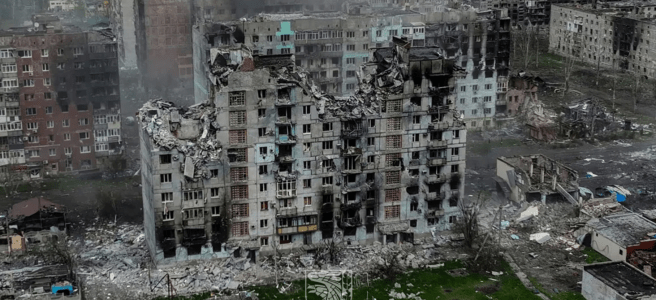
Peace in Ukraine will require Ukraine and its US/NATO backers to acquiesce to Russia’s demands. It’s not simply recognizing Russia’s control over the various parts of eastern Ukraine that they have or will soon have taken over. “It’s about addressing the ‘primary roots of the conflict,’ as Putin repeated in Anchorage: that Ukraine will never join NATO, that the West will not transform it into a de facto military outpost on Russia’s border, and that a broader ‘balance of security in Europe’ be restored.”

Were those demands to be met, Fazi argues, the result would be “a wholesale reconfiguration of the global security order—one that would reduce NATO’s role, end US supremacy, and acknowledge a multipolar world in which other powers can rise without Western interference.” These demands have been stated clearly and consistently by the Russians since before the February 2022 invasion of Ukraine. The reason why peace remains impossible in Ukraine is that such demands (and the resultant “reconfiguration of the global security order”) is simply something that “Trump—and more fundamentally the US imperial establishment, which operates largely independent of whoever occupies the White House—cannot concede to.”

Continue reading “Peace in Ukraine? [American Politics #17]”

Pacifism in a time of war and chaos [American Politics #16]

Ted Grimsrud—March 10, 2025

I am deeply troubled by the wars and rumors of war, the social chaos, and the strong sense of pessimism that seem to be so much a part of our current situation. I also feel confused, uncertain, and relatively powerless. At such a moment, reflection on my core convictions is one way to steady my nerves, if nothing else. Almost exactly three years, a couple of weeks after Russia’s intensifying the conflict with Ukraine with their “special military operation,” I published a blog post on my Thinking Pacifism site that came out of such reflection, “Thinking as an American pacifist about the Russian invasion.” In this post, I want to update the thoughts I shared then.

“Pacifism” as a core conviction

It is challenging to be a pacifist in an environment with a strong cultural consensus in favor of military action. The United States has been deeply involved in the war that has been going on in Ukraine since 2014. When that conflict greatly intensified three years ago, the US prowar consensus also intensified, with both strong support for accelerated military aid for Ukraine and strong condemnation of Russia, usually couched as condemnation of Russian leader Vladimir Putin. It has been virtually impossible to find dissent from the insistence on support for war in the American mainstream media, among Democratic Party politicians, and in my social media circles. But this support for war is at odds with my pacifist convictions.

I do believe that being a minority, even a small minority, due to one’s convictions is not a good reason to weaken one’s convictions. We should, of course, always be open to testing the validity of our convictions in face of challenges. However, it is actually to be expected that pacifist convictions will not widely be shared when the cultural zeitgeist favors war. Rather than doubt the validity of my pacifist convictions, I want to ask how these convictions speak to my warist context.

I use “pacifism” here to refer to a fairly general belief. I use it as roughly equivalent to, say, being a humane person, a person who supports social and political self-determination for all people, a person who affirms the United Nations Universal Declaration of Human Rights. Pacifism affirms that to support war is antithetical to humane values, to the practice of self-determination, and to an affirmation of universal human rights. In what follows, when I use “we” I mean those of us who affirm these pacifist convictions (even if one may not like to use the term “pacifism” itself—I use this term as a convenient rubric for this set of convictions, but I care about the convictions more than the term itself).

Continue reading “Pacifism in a time of war and chaos [American Politics #16]”

Theater of the absurd [American Politics #15]

Ted Grimsrud—March 3, 2025

As I try to pay attention to the wider world spinning out of control and heading toward who knows what kind of fresh hell, I keep trying to reflect on my peace-oriented core convictions and to learn more about history. My core convictions remind me that the US seems bent on world domination and thus, by definition as long as this is the case, seems unable actually to contribute to world peace. Americans who do care about peace need to question the idea that there is some way in our current world for the US to play a constructive role in peacemaking. It has rarely happened in the past eighty years, and it doesn’t seem likely to be happening any time in the foreseeable future.

Two fantasies

From the questionable idea of the US role as an agent for peace comes the fantasy that the Biden/US/NATO policies in Ukraine were about something other than trying to take down Russia and seeking to further enrich US-based war profiteers through the proxy war. Many liberal pundits and corporate media reporters continue to push the idea that the war is a stalemate that can be turned in Ukraine’s favor rather than recognizing that Russia pretty much controls the situation and will heretofore call the shots with Ukraine on the brink of collapse.

Or, we have the fantasy that Trump is a genuine peacemaker who has a plan in mind that will lead to an end to the war. This second fantasy attractively serves as an alternative to the first. I am not as confident in my critique of it. However, because Trump also seeks US world domination and because he also seems to want to somehow squash China (hence, the motive to leave the Ukraine war to the Europeans and focus US energy on China), I actually see little hope that he genuinely seeks peace. We should also note that at the same time that Trump lectures Zelensky about peace he also approves an “emergency” allotment of $3 billion of weaponry to Israel in apparent support for the Israeli refusal to negotiate in the second phase of the agreed-upon ceasefire with Hamas and instead to plan for more violence.

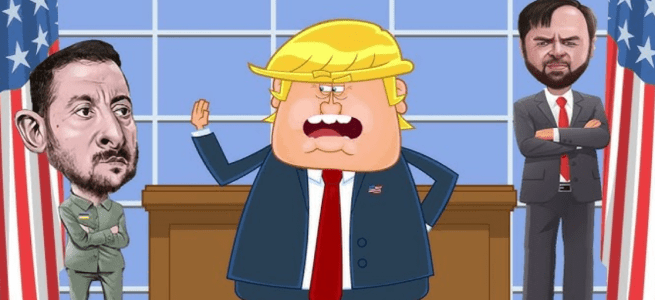
The amazing dustup between Trump (with his faithful sidekick J.D. Vance) and Ukrainian president Zelensky on Friday was shocking theater. As never before we saw a US president being intensely argued with in public—and arguing back. I have no idea what was and is going on in the background and what the fallout will be from this angry display. Reactions I have read seem to show more about the various observers’ predispositions concerning these people than any particular insights about what was actually going on.

Continue reading “Theater of the absurd [American Politics #15]”

Despairing political confusion [American politics #14]

Ted Grimsrud—February 24, 2025

I have believed for a long time that the world will be better off when the American Empire falls from its stature as the most powerful superpower. For a long time, I hoped against hope that this fall would be voluntary, that somehow the US would choose to let go of its drive to dominate the world as the top dog and find ways to be collaborative in a multipolar world.

Is the American Empire falling our only hope for peace?

I now simply cannot imagine that a voluntary giving up of domination will happen. It seems likely that only the American Empire falling apart and involuntarily losing its hold of the world’s reins of power will save the world. And it seems like we are headed toward that outcome perhaps more rapidly than ever. This may be good for the world—though not if the US fights so hard against its demise that it takes the rest of the world down with it.

I don’t understand very well the details of what is going on right now. Obviously, we see a shocking assault on the federal government by the newly installed Trump administration, an assault that seems ill-considered, ill-planned, vicious and destructive for viciousness’s and destructiveness’s sake. At the same time, I do not trust or respect most of the critiques of Trump, et al, that come from Democrats and the mainstream corporate media.

It seems like an extremely important sensibility for me—though I see little evidence of this in most of the discourse on our current situation—to see that both sides in our current political alignment in this country can be, in fundamental ways, wrong. Trump’s (and his acolytes’) horrifically misguided visiting what may be irreversible damage on our country does not negate the Democrats’ own misguided politics.

Continue reading “Despairing political confusion [American politics #14]”

Where is American Warism Headed?

Ted Grimsrud—October 22, 2024

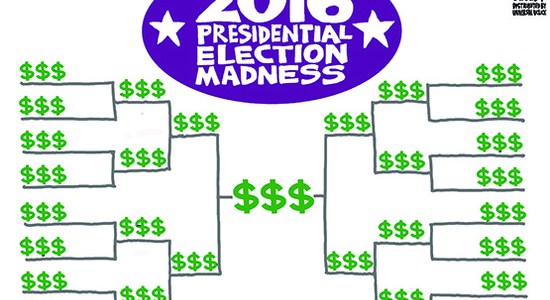
We live in a time of great uncertainty. I find it difficult not to be quite discouraged about the direction the world seems to be going. What kind of future do we have? The presidential election in the United States that we are in the middle of (I mailed in my ballot the other day) is considered by many to be one of the most important we have ever faced.

No matter the outcome, warism will win the election

One of the outcomes of this election, though, that does seem fairly certain is that the American military and American militarism in general will remain engaged and expansive regardless of who is elected. We all know that Trump is all for militarism even if his (empty) rhetoric at times may seem to claim otherwise. Likewise, the Harris campaign has made it clear that she will be committed to continue on the warist path followed by the Biden administration in both Ukraine and Western Asia. So, with regard to what I believe is the most important issue facing our country—our involvement in global wars and preparations for war—this election will change nothing no matter how it turns out.

The two big wars we currently are fighting—in Ukraine and in Israel/Palestine—have not been going all that well for our side. In both cases, we see that American might seems to count for much less than what has been assumed. Simply the fact that both continue to be unresolved in itself tells us a great deal about the ineffectiveness of our weapons and leadership. Could it be that we are nearing the end of the post-World War II era of American military domination? Has the US quest for global dominance finally failed? If so, what will be the consequences?

Is American dominance coming to an end?

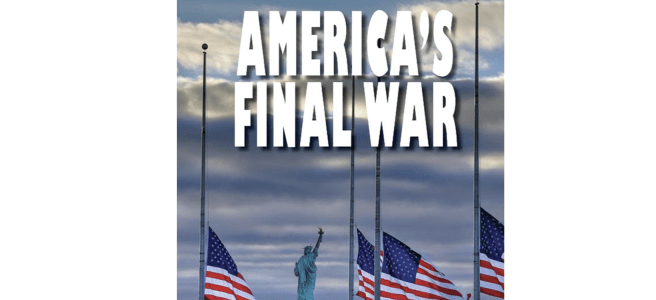
I recently read a challenging and surprising book that argues that indeed the end of an era is at hand. America’s Final War by Andrei Martynov (Clarity Press, 2024) argues that the US military is facing a failure in Ukraine that signals a profound shift in the balance of power and a certain descent into loss of power and influence by the American Empire. I thought that the failure to achieve quick victory in these two wars might indicate that American dominance is no longer what it once was. Martyanov goes further—the end is actually at hand. Is this possible?

Continue reading “Where is American Warism Headed?”

Christianity on war and peace: An overview

Ted Grimsrud—March 15, 2018

[I was recently asked to write up the following brief overview of how Christians tend to view warfare. It will hopefully be published in the forthcoming Bloomsbury Companion to Studying Christians.]

Accounts of how Christians think and act in relation to war have tended to repeat the general typology that was introduced back in 1960 by historian Roland Bainton in Christian Attitudes Toward War and Peace. Bainton saw three categories: pacifism (the commitment not to participate in war in any form), the just war (the willingness to go to war when certain criteria insuring the justness of the war are met), and the crusade (a sense of call from God to fight in a war that is understood to be divinely required).

However, this typology has been criticized for leaving too many options out and over-simplifying what is left. As an alternative, I propose a revised typology that has two main types: (1) Negatively disposed toward war and (2) positively disposed toward war. Each of these two types has three subtypes.

“Negatively disposed” toward war

What unites the three “negatively disposed” approaches is the conviction that, morally, the benefit of the doubt is always against war.

  1. Principled pacifism. This view is against war based on starting principles. For example, some Christians have said that they can not fight due to their understanding of Jesus’ commands such as “love your enemies.” The relative justice of particular wars is irrelevant. For example, in the United States during World War II those who were morally opposed to fighting were allowed to do alternative service as conscientious objectors. Such conscientious objectors refused military service simply because they believed any possible war was wrong due to their moral principles. Even if their country was to fight in a “just war,” principled pacifists would still refuse to fight.
  2. Pragmatic pacifism. This view is against war based on the evidence of how warfare works in actual practice. These conclusions follow from using just war criteria to conclude that all actual wars are certain to be unjust; that is, this pacifism is based on evidence. This view suggests that each war has violated some if not all the standard just war criteria.
  3. Critical just war. This view differs from “pragmatic pacifism” due by being open to the possibility that just war criteria may be met. These criteria typically are sorted into two categories: “just cause” (e.g., defending against aggression, resisting tyranny, stopping atrocities, declared by a legitimate authority, only undertaken as a last resort, undertaken with the near certainty of victory) and “just means” (e.g., noncombatants are not targeted, the violence used is not out of proportion to the good that the war achieves, of limited duration, the humane treatment of prisoners of war). This view starts with the assumption that any particular war is not just unless proved otherwise. The logical conclusion for those holding this view is that wars that do not overcome that burden of proof should be opposed. Something like this was a common view in the U.S. during the Vietnam War for many draftees who refused to fight went to Canada or prison.

Continue reading “Christianity on war and peace: An overview”

Pacifism and violence in the struggle against oppression

Ted Grimsrud—October 29, 2017

Is pacifism a viable social philosophy? I believe that it is, though I also recognize that arguments in favor of the possibility that at times violence might be appropriate can seem pretty persuasive. Nevertheless, as I will outline later in this post, I think the moral and practical problems with violence are ultimately insurmountable.

The impact of Mohandas Gandhi and Martin Luther King, Jr., in the twentieth-century put principled nonviolence on the table as a possible option for those who desire social transformation. As well, the historic peace churches (Mennonites, Quakers, and Brethren) have sought in recent generations to apply their long tradition of Christian pacifism to social issues. But many have questioned whether pacifism is an adequate approach in the real world—whether it might even be unhelpful to the quest to overthrow injustice.

Principled pacifism may be defined as the conviction that it is never morally acceptable to use lethal violence against other people. This conviction has never been widely held, even though in the United States it has been present in a fairly prominent way dating back to the establishment of the Pennsylvania colony in the 1680s. The main impact of pacifist convictions in the US until the 20th century was the refusal of pacifists to join the military and fight in wars. The possibility of self-consciously nonviolent direct action did not gain widespread acceptance until the 20th century.

Changing notions of peacemaking

I write as a Mennonite Christian pacifist, though I believe that pacifism is a valid commitment for anyone. Several 20th century factors combined to transform the understandings and practices of principled pacifism among “peace church” Christians. World War I showed just how widespread and utterly destructive modern war could be (though much worse was soon to come), so a pragmatic case for rejection of war became more widespread. The philosophy and practice of nonviolent direct action as a means to bring about social change gained currency especially through the work of Gandhi in South Africa at the turn of the century and a couple of decades later in India. And peace church people became more acculturated and more likely to feel a sense of responsibility for having an impact in the wider world. Continue reading “Pacifism and violence in the struggle against oppression”

Why, in the end, I can’t vote for Hillary Clinton

Ted Grimsrud—November 4, 2016

Few of the people I know, even those who strongly supported Bernie Sanders in the primaries, are agonizing about their presidential vote next week. It is clear to just about everyone in my circles, it seems, that Donald Trump’s unacceptability as president could not be more clear. Hence, a vote for Clinton is a no-brainer.

Thinking in the context of the electoral college

I have been unsure, however. Not that I would imagine voting for Trump. Not that I don’t believe that Trump would be a complete disaster as president, a horror beyond imagining. But it seems important to me to recognize that our presidential election, given the undemocratic reality of the electoral college, is actually 50 different elections. As we learned in 2000, the winner of the national popular vote will not necessarily win the election.

So, the particular election I am voting in is the election that will determine the votes of Virginia’s members of the electoral college. This fact is important to keep in mind as I reflect on my struggle to discern how to cast my ballot. It is altogether possible that if we did go by the popular vote, I might decide to vote for Clinton—not so much as a vote for her as for a vote that would prevent Trump’s election (I made this kind of argument for voting for Obama in 2012—whereas in 2008 I happily [and naively] voted for Obama, believing at least a little in the hopey, changey stuff).

It is also altogether possible that if I lived in a state such as Ohio or Florida, where the outcome seems very much in doubt and whose electoral votes will be crucial to the outcome, I would vote for Clinton.

But those are irrelevant considerations for me as a resident of Virginia. In a stark contrast to 2000, when I voted for Ralph Nader because Virginia was in the bag for George Bush (meaning a vote for Albert Gore seemed like a wasted vote), now it seems as if Virginia is in the bag for Clinton. I am glad for this for two reasons—one is that I do want Trump to lose, the second is that I feel freer to think of my vote as one I can cast based on my ideals than simply a vote to prevent a worse evil happening. Continue reading “Why, in the end, I can’t vote for Hillary Clinton”

Our fathers’ war

Ted Grimsrud—December 26, 2010 

Several months ago, I embarked upon a big project of trying to make some sense of the moral impact of World War II on the United States. I have done quite a bit of reading, speaking, and writing so far—aided by the blessing of a sabbatical from my teaching responsibilities at Eastern Mennonite University. This lecture especially summarizes some of what I have been thinking about. Here is the link to the rough drafts of the chapters to this book.

One theme has arisen for me that I did not anticipate when I started. That is thinking a lot more about my own father’s involvement in this war and how that involvement might have had an impact on our relationship. I was the fourth of my parents’ five children, but the first and only son. On the surface, I can think of several ways the war shaped my life—I was named after a friend of my dad’s who died in combat during the war, my parents met each other because of the war, and the new medical technology that saved my life when I was born (blood transfusions) would likely not have been available had it not been for the war.

Something I had not really thought about until I started on my project, though, was the trauma the war inflicted on those who fought in it. It makes a lot of sense to imagine the terrible trauma on the people in the many parts of the world who endured the fighting first hand, and the trauma for those societies that poured heart and soul into the fight and lost, and the trauma for the loved ones of the millions upon millions who lost their lives in the war (including about 400,000 American soldiers).

But what about the soldiers who fought on the winning side, who returned home physically whole to a country largely unscathed by the conflict, and who went on to live successful lives? That is, what about people like my father? Continue reading “Our fathers’ war”