Why we should think of God as pacifist—(1) Introduction

Ted Grimsrud—June 3, 2014

Christianity for too long has been too implicated in violence. Wars, rumors of war, preparation for war, violently punitive criminal justice practices, violent child discipline practices, violence toward women, sexual minorities, and other vulnerable people, the exploitation of non-human animals and the natural world. There may be no issue as pressing for the viability of the Christian tradition than breaking the spiral of violence that Christians have been all too active in sustaining.

We may easily think of various components of a violence-overcoming expression of Christian faith—including growth in skills of nonviolent conflict resolution, cultivating love for our neighbors (and expanding the definition of neighbor to include even enemies), cultivating peaceable ways of raising children, enhancing the celebration of biblical bases for peace in our congregations, growing in abilities to deny the violence-empowering dynamics of “othering,” and so on.

In a series of four blog posts, I want to reflect on an underlying issue: how might the ways we think of God contribute to overcoming the curse of violence? I will start with a bold hypothesis. We should actually think of God as pacifist. One way we might define how we use the word “God” is that God is what we worship, what constitutes the core of our sense of what matters most in life, what is most essential to our existence, and what empowers us to feel at home in the universe. Thinking of God as pacifist, then, would be a pretty big deal. Continue reading “Why we should think of God as pacifist—(1) Introduction”
How the Old Testament story refutes the God-as-punisher assumption

Ted Grimsrud—May 25, 2014

I keep thinking of new angles for reflecting on the perennial question of how, as a Christian pacifist, to think about the portrayal of God in the Old Testament. What I will do in this post is think about how the main story line of the Old Testament does not work if we assume that the God portrayed there is fundamentally violently punitive.

Obviously, the Old Testament is a widely diverse collection of writings from many different times and places that reflects many different points of view. And equally obviously, some of these diverse writings tell us that God engages directly in violently punitive acts and directly commands some human beings violently to punish other human beings (both in the sense of general laws and in the sense of direct incidents). Modern critical biblical scholarship has strongly emphasized this diversity.

However, the writers of the Old Testament and the communities that gathered and utilize the writings have not approached this collection as mainly an inchoate accumulation of disparate texts. To the contrary, often in the Old Testament (as well in the New Testament), the writers themselves offer summaries of what they portray as the core story to which the collection as a whole witnesses. And the communities that have used these writings until quite recently have tended to read the Old Testament as containing a coherent story, one that offers clear guidance for those who see themselves as in continuity with the communities that created this collection.

The precise content of this “core story” of course has been and continues to be debated. What I offer is only one way to construe the story. I won’t make the case here that it’s the best one, though I do think it reflects the general orientation of the various summaries of the story line in the Bible itself. My main point is to suggest that looking at the story line is a better way to approach the God-as-violent-punisher theme than simply reporting and struggling with various specific incidents and commands.

My approach is to say that the most meaningful (or, one could say, the most authoritative) element of the biblical writings is the big story—the specifics should be understood in light of the whole. At some point soon I hope to spend more time reflecting on how this approach works in helping us use those texts that portray God as a violent punisher. For now, though, I simply plan to explain why I think the story line does not work if the God of the story actually is a violent punisher. Continue reading “How the Old Testament story refutes the God-as-punisher assumption”

Damaging the Christian faith? Questions about some anti-gay sentiments

Ted Grimsrud—April 27, 2014

I wrote in an earlier post that I have been disappointed that most conversations that I am aware of about how churches and church-related institutions should respond to LGBTQ folks in their midsts don’t seem to be very theological. Those on the “restrictive” side assert over and over again that the basic issue is the Bible and authentic Christian faith on the one side (theirs) and humanism, relativism, and liberalism on the other. And, it seems, many on the “inclusive” side don’t mind this framing of things.

As I express in that earlier post, I am not happy with that framing, and I try to show there that, for example, my workplace, Eastern Mennonite University, should adopt inclusive hiring practices because of our theological convictions and because we affirm the importance of the Bible. Of course, my sentiment is not gaining widespread affirmation.

Concern for the health of Christian faith

Certainly, the main reason for my convictions and the main motivation for trying to articulate them is my concern for the pain that discrimination causes for people who are hurt by it. It is because of the Bible’s call for love, for compassion, for respect, for hospitality, that churches and church related institutions should take an inclusive approach. We should be welcoming because of the damage a non-welcoming approach does to vulnerable people.

Just lately, though, I have been wondering that perhaps it should also be for the sake helping churches and church-related institutions themselves not to be damaged by problems that arise with following the restrictive path. And, in particular, I’ve been thinking a bit about whether assertions for the necessity for taking a restrictive approach actually might undermine Christian faith itself. Part of what has triggered these reflections just now are several short statements of opposition to movements within churches and church-related institutions that have formerly been restrictive toward becoming more inclusive. Continue reading “Damaging the Christian faith? Questions about some anti-gay sentiments”

Why Eastern Mennonite University should quit discriminating (part two)

Ted Grimsrud

[This post picks up the story in the middle—here is the link to Part 1]

The goodness of marriage

Before we consider what the main bases for discrimination may be, we need to spend a bit of time on marriage—in part of strengthen our sense that a rationale to deny marriage to a gay couple or to force a gay person to choose between marriage and employment at a place such as EMU needs to be strong and clear.

Christians consider marriage to be a good thing. While the Bible does not give a detailed blueprint for what constitutes a Christian marriage (in fact, it may be a bit surprising when one looks for such a blueprint to realize how little direct help the Bible gives—and a bit surprising also to realize what happens should we scrutinize the Bible looking for a model husband given that virtually all the major male characters in the Bible are either married to more than one woman or to none at all!), contemporary Christians see in the Bible general themes that contribute to our sense of Christian marriage.

Contemporary Christians would tend to see many of the following as part of their understanding of marriage: (1) it is based on the couple’s shared Christian values and commitments; (2) it is centered on promises of fidelity, commitment, monogamy; (3) it is accountable to a faith community for support and encouragement; (4) it is considered to be permanent, “until death do us part;” (5) it is characterized by companionship and intimacy (a key part of my recent thinking about marriage is the significance of the original image in Genesis 2 where Adam is joined by Eve, in part, because he was “lonely”); and (6) it is the context for the birthing and nurturing of children.

Let’s imagine a couple, two Christian women named “Ilse” and “Jennifer” (my description here is based on actual people that I know). They are legally married, life-long Christians who followed the typical path of joining their lives together: courtship, pre-marital counseling, discernment before committing themselves to one another, marriage, a shared life of fidelity and mutual respect, children, ministry.

We see in their lives the fruits of a healthy, life-giving marriage. What would be bases for EMU denying one of them employment, assuming she has the training and abilities to be seen as a strong candidate, one who would likely succeed and offer much to the EMU community and mission? Continue reading “Why Eastern Mennonite University should quit discriminating (part two)”

Why Eastern Mennonite University should quit discriminating (part one)

Ted Grimsrud

The place where I have been working since 1996, Eastern Mennonite University, is currently engaged in a “listening process.” This process is meant to provide input for the school’s leadership as it considers making an overt policy of non-discrimination in relation to hiring faculty and staff who are in “covenanted same-sex relationships.” In the public statements concerning this process, the main rationale that has been given for changing hiring practices has been, it seems, that people in the EMU community disagree about these issues, that increasing numbers of new hires at EMU express disagreement with the assumed position of Mennonite Church USA (owner of EMU) that covenanted same-sex relationships are sinful, and a sense that younger people (i.e., including prospective EMU students) are less likely to share the restrictive views of the older generation.

This process is explicitly not about considering these issues from a theological framework. This is from one of the FAQs on the EMU website: “It is not our desire in this listening process to enter into theological debate when some of the most respected theologians and church leaders do not agree on interpretation. Rather, it is our desire to focus on relationships and prayer in a way that reflects the life and love of Christ in the midst of deeply held beliefs and values.”

However, since I am a Mennonite theologian (teaching in the Bible and Religion Department at EMU and an ordained Mennonite pastor), I can’t help but think about these issues theologically. So I want to articulate a theological rationale for EMU to quit discriminating. One reason that I think such a rationale is important for EMU’s consideration is my sense that the only possible reason for discrimination is theological (that is, that God declares such relationships to be sinful). So, this is inherently theological terrain that cannot be navigated without, we could say, a theological compass.
Continue reading “Why Eastern Mennonite University should quit discriminating (part one)”

“Othering” and Mennonite sexuality struggles

Ted Grimsrud

I came across a quote in the book Empire by Michael Hardt and Antonio Negri that helped me think a bit more about our current discussions about sexuality in the Mennonite world. I’ll share the quote in a bit, but first I want to set the context.

Othering and the Cold War

Several years ago, as I was working on my book on World War II’s moral legacy, I struggled to understand how the phenomenon of “global communism” could justify the American commitment to its national security state and military interventions around the world. I realized that a key moment was President Harry Truman’s “Truman Doctrine” speech in 1947 that stated, in effect, that there is only one communism, that this communism is behind a vast system of anti-American actions around the world, and the presence of such anti-American actions requires swift and decisive American military intervention. To label people communists was effectively to signify them as the “other” who are different and are inherently a threat to our security. So, military actions (public and secret) in such disparate locations as Greece, Korea, Vietnam, Nicaragua, Indonesia, Guatemala, and Iran followed over the next few decades.

I was struck by how this dynamic insured that little effort would be exercised actually to understand the specific, on-the-ground context for the “anti-American” dynamics. It was a simple process: if there was a lack of support for American interests it was because of global communism. If the lack of support could be labeled as communist-inspired, then everything needed to be known was obvious. There is only one “communist practice”—all communists are essentially the same (and, even more pernicious, all “anti-Americans” are communists). It is quite remarkable to take even a cursory look at the series of conflicts that U.S. engaged in and see an almost identical pattern over and over again where the “enemies” of the U.S. were labeled as “communist” (i.e., definitely labeled as immoral and worthy of violent opposition) and responded to with often devastating force.

The end of the Soviet Union deprived the U.S. of the “global communism” label as a justification of militarism. However, surely not coincidentally, at about the same time as the end of the Soviet empire, the spectre of global terrorism arose and in many ways, down to our present day, successfully played the same role. Again, there seems to be only one terrorism. When we apply that label to resistance to American interests, we know all we need to know and proceed accordingly. Continue reading ““Othering” and Mennonite sexuality struggles”

Does the Bible have a coherent peace message?

Ted Grimsrud

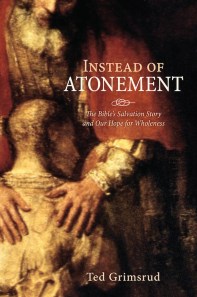
I wrote my book, Instead of Atonement: The Bible’s Salvation Story and Our Hope for Wholeness, out of a conviction that the Bible does contain a coherent peace message (or, I could say, a coherent healing message or a coherent mercy message). Surprisingly to me, I wonder now whether this conviction is shared by all Mennonite academics.

While I would have preferred a more sympathetic reviewer, I appreciate the issues raised by Mennonite Old Testament scholar Derek Suderman’s review of Instead of Atonement in the January 2014 Mennonite Quarterly Review. I want to reflect on several of those issues, not mainly to argue with Suderman but more to take the opportunity offered by his review to address some key elements of how we wrestle with the Bible in face of our call to be agents of healing in the world today.

There will be five issues that I will write about: (1) Is the best way to approach “biblical concepts” through focusing on the big picture or on analyses of specific words? (2) How do we understand God’s judgment in relation to God’s mercy? (3) How seriously should we take the Bible’s own way of summarizing its salvation story? (4) Is suggesting that the Bible has a coherent message actually making an inappropriate “universalized claim”? (5) What kind of assumptions should we have as we approach the Bible? Continue reading “Does the Bible have a coherent peace message?”

Salvation and the way of peace—(6) Is There an Atonement Model in This Story?

[This is the sixth in a series of six posts that will summarize the argument of my recent book, Instead of Atonement: The Bible’s Salvation Story and Our Hope for Wholeness (Cascade Books, 2013). Here is a link to the first five posts in the series.]

CASCADE_Template

The Basic Argument: Old Testament Salvation

For many Christians, the “biblical view” of salvation centers on Jesus’s death as a necessary sacrifice required to make salvation possible. This is the doctrine of the atonement, commonly defined as “how Christ accomplished our justification through his sacrifice on the cross.” However, the Bible’s portrayal of salvation actually does not focus on Jesus’s death as the basis for reconciliation of humanity with God.

The Old Testament emphasizes a few key moments at the heart of salvation: (1) the calling of Abraham and Sarah to parent descendants who would form a people to bless all the families of the earth; (2) the liberation of these descendants from slavery in Egypt; (3) the coalescing of these liberated slaves into a coherent peoplehood shaped by Torah; (4) the establishment of this community in the promised land; and (5) the sustenance of this community even after the destruction by the Babylonians through the prophets and Torah.

The story portrays each of these five “moments” as expressions of God’s unilateral mercy. In none of these cases was God constrained by holiness or the need to balance the scales of justice before the gift is given. In some cases, violence may be seen as an element of the story. Human beings do reap consequences for their injustice. However, the violence is peripheral. The gift does not require that there be pre-payment of appeasement or punishment. It is unearned; the violence is not inherent in its bestowal.

The centrality of the gift may be seen in the role the law and sacrifices play in salvation. Both are second steps, responses to the gift. God acts directly to give life to Abraham and Sarah; then they offer sacrifices. God acts directly to liberate the Hebrew slaves from Egypt; then God gives the law to shape the people’s responsive living. Salvation is not the consequence of obedience to the law or the offering of sacrifices. To the contrary, obedience to the law and the offering of sacrifices are consequences of salvation.

This view of salvation is reinforced by Israel’s prophets even amidst their sharp critiques. They proclaim that salvation is a gift; it simply requires trust, while its fruit is faithful living. Reject the gift and you will face consequences—but even then God awaits your return should you choose to do so. Continue reading “Salvation and the way of peace—(6) Is There an Atonement Model in This Story?”

Salvation and the way of peace—(5) Romans and Revelation

Ted Grimsrud

[This is the fifth in a series of six posts that will summarize the argument of my recent book, Instead of Atonement: The Bible’s Salvation Story and Our Hope for Wholeness (Cascade Books, 2013). Here is a link to the first four posts in the series.]

CASCADE_Template

Paul on the need for salvation

The interpreter of the story of Jesus’s life, death, and resurrection who has shaped the generations since most powerfully has been the Apostle Paul. Christian salvation theology has, for better and for worse, tended to be Pauline salvation theology. After examining key elements of Paul’s thought, I conclude that Paul understands salvation in ways fully compatible with the Old Testament and the story of Jesus.

Like his predecessors, Paul understands salvation in terms of God’s merciful intention to bring healing to a broken world. Paul does not present salvation in terms of retributive justice or a mechanistic view of God’s holiness and honor. Salvation, for Paul, is a gift of a relational God who seeks to free humanity from its self-destructive bondage to the powers of sin and death.

Romans 1–3 provides one important opportunity for Paul to spell out his understanding of Jesus as savior. At the heart of the sin problem for Paul is the dynamic of idolatry, people giving ultimate loyalty to entities other than God—with the consequence that instead of experience God’s healing justice, idolators experience “wrath.”

As Paul will make clear in Romans 5:1-11 and 11:32, God’s intentions toward humanity are about salvation. Hence, we make a mistake if we interpret “wrath” as God’s punitive anger directly aimed at people God has rejected. We should understand “wrath” in relation to the gospel. “Wrath” refers to how God works in indirect ways to hold human beings accountable, “giving them up” to the consequences of their giving their loyalty to realities other than life and the giver of life.

The true law exposes the sins of us all. It helps us see when we exchange love for neighbors with trust in idols. At such times, instead of practicing justice we instead practice injustice and violate God’s will for our lives. This problem characterizes Jews and Greeks alike. This is the problem: the universality of the domination of the “power of sin” (Rom 3:9) over all groups of people. Being a member of the empire does not save one—nor does being a member of the religious institutions that had emerged around Torah. In fact, when such membership fosters injustice it has become a curse, a ticket to alienation and idolatry. Continue reading “Salvation and the way of peace—(5) Romans and Revelation”

Salvation and the way of peace—(4) Jesus’s death and resurrection

Ted Grimsrud

[This is the fourth in a series of six posts that will summarize the argument of my recent book, Instead of Atonement: The Bible’s Salvation Story and Our Hope for Wholeness (Cascade Books, 2013). Here is a link to the first three posts in the series.]

CASCADE_Template

The story of Jesus’s death helps us understand the violent dynamics of our world and helps us answer the question of how to respond to violence without adding to the violence. This story helps us understand why the simple message of God’s love has not been readily embraced in our world. And this story helps us understand how God works to overcome these problems.

Using the logic of retribution (and its application in atonement theology) as the basis for understanding the meaning of Jesus’s death and our salvation actually leads to the opposite conclusion from what the story conveys. The story tells us that the logic of retribution was an instrument of the fallen Powers, not God—and that Jesus’s followers should see in the story a direct refutation of that logic.

In what sense does Jesus bring salvation from the dominance of the fallen Powers? The Powers rely on belief. As long as we believe in their ultimacy, trusting in them for security and meaning, the Powers rule. Jesus challenges human beings to change our allegiance. He asks us to trust in God’s love and not the sense of superiority over others that legalistic belief in the law provides. He asks us to end our trust in the assured access to God that sacred rituals (at a price) provide. He asks us to end our trust in the sense of power over others that being on good terms with the empire provides. In these ways, trust in Jesus breaks the hold of the Powers.

Jesus’s death links with salvation in that: (1) it exposes the fallacy of the logic of retribution; (2) it exposes the direct link between this murderous logic and the institutions that exploit it; (3) it shows that the spiral of violence that is set loose and ever-deepened by this logic may be broken only by non-retaliation and mercy in the way Jesus embodied them; and (4) it sets the stage for God’s act that vindicates how Jesus exposed the Powers and embodied domination-free life when God raises Jesus from the dead. Continue reading “Salvation and the way of peace—(4) Jesus’s death and resurrection”