A passionate Christian voice for abolishing the death penalty

Ted Grimsrud—October 20, 2016

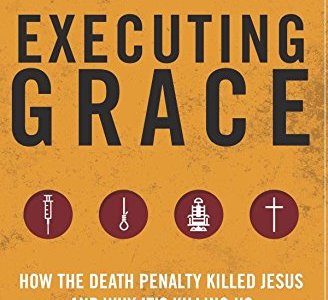
A review of: Shane Claiborne. Executing Grace: How the Death Penalty Killed Jesus and Why It’s Killing Us. San Francisco: HarperOne, 2016. 313 pp.

In Executing Grace, Shane Claiborne, a pastor, activist, and writer of popular theology, has written what we could call a “heart based” argument for abolition of the death penalty. He emphasizes at the beginning that this book is not so much about “capital punishment” as it is about “grace, mercy, forgiveness, and love” (p.3). Or, perhaps more precisely, the book is about “grace, mercy, forgiveness, and love” as applied to the death penalty.

The style is personal, even chatty. But the plentiful stories are powerful, and the theological logic is straightforward. One set of stories concern loved ones of murder victims who oppose the death penalty. Many of these numerous loved ones base their opposition on their beliefs about, Jesus, and the dynamics of forgiveness. Part of Claiborne’s critique concerns the American system that silences these voices in the name of “justice.”

Death penalty proponents have used the Bible to justify executing convicted murderers. As Claiborne points out, “over 85 percent of state executions in the last thirty-eight years occurred in the so-called Bible Belt” (p. 43). So, for an evangelical Christian such as Claiborne, the task is not to argue that the Bible should play no role in the practices of a secular nation such as the United States. Rather, he endeavors to reread the Bible and show that its message ultimately supports the abolition of capital punishment. Continue reading “A passionate Christian voice for abolishing the death penalty”

“Peace Theology” and “Peacebuilding”: How Strong is the Connection?

Ted Grimsrud—September 26, 2016

Back last January, I wrote a post on this blog called “Have Mennonites Moved Past Peace Theology? A Response to From Suffering to Solidarity. I reflected on a recently published, well-executed collection of essays on Mennonite peacebuilding edited by Andrew Klager, From Suffering to Solidarity: The Historical Seeds of Mennonite Interreligious, Interethnic, and International Peacebuilding. This book purports to take a historical approach to Mennonite peace work. My comments were quite laudatory of the book itself, with a few questions, but then I used the book as a jumping off point for reflecting on the relationship (or lack thereof) between Mennonite theological convictions and the current discipline called “peacebuilding.”

The post triggered some useful conversation in the comments section for a few days, which for my blog is a sign of success. I had occasion to reread the post just lately because I learned of a response to my reflections written some seven months ago by the editor of the book, Andrew Klager. The post, “Ted Grimsrud’s Response to ‘From Suffering to Solidarity’: Continuing the Conversation—By Andrew Klager,” raises some interesting points that I think might be worth further reflection.

Some disappointments

I am disappointed that I only now learned of Andrew’s post, and that my learning of it was totally by accident, the result of activating Google alerts on my name. Though Andrew, as the title of his post indicates and as is reflected in the post itself, wrote his piece in service of “continuing the conversation,” he didn’t let me know that he had written it, and so I didn’t have a chance to converse with his thoughts until now.

However, because I remain quite interested in the issues these posts address, I want to think a bit more about them here (and I’ll send Andrew a Facebook message so he knows I have written this!). As I reread my original piece, I find myself pretty happy with what I wrote. I think I clearly raised some important concerns about how the lack of attention to the faith-based convictions that underlie Mennonite peace practices threatens to cut off those practices from their cultural and theological roots—with possible problematic consequences down the line.

So, I am also disappointed that Andrew’s response to my reflections was mainly defensive and, actually, in the end actually seems to confirm some of my concerns. In a nutshell, he reiterates the assumption I find all too common among many the peacebuilding advocates that I know and know of, namely, that the presence of fruitful present-day peace work among Mennonites is strong evidence in itself that of course this work is grounded in Mennonite theology—without responding to my main point that by not self-consciously expressing their convictions, Mennonite peacebuilders may be in danger of  separating the practices from the convictions in ways that will eventually lead to a withering of the practices. Continue reading ““Peace Theology” and “Peacebuilding”: How Strong is the Connection?”

A simple way to world peace? Recognize America as “Beast”

Ted Grimsrud—September 19, 2016

I offer what follows as a thought experiment, an attempt to flesh out a recent late night rumination. I finished reading a fine book, Douglas Fry, Beyond War: The Human Potential for Peace. Fry, who is an anthropologist, seeks to refute the notion of “man as warrior” that assumes that human beings are innately hardwired to fight wars. Fry focuses on hunter-gatherer societies; he argues that some of these societies, presumably more revelatory of human nature, are not warriors.

I like Fry’s argument, though since I don’t know much about hunter-gatherer societies, I mostly have to take his word for it on the evidence he cites. But what he suggests fits well with other things I have read over the years. At the very end of the book he tries briefly to draw broader implications. Here he speaks of the need for a stronger, UN-type organization to help nations avoid warfare.

That suggestion made me think. It’s not that I necessarily disagree with that kind of approach—I’d like to see the peacemaking work of the UN be strengthened and more effective, as well as a stronger and more effective international law regime. But then I thought, surely the most powerful force that resists that kind of movement is the United States. If the US were committed to UN peacemaking work and international law, then we’d have a much more peaceable world. Continue reading “A simple way to world peace? Recognize America as “Beast””

Misconstruing the Trump Crisis

Ted Grimsrud—September 5, 2016

We are in the middle of what seems certain to be one of the worst presidential campaigns in United States’ history. We have the two candidates with the highest negativity ratings in the history of measuring that indicator.

Trump as disaster

And the thing is, the negative ratings for Donald Trump are not nearly as high as they should be. In this blog post, I take it for granted that Trump is a terrible person, remarkably unsuited to be president of the USA. He’s dishonest, narcissistic, mean-spirited, bigoted, ignorant, irreverent, thin-skinned, controlling, sexist, racist, and surrounded by yay-sayers. A disaster in every way; a world-class con-man in the words of Matt Taibbi.

Something else I take for granted in this post is that Hillary Clinton’s negative ratings are too high. She’s not nearly as bad as her public image would imply—at least in the sense that she has been for years and continues to be unfairly vilified, disrespected, slandered, and the like in large part due to her being a woman. At the least, she is vilified often for the wrong reasons.

So, Trump is a disaster who shouldn’t be the candidate of a major political party and as his party’s candidate should not be nearly as close to leading the race as he is. And Clinton is unfairly discriminated against because she is a woman.

And yet, the way the campaign seems to be unfolding is quite troubling for other reasons. As awful as Trump is, he is not the reincarnation of Hitler. There is debate among “experts” whether the invocation of Hitler in relation to Trump violates Godwin’s Law (the idea that internet debates, if they go on long enough, tend to end with references to one’s opponent being like Hitler—a move that in some settings leads to a declaration that in invoking Hitler, one loses the debate).

Regardless, one could argue that the Trump-is-like-Hitler references exaggerate both Trump’s power and his darkness. Trump actually differs from Hitler in crucial ways—maybe most significantly in having nothing even remotely like Hitler’s Nazi Party to implement his inhumane ideology, not to mention also having nothing even remotely like Hitler’s coherent, long-standing, and well-articulated ideology.

Continue reading “Misconstruing the Trump Crisis”

The missing peace in the Democratic Party convention

Ted Grimsrud—August 1, 2016

It seems that the recently concluded Democratic Party convention (DNC) was a success. Clearly, the convention was orchestrated to show a direct contrast with the Republican Party convention the previous week—highlighting diversity, care for the poor, positive hope for the nation, and the like. And unity. The threat of major disruption from supporters of Bernie Sanders proved to be minimal—beyond some random “no more war” chants that were ignored by the people in charge. Sanders helped with his explicit support for Clinton.

Sanders’s speech was a model in how he affirmed Clinton’s candidacy going forward while he also reemphasized the core themes of his campaign. He received a kind of affirming echo from Clinton in her speech, as she lifted up many Sandersian points. Surely, the success of his insurgency campaign pulled her in his direction—and one can fantasize that Sanders and many others will help keep her to her word on many of the issues: vs. harmful free trade agreements, for economic justice, for greater access to higher education, for an increased minimum wage, for criminal justice reform, challenging the big banks, et al.

However, there was something crucial missing from Sanders’s speech—and he perhaps lost the one opportunity possible at the convention to challenge the worst of Clinton’s politics. Sanders said nothing about opposition to war and militarism. And, so, the empire continues to hurtle toward brokenness—and to take all of us with it. There are many angles one could take in decrying this lack of opposition—I write as a Christian theologian. Though it was indeed remarkable how visible explicit Christian faith was at the DNC, I take little comfort in a phenomenon I normally might have welcomed. This Christian presence runs the danger of being just another baptism of empire, even if “kinder and gentler” (ironic allusion to George H.W. Bush intended) than previous baptisms, if it won’t lead to an explicit commitment to “no more war.” Continue reading “The missing peace in the Democratic Party convention”

Refuting the evangelical rejection of same-sex relationsips: A response to James Brownson’s Bible, Gender, Sexuality

Ted Grimsrud—July 5, 2016

Evangelical Christians in North America are evolving—gradually—to become more welcoming of LGBTQ Christians. One indication of this movement is the growth in the number of books that come from a relatively conservative theological perspective arguing on biblical grounds for such welcome. One of the best of these books is Bible, Gender, Sexuality: Reframing the Church’s Debate on Same-Sex Relationships (Eerdmans, 2013) by James V. Brownson.

Brownson is a long-time New Testament professor at Western Theological Seminary and an ordained minister in the Reformed Church in America. The RCA resembles Mennonite Church USA in the wide theological diversity among its congregations. As a whole, it appears to fit into an interesting space between the evangelical world and the “mainstream” Protestant world—active in ecumenical relationships on both sides.

However, as far as I know, Brownson represents a minority perspective in the RCA with his argument for the affirmation of same-sex marriage. His views as expressed in this book surely will evoke strong antipathy from many corners of the RCA world.

A parent’s response

One way to situate this book is to see it as a father’s response to his son coming out at gay. This event, which Brownson calls a “dramatic shock to my life,” challenged him “to re-imagine how Scripture speaks about homosexuality” (p.1). Most fathers in this situation (and I know quite a few who made a move somewhat like Brownson’s—becoming affirming of same-sex relationships as a consequence of one’s child coming out) don’t have the expertise to write a 300-page scholarly treatise that chronicles this “re-imagining.” We should be grateful that Brownson does.

Of course, Brownson’s transparency could lead a suspicious reader to dismiss his book as special pleading. Brownson’s bias of acceptance of his son could be seen as undermining his scholarly objectivity, perhaps fatally. On the other hand, for some of us this confession of personal interest actually helps validate Brownson’s work. It shows that he will understand the human issues involved, in particular the pain caused by restrictive arguments that all too often show a profound disregard for the emotional and relational costs of their agenda. Continue reading “Refuting the evangelical rejection of same-sex relationsips: A response to James Brownson’s Bible, Gender, Sexuality

What does hope even mean?

Ted Grimsrud—Sermon at Shalom Mennonite Congregation—June 26, 2016

I’d like to start with a bad analogy; it links having a strained back with having grandchildren. This is how it goes. About 25 years ago, for the first time I got laid up with a bad back. My distress was triggered when I played in an alumni basketball tournament at my old high school. Before that I had never had back trouble and was not very aware of anyone else having a bad back—I would have thought it was quite rare. But then, as I was gradually recovering, people I knew who had bad backs seemed to come out of the woodwork. Many people kindly commiserated with me, sharing my pain.

Then, almost exactly ten years ago I became a grandparent. Before that I thought very little about people I knew being grandparents. Certainly, I knew that other people were grandparents. But I hadn’t felt it. Then, boom, I had this big thing in common with other people—kind of like having a fragile back….

What does it even mean?

So, the punch line to my sermon this morning ultimately will be about grandchildren—keep that in mind. In a sense, any talk about hope comes down to our grandchildren (real or potential, literal or metaphorical). But for now, I want to mention something else about my grandchildren; that is, grandchild #2, Marja.

Last summer when we were hanging around with 5-year-old Marja, we drove by a bright orange “detour” sign and orange road barriers. “What’s that?” she asked. “A detour sign.” “Detour; what does that even mean?” We chuckled and noticed that she was using that phrase a lot, “what does X even mean?” We later realized that her mother uses that phrase a lot, too—so it’s kind of hipster idiom, I guess. As in, “what does it even mean” when a certain presidential candidate says let’s “make America great again”?

Brian asked me to share this morning about the major transition that’s happening in my life. I wasn’t sure how to do that. I decided that to reflect on how, in my first month of retirement, I suffered from major sciatica pain wasn’t exactly sermon material—nor, even, the joys of greatly reduced sciatica pain. So, instead I want to talk about one of the main ideas I’ve been thinking about. This is a kind of guiding focus for these coming years of theological work in my post-teaching career—the notion of hope.

Continue reading “What does hope even mean?”

It’s time for a change….Reflections on a transition

Ted Grimsrud—May 3, 2016

It’s time for a change
I’m tired of that same ol’ same
The same ol’ words the same ol’ lines
The same ol’ tricks and the same ol’ rhymes

Days precious days
Roll in and out like waves
I got boards to bend I got planks to nail
I got charts to make I got seas to sail

I’m gonna build me a boat
With these two hands
It’ll be a fair curve
From a noble plan
Let the chips fall where they will
Cause I’ve got boats to build

Guy Clark, “Boats to Build”

Last Friday, I turned in my grades for the last time. I gave my last exam last Wednesday. It was about a year ago that I decided that this would be my final year teaching at Eastern Mennonite University and that  I would take an early retirement. Or, as Kathleen and I see it, I will transition from being a full-time college professor who writes on the side to being a full-time writer.

Last Sunday morning in church, I shared about my plans. I mentioned that EMU does not put a lot of pressure on faculty to publish; it’s not really a “publish or perish” place. But now, the pressure will increase. As Kathleen will be taking on a more central role in providing our income, she’s telling me that it will be “publish or perish.” I think she’s kidding (a little, at least), but we both certainly are excited about this transition and have high expectations.

The past year since I “gave my notice” moved quickly, and I am excited for it to be over. It’s been a good year in many ways, but not for a second have I doubted that it is time for this change—even if I am not entirely sure what to expect in these years to come. As Guy Clark sings, “Let the chips fall where they will, ’cause I’ve got boats to build.”

A time of transition like this may be a good time to look back and to look ahead. How did I get here? What clues about what’s to come may be discerned in the trajectory what what has gone before? How have I been prepared for this new stage?

It is a bit unsettling to notice a pattern in my life. Things fit pretty much into 20 year segments. I have my younger years of formal education and a kind of meandering in terms of getting a sense of my life’s vocation and passion. That period ended, it seems to me now, in the Spring of 1976, my last term in college when I took my first philosophy classes (I never did take a religion class in high school or college). I was primed for the classes (“Philosophy of Religion” and “Existentialism”). The previous couple of decades had prepared me, in a way, so those classes turned out to be a gateway to a life of a theologian. Continue reading “It’s time for a change….Reflections on a transition”

A Kinder, Gentler Machine-Gun Hand? A Response to Preston Sprinkle’s People to be Loved: Why Homosexuality is not Just an Issue

Ted Grimsrud—March 31, 2016

Back in the early 1990s, Neil Young recorded a song, “Rockin’ in the Free World,” that protested social circumstances in Reagan/Bush America. It included this line, referring to the language of the Bush campaign calling for a “kindler, gentler America” and pointing to “a thousand points of light” that reflect the goodness of the country: “We’ve got a thousand points of light for the homeless man, we’ve got a kindler, gentler machine-gun hand.”

Young called out the Bush campaign for its misleading message, its claims to seek a more humane country that was contradicted by the actual policies that only exacerbated the dynamics leading to homelessness and that sought expanded militarism.

I’m a little uneasy with using this rhetoric in relation to the current discussion in evangelical Christian circles about whether and how to be welcoming toward sexual minorities. However, I think the question raised by remembering Young’s critique applies.

Is the effort Preston Sprinkle makes (echoing numerous others) to emphasize the call to love gay people actually a signal of a “kinder, gentler” evangelical community—or is it only reflecting a façade of “kindness” that does not actually signal much of a change at all? I’m afraid my reading of the book People to be Loved: Why Homosexuality is not Just an Issue (Zondervan, 2015) leaves me with a strong impression of a deeper-seated “machine-gun hand” that remains solidly in place.

Do actual people really matter much?

Sprinkle is a New Testament scholar with a PhD from the University of Aberdeen and is currently an administrator at Eternity Bible College (Boise, ID). He has written several widely circulated books. He begins and ends People to be Loved with attractive reflections on the need to “love the sinner.” But he also spends the large majority of the book focused on how the Bible supposedly clearly describes and condemns the “sin” that must be hated. These dual foci, “love the sinner; hate the sin,” widespread in evangelical writing on these issues, are difficult to reconcile.

Continue reading “A Kinder, Gentler Machine-Gun Hand? A Response to Preston Sprinkle’s People to be Loved: Why Homosexuality is not Just an Issue

Have Mennonites Moved Past Peace Theology? A Response to From Suffering to Solidarity

Ted Grimsrud—January 11, 2016

A new book collects 17 essays that purport to analyze the “historical seeds of Mennonite interreligious, interethnic, and international peacebuilding” (the subtitle to Andrew P. Klager, ed., From Suffering to Solidarity [Pickwick Publications, 2015]). It’s a collection of interesting and well-crafted essays that covers a wide range of topics that do fit under the general rubric of Mennonite peace work. Definitions are a bit of an issue in thinking about this book, as I will discuss below. However, just taken at face value, the peace-focused writings make an excellent contribution.

Many insightful pieces

The book is organized with three sections: historical background, analyses of “Mennonite peacebuilding approaches,” and discussions of how these approaches have been applied “in conflict settings.” The emphasis is on the practical and specific, and many inspiring stories are told. I’ll highlight just a few of the wide selection of informative chapters.

John Derksen, who teaches conflict resolution studies at Menno Simons College in Winnipeg, gives a nice overview of the early 16th century Anabaptists, claiming “much of Mennonite nonviolent advocacy and peacebuilding today finds its roots in 16th-century Anabaptism” (page 13). This descriptive survey accounts for the sources of the Anabaptist peace emphasis, though it doesn’t make overt connections between these 16th-century “roots” and present-day peacebuilding. This lack would not be a problem in this book if later writers had picked up on Derkson’s narrative. However, there is little mention of Anabaptists in what follows. As it is, we get a good sense of the 16th century movement but not much of a sense for how it directly has influenced our current practices.

John Roth’s essay, “Historical Conditions of Mennonite Peacebuilding Approaches: Global Anabaptism and Neo-Anabaptism,” while a bit cheer-leady in tone, describes a dizzying and inspiring array of Mennonite peace activities around the world in recent decades. He can’t go into much detail, of course, but having his account of one effort after another (and knowing he has to leave many out to keep the essay to a manageable length) impresses the reader with just how seriously Mennonites have been taking their vocation to be peacemakers.  Continue reading “Have Mennonites Moved Past Peace Theology? A Response to From Suffering to Solidarity