God is not a pacifist, right?

[Ted Grimsrud—December 16, 2012]

Last month at the American Academy of Religion and Society of Biblical Literature annual meetings (as I reported), I was challenged again to consider how to think about God in relation to violence. I heard a couple of pacifist Old Testament scholars (a very small population as far as I can tell) in separate settings state explicitly that they believe “God is not a pacifist.” This is a relatively common view in my broader circles among scholars who still often make the point that they themselves are pacifists (a widely cited expression of this view is A. James Reimer, “God is not a pacifist,” Canadian Mennonite [July 26, 1999]; also in A. James Reimer, Mennonites and Classical Theology, 486-492).

This viewpoint strikes me as counter-intuitive. Like what I assume would be the case for all pacifists, I believe that violence is a bad thing and that responding to wrongdoing nonviolently is a good thing. I base this belief, in part (again like I would assume all Christian pacifists would), on Jesus’ command: “Love your enemies, do good, and lend, expecting nothing in return. Your reward will be great, and you will be children of the Most High; for he is kind to the ungrateful and the wicked. Be merciful, just as your Father is merciful.” (Luke 6:35-36) I tend to think that pacifism is an aspiration for a high level of ethical rigor that finds its grounding in God’s will and character. So it is a little discordant to hear that “God is not a pacifist” but we should be. Obviously, the people who believe this are bright, sincere, committed to faithful living, and thus to be taken seriously. So I want to try to understand.

Why we would say “God is not a pacifist”

These are some of the ideas I heard expressed that seem to support the belief that God is not a pacifist: Continue reading “God is not a pacifist, right?”

One problem (among many) with the just war theory

[Ted Grimsrud—December 9, 2012]

Though I am strongly committed to pacifism (hence the name of this blog!—here are links to many of my writings on pacifism), I am finding myself more and more intrigued with the just war theory. For one thing, the theory provides our language for thinking about war morally, especially for thinking about specific wars. I also think that just war thought has potential for encouraging opposition both to specific wars and to war preparation in general. However, I say “has potential” intentionally, though, because I think the potential has largely been unrealized.

I think one of the big problems most writers on just war have that makes understanding the tradition more difficult is acting as if the two basic options in the Christian tradition in relation to war have been pacifism or just war. What is left out (a huge elephant in the room) is what has been by far the majority view towards war: what I will call (following John Howard Yoder, see Christian Attitudes to War, Peace, and Revolution) the “blank check.” The blank check is the basic attitude that when it comes to war a citizen should essentially simply obey one’s government (i.e., give the government a blank check in relation to responding to war).

Perhaps we could say that someone such as Augustine argued for “just war” in relation to (a precious few) governmental leaders, though not at all in a rigorous way. By the time of Machiavelli, the overt argument for “realism” mainly simply stated what governmental leaders actually did much more than suggest a change from “just war” to straight self-interest. But from the start (meaning from the time in the fourth century when Christians began thinking of their ethics in terms of being responsible for the state), for ordinary citizens the basic stance toward war was “blank check” not “just war” (Augustine himself insisted that Christians should obey their governmental leaders, leaving discernment of the justness of war to those in charge of the society).

For this reason, we find next to no emphasis throughout the history of Christianity on what people should do when being expected to fight in unjust wars. And the just war theory has mainly played the role of providing bases to evaluate the relative justness of wars after the fact in totally non-binding ways.  Continue reading “One problem (among many) with the just war theory”

Why the Bible matters for theology

Ted Grimsrud

Probably the class I teach that I enjoy the most is Biblical Theology of Peace and Justice. I had an especially good group of students this semester, and I am sorry that our time together is coming to an end. We do a quick run through of the Bible, starting with Genesis and ending with Revelation. We focus on big themes that relate to peace and justice—some of the problematic texts such as the Joshua conquest as well as texts that more directly point toward pacifism and antipathy toward power politics.

The Bible is of course way to big and complex to be covered in just one undergraduate semester-long class. We have to skip a tremendous amount of important material and surely over-generalize as well as over-emphasize some parts in relation to others. But, still, I think many good things happen in this class and it provides students with an interpretive framework that at least in some cases sticks with them and helps them as they do more studying and thinking.

Even though I follow a similar outline each time I teach the class (I think this is the sixteenth time I have taught it—we always read John Howard Yoder, The Politics of Jesus, and Walter Wink, Engaging the Powers), I still find each opportunity to do this class a time myself to think new thoughts and make new connections. One huge factor, of course, is the different make up of students who always have questions and observations different than their predecessors. It is also the case, though, that no one can fully master this material. Each time I work through it, I see new things.

I want to write a little here about what I am especially noticing this year. This class is actually listed as a “theology” and not “biblical studies” class (I wish this were not the case) because, I suppose, my main areas of teaching are theology and ethics. Though I think this class should have a BIST rather than THEO prefix, I also recognize that I teach it more as a theologian than a biblical studies scholar. And I can’t help but think about the Bible in relation to what we could call “doctrinal theology” (as I elaborate in my book Theology As If Jesus Matters: An Introduction to Christianity’s Main Convictions). What I have realized this semester is that the reason I, as a theologian, care about the Bible so much and do so much of my constructive theology based on the Bible is because the Bible is, we could say, “this-worldly” in a way that later Christianity and Christian theology are not. Continue reading “Why the Bible matters for theology”
A pacifist at the AAR/SBL

Ted Grimsrud

Last weekend, my wife Kathleen and I made our annual trip to the big city to hobnob with 10,000 religion scholars. That is, we attended that convention of the American Academy of Religion and Society of Biblical Literature in Chicago, November 17-20. As per usual, we had a great time. This year, things were pretty low key—both in the sense of not having many responsibilities and of not attending any high powered, life changing sessions (no Cornel West, Judith Butler, Jeffrey Stout, or Robert Bellah this year).

As always, the biggest highlights were the times with friends—especially those who I usually only see at these meetings, but also some new friends (including meeting in the flesh a couple of cyber friends) and even some good times with people I see regularly.

Because I didn’t have much business to attend to and didn’t really have much interest in the book fair (I’m not quite sure why this was; in the past, I spent as many hours as I could with the always amazing collection of books from hundreds of publishers—maybe as I get older I realize just how many books I already have that I will never read), we spent most of our time attending sessions. While my socks stayed securely on my feet throughout, I still found the sessions interesting and stimulating of thought—even if mostly it was to argue against much of what I heard. Here are some highlights. Continue reading “A pacifist at the AAR/SBL”

Faith and Politics (Including Voting)

Ted Grimsrud

All this talking and thinking about voting (this post is part three: #1—Should a pacifist vote for a warmonger?; #2 —More thoughts about voting (or not) for a “warmonger”) has pushed me to think about what I understand politics to be about and what this has to do with my faith convictions. These are some thoughts.

Biblical politics

I find the Bible enormously helpful for thinking about politics. Not that it gives us a blueprint or an explicit political philosophy or even a list of principles for godly politics. Just that it tells a story (a complicated story, with many subplots) that we can share in—a story, ultimately, of people trying to join together to make the world more peaceable in light of their understanding of God’s will for their lives.

In a nutshell, I would define “biblical politics” as people working together for peace. “Peace” I would understand as “biblical shalom”—the wholeness of the community, all people living harmoniously with one another and with the rest of creation. The operative sense of “politics,” then, is people working together in community for the sake of shalom.

The Bible, thus, is intensely political as it tells both of how communities can operate in peaceable ways and of how communities violate shalom (and suffer the consequences). From Genesis’s account of the communal problems that emerge when people turn from shalom to Revelation’s account of a great city of peace (the New Jerusalem) being established on earth, the Bible focuses on politics done (or not) in light of the peaceable will of the creating and sustaining God of the universe.

Continue reading “Faith and Politics (Including Voting)”

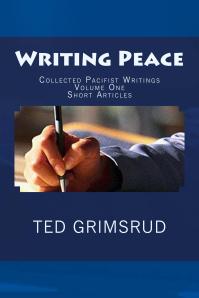
A new book!

Peace Theology Books, 2012. 188 pages.

[To purchase ($15) go here]

For thirty years, Mennonite pastor and theologian Ted Grimsrud has sought to present the call to peacemaking in a series of short articles published in various settings. When read together, they convey a powerful and practical vision for biblically-based pacifism.

The first section of the book collects articles on various topics related to Christian peace convictions published in church periodicals.
The second section contains short meditations on a variety of biblical texts originally published in Mennonite Weekly Review. These meditations present the Bible as a book of peace.
The third and final section contains devotional articles written for Purpose magazine that reflect on how peace concerns are relevant for various aspects of the Christian life.
Though prepared for various settings over three decades, when collected together and read as a whole, the articles in Writing Piece present a coherent message about the viability of Christian pacifism.

More thoughts about voting (or not) for a “warmonger”

Ted Grimsrud

As we draw closer to election day, 2012, I continue to reflect on the voting issue. My October 1, 2012, post asked the question “Should a pacifist vote for a warmonger?”  [UPDATE: I posted a third installment on October 28: “Faith and Politics (Including Voting)”] I concluded that though indeed I believe that President Obama’s four years in office have been a time of increasingly distressing militarism, I still will vote for him. I posed this choice not so much as voting for a lesser evil but as voting against a greater evil. That is, I do not understand my vote to be an expression of support for Obama but to be an expression of opposition to the far more distressingly militaristic and destructive-in-many-more-areas policies I would expect from a Romney administration.

The original posts received many thoughtful and perceptive comments. Within the comments section, several other fascinating conversations that went beyond my own contribution emerged. With these responses and numerous conversations with friends and more reading and thinking, I want to take some time to say a bit more—mainly to try to restate and clarify the argument I am trying to develop. Continue reading “More thoughts about voting (or not) for a “warmonger””

Should a pacifist vote for a warmonger?

Ted Grimsrud

This election season is (or should be) an agonizing time for pacifists and other people in the United States who care deeply for peace on earth. Perhaps as much as any time in the history of this country, an uncritical embrace of militarism as a way of life is on display. We have a president running for re-election proudly trumpeting his success in one military intervention after another (including direct assassination of “national enemies”)—and being harshly criticized by his main opponent for being a wuss on national security issues.

Except for people like us on the fringes, Obama’s militarism is not seen as a problem in the national discussion. The country faces extreme economic difficulties and the two main options in this election are giving the military either a somewhat greater share of the national treasure or a much greater share.

Peace advocates’ discouragement with Obama

American peace advocates’ discouragement is heightened by the reality that we thought we might be getting something better four years ago. And we weren’t alone in the world—how else to explain Obama’s clearly premature Nobel Peace Prize (now a distant memory) other than as a statement of hope from the selectors that he truly would provide a new direction in American foreign policy? Yet, when all is said and done, what we see over the past four years is a slight decrease in the bellicose posturing that characterized the Bush administration, but overall a continuation of the trajectory of empire as a way of life.

So, it is understandable that many peace advocates who supported Obama in 2008 (with admittedly varying degrees of enthusiasm—no one I know or know of expected Obama to tack very far toward a truly new, peace-oriented national security agenda; but we did hope for some major positive shifts) are now asserting that they will not vote for him this time. None of these folks, of course, are remotely interesting in voting for Mitt Romney—they talk either of voting for a third (or fourth or fifth) party candidate or of abstaining. Continue reading “Should a pacifist vote for a warmonger?”

A helpful resource on homosexuality

[A review of C. Norman Kraus, On Being Human: Sexual Orientation and the Image of God (Cascade Books, 2011)]

Reviewed by Ted Grimsrud

Norman Kraus provides something that has, by and large, been missing from Christian theological discussions about homosexuality—careful theological analysis of some of the foundational issues about how we understand human beings in the image of God.

This short book contains an essay from Kraus that is thoughtful, carefully laid out, and fairly dense, accompanied by several short responses to Kraus’s statement by people representing four somewhat diverse perspectives, though all laudatory of Kraus’s effort. While Kraus and his companions in this book are Mennonites and the book certainly speaks to Mennonite debates and efforts at discernment, it is written in a more general tone that makes the book relevant and useful for a variety of church-related contexts.

As I read it, this book most centrally argues for an understanding of human life where we recognize our creation in God’s image and, from that recognition, appreciate our created need for intimacy with other human beings and, for the vast majority of us, a need for one particularly intimate relationship that involves commitment, mutuality, and sexual expression.

Kraus does affirm, in this context, the moral validity of same-sex intimacy that follows the same moral expectations Christians affirm for heterosexual relationships—fidelity, a livelong commitment, shared life in the context of involvement in a congregation. He does this while giving little attention to the debate about the several short biblical passages that are usually affirmed or debunked as providing churches’ most authoritative guidance. Continue reading “A helpful resource on homosexuality”