Are we inherently violent? [Questioning faith #21]

Ted Grimsrud—April 16, 2023

One of the difficult issues that often comes up in discussions about pacifism is the widely held view that human beings are inherently violent. A common version of this view holds that we are born with a disposition toward violence that is part of our genetic makeup, in part because violence is necessary to successfully compete in the dynamics of survival of the fittest that is characteristic of the human project. Hence, violence is natural, and pacifism is unnatural and unrealistic—and untenable.

Not all pacifists agree with what I will argue for about human nature here. In fact, I first developed the ideas about human nature that I believe fit best with pacifist convictions for a public debate with a pacifist who argued for what I describe below as the “hard-wired view.” My debate partner believed that the call to pacifism that Jesus made was actually a call to defy our basic human nature and make a conscious choice to embrace love. I admire people who take this approach, but I also think that most people who take the hard-wired view draw from it bases for anti-pacifist conclusions. More importantly, I think the more pacifism-friendly view of human nature I will sketch actually fits the evidence we have about human existence better than the other options.

Views of human nature

I will summarize three general viewpoints concerning human nature that I think represent the main options: the “hard-wired view,” the “blank-slate view,” and the “flexible view.”

(1) The hard-wired view posits that human behavior is largely determined by a quite thick reality of human nature. One main focus of many with this view is on our genetic make-up, asserting that our behavior is profoundly shaped by our genes. As concerns violence, the “hard-wired view” tends to see human beings as naturally violent. We are born violent, we tend toward violence, our work of minimizing violence should focus on finding relatively non-harmful outlets for these naturally violent tendencies. At best, we may redirect violent tendencies, but we cannot hope to live without violence.

(2) At the opposite end of the spectrum from the hard-wired view, we may speak of the blank slate view. This view asserts that it is meaningless to posit a “human nature;” we are all born with blank slates, and human behavior is totally shaped by our environments and is variable and non-determined.

(3) A second alternative to the hard-wired view we may call the flexible view. This view, which I hold, agrees with the hard-wired view that human nature is a meaningful concept, but would differ from that view by denying that human behavior is in any meaningful sense determined by genetics or, really, by any other unchanging element of human nature.

Continue reading “Are we inherently violent? [Questioning faith #21]”
Why do so many Christians support warism? [Questioning Faith #20]

Ted Grimsrud—April 13, 2023

One of the aspects of Christianity that has long troubled me and has played an increasingly significant role in my sense of my own faith has been how Christianity has for so long and so decisively been comfortable with “warism” (by which I mean to believe in war, to have a generally uncritical and positive disposition toward preparing for, threatening, promoting, and ultimately fighting in war). I grew up in my family with a mild warism and a vague Christian sensibility and had no sense that there could be a tension between the two. After my conversion at age 17, my religious convictions became much stronger as did my warism (in church, I was presented a very favorable view of America’s wars).

However, a few years later, I embraced Christian pacifism and became convicted that warism and Christian faith should be mutually exclusive. The contradiction became apparent once I began to see Jesus’s message as politically normative for Christians. Very quickly, I also came to see warism as deeply problematic on its own terms even when not judged in light of Jesus’s message. Mainly, though, my convictions about Jesus showed me the inherent problems with warism. As John Prine sang back in those days, “Jesus don’t like killing, no matter what the reason for.” I faced a crucial historical question. What changed? If Jesus was about peace, how did his followers become so warist?

Christianity’s turn from Jesus’s way

From the time of my embrace of Christian pacifism, I have wanted to understand better why the large majority of Christians have tended not to do likewise. I learned that the history of Christianity from New Testament times to the fourth century is ambiguous on questions of war and peace. Hence, analyses tend to be contested. I feel comfortable saying, though, that earliest Christianity did (with few exceptions) apply Jesus’s teachings in a way that led to pacifism. We have no record of a Christian leader supporting participation in warfare until the 4th century.

The evolution of Christianity during its first few centuries did move in the direction of the acceptance of war even though not in overt and direct ways. The big picture political situation changed early in the 4th century when Emperor Constantine formally established a rapprochement with Christianity following generations of intense and at times deadly persecution. Christians, it seems, accepted that connection immediately and without debate and in short order became soldiers and supporters of the Empire’s wars—to the point that less than a century after the initial rapprochement, only Christians were allowed in the Roman military.

Shockingly (at least from the point of view of Christian pacifism), the history of Christianity since the 4th century is, essentially, a history of the largely uncritical acceptance of war in almost all Christian communities. This is shocking because this warism seems so drastically contrary to what Jesus advocated. It is also shocking because we have virtually no record of debate or disagreement with the turn toward war among Christian leaders. And it is shocking as well that Jesus’s life and teaching essentially disappeared from the main accounts of Christian theology and ethics (this is apparent early on in the authoritative creeds and confessions of the churches that, typically, if they mention Jesus’s life at all, jump from his virgin birth to his crucifixion).

Continue reading “Why do so many Christians support warism? [Questioning Faith #20]”

How should we think about the violence in the Old Testament? [Questioning Faith #19]

Ted Grimsrud—April 7, 2023

I have heard it said that the stories in the Old Testament about God’s involvement in war, punishment, and various other forms of violence have been responsible for more Christians losing their faith than any other single thing. I have no idea whether that is actually true, but I do know from my career as a pastor and teacher that Old Testament violence is a problem for lots and lots of people. Because the Old Testament is so big and diverse and the issues so complex, it is impossible to give a quick, clear, and concise answer to the questions. But because they are so often present and distressing, I think it is important to try to have some kind response in mind. What follows is mine—which is admittedly not likely to change anybody’s mind.

Starting with God’s love

My starting point for all theological questions is my core theological conviction: God is love. It follows from that, for me, that I would affirm that God is nonviolent, as I believe that violence and love are mutually exclusive. And, I happen to believe that the Bible supports these convictions. So, when I turn to the Bible, I am seeking to understand what the Bible’s teachings are that give us the best images of God. What in the Bible leads us to confess God’s love and, thus, nonviolence? And what should we think about the parts of the Bible traditionally cited as the bases for denying that God is nonviolent?

Let me first, though, say just a bit about what saying “God is nonviolent” means for me. In a nutshell, to make such an affirmation is to confess that the Bible teaches that God created what is out of love and for the sake of love. It also teaches that God participates in the world most directly in how God brings healing in the face of brokenness, binding wounds, reconciling alienated relationships, and empowering creativity and compassion.

Also, I believe that the Bible’s definitive portrayal of God is found in the story of Jesus. That is, God is most clearly and reliably known to humanity in the life, teaching, death, and resurrection of Jesus. My affirmation of God’s nonviolence finds its strongest grounding in my affirmation of Jesus’s nonviolence. Just as it is unthinkable to me that Jesus would punish, hate, exploit, or violently coerce, so is it unthinkable that God would.

Continue reading “How should we think about the violence in the Old Testament? [Questioning Faith #19]”

It’s not the Bible’s fault Christians are violent [Peace Theology #4]

Ted Grimsrud—February 9, 2021

It’s fairly common for me to see or hear someone bemoan the influence of the Christian Bible. People blame it for all kinds of wars and rumors of war, tribalism, and other boundary maintenance violence. It seems that most of the people I know, with all sorts of faith convictions, share in this concern. For many of them, the Bible is also a source of light—so it’s both a necessary resource and a problem.

Now, I hate war and all kinds of violence at least as much as my neighbors. I hate how violent Christians are. And I spend a lot of time with the Bible. I think I have a pretty good understanding about all these criticisms of the Bible and the sense of how the Bible seems to contribute to a more violent world. However, I love the Bible without any qualms. I have nothing but good things to say about the Bible. In my view, it’s not the Bible’s fault that Christians are violent. Let me briefly explain.

How do we read?

The Bible’s connection with human violence stems from how we read and apply it. The Bible is not itself violent but is only used by human beings in ways that lead to violence. It is a thoroughly human document—written by human beings, translated by human beings, interpreted by human beings, and applied by human beings. So, if the Bible is linked with human violence that is because of the humans who read it and apply it in violent ways. It’s not the Bible’s fault. All the Bible can do is provide us with the materials that we then use. I believe the materials in the Bible as a whole actually underwrite peace and undermine warism. I have addressed themes of the Bible and peace in detail elsewhere. But here I want to focus on our ways of reading, not the content.

It is certainly not that the Bible does not contain stories of violence or even portray God as doing violence and commanding violence. There are plenty of violent stories and violent teachings—though maybe not as many as sometimes thought. Regardless, those seemingly pro-violence materials only support our violence when we choose to have them do so.

Continue reading “It’s not the Bible’s fault Christians are violent [Peace Theology #4]”

The Toxic Sludge in America’s Soul: The Tragedy of Systemic Racism (Civil War #8)

Ted Grimsrud—November 6, 2020

As I write this, Joe Biden nears the number of electoral votes needed to become President of the US.  Donald Trump is fighting all out to prevent that outcome, but at this point seems most likely to fall short. However, enough people did vote for Trump—millions more than in 2016—that the contest is close enough that the possibility of Trump’s success can’t be ignored. Something that troubles me deeply is the question of how the election could have been this close.

I suspect that to answer that question will require, among other things, a deepened awareness of American history. How is it that we have an electorate that would offer so much support for a vicious, incompetent, narcissistic individual whose most remarkable feature might be his utter lack of redeemable characteristics? There is literally nothing to like about Trump—no compassion, no empathy, no sense of humor, no insightfulness, no loyalty, no sincerity, no generosity, and nothing else that is attractive on a human level. Trump gained and sustained power by appealing to the worst aspects of this country’s character and ruthlessly exploiting the many weaknesses of its political system.

The Civil War, white supremacy, and their toxic legacy

As I have been studying the American Civil War and the “peculiar institution” (slavery) that triggered it—and the on-going legacy of both that war and its context of white supremacy—I have been impressed with a sense of this large chunk of the nation that has been resolutely opposed to recognizing the humanity of the people forcibly enslaved and exploited and their descendants. The persistence of that opposition is breathtaking once one notices it—and may in significant ways help explain our country’s current political brokenness.

I gained some insights from a book I recently read by Carol Anderson, a historian at Emory University, called White Rage: The Unspoken Truth of Our Political Divide. I don’t particularly like the title, but there is very little else about the book that I am critical of. It’s a concise, highly readable, and actually quite level-toned summary of the persistent and largely successful ways that the United States as a society has refused to give more than a few inches to the efforts of many over the years to create a more just society. It tells the story of how the US has refused to implement the promise of a nation with liberty and justice for all.

As I read this book, I thought of our current situation where about 48% of voting Americans supported our current president, seemingly regardless of how cruel, destructive, and inept his leadership might be. The reading I have been doing lately related to 19th century America, especially focused on the lead-up to the Civil War, the war itself, and its aftermath, leaves me with a strong sense of a deep-seated intractability of white supremacy regardless of how cruel and destructive it might be. Anderson’s book provides a kind of bridge account, showing how the toxic sludge of 19th century Slave Power never went away.

Continue reading “The Toxic Sludge in America’s Soul: The Tragedy of Systemic Racism (Civil War #8)”

The pacifist ache: What’s missing in our politics? [Pacifism/Peace Theology #2]

Ted Grimsrud—July 6, 2020

At this stage in my life, especially during our new era of social distancing, I am more an observer than active participant in American politics. Even from a bit of a remove, though, I have experienced this year, 2020, as an emotional roller coaster. It has made me think of the old ABC Sports show, “Wide World of Sports,” and its iconic opening with brief glimpses of “the thrill of victory and the agony of defeat.”

The ups and the downs

I was thrilled when Bernie Sanders won the Nevada primary, looked to be the leader in the race for the Democratic nomination, and appeared to be showing that a candidate advocating for policies such as Medicare for All and a Green New Deal actually could realistically hope to be elected to the presidency. Then, all too quickly, came the triple whammy of Joe Biden snatching victory from the jaws of defeat versus Sanders, the emergence and shocking spread of the COVID-19 pandemic, and Donald Trump continuing his descent into unfathomable presidential malfeasance and incompetence. Trump’s failures were made all the more devastating in face of our need for a constructive governmental response to the pandemic.

More recently, though, I have again been thrilled with the emergence of what seems like one of the most radical popular uprising in our nation’s history—a direct challenge to the ever-strengthening hold of militarized policing and an empowering of the victims of our nation’s centuries-old plague of white supremacy.

So, it has been and continues to be an emotional yo-yo. It’s quite a time for political junkies—and for everyone else who is interested in what is going to become of our society. In all this, there is always a tension for me, what I will call a “pacifist ache.” I felt even in the height of my hopefulness about Bernie’s chances, and I feel it even when I am most hopeful about our current uprising. It has to do with lack of interest in pacifism (by which I mean the conviction that all of life is precious which leads to a rejection of war and other forms of lethal violence). Of course, this is not surprising. Pacifism has almost always been ignored or dismissed in American politics. Still, it’s too bad. I have spent a lot of time over the past 45 years imagining how a pacifist sensibility could help things out a lot in our society. Continue reading “The pacifist ache: What’s missing in our politics? [Pacifism/Peace Theology #2]”

Pacifist questions during an uprising [Pacifism/Peace Theology #1]

Ted Grimsrud—June 25, 2020

Since we are in the midst of the turmoil, we don’t yet fully understand just how earthshaking this first half of 2020 will turn out to be. Right now, though, it feels as if we are in the midst of rapid and dramatic events that will change the world as we know it. It’s exciting but also unnerving. I wonder what thoughts those with pacifist convictions might have to offer.

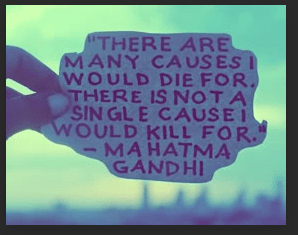
What do I mean by “pacifist convictions”? I think of pacifism as an aspiration to live and think as if nothing matters as much as love. This leads on the one hand, to a commitment to resist domination and injustice, and on the other hand, to a commitment to avoid violence. I don’t think of pacifism as a quest for purity and total consistency so much as holding ahead of us the goals of healing, of justice, of compassion and recognizing, with Gandhi (perhaps our most important theorist of pacifism), that the means of achieving those goals must be consistent with the goals themselves.

This blog post will be the first of many as I try to return to more regular blog activity during our time of upheaval. I am being challenged to revisit my core convictions and try to imagine their relevance to the world I am observing. It’s a good time to try to think one’s thoughts through. Let me reflect on three pacifism-inspired questions: (1) What about the impact of property destruction during the current demonstrations? (2) Is it possible for people seeking change to resist the polarization that seems so pervasive in American society right now? (3) Is it important to raise issues related to our nation’s warism even as we deal with more immediate crises? Continue reading “Pacifist questions during an uprising [Pacifism/Peace Theology #1]”

Is violence necessary to win freedom? The resistance to American slavery [Civil War #6]

Ted Grimsrud—September 4, 2019

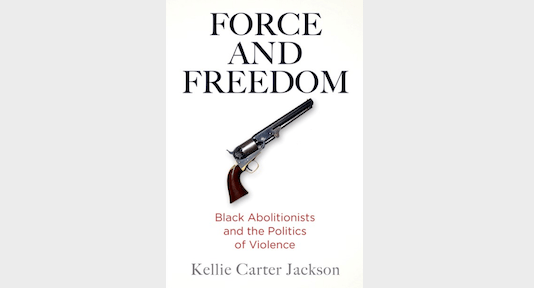
A new book challenges many of my assumptions about the role of violence and nonviolence in resistance to white supremacy and enslavement in American history. Kellie Carter Jackson, a historian who teaches at Wellesley College, in Force and Freedom: Black Abolitionists and the Politics of Violence (University of Pennsylvania Press, 2019) argues for the centrality of necessary violence in the work of resisting and ending slavery. Though she alludes only briefly to the more recent Civil Rights Movement, she seems to believe that violence was a necessary part of the positive gains made in the 1950s and 1960s as well.

An interesting book

I found this book quite interesting—which, unfortunately, is a comment I make only partly as a compliment. One of Carter Jackson’s achievements that I fully affirm is how she draws attention to the numerous black advocates for abolition in the several decades prior to the Civil War. All too often, the story of the abolitionist movement has focused almost exclusively on the white leaders with the addition of Frederick Douglass. Carter Jackson helps us see how vital and widespread the movement among black activists in the North actually was.

As well, Carter Jackson provides an insightful account of the evolution of the abolitionist movement in face of the extraordinary intransigence of white supremacists in the South and the North. At the beginning of the William Lloyd Garrison-led “formal” abolitionist movement in the early 1830s, the emphasis was on “moral suasion” that was self-consciously opposed to the use of violence to effect liberation for the enslaved. Over the following several decades, as the regime of enslavement became more entrenched—with the deep-seated collaboration of Congress, various pro-slavery presidents, and the Supreme Court—those committed to its eradication became increasingly impatient with the emphasis only on “suasion.” Belief in the necessity of violence for the liberation of the enslaved became increasingly widespread.

However, I do not believe that Carter Jackson has successfully made the case for her more wide-ranging claims (albeit usually only implicitly stated) that violence was indeed necessary, then and ever since, for achieving both liberation from slavery and social equality. In her epilogue she tellingly quotes Cynthia Washington of the Student Nonviolent Coordinating Committee from the 1960s, “I was never a true believer in nonviolence.” Washington “carried a handgun in her bag. And though she never fired it, she made it clear that she was willing to do so” (p. 160). Carter Jackson clearly sees Washington’s views on nonviolence as reflecting her own—that is, she doesn’t really give nonviolence a chance. Continue reading “Is violence necessary to win freedom? The resistance to American slavery [Civil War #6]”

Pacifism in America, part four: Pacifism in the Civil Rights Movement

Ted Grimsrud—June 7, 2019

The 20th century has accurately been called the century of total war. The massive death and destruction visited upon the people of the world especially in the first half of that century (with the constant threat of exponentially more death and destruction with the possibility of nuclear war) obliterated the basic human belief in the preciousness of life. One of the pillars of authentic human civilization is organizing society in light of the belief in the preciousness of life. That is why we put so many resources into, for example, healthcare, education, sanitation, and agriculture. We seek to make it possible for human life to thrive.

Powerfully countering all this momentum toward enhancing life, war and the preparation for war treats human life as shockingly expendable. The best and most creative resources of western civilization are focused on killing, not on enhancing life. Yet we still face profound injustices. One of the major justifications for war is the assertion that war is necessary as a means to resist evil. Are there alternative ways to resist evil without relying on violence?

As historian Joseph Kip Kosek wrote, “the problem of the twentieth century was the problem of violence. It was not, as such, Fascism, Communism, economic inequality, or the color line, though all of these were deeply implicated. It was, above all, the fact of human beings killing one another with extraordinary ferocity and effectiveness”(Joseph Kip Kosek, Acts of Conscience: Christian Nonviolence and Modern American Democracy, 5).

The massive resources the United States devoted to resisting fascism and communism in World War II did in fact not result in enhanced human wellbeing. Those efforts did not recognize as fundamental the profound problem of violence. By using violence to counter those twin ideologies over the past seventy years, the U.S. found itself on a rapid descent toward militaristic self-destruction. We do have one example, though, of significant progress in overcoming injustice without extreme violence.

The Civil Rights Movement

The American Civil Rights movement of the 1950s and 1960s, in important respects, reflected an attempt to keep the problem of violence at the forefront and to challenge a devastating social problem in light of the centrality of the problem of violence. By refusing to subordinate the problem of violence to some other problem, for a brief but extraordinarily fruitful moment, the American Civil Rights movement actually made enormous progress in genuine social transformation. Continue reading “Pacifism in America, part four: Pacifism in the Civil Rights Movement”

Is Christian pacifism a thing?

Ted Grimsrud—May 20, 2019

I can imagine several ways that the question I ask in the title of this post could go, so I want to start by explaining what I mean. By pacifism, I have in mind the principled unwillingness to support or participate in warfare or other forms of lethal violence (though I will say a bit more below that will define pacifism in more detail). For the purposes of what I write here, I assume the validity of pacifism. My question has to do with whether there is a type of pacifism that is uniquely Christian—that is, in effect, only available to Christians.

To make this more personal, I can rephrase the question: (1) Am I a pacifist because I am a Christian? Or, (2) Am I a Christian because I am a pacifist? Which comes first? Which is more essential? Now, of course, most Christians are not pacifists. And surely many pacifists are not Christians. As I have thought about this lately, I have come to conclude that though my self-awareness of having an explicitly pacifist commitment came at a time when I would have believed #1 (that I was a pacifist because I was a Christian), I now think that #2 is true for me (that is, to the extent I would see myself as a Christian it is because I am a pacifist and I know of a kind of Christianity that affirms pacifism). I should also say before I go further that I recognize that so much of this kind of discussion depends on how we define our terms. I will try to do that with care as I move along—but I request of the reader some tolerance with the limits of our language. I offer these reflections more as a kind of thought experiment than pretending to present anything definitive. Continue reading “Is Christian pacifism a thing?”