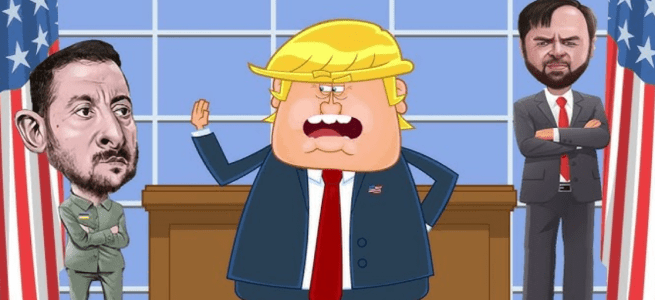
Theater of the absurd [American Politics #15]

Ted Grimsrud—March 3, 2025

As I try to pay attention to the wider world spinning out of control and heading toward who knows what kind of fresh hell, I keep trying to reflect on my peace-oriented core convictions and to learn more about history. My core convictions remind me that the US seems bent on world domination and thus, by definition as long as this is the case, seems unable actually to contribute to world peace. Americans who do care about peace need to question the idea that there is some way in our current world for the US to play a constructive role in peacemaking. It has rarely happened in the past eighty years, and it doesn’t seem likely to be happening any time in the foreseeable future.

Two fantasies

From the questionable idea of the US role as an agent for peace comes the fantasy that the Biden/US/NATO policies in Ukraine were about something other than trying to take down Russia and seeking to further enrich US-based war profiteers through the proxy war. Many liberal pundits and corporate media reporters continue to push the idea that the war is a stalemate that can be turned in Ukraine’s favor rather than recognizing that Russia pretty much controls the situation and will heretofore call the shots with Ukraine on the brink of collapse.

Or, we have the fantasy that Trump is a genuine peacemaker who has a plan in mind that will lead to an end to the war. This second fantasy attractively serves as an alternative to the first. I am not as confident in my critique of it. However, because Trump also seeks US world domination and because he also seems to want to somehow squash China (hence, the motive to leave the Ukraine war to the Europeans and focus US energy on China), I actually see little hope that he genuinely seeks peace. We should also note that at the same time that Trump lectures Zelensky about peace he also approves an “emergency” allotment of $3 billion of weaponry to Israel in apparent support for the Israeli refusal to negotiate in the second phase of the agreed-upon ceasefire with Hamas and instead to plan for more violence.

The amazing dustup between Trump (with his faithful sidekick J.D. Vance) and Ukrainian president Zelensky on Friday was shocking theater. As never before we saw a US president being intensely argued with in public—and arguing back. I have no idea what was and is going on in the background and what the fallout will be from this angry display. Reactions I have read seem to show more about the various observers’ predispositions concerning these people than any particular insights about what was actually going on.

Continue reading “Theater of the absurd [American Politics #15]”

Despairing political confusion [American politics #14]

Ted Grimsrud—February 24, 2025

I have believed for a long time that the world will be better off when the American Empire falls from its stature as the most powerful superpower. For a long time, I hoped against hope that this fall would be voluntary, that somehow the US would choose to let go of its drive to dominate the world as the top dog and find ways to be collaborative in a multipolar world.

Is the American Empire falling our only hope for peace?

I now simply cannot imagine that a voluntary giving up of domination will happen. It seems likely that only the American Empire falling apart and involuntarily losing its hold of the world’s reins of power will save the world. And it seems like we are headed toward that outcome perhaps more rapidly than ever. This may be good for the world—though not if the US fights so hard against its demise that it takes the rest of the world down with it.

I don’t understand very well the details of what is going on right now. Obviously, we see a shocking assault on the federal government by the newly installed Trump administration, an assault that seems ill-considered, ill-planned, vicious and destructive for viciousness’s and destructiveness’s sake. At the same time, I do not trust or respect most of the critiques of Trump, et al, that come from Democrats and the mainstream corporate media.

It seems like an extremely important sensibility for me—though I see little evidence of this in most of the discourse on our current situation—to see that both sides in our current political alignment in this country can be, in fundamental ways, wrong. Trump’s (and his acolytes’) horrifically misguided visiting what may be irreversible damage on our country does not negate the Democrats’ own misguided politics.

Continue reading “Despairing political confusion [American politics #14]”

Where is American Warism Headed?

Ted Grimsrud—October 22, 2024

We live in a time of great uncertainty. I find it difficult not to be quite discouraged about the direction the world seems to be going. What kind of future do we have? The presidential election in the United States that we are in the middle of (I mailed in my ballot the other day) is considered by many to be one of the most important we have ever faced.

No matter the outcome, warism will win the election

One of the outcomes of this election, though, that does seem fairly certain is that the American military and American militarism in general will remain engaged and expansive regardless of who is elected. We all know that Trump is all for militarism even if his (empty) rhetoric at times may seem to claim otherwise. Likewise, the Harris campaign has made it clear that she will be committed to continue on the warist path followed by the Biden administration in both Ukraine and Western Asia. So, with regard to what I believe is the most important issue facing our country—our involvement in global wars and preparations for war—this election will change nothing no matter how it turns out.

The two big wars we currently are fighting—in Ukraine and in Israel/Palestine—have not been going all that well for our side. In both cases, we see that American might seems to count for much less than what has been assumed. Simply the fact that both continue to be unresolved in itself tells us a great deal about the ineffectiveness of our weapons and leadership. Could it be that we are nearing the end of the post-World War II era of American military domination? Has the US quest for global dominance finally failed? If so, what will be the consequences?

Is American dominance coming to an end?

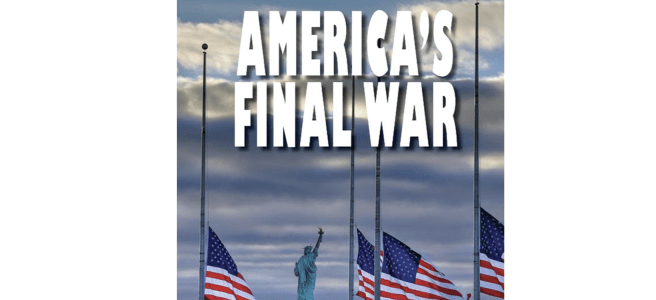
I recently read a challenging and surprising book that argues that indeed the end of an era is at hand. America’s Final War by Andrei Martynov (Clarity Press, 2024) argues that the US military is facing a failure in Ukraine that signals a profound shift in the balance of power and a certain descent into loss of power and influence by the American Empire. I thought that the failure to achieve quick victory in these two wars might indicate that American dominance is no longer what it once was. Martyanov goes further—the end is actually at hand. Is this possible?

Continue reading “Where is American Warism Headed?”

Is there an end in sight? The US Empire sinks ever lower [American Politics #9]

Ted Grimsrud—April 22 2024

“Rage, rage against the dying of the light.” (Dylan Thomas)

I have come to feel one little sliver of gratitude for the current devastating violence that Israel (with the backing of the United States) is visiting on Gaza. It helps us see more clearly the reality of the US/NATO backing of the doomed Ukrainian war against Russia and the reality of the scaling up of American war cries in relation to China. The US Congress’s recently passed spending bill to fund billions for war and war preparation in Israel, Ukraine, and Taiwan makes obvious the actual dynamics.

The motives of the US Empire: Corporate profit and domination

I’d say first of all, the US/NATO pursues these wars and possible wars in order to redistribute money from their taxpayers to corporate war profiteers. And, then, second, these wars and possible wars are justified as necessary to further the empire’s obviously failing agenda of being the dominant power in a “unipolar” world. This agenda, of course, is framed in terms of resisting the expansionist intentions of Russia and China. However, when we look at the whole picture in light of the destruction of Gaza, we see more clearly that there is nothing defensive about any of these situations—Gaza is simply about conquest and devastation. To see that about Gaza in turn helps us see what, in reality, the others are about as well.

A recent, typically insightful essay by Aaron Maté helps make all of this clear. He points out, first, that this new bill is all about directing money to the war corporations. He quotes House Armed Service Chair Mike Rogers: “Nearly all the money we’re spending to arm Ukraine [and, I may add, Israel and Taiwan] doesn’t leave this country,” but instead “goes directly to US companies and American workers to produce more weapons at a faster pace.” As it turns out, a lot of the money in this particular bill won’t even go to Ukraine or Israel in any direct way but rather will be spent simply to rebuild the American store of weaponry.

Continue reading “Is there an end in sight? The US Empire sinks ever lower [American Politics #9]”

More critical thoughts on America’s proxy war [American politics #7]

Ted Grimsrud—October 5, 2023

[Early in 2022, after Russia greatly accelerated its military engagement with Ukraine, I wrote  several blog posts and then some shorter posts on Facebook  with my reflections. After many months, I decided to re-engage these issues as the war continues unabated. I posted several times recently on Facebook and consolidated those into a blog post, “And they call it democracy…. Critical thoughts on America’s proxy war.” Here are a couple more posts.]

History may not repeat itself but at times it sure rhymes (9.22.23)

I recently read a book from the late 1970s, The Washington Connection and Third World Fascism, by Noam Chomsky and Edward Herman. It is a detailed report on the carnage visited on various countries around the world (e.g., Indonesia, Thailand, the Dominican Republic, and—especially—Vietnam) by the American Empire in the 1960s and 1970s. The section on Vietnam especially caught my attention as I thought of America’s involvement in the current Russia/Ukraine war.

On the surface, the differences between the Vietnam War back then and the current war in Ukraine are obvious and significant. Back then, it was the US invading Vietnam with hundreds of thousands of our troops; now, we are mainly only offering military aid (no troops) to Ukraine as it is invaded by Russia.

However, I find it instructive to think of a few of the similarities. With the Vietnam War, the US military planners well knew by 1965 that it was a war they could not win. From that point on until the final withdrawal ten years later, the US pursued extraordinarily destructive military operations for purposes entirely separate from actually defeating their Vietnamese enemies. It was clear during that entire time that eventually the war would end with a US defeat. So, why did they continue? It had to do with broader American “strategic interests” in the world and with American “prestige.”

Is the same kind of dynamic present in our current conflict? The much-heralded Ukrainian “counteroffensive” seems not only to have failed; it seems quite likely that the US/NATO leaders who pushed for that effort knew it would fail from the beginning. Why would they do this? It is hard to imagine an alternative to the reality that it’s about “strategic interests” and “prestige” that have absolutely nothing to do with the wellbeing of the Ukrainian people.

Continue reading “More critical thoughts on America’s proxy war [American politics #7]”

A Christian pacifist in the American Empire, part 3: The American Empire without blinders

Ted Grimsrud—September 15, 2023

In the first post in this three-part Theological Memoir, “Embedded Theology,” I gave an account of my first two decades of life with a focus on how my “embedded theology” led me to accept the “blank check” regarding my loyalty to the American Empire, even to the point of being (reluctantly) willing to go to war if called. This acceptance of the blank check was, if anything, strengthened when I became a Christian and was taught that the “gospel” included an embrace of American patriotism.

The second post, “Jesus’s gospel of peace,” describes the circumstances around the transformation of my perspective due my encounter with Jesus—an embrace of Christian pacifism and a rejection of the blank check that involved a deeply critical disposition toward the American Empire. I also briefly sketch the Bible-oriented theology that undergirds that critical disposition.

My encounter with the gospel of peace has defined the rest of my life. Right away in 1976, I sought to bring together the two main elements of this new exciting vision for life and faith: First, an embrace of Jesus’s gracious and humane call that love of God and neighbor are the core meaning of life. Second, an ever-widening analysis in our social and political context of the vicious, expansionist, profoundly violent American Empire. From the very start, for me, these were two sides of a single coin. The call to love illuminated the realities of the Empire and the realities of the Empire continually challenged me to understand the practical and embodied character of the call to love. The more I studied the Bible, the more convinced I became of the radical nature of this story of God’s call of a people to bless all the families of the earth with their message of shalom. In this post I will outline my critique of the American Empire.

Continue reading “A Christian pacifist in the American Empire, part 3: The American Empire without blinders”

One pacifist’s reflections on the Russia/Ukraine war

Ted Grimsrud—September 4, 2023

I have a number of friends who are quite sympathetic to the plight of the Ukrainian people in the face of the terrible war that is going on in the eastern part of that nation. Along with that sympathy seems to exist a corresponding sympathy with the American military support for Ukraine and the account of this war given by US/NATO sources. I share the first sympathy but not the second.

As has famously been said, the “fog of war” renders clear understanding of the elements of any war very difficult—generally, this “fog” extends to the various stories that are told about the factors that led to a war and the factors that could resolve it. I certainly don’t claim to be able to pierce all these levels of fog in relation to the Ukraine war, but as I struggle to make what sense of the situation as I can, I have some reflections to offer. (I want to thank one of my doubly sympathetic friends, Howard Pepper, for some stimulating comments he made in response to my recent blog post on Philip Short’s biography of Vladimir Putin. What follows is meant not so much as an argument with Howard as simply a chance to spell out my position without an attempt to offer evidence or justifications.)

The Russian choice for war is morally wrong

As a pacifist, I *do* condemn Russia’s military engagement with Ukraine as immoral. I think it is wrong in principle, and I think in practice it does not and will not serve the wellbeing of Russia and its people. At the same time, I condemn as immoral Ukraine and its US/NATO backers for provoking that engagement and fueling it with weaponry and training. I condemn US/NATO for building up Ukraine’s military for many years and for helping to exacerbate the longstanding tensions among the Ukrainian-speaking and Russian-speaking residents of Ukraine. It is quite clear already that pursuing a military response to Russia is not and cannot hope to serve the wellbeing of Ukraine and its people. I don’t think one has to be a pacifist to express this condemnation on both sides, but certainly no pacifist should fail to do so.

I condemn the Russians for not working harder to find ways through diplomacy to address the concerns that led them to take the step of greatly accelerating the militarization of the conflict with Ukraine that had been simmering since at least 2014. Probably even more, though, I condemn the US/NATO and their allies in the Ukrainian leadership for not respecting what seem to be legitimate security fears on the Russians’ part in relation to the eastward expansion of NATO nor being willing to converse with Russia’s expressed concerns and expressed willingness to negotiate in the months leading up the Russia’s February 2022 invasion.

Continue reading “One pacifist’s reflections on the Russia/Ukraine war”

And they call it democracy…. Critical thoughts on America’s proxy war

Ted Grimsrud—August 24, 2023

[Early in 2022, after Russia greatly accelerated its military engagement with Ukraine, I wrote several blog posts and then some shorter posts on Facebook with my reflections. After all these months, I decided to re-engage these issues as the war continues unabated. Here are several recent Facebook posts.]

War, what is it good for? Absolutely nothing! (August 3, 2023)

War almost always ends up way worse than those who initiate it expect. Classic examples are the American Civil War and World War I, in both cases famously entered into by all sides with the expectation the war would be quick and victorious. What followed were the two worst bloodbaths in human history up to the time with indecisive results. American history in the past 75 years is full of case after case of this dynamic (e.g., Korea, Vietnam, Iraq, Afghanistan).

Almost certainly, Russia expected its direct military intervention in the Ukrainian civil war to end quickly back a year and a half ago. There is a chance it might have had the negotiations of the Spring of 2022 managed to reach a conclusion. However, Ukraine pulled back, and the current devastating war of attrition accelerated with no happy ending in sight.

More controversially, some observers are suggesting that the US/NATO side of this conflict was also a miscalculation that is leading to profoundly negative unanticipated consequences for that side. One of these observers is the American political scientist John Mearsheimer, a professor at the University of Chicago. Mearsheimer is often categorized as a “realist” who, it could be said, believes in the American Empire but believes many of the past and current actions of the empire are ill-considered and self-defeating.

In a recent interview, he reemphasizes his perception that the Ukrainian counteroffensive against Russian forces in eastern Ukraine right now is essentially a hopeless operation and has been from the start. The West pushed Ukraine into this operation, but to Mearsheimer, it was “like encouraging them to launch a suicidal offensive that is completely counterproductive.” Why the push? “The West is very fearful that time is running out, that if the Ukrainians don’t show some significant success on the battlefield in the year 2023, public support for the war will dry up and the Ukrainians will lose—and the West will lose.”

Continue reading “And they call it democracy…. Critical thoughts on America’s proxy war”

More thoughts about Ukraine and the American Empire [Pacifism Today #8]

Ted Grimsrud—June 23, 2022

[In early March, as the conflict in Ukraine gained the world’s attention, I began to write about that conflict, especially in relation to the American Empire. I posted a blog entry, “Thinking as an American pacifist about the Russian invasion” on March 3. On April 10, I posted “Reflecting morally on the conflict in Ukraine,” a collection of four shorter Facebook posts from the previous month. This current post also collects Facebook posts and leaves them essentially unchanged.]

So, what’s going on with Russia/Ukraine? [5.10.22]

I have struggled with how best to understand the current conflict in Ukraine and, especially, the American role in it—especially in light of Jesus and his biases toward peace and against the power elite. These are some brief points about which I have developed some clear impressions (subject to revision):

1. The US has been seeking a unipolar world at least since 1945 (for example, note the size of the American military budget in relation to the rest of the world and its extensive set of military bases around the world). This quest for global dominance has led to the US relationship with the Soviet Union/Russia to be very adversarial. Russia has a long history of facing aggression from the West going back to Napoleon.

2. Ukraine was the site of armed conflict before the Russian invasion in early February 2022, with thousands dying since 2014. What happened in February was an acceleration of the conflict, not an initiating of it.

3. There are great profits for arms dealers (war profiteers) in the deepening of this conflict. These profits come on top of the great profits throughout the Cold War era and the resistance to a post-Cold War “peace dividend.” These profits have been a key factor driving American policies.

4. Our mainstream (corporate) media are mainly repeating what they are being fed by government. Note the lack of dissenting voices in relation to the militarized American response in the core national media (e.g., Times, Post, NPR, CNN, MSNBC, New Yorker, Atlantic).

Continue reading “More thoughts about Ukraine and the American Empire [Pacifism Today #8]”

Reflecting morally about the conflict in Ukraine [Pacifism Today #6]

Ted Grimsrud—April 10, 2022

[In early March, as the conflict in Ukraine gained the world’s attention, I wrote a blog post, “Thinking as an American pacifist about the Russian invasion.” In the weeks since then, I have continued to think—and posted several shorter reflections on Facebook. I have gathered those pieces into this blog post essentially unchanged.]

Some different concerns in response to the Russian invasion [3.9.22]

Like most people I know, I am heartsick about the Russian invasion of Ukraine and the possibility of an expanding and continuing conflict. However, I don’t notice many other people voicing some of my main concerns.

It was almost 50 years ago that I first learned that my country’s leaders regularly, and to devastating effect, lied to justify engagement in unjust and disastrous military actions around the world. When I was in college, I learned to know numerous Vietnam War vets who told me stories that made my hair stand on end. To a man, they bitterly spoke of the lies we Americans were being told about that war.

Continue reading “Reflecting morally about the conflict in Ukraine [Pacifism Today #6]”