An Anarchistic Reading of the Bible (4)—Conquest and Kingship

Ted Grimsrud—February 16, 2015

 This is the fourth in a series of posts.

We find an intense struggle at the heart of the Old Testament story—and hence at the heart of the biblical faith. It’s a political struggle. We could characterize it as a struggle between the “Empire way” and the “Torah way.” According to the story, following the liberation of the Hebrews from enslavement in the Egyptian Empire, they started a process of finding out how to embody the liberation they had experienced. God provides them with a blueprint for liberated existence, the law codes, Torah.

The story treats it as a matter-of-fact development that this liberated community would take over and settle in the land of Canaan, where they could seek to embody Torah and ultimately bless all the families of the earth. However, the process of entering the land and then sustaining their life in the land was complicated. Could the land be gained without extraordinary violence, given the unwillingness of the inhabitants of the land simply to turn it over? Can the community be sustained as a territorial political entity with borders to defend and an identity to protect without moving towards an empire-like political economy? Can the anarchistic sensibilities I identified in previous posts survive?

The “conquest of Canaan”

On the one hand, the story of the forcible entry of the Hebrews into Canaan does have important parallels with the story of the Exodus—parallels that point at least somewhat in an anarchistic direction. On the other hand, especially when read in light of the ultimate outcome of this excursion into linking with promise with territoriality, this part of the story ends up being a pretty sharp repudiation of statehood as a channel for the promise.

The actual “conquest” where the Hebrews take over the land is notable in how the victory depends on God’s direct intervention, not on generals, warriors, horses, chariots, and careful human planning. The picture, surely not at all realistic, is of a decentralized, ad hoc, even rag tag group of invaders whose success depends upon God’s actions and whose victory does not empower military leaders and a revolutionary vanguard. God is the leader from beginning to end, and the particular events tend to reinforce the sense that this is not the beginnings of a traditional political kingdom but something different. Continue reading “An Anarchistic Reading of the Bible (4)—Conquest and Kingship” →
An Anarchistic Reading of the Bible (3)—Exodus and Torah

Ted Grimsrud—February 9, 2015

 This is the third in a series of posts.

My argument that the Christian Bible, when read as a whole, reflects a strong anarchistic sensibility certainly has at its center the life and teaching of Jesus. However, the heart of the Old Testament story—exodus and Torah—also provides important support for seeing the two main components of this sensibility (a strong suspicion of state power and an optimism about human potential for self-organization) as biblically grounded.

The exodus story is remarkable in how it contrasts the main characteristics of the Hebrews’ God with the main characteristics of the Egyptian empire. Given what follows in the rest of the Bible, it seems appropriate to see Egypt not simply as one specific opponent to the Hebrews in the ancient past but as a representative of power politics in general that is meaningful throughout the story and down to the present. Egypt also provides the model over against which the social philosophy of Torah is articulated—a model of bottom-up power over against Egypt’s top-down power.

Our introduction to Pharaoh: Genesis 41

When we simply read the Bible from the beginning without thinking about what comes later, our first encounter with Pharaoh, the god-king of Egypt, is pretty benign—at least on the surface. The morality tale of Joseph, the eleventh son of Abraham’s grandson Jacob, among other things, gives us an account of how the people of the promise ended up in Egypt.

Joseph is sold into slavery by one of his brothers (who did this to save Joseph’s life after the other brothers left him to die in the desert). What follows is an amazing story of Joseph’s wisdom and God’s providence that places Joseph next to Pharaoh as a key adviser. Joseph’s brilliant suggestions provide a plan that will save the lives of many in face of severe famine—including Joseph’s own family.

On the most obvious level, Pharaoh is presented as a wise leader, willing to listen to his bright subordinate and act in ways that to help people survive the famine. But, it is also clear—especially in light of the story’s sequel in the book of Exodus—that Joseph’s advice shrewdly greatly expands Pharaoh’s power and wealth. In exchange for providing people with scarce food, Pharaoh gains title to their land. Continue reading “An Anarchistic Reading of the Bible (3)—Exodus and Torah” →

An anarchistic reading of the Bible (2)—Creation and what follows

Ted Grimsrud—February 2, 2015

This is the second in a series of posts.

In this survey of some biblical themes looked at from an anarchistic angle, I will not be real precise in my use of “anarchistic.” I’ll be talking about a sensibility more than a full-fledged political philosophy. The key “anarchistic” motifs I will focus on will be a strong suspicion toward centralized social power, especially kingdoms and empires, and an optimism about human possibilities for self-organizing and decentralized social power.

And I will be reading the Bible in fairly naïve and straightforward ways. I approach the Bible as a storybook and see it as providing a loosely coherent message, amidst a great deal of diversity. I will focus more on the loose coherence than the diversity—largely due to a desire to find usable guidance in the Bible. At the same time, in reading the Bible more as a storybook, I mean to reject any authoritarian dynamics. The story is invitational and winsome, more than coercive or dominatingly powerful.

The story of creation

The very beginning of the Bible provides much important information about the Bible as a whole, about the cosmology of the whole, about the character of the God seen to be central to the entire story, and about the relationships between humankind and this God.

Though the creation account in Genesis one portrays God as the power behind what is, the actual exercise of that power is muted. God speaks and what is is made. The dynamic is quite peaceable—in contrast to some other ancient creation myths (especially the Babylonian) that portray violence at the heart of things. Continue reading “An anarchistic reading of the Bible (2)—Creation and what follows” →

An anarchistic reading of the Bible—(1) Approaching the Bible

Ted Grimsrud—January 25, 2015

[This post is a continuation of the conversation about anarchism that I have started in this blog in months past—the most recent post was “More thinking about an ‘anarchistic’ Christianity” on December 15, 2014. It’s an introduction to a series of seven or eight posts that give a quick survey of some anarchistically-inclined dynamics in the Bible.]

I have become motivated to pursue, as a thought experiment, an anarchistic reading of the Bible, for several reasons. For quite some time, probably going back to my discovery of Christian pacifism now nearly 40 years ago, I have found the Bible to be a great resource for thinking politically. However, it has been rather difficult to find connecting points between biblical politics and our current political landscape. I don’t find attempts to link biblical politics with liberal democracy all that attractive; likewise with Marxism. Yet, I also am uneasy with the way numerous, say, “post-liberals” (most notably Stanley Hauerwas) link biblical politics with the institutional church (or is it an idealized “church”?).

But what about anarchism? I can imagine anarchism as a more fruitful philosophical partner than liberal democracy or Marxism. And as more creative and more easily engaged with the entirety of human social life than the institutional (or idealized) church. And I have suspected for some time that the politics most characteristic of the Bible links fairly closely with at least some construals of anarchism, even if anarchists have tended to be quite anti-Christian and Christians anti-anarchist.

At this point, though, I am not as prepared to discuss anarchism itself as I am to think about a general anarchistic sensibility in relation to the Bible. So my definition of anarchism is purposely quite broad and simple. I am thinking of anarchism as having two main components, a negative one and a positive one. The negative one is a suspicion of authority, especially in relation to the state (though I think an anarchistic sensibility should be just as suspicious of corporate power and the power of other large institutions). This leads to a de-centering of the state as the basic instrument of human political life. The positive component is the affirmation of human possibilities to self-organize, to manage our affairs in decentralized, self-managed communities. Continue reading “An anarchistic reading of the Bible—(1) Approaching the Bible” →

Teaching on same-sex marriage and the Bible

Ted Grimsrud—January 20, 2015

This past Sunday, January 18, I had another chance to talk about same-sex marriage in a Mennonite congregation. I was invited to speak at Oak Grove Mennonite Church, near Smithville, Ohio. My assignment was to give a talk to a large Sunday School class, preach the morning sermon, and respond to questions in an early afternoon session. It was a good experience for me and, I hope, for the congregation.

One interesting aspect of the visit was how this congregation is really in the middle of the road (or maybe, several roads). Within the congregation, it appears that the more common view would be inclined to what I call the “restrictive” side of things—believing that full acceptance of, say, same-sex marriage, is not appropriate. There seem to be many, though, who likely would tend more to the “inclusive” side and be open to accepting same-sex marriage. However, the point of the visit was not for them to reveal their views to me, but for me to share mine with them.

I put my presentations together so that the sermon, “What matters most to Jesus,” would speak in more general terms about the centrality of hospitality in the Bible, concluding with a focus on Jesus’s teaching. The sermon does not address same-sex marriage directly, but sets the stage for the lecture by establishing a benefit of the doubt in the Bible toward a welcoming stance in general, especially toward vulnerable people. Then, the lecture (“The Bible and same-sex marriage”) would focus more directly on marriage and make an argument for why Christians should embrace same-sex marriage and apply to it the same kind of moral framework as they do to opposite-sex marriage.

I have posted the two presentation on my Peace Theology website (here are links to the sermon, “What matters most to Jesus,” and to the lecture, “The Bible and same-sex marriage”). To follow the argument I tried to make, one should read the sermon first and then the lecture.

Reflections on the experience

The discussion that followed, the presentations and personal conversations helped me to see how I could have perhaps reshaped what I did and made the argument more clear. I also continue to wonder about the overall utility of such discussions—as well on the character of the argument I try to make and the appropriateness of me doing such presentations. Continue reading “Teaching on same-sex marriage and the Bible” →

Preaching on Romans

Ted Grimsrud—January 12, 2015

Last Fall I began a new sermon series. Every month (or so), I plan to take a chapter from the book of Romans for reflection. I am especially interested in reading Romans as anti-empire literature, recognizing, of course, that Paul’s main concern was positive—what he calls “the obedience of faith.”

I think, though, Paul’s vision for faithful living can best be understood against the backdrop of the Roman Empire. To follow Jesus, to live faithfully in relation to the true God, Paul believed, required being aware of the main story that competes with the gospel—the story of empire. After all, Paul is writing this letter to Christians who actually live in the belly of the beast. And all Christians of that time would always be aware that the empire killed Jesus as a rebel against Rome.

Yesterday, in the third of the sermons, I talked about Romans 2.

Here’s a link to that sermon: “How churches go wrong.” And here’s a link to the whole series.

Does God have a “design” for marriage—that excludes gays?

Ted Grimsrud—January 5, 2015

 A recent book, Same-Sex Marriage: A Thoughtful Approach to God’s Design for Marriage (Baker, 2014) by Sean McDowell and John Stonestreet, makes the case that Christians should reject same-sex marriage. The main reason for this rejection is that God has an ironclad “design” that allows only for male/female marriage. This “design” is revealed in scripture and in the nature of human intimate relationships, most importantly in the possibility for procreation that only male/female partners have.

How persuasive is this book’s argument?

Some good points

One of the main strengths of the book is that it strives for and largely achieves an irenic tone. While it is hard to imagine the main argument of the book being persuasive to someone who doesn’t start out agreeing with it (which to me is not necessarily a flaw; I don’t think the authors are necessarily trying to convert same-sex supporters), those who don’t agree with the book’s argument might, nonetheless, well find the book readable and interesting. If someone who accepts same-sex marriage wants to understand the arguments against it, this book would be a good choice. And certainly those who don’t like same-sex marriage will find in this book strong bases for their opposition.

McDowell and Stonestreet (henceforth, M&S) recognize that evangelical Christianity faces a public relations problem with its opposition to same-sex marriage. So they want to counter the impression that “anti-homosexual” is an accurate description of present day evangelical Christians while nonetheless making the case for opposing same-sex marriage. This is a delicate balance to try to achieve, and they are not particularly successful in doing so. But in their effort, they do mute the typical negative rhetoric a great deal.

As well, they (fleetingly) make a number of concessions that earlier evangelicals on the restrictive side (most notably Robert Gagnon in his widely circulated book, The Bible and Homosexual Practice—tellingly not referenced in Same-Sex Marriage) were loathe to. For example, they write: “Many Christians insensitively repeat over and over that [homosexuality is a choice], but to many of the men and women we have talked with who struggle with same-sex attraction, it isn’t. They look at their lives and say, ‘I would have never have chosen this. I can’t choose not to feel this way. I’ve tried to feel straight, but nothing has changed.’ We believe them.” (p. 118). M&S don’t actually wrestle much with the implications of this concession, but it is progress that they have made it.

The basic argument the book makes against the acceptance of same-sex marriage seems pretty straightforward. The basic rationale for M&S opposing same-sex marriage is clear and hence can be wrestled with.

The core argument

This is what M&S present as the heart of their concern: Christians—and everyone else—should reject the notion that people of the same sex can enter into a marriage relationship. Churches should not bless such marriages, and the state should not recognize them as legal unions (there are a couple of hints that M&S would not oppose “civil unions” as long as they are not called marriages; it’s too bad they don’t address that issue more thoroughly). Continue reading “Does God have a “design” for marriage—that excludes gays?” →

More thinking about an “anarchistic Christianity”

Ted Grimsrud—December 15, 2014

My sense is that the anarchist tradition and its messy diversity, going back to the early 19th century and continuing into the present, offers some interesting resources that might prove useful for peace theology. Right now, my knowledge of anarchism is fairly limited, but I am learning more about it all the time. I would at this point identify with an anarchist sensibility that centers on a negative view of centralized political authority and a positive view of human possibilities of ordering social life in ways that enhance human flourishing from the bottom up.

I am not interested in a rigid political ideology, nor in debates about what is and is not authentic anarchism. Rather, I am interested in a looser sensibility that can provide lenses for interpreting the Bible, Christian tradition, and present social issues in peaceable ways. I want to keep learning more about the anarchist tradition—including the most famous “classic” anarchists such as Proudhon, Bakunin, Tolstoy, Kropotkin, and Goldman; their less well-known contemporaries such as Landauer, Reclus, and Malatesta; and various post-World War II expressions. However, for now my main interest is to go ahead with an exercise in looking again at the biblical materials with an anarchistic sensibility.

My posts from the other day, “‘Saving’ the Joshua story? An anarchistic reading,” and from August, “Does the Bible teach anarchism?” got me started. Over the next several weeks I hope to post a number of summaries of class discussion about the Bible from my “Christian anarchism” class at Eastern Mennonite University this past semester.

However, first I want to take a little time to reflect on some issues brought up in several comments in response to the “Joshua story” post by John Miller and Bob Herr (follow the above link and scroll down to see their comments). Both gave some push back that focused more on the political ramifications of what I wrote about than the theological dimension that is more my area of expertise. But thinking about their points ultimately can be helpful for theological reflection.

What about government?

John Miller responds as if what I have in mind is a stereotypical anarchist rejection of government altogether. I am more comfortable using “anarchistic” as an adjective than claiming to be a full-fledged “anarchist.” As I discussed in my July 10, 2013 post, “John Howard Yoder and anarchism,” I am attracted to what is being called “post-anarchism.” One of the main ideas is that we shouldn’t make the state central—either in terms of making overthrowing it our main focus or in terms of looking to it as our main source of social justice.

In my 2004 essay, “Anabaptist Faith and American Democracy,” written before I became directly interested in anarchism, I made a sharp distinction between two American stories, the democracy story and the empire story. Perhaps my affirmation of the “democracy story” would separate me from some more strict anarchists. However, I see anarchist sensibilities as helpful resources for seeking the “well-functioning society” John also seeks. Continue reading “More thinking about an “anarchistic Christianity”” →

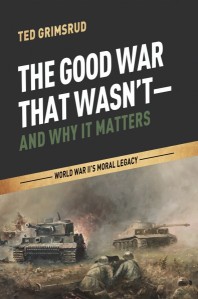
A New Book on World War II’s Moral Legacy

December 3, 2014—Ted Grimsrud

Cascade Books has just published my book, The Good War That Wasn’t—And Why It Matters: World War II’s Moral Legacy. Here is the home page for the book on my website, with links to other sites where it can be previewed and purchased.9781625641021

This book is, in essence, a pacifist’s attempt to answer the question, “what about Hitler?” or “what about World War II?” using the moral reasoning of the just war tradition and common American values.

How the book is unique, as far as I know, is that it not only interrogates the War itself, it also traces the impact of the War on American national security policy in the generations since—as well as looking closely as the story of the war opponents and their legacy. Continue reading “A New Book on World War II’s Moral Legacy” →

“Saving” the Joshua story? An anarchistic reading

Ted Grimsrud—November 13, 2014

One of the more challenging passages in the Bible is the story told in the book of Joshua. God’s chosen people enter the “promised land,” meet with opposition from the nations living there, and proceed—with God’s direction and often miraculous support—the kill or drive out the previous inhabitants. The book ends with a celebration that now the Hebrew people are in the Land, poised to live happily ever after.

Probably the most difficult aspect of the story to stomach is the explicit command that comes several times from God to the Hebrews to kill every man, woman, and child as part of the conquest. This element of the story is horrifying, even more so in light of the afterlife of this story where it has been used in later times to justify what are said to be parallel conquests—such as the conquest of Native Americans and nature southern Africans. So what do we do with it as pacifists? Or, really, even if for those who are not pacifists, how could any moral person want to confess belief in such a genocidal God?

The dismissal strategy

Probably the easiest response to the Joshua story is simply to dismiss it. To say, this is not part of our story. The God of conquest is not the God of Jesus Christ. One way to think of this is simply to say that the Bible here contains stories that cannot possibly have been true. We can’t know why these stories were included in the Bible, but we can know that we need to repudiate them—or at least agree to ignore them.

I hope some time in the not too distant future to reflect in more detail on this problem. There are various strategies to read Joshua in ways that don’t go to the total dismissal extreme but to in fact see some truths expressed there that may be appropriated for peace theology (this may be said to be the strategy taken by Mennonite scholars such as Millard Lind and John Howard Yoder). And there are other strategies, not necessarily with a peace theology agenda, for coming to terms with the story in ways that do not require its repudiation but still allow us to place our priority in reading the Bible on the message of Jesus.

For now, though, I simply want to reflect on a particular reading strategy I just thought of. To me, it’s quite different than the total dismissal strategy, though since I do not accept the historicity of this story, some might see it as pretty close to dismissal. I don’t actually feel much of a need to protect the Joshua story from dismissal—however, I still tend to want to see if we can find meaning in the story that at the least will help us put it in perspective and protect us from the uses that find in the story support for our violence. More than defending Joshua per se, I am interested in defending the larger biblical story of which it is a part—an essential story for faith-based peacemakers. Continue reading ““Saving” the Joshua story? An anarchistic reading” →