What would Jesus say about the Russians?

Ted Grimsrud—January 29, 2017

“What would Jesus say?” is a common questions Christians ask when they are in the midst of discerning what they themselves should say or do. For it to be a helpful question, I think we do better to think in terms of Jesus’s general moral outlook more than looking for specific verses to apply directly to our time.

I’m not sure I would say that people of good will (not only professing Christians) must ask this question—but I think it would almost always serve us well. And, clearly, if we draw from Jesus’s general moral outlook, we retain a large measure of responsibility to think and reason and act for ourselves. Jesus’s moral outlook gives us guidance but it does not give us a direct blueprint.

Currently, in the United States, we are badly in need of careful moral discernment. We are badly in deed of a moral outlook that gives us a stable set of moral convictions that will resist our tendency to look for guidance that justifies our own actions or simply allows us to condemn our enemies because they are our enemies. That is, we are in need of moral guidance that demands that whatever criteria for morality we use apply equally to ourselves as they do to our opponents.

It is risky right now to appeal to Jesus because so many people in power present themselves as “Christians” while acting and speaking in ways that are very much in tension with the actual life and teaching of Jesus. So, to evoke Jesus makes one vulnerable to be dismissed as simply another pious-sounding hypocrite. At the same time, appealing to Jesus’s actual moral outlook might provide a basis for challenging the approaches of self-professing Christians. That is what I hope to do with this blog post.

Continue reading “What would Jesus say about the Russians?”

Ten books for radical Christians: Faithful living in the Trump era, part 6

Ted Grimsrud—December 14, 2016

One of my responses shortly after Trump’s election was to think about a reading list of books I have found helpful as I seek to understand how my Christian faith might help me understand and respond to this new phase in American history. My thought in sharing this list is not that I am providing any definitive guidance. As with my previous post on helpful news sites, here I am also hoping to stimulate sharing. What is a book (or few) that you think would be helpful for these times?

This is a fairly random list. I thought about it just long enough to come up with ten titles I feel good about. In time, with more thought, I would formulate a much different list. My hope though, is simply to get some ideas out there. I am confident that each of these books is worth paying attention to. I don’t actually think they are the ten best or most important books. If we’re serious about understanding our situation, along with listening to each other, along with keeping up with the news and analysis, we will need to read more than ten books.

As a rule, these books are quite readable and written for educated non-specialists. A few are overtly theological; the others provide useful awareness of our setting where Christians are trying to live out our theology.

(1) Walter Wink. Engaging the Powers: Discernment and Resistance in an Age of Domination. Fortress Press, 1992.

This remarkable book still stands as a unique multi-disciplinary effort. A quarter of a century after its publication, it remains the best example of the fruitful combining of biblical theology, social analysis, and transformative activism I’ve ever seen. Wink writes out of a passion for nonviolent social transformation that he expressed through his own activism. He understands the social dynamics of the “domination system” within an America enslaved to the myth of “redemptive violence” (Wink coined both of these quoted terms in this book). Like precious few other thinkers, Wink combined a commitment to social transformation (and a profound structural analysis) with an awareness of the need for a vital personal spirituality. Though a long book, Engaging the Powers is quite readable, and it’s inspirational. It’s scholarly and practical at the same time.

(2) Walter Brueggemann. The Prophetic Imagination, 2nd ed. Fortress Press, 2001 [original edition 1978].

Brueggmann is a wonder, an extraordinarily prolific writer still going strong well into his ninth decade of life. Probably his main importance for this list is that like no other writer, he gives us message of the political radicalism of the Old Testament as a necessary resource for present-day Christians (and all other people of good will). Just about any of his books is worth reading for this message. I cite this older volume (the second edition adds little to the first) as a basic introduction to a prophetic reading of the Bible. One of his key insights (if a bit simplistic) is the distinction in biblical writing between the “prophetic consciousness” and the “royal consciousness.” The Bible itself contains a debate between these two viewpoints, though in the life and message of Jesus it ultimately sides decisively with the prophetic—a crucial insight to keep in mind in our day.

Continue reading “Ten books for radical Christians: Faithful living in the Trump era, part 6”

The book of Revelation on living in Empire: Christian faith in the Trump era, part 4

Ted Grimsrud—December 11, 2016

The book of Revelation does not have a positive reputation these days. For many Christians it is seen as hopelessly complicated and obscure. In my opinion, it is indeed the case that understanding Revelation is difficult. I have been studying it pretty intensively, off and on, for about 40 years now. I believe I have to a large degree figured Revelation out, and I am trying to find clear and accessible ways to explain what I have figured out. But it is not a quick and easy task (one place I presented my ideas was in my congregation, where I preached a series of sermons on Revelation—I summarized the main points in some blog posts; it took 18 to cover all the points I had to make, and I felt as if I only scratched the surface). Revelation does not fit on a bumper sticker!

Perhaps, though, part of what makes Revelation potentially very useful for peacemakers today is precisely its complexity. But even with that complexity, I think some of the useful insights we can gain from Revelation are not obscure or inaccessible. If we are to learn from Revelation about how better to live faithfully in our troubled times what might be some of the key lessons? I’m at work on a book-length commentary on Revelation that will focus on this question. Here are some summary points:

(1) Keeping the way of Jesus central

Revelation offers the Bible’s most extended and profound critique of the dynamics of empires and their effects on people of faith. This critique remains important. However, we should also remember that the central concerns for the book are the health and faithfulness of the communities of Jesus’s followers. John critiques Rome in order to help his Christian readers to “follow the Lamb wherever he goes” (14:4).

This ordering of priorities remains important. I don’t think the lesson is so much that we should focus only internally on the life of the institutional church while remaining indifferent toward our broader social situation. More so, I think the point for us is the reminder that in all areas of our lives, the way of Jesus remains our guide. We always run the risk of marginalizing that approach to life—sometimes with a preoccupation on the machinations of those “inside the beltway.” However, whatever healing is to come for our world and whatever the role of the “great nations” in that healing might be, the ultimate bases for healing remains always the message of Jesus—love God and love neighbor. And this way of healing has to be embodied in actual face-to-face relationships even as we also do what we can to further humane public policy on the macro level. This embodiment is why the congregations are so important to John. Continue reading “The book of Revelation on living in Empire: Christian faith in the Trump era, part 4”

A pragmatic case for voting Green

Ted Grimsrud—November 7, 2016

My post on Friday, “Why, in the end, I can’t vote for Hillary Clinton,” elicited quite a bit of discussion both here on the blog, on Facebook, and on the Mennonite World Review site where it was reblogged, as well as the MWR Facebook page.  I found most of the conversation to be discouraging. The Clinton supporters who responded, mostly personal friends, mostly Mennonites, mostly political progressives, mostly inclined toward pacifism, rarely if ever addressed the heart of my argument.

Problems with Clinton

My argument was not about Trump vs. Clinton but it was about the concerns posed by a potential Clinton presidency, most importantly (I suggest) in the areas of militarism and imperialism. I didn’t imply anything less than a deeply negative view of Trump. I stated that the question about voting for Clinton or not was for me a question that depended on being in a state where Clinton is almost certain to win (or, even more, in a state where Trump is certain to win)—not a truly contested state. Given that dynamic, I suggested that for me a vote for Jill Stein has the virtue of affirming a vision that actually affirms peace as a core commitment.

However, almost all of the negative comments turned it back to Clinton vs. Trump. There was hardly a hint that anyone is deeply troubled by Clinton’s warism—and interestingly, no one felt the need to challenge my assumptions about this warism. So, the basic sense is that yes, indeed, Clinton is committed to greater militarism and imperialism, but this is nothing to be worried about.

Now, my argument did rest on the premise that Clinton almost certainly would win Virginia. One of the ways I supported this premise was to point out that neither Trump nor Clinton was campaigning here, with the implication that both campaigns were accepting that Clinton would win Virginia. Well, since I wrote that, it turns out that Trump is coming here. As I said I would under those circumstance, I am reconsidering my vote. Continue reading “A pragmatic case for voting Green”

Why, in the end, I can’t vote for Hillary Clinton

Ted Grimsrud—November 4, 2016

Few of the people I know, even those who strongly supported Bernie Sanders in the primaries, are agonizing about their presidential vote next week. It is clear to just about everyone in my circles, it seems, that Donald Trump’s unacceptability as president could not be more clear. Hence, a vote for Clinton is a no-brainer.

Thinking in the context of the electoral college

I have been unsure, however. Not that I would imagine voting for Trump. Not that I don’t believe that Trump would be a complete disaster as president, a horror beyond imagining. But it seems important to me to recognize that our presidential election, given the undemocratic reality of the electoral college, is actually 50 different elections. As we learned in 2000, the winner of the national popular vote will not necessarily win the election.

So, the particular election I am voting in is the election that will determine the votes of Virginia’s members of the electoral college. This fact is important to keep in mind as I reflect on my struggle to discern how to cast my ballot. It is altogether possible that if we did go by the popular vote, I might decide to vote for Clinton—not so much as a vote for her as for a vote that would prevent Trump’s election (I made this kind of argument for voting for Obama in 2012—whereas in 2008 I happily [and naively] voted for Obama, believing at least a little in the hopey, changey stuff).

It is also altogether possible that if I lived in a state such as Ohio or Florida, where the outcome seems very much in doubt and whose electoral votes will be crucial to the outcome, I would vote for Clinton.

But those are irrelevant considerations for me as a resident of Virginia. In a stark contrast to 2000, when I voted for Ralph Nader because Virginia was in the bag for George Bush (meaning a vote for Albert Gore seemed like a wasted vote), now it seems as if Virginia is in the bag for Clinton. I am glad for this for two reasons—one is that I do want Trump to lose, the second is that I feel freer to think of my vote as one I can cast based on my ideals than simply a vote to prevent a worse evil happening. Continue reading “Why, in the end, I can’t vote for Hillary Clinton”

The Book of Revelation’s Revelation to Eastern Mennonite University

Ted Grimsrud—October 15, 2016

[This is a transcript of a talk presented to the Annual Haverim Breakfast during Eastern Mennonite University’s Homecoming Weekend, October 15, 2016. Haverim is a support group of friends of EMU’s Bible and Religion Department.]

I am glad to be here today to share with you. I well remember 20 years ago when I attended my first Haverim breakfast; it seems like yesterday. It’s hard to believe that now as I share this talk, it’s so many years later and I stand up here as a retiree.

My life with the book of Revelation

In a sense I am going full circle right now. My first book, published before I started teaching at EMU, was on the book of Revelation. Now, the first book I hope to publish after I have finished teaching at EMU will also be on Revelation. When I am done with it, maybe someone could read both books and tell my how my thinking has changed.

When I was asked to speak this morning, I faced a problem. What to talk about. Well, it’s like the joke. If you have a hammer in your hand, any problem looks like a nail. My version, if you have the book of Revelation on your mind, any problem of what to give a talk about looks like something related to Revelation.

Well, I chave found Revelation to be remarkably relevant for thinking about faith in our contemporary world—over and over again. I believe that much more strongly now than I even did when I was writing a book about it thirty some years ago.

I suppose I owe my career at least somewhat to Revelation. When I became a Christian as a teenager, I was taught what we might now call “Left Behind” theology—a strong emphasis on the End Times, on Jesus’s soon return, on the Rapture that will come before the Great Tribulation and allow we Christians to escape the carnage—and all proof-texted from Revelation. So, my initial impression was that Revelation was about the future and that the future predicted in Revelation is at hand. It was a book of war and judgment, death and destruction—with a joyful ending only for those whose personal savior is Jesus.

When my theology changed and I became a pacifist and learned that most Christians in fact did not believe in the Left Behind theology, I began to ignore Revelation. It ceased to be part of my usable Bible. But I was taught by some of my new pacifist mentors that all of the Bible, properly interpreted, is usable and can support pacifist convictions. I learned of Millard Lind’s work on the Old Testament and had my anxiety about that part of the Bible undermining pacifism alleviated. But no one said anything explicitly about Revelation supporting pacifism. Continue reading “The Book of Revelation’s Revelation to Eastern Mennonite University”

A simple way to world peace? Recognize America as “Beast”

Ted Grimsrud—September 19, 2016

I offer what follows as a thought experiment, an attempt to flesh out a recent late night rumination. I finished reading a fine book, Douglas Fry, Beyond War: The Human Potential for Peace. Fry, who is an anthropologist, seeks to refute the notion of “man as warrior” that assumes that human beings are innately hardwired to fight wars. Fry focuses on hunter-gatherer societies; he argues that some of these societies, presumably more revelatory of human nature, are not warriors.

I like Fry’s argument, though since I don’t know much about hunter-gatherer societies, I mostly have to take his word for it on the evidence he cites. But what he suggests fits well with other things I have read over the years. At the very end of the book he tries briefly to draw broader implications. Here he speaks of the need for a stronger, UN-type organization to help nations avoid warfare.

That suggestion made me think. It’s not that I necessarily disagree with that kind of approach—I’d like to see the peacemaking work of the UN be strengthened and more effective, as well as a stronger and more effective international law regime. But then I thought, surely the most powerful force that resists that kind of movement is the United States. If the US were committed to UN peacemaking work and international law, then we’d have a much more peaceable world. Continue reading “A simple way to world peace? Recognize America as “Beast””

Misconstruing the Trump Crisis

Ted Grimsrud—September 5, 2016

We are in the middle of what seems certain to be one of the worst presidential campaigns in United States’ history. We have the two candidates with the highest negativity ratings in the history of measuring that indicator.

Trump as disaster

And the thing is, the negative ratings for Donald Trump are not nearly as high as they should be. In this blog post, I take it for granted that Trump is a terrible person, remarkably unsuited to be president of the USA. He’s dishonest, narcissistic, mean-spirited, bigoted, ignorant, irreverent, thin-skinned, controlling, sexist, racist, and surrounded by yay-sayers. A disaster in every way; a world-class con-man in the words of Matt Taibbi.

Something else I take for granted in this post is that Hillary Clinton’s negative ratings are too high. She’s not nearly as bad as her public image would imply—at least in the sense that she has been for years and continues to be unfairly vilified, disrespected, slandered, and the like in large part due to her being a woman. At the least, she is vilified often for the wrong reasons.

So, Trump is a disaster who shouldn’t be the candidate of a major political party and as his party’s candidate should not be nearly as close to leading the race as he is. And Clinton is unfairly discriminated against because she is a woman.

And yet, the way the campaign seems to be unfolding is quite troubling for other reasons. As awful as Trump is, he is not the reincarnation of Hitler. There is debate among “experts” whether the invocation of Hitler in relation to Trump violates Godwin’s Law (the idea that internet debates, if they go on long enough, tend to end with references to one’s opponent being like Hitler—a move that in some settings leads to a declaration that in invoking Hitler, one loses the debate).

Regardless, one could argue that the Trump-is-like-Hitler references exaggerate both Trump’s power and his darkness. Trump actually differs from Hitler in crucial ways—maybe most significantly in having nothing even remotely like Hitler’s Nazi Party to implement his inhumane ideology, not to mention also having nothing even remotely like Hitler’s coherent, long-standing, and well-articulated ideology.

Continue reading “Misconstruing the Trump Crisis”

The missing peace in the Democratic Party convention

Ted Grimsrud—August 1, 2016

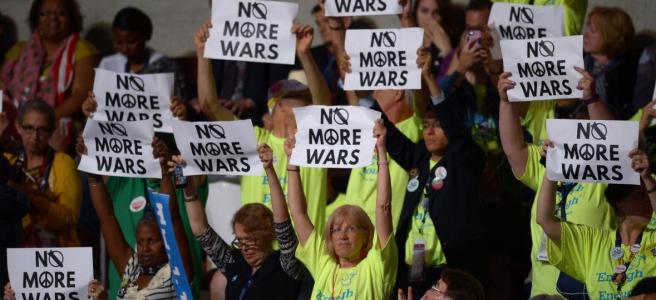
It seems that the recently concluded Democratic Party convention (DNC) was a success. Clearly, the convention was orchestrated to show a direct contrast with the Republican Party convention the previous week—highlighting diversity, care for the poor, positive hope for the nation, and the like. And unity. The threat of major disruption from supporters of Bernie Sanders proved to be minimal—beyond some random “no more war” chants that were ignored by the people in charge. Sanders helped with his explicit support for Clinton.

Sanders’s speech was a model in how he affirmed Clinton’s candidacy going forward while he also reemphasized the core themes of his campaign. He received a kind of affirming echo from Clinton in her speech, as she lifted up many Sandersian points. Surely, the success of his insurgency campaign pulled her in his direction—and one can fantasize that Sanders and many others will help keep her to her word on many of the issues: vs. harmful free trade agreements, for economic justice, for greater access to higher education, for an increased minimum wage, for criminal justice reform, challenging the big banks, et al.

However, there was something crucial missing from Sanders’s speech—and he perhaps lost the one opportunity possible at the convention to challenge the worst of Clinton’s politics. Sanders said nothing about opposition to war and militarism. And, so, the empire continues to hurtle toward brokenness—and to take all of us with it. There are many angles one could take in decrying this lack of opposition—I write as a Christian theologian. Though it was indeed remarkable how visible explicit Christian faith was at the DNC, I take little comfort in a phenomenon I normally might have welcomed. This Christian presence runs the danger of being just another baptism of empire, even if “kinder and gentler” (ironic allusion to George H.W. Bush intended) than previous baptisms, if it won’t lead to an explicit commitment to “no more war.” Continue reading “The missing peace in the Democratic Party convention”

The case for Bernie Sanders

Ted Grimsrud—May 27, 2016

Yesterday on Facebook, a friend of mine, Jessica Penner, raised a question to me in a conversation about our current presidential campaign:

Okay, let’s say Bernie gets the nomination and wins the election. HOW will he get done half (or even a quarter) of what he plans with a congress that won’t vet a Supreme Court justice for the sitting president, with a congress that stripped Obamacare to a shadow of what the sitting president envisioned, with a congress that works to get rid of what good Obamacare does (and hurt people like me–a person working full-time but without benefits who also has pesky pre-existing conditions) that our sitting president created. HOW WILL HE DO IT? NO ONE HAS ANSWERED THIS QUESTION. I told your grandson several months ago that Bernie has my heart, but Hillary has my head. Tell me how he will do it, and maybe Bernie might creep into my head.

I don’t have a quick and decisive answer to this challenge, but I think it is worth taking a little time to respond. For me, both my heart and my head tell me that Sanders is the best serious presidential candidate that we have had since Jesse Jackson and that if he were elected at the least his presidency would be way less destructive than a Clinton presidency. I’m not sure Sanders would be all that effective in terms of his agenda, but I am sure Clinton would be devastatingly worse.

I think our current system is failing at an ever faster speed. I don’t have much hope that a Sanders presidency would prevent a catastrophe. However, I do see a glimmer of hope; on the other hand, to me the main difference between a Clinton presidency and a Trump presidency would be about levels of despair. So, really, the case for Sanders has mostly to do with the case against Clinton. However, Sanders is long committed to a positive agenda that truly would bring about major changes and might turn the direction of the system around. Even if he has little chance of implementing much his agenda, if he were president there would be some chance. A Clinton presidency would at best push us just a bit more slowly down the slide into catastrophe than a Trump presidency.

Some specific themes:

(1) I don’t think it’s fair to imply that Sanders couldn’t get his agenda approved by a Republican Congress while Clinton could. We can completely agree that the current Congress is set up to foil any legislative initiative any Democratic president would pursue. This is not, in any sense that I can see, a point in Clinton’s favor. She would go into office with a much deeper and longer-established level of antipathy from Republicans than Sanders would, so it seems at least as likely that she would not be able to get her goals passed.

The difference I see would be more on the level of the things the president can accomplish in spite of Congress. It seems like Obama finally at the end of his time in office has decided to push his agenda more forcefully and to some positive effect (e.g., stronger environmental oversight, the opening to Cuba). I’m more confident of Sanders being assertive in this way than Clinton. Plus, even more, I’m more confident of Sanders appointing a Cabinet that would pursue more progressive policies—most obviously with his commitment to resisting the domination of Wall Street we have seen among many of Obama’s appointees (and likely Clinton appointees). Continue reading “The case for Bernie Sanders”