Ted Grimsrud—November 14, 2025
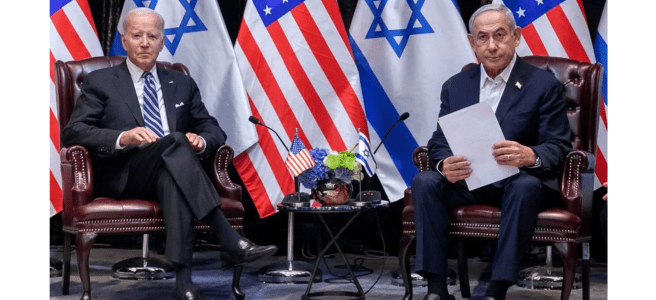
Along with the various pillars of the US national security state that were established during the 1940s (such as the building of the Pentagon, establishing the nuclear weapons program, and creating the CIA and the National Security Council), another key element of the American Empire that dates back to the 1940s is America’s close alliance with Israel. The “special relationship” of the US with Israel has been the 21st century’s definitive expression of the American Empire. No other nation has as regularly backed American foreign policies. Israel’s failure to resolve its persistent conflicts with the people it has shared Palestine with throughout its existence has had huge ramifications for the US and its moral standing in the world. The US actually played only a secondary role in Israel’s foundation and early history. It was after the Six Day War of 1967 that the alliance become close and nearly unconditional.
The emergence of Zionism
The Zionist movement originated in Eastern Europe in the 19th century. These early Zionists imagined ancient Israel’s territory as a Jewish homeland. Early in the 20th century, the Ottoman Empire dominated Palestine. European Zionists began to move to Palestine and hoped eventually to gain political control of the area. The Arab population largely tolerated those initial Zionist settlements. In time as it became clearer that the new settlers did not seek harmonious coexistence and in fact wanted to displace the original inhabitants, tensions inevitably followed.
The European Zionists sought a major power to align with. Eventually, the British became that power. The Zionist cause was helped by the presence in Britain of Christian Zionists in positions of power. The British wanted a foothold in Western Asia near the newly constructed Suez Canal. The Balfour Declaration of 1917 set British policy for the following decades. It affirmed British support for the creation of a “Jewish homeland” in Palestine. The Declaration alluded to respect for the rights of the native Arab population—but only in a general sense with no support for a state for Palestinians. In fact, the Palestinians remained nameless.
Britain gained direct control over territories in the region after World War I in hopes mainly to strengthen control over the newly established oil production sites. The new League of Nations gave the British a Mandate to govern Palestine, directing the British to prepare the territory for self-governance. Palestinian Arabs increasingly recognized the Zionist settlements’ threat to their interests. However, they found it difficult to unify politically. The British overseers encouraged the tensions among the various Palestinian factions.
The emerging great conflict
Tensions between the Zionists and Palestinians came to a head in 1936 with a full-scale revolt of the latter against the British rulers. This revolt had devastating consequences for the Palestinians. The British cracked down viciously, supported by Zionist militias. Thousands died and many more faced imprisonment and exile. After the 1936-37 revolt, Britain recognized the depths of the conflict among the Zionists and Palestinians. After years of disregard for Palestinians, they sought to accommodate the interests of both sides but gained little traction. Zionists wanted only a Jewish state with no power sharing with Palestinian Arabs. On the other side, the Arabs found themselves extremely disorganized and plagued by diverse intentions.
World War II distracted Britain from Palestine. The Zionists continued to organize and prepare for the opportunity to establish their state. At the war’s end, the British stated they would not continue to govern under the auspices of the Mandate when it ended in 1947. At that point, the Zionists declared Israel’s statehood. This led to war with many of the Arab states. Israel quickly won that war as the US, Britain, and newly formed United Nations stood aside. The Arab-Israeli war started in early 1948. The ability of the UN to intervene effectively required the strong support of the US. The Zionist lobby in the US had grown in strength, and it effectively pressured American President Harry Truman to affirm the establishment of Israel. Truman did so reluctantly as he personally supported a binational Palestinian state. However, he felt that it would be too politically costly for Democrats in an election year to resist the Zionists.
The special relationship
Truman faced two sets of American advocates. The Zionists constituted one set in support of Israel’s interests. The second set of advocates, less positive toward Israel, centered in the US State Department. They feared that Arabs in the region, if alienated by the US, would turn more readily toward the Soviet Union and jeopardize American access to oil. The US sought both to support Israel and to work with the oil-producing states. During the 1956 Suez Canal crisis, France and Britain invaded Egypt with Israel’s support after Egypt had nationalized the Suez Canal. The Americans opposed that action and forced France and Britain to withdraw. Israel thus recognized that it would need to stay on good terms with the Americans.
In the Six-Day War in June 1967, Israel crushed an Arab alliance and greatly expanded its territory to include an occupation of the Gaza Strip (until 1967 governed by Egypt) and the West Bank (until 1967 governed by Jordan). Occupation of these two territories, considered to be part of “greater Israel” by Zionists, would be temporary according to UN resolutions. However, Israel soon established settlements of permanent Zionist residents. In the decades to follow, the settlements grew until it became clear that Israel intended to annex these territories. Even more importantly, the 1967 war solidified the close relationship between the US and Israel. Israel became America’s most important ally in Western Asia and beyond. The Americans’ close relationship with Israel’s military could help retain their access to oil.
The US has since always supplied Israel with massive military aid. From the time of the rise of Zionist advocacy following World War I, immense political pressure has been brought to bear on US leaders to protect Israel’s interests. At the same time, contemporary Israel has closely supported American militarism and world domination. The influence, that is, does go both ways.
Israel’s on-going war against the Palestinians
From when Zionists first sought to establish a Jewish state in Palestine, they believed in the need to displace the indigenous inhabitants. Palestinians had few opportunities to create a self-determined political community. Out of the Palestinian struggle, several organized attempts to create possibilities for Palestinian self-determination emerged. In 1964, activists formed the Palestine Liberation Organization (PLO) to lead resistance to Israel. The PLO initiated guerilla activities such as plane hijackings. In the early 1980s, Israel attacked the PLO stronghold in Lebanon with overwhelming force. The attack drove the PLO leadership into exile, but the brutality of Israel’s attacks undermined the prestige of the Israeli project around the world.
The Labor Party (the “moderate” wing of Zionism) held power in Israel beginning in 1948. However, the more conservative Likud Party gained control of the government a few years before the Lebanon war. With the Lebanese invasions, Israel more openly emphasized its end game of domination, including expanding Zionist settlements in the West Bank and Gaza that made the Palestinian hope of an independent state impossible. Several meetings to discuss a “peace plan” between Israel and the PLO proved to be mostly fruitless. A Zionist extremist assassinated the main Israeli participant, Labor Prime Minister Yitzhak Rabin, in November 1995. With Rabin’s death, the Israeli commitment to total domination continued unhindered.
The Hamas alternative
The PLO leadership tended to be authoritarian and prone to self-enrichment. Hamas was established as an alternative in the late 1980s. It began as a Palestinian branch of the Muslim Brotherhood that focused on the religious message of Islam and on social services. The Israelis supported the Brotherhood as competition to the PLO and its successor, the Palestinian Authority. The Brotherhood, with Israeli support, created Hamas. Hamas became popular due to its effective work in addressing the practical needs of a vulnerable and suffering population. It also engaged in numerous violent acts of resistance against Israel.
Hamas, in 2001 led coordinated resistance to the occupation in Gaza and the West Bank. This Second Intifada followed an earlier mass uprising of 1987. When the US pushed for elections among Palestinians to elect a government, both Israel and the Americans encouraged Hamas to run a set of candidates. The Israelis hoped Hamas’s presence would weaken the power of Fatah, the most powerful party within the Palestinian Authority coalition. Hamas agreed, not with the intent of winning but more simply to establish their presence as part of the picture.
Hamas resounding 2006 victory shocked everyone (including Hamas). The Americans, Israelis, and Fatah all reneged on their agreement to respect the election’s outcome, ignoring international observers who judged the election to be fair. At this point, Hamas abandoned the guerrilla tactics they had earlier used and accepted, in practice, the legitimacy of the Israeli government. Israel refused to recognize the new Palestinian government. The US cut off aid to Gaza, and the Israelis withheld from the Hamas government the tax revenues they had collected on Hamas’s behalf. As well, the Israelis encouraged Fatah to refuse to accept the election’s outcome and in fact initiate a civil war to stop Hamas from taking power.
Israel intensified its aggression toward the Palestinians and essentially turned Gaza into what many called “an open-air prison.” Gazans faced periodic episodes of overt Israeli violence labeled “mowing the grass” that made Gaza almost uninhabitable for its residents. Meanwhile, politics in Israel moved more to the right with the collapse of the Labor Party. With only limited support from the Arab world, Hamas continued to resist the Israeli occupation.
October 7, 2023
In an October 7, 2023, surprise attack, Hamas forces captured hundreds of Israeli soldiers and other hostages, the most successful Palestinian action ever versus Israel. In the chaos of the attack, Hamas and Israeli soldiers killed over 1,000 Israelis. Israel then invaded Gaza, killing tens of thousands, mostly children and women. The Israelis obliterated the infrastructure of northern Gaza, focusing especially on hospitals and educational facilities. The US provided all the military supplies that Israel wanted to continue its onslaught. The Hamas-led resistance continued for many months. As Israel marched on, the likelihood seemed to increase that Israel engaged in a pre-planned effort to drive the Palestinians completely out of Gaza.
Violence escalated when Israel and the US attacked Iran in June 2025. A sneak attack surprised Iran in the middle of peace negotiations with the US. The Iranians, staggered by the attacks, managed to regain their footing and retaliate. After twelve days, with significant damage to both, Iran and Israel agreed to a ceasefire. Observers expected renewed fighting before long.
What of the American Empire?
The Hamas incursion and Israel’s disproportionate response signal a major change in the story of the American Empire and Israel. The world watched a genocide—directly underwritten by the Americans. The moral high ground of the US at the end of World War II was gone. The Empire’s support for Israel’s interests have inevitably significantly diminished the international reputation of the US and undermined American soft power around the world.
Section three of this series of posts has recounted the long American history of involvement in and support for unjust wars and interventions. Perhaps as never before, with the Israeli genocide, the meaning of this history has become visible to the wider world. Will this event signal the final end of the American Empire’s veneer of good intentions and support for social justice in the world? As the world watches these devastating events, will we see the massive disbelief in the validity of the American Empire that will be needed for the Empire’s demise finally to become manifest?
[This is the 22nd of a long series of blog posts, “A Christian pacifist in the American Empire” (this link takes you to the series homepage). The 21st post, “The Cold War redux and the demise of the American Empire,” may be found by clicking on this link. The 23rd post, “Conclusion: A Christian pacifist in the American Empire (part one)” may be found by clicking on this link.]

 Thinking Pacifism
One thought on “The fatal alliance: The US and Israel”