Ted Grimsrud—September 19, 2025
The connection between American Christianity and the preparing for and fighting wars has been long-standing. In this post, I will recount my own somewhat unusual path in navigating this connection. Growing up in the late 1950s and 1960s, I knew little of the wider world. The social and political currents I described in earlier posts certainly shaped the general sensibility of the world I grew up with. However, the impact on me was at most indirect. A key factor for me, in time, proved to be religious faith. Surprisingly, because my family had little religious involvement and my home community would have been considered largely irreligious. Yet….
On the margins of Christianity
I grew up on the margins of Christianity. In my small hometown, Elkton, Oregon, my family attended a tiny Methodist congregation until I was eight years old, when the congregation closed its doors. Our town hosted only one other congregation at that time, a community church. After our Methodist church closed, we would go to Sunday School at that church most weeks.
As a child, I was on my own in terms of faith convictions. I had a lot of curiosity and talked about religion with friends though I do not know why I was so interested. I don’t remember anything from my experience of going to church that ever piqued my interest. I didn’t get challenged by my parents to think about such things. I suspect I had a natural curiosity about the meaning of life and the religious dimension. My interest in God and the big issues intensified as I got older. I had a self-conscious perspective when I entered my teen years inclined to conclude that God did not exist. But it was an open question that I had a keen interest in.
The first move for me came during the Spring of my sophomore year in high school. A friend of mine died of cancer when he was in his twenties. His death left the community grief-stricken. During his funeral, I felt for the first time a strong sense of the presence of God. From then on, I no longer thought of myself as an atheist. About a year later, I started spending time with a somewhat older friend who had became active in a Baptist congregation that had recently started in town. My friend gently engaged me in conversations about faith. He mainly conveyed a general message of God’s love and a simple process to gain salvation. That process mainly involved the seeker praying to God a prayer of repentance for one’s sinfulness and of a desire to trust in Jesus Christ as the savior whose death on the cross opened the path to God’s forgiveness. Finally, one evening in June 1971, I offered the prayer my friend had described to me. I experienced this as a moment of genuine change.
Immersed with the Baptists
I began going to church with my friend. The Pastor played a more central role in teaching me Baptist theology than my friend did. I listened to his sermons and talked with him. I read books he recommended and listened to tapes of his teachers. I oriented my beliefs around those convictions. I remember four key ideas: (1) We are fundamentally sinners, alienated from an all-powerful, punitive God. (2) Our world rebels against God who justly dooms it to be destroyed. We may escape this judgment when we trust in Jesus as our savior. (3) God’s final judgment will come at any moment when Jesus returns. Only those who trust in Jesus will be safe from this judgment. (4) We have the task as Christians to evangelize, to take every opportunity we have to tell as many people as we can about this coming judgment and God’s only path to salvation.
This theological package placed at the center belief in Jesus’s death on the cross as a sacrifice for our sins. God wanted us to be saved but not as long as we remained unrepentant. God’s holiness would not allow that. God required payment to pay the price of our sins. The only adequate payment involved Jesus’s death as a sacrifice to God. No one actually explained these points. They simply made up a package that we took on faith. We could not say how this process worked. At the heart of this take on Christianity we find harshness—God’s negative disposition, the certainty of judgment and punishment, and the need for an act of supreme violence against the innocent Jesus to set things right. Though framed in the context of God’s love, this theology actually had the effect for many people (including me) of facilitating a lot of fear and insecurity. With a God this judgmental and punitive, how can we ever be safe and secure?
This theology fit with our culture’s belief in the myth of redemptive violence—to resolve problems, to find security, violent acts must be done. Such a myth served support for warism. The need for redemptive violence has its origins with God and reflects how God works with the world. This theology fit well with the idea of the waring state as an agent of God’s judgment in the world—especially our American state so clearly affirmed by God.
The messages in my congregation had no sense that Jesus embodied the way of peace on earth. We did not learn that Jesus’s followers in the world should be in favor of peace. We knew Jesus as our personal savior who most importantly lived a perfect life so he could be an adequate sacrifice. As such, he made it possible for us to go to heaven. That mattered most. We did not expect his message to be a guide to how we thought of war and peace in our current lives.
We felt no tension between the message of Jesus and the message our nation gave us about the necessity and even goodness of our nation’s wars. Church provided strong affirmations of God’s approval of our wars and our need to support those wars—specifically, at that time, the war in Vietnam. Mixed with this warist patriotism I heard constant allusions to the soon to come Battle of Armageddon where the Antichrist would support America’s current enemies.
I learned that Oregon’s US Senator Mark Hatfield, known to be an outspoken opponent of the Vietnam War, identified as a Christian—and not only a Christian but a Baptist. That discovery shook me and as soon as I could talked with Pastor about it. How can Hatfield be a genuine Christian while opposing this war? I’ve wondered about this, too, Pastor said. While we couldn’t say for sure that Hatfield was not a Christian, we certainly had our doubts.
My blank check nationalism gave a benefit of the doubt in favor of America’s wars. As a product of embedded theology, this view did not consider the arguments that antiwar activists made and test those arguments with the evidence concerning American warism. The blank check has little to do with evidence but grows because it helps its believers to avoid considering evidence. Rather than think about what antiwar activists said, I dismissed them based on how they looked, the tone they set, and—mostly—just my assumption that they could not be right.
Fundamentalism and warism
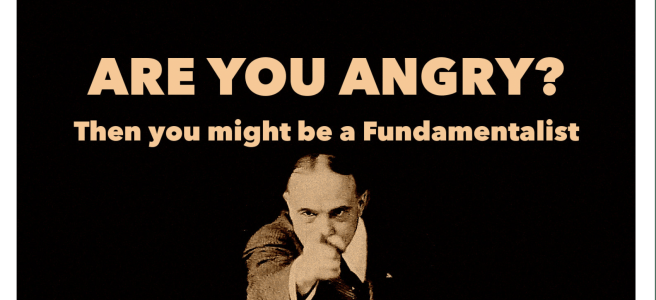
Fundamentalist Christians have long been strong supporters of American warism. Some of the strongest support for the Confederacy in the lead up to and prosecution of the Civil War in the mid-19th century came from conservative Christians. The term “fundamentalist” did not come into use until the turn of the 20th century, but we may discern a direct line from those 19th century Confederate Christians to many of the later fundamentalists. The legacy of the Civil War in the former Confederacy included a continuation of the strong militarism that characterized the South from colonial times. This militarism linked closely with Christian beliefs and practices. My Baptist congregation did not have overt connections with the South. But its denomination had deep roots in southern culture. It had been started in Texas, had its Bible college in southern Missouri, and its best-known pastor and church were in Virginia (Jerry Falwell).
My surroundings conditioned me enough toward warism that I would not have been put off by how I was pushed to be prowar in my church. My mild inclination toward a peaceable sensibility in life fell aside when I became a Christian. My newfound faith made me more warist. My willingness to be drafted followed from the embedded theology of my early years. But the Christianity I became immersed in made me more willing to go.
I believed what the church told me, that faithful Christians should affirm war and patriotism. I might have been inclined to question the Vietnam War and militarism by my disposition, but I repressed those inclinations for quite some time. Plus, I simply did not know of anyone who did dissent from what I was taught in church. So, when it came time to register for the draft after my 18th birthday, I did so with pride. I expected when I registered that I might end up in Vietnam. I did not much like that idea, but I accepted the possibility. I felt no attraction to being a soldier, but I had no doubts about doing so if drafted.
The next step: Heading to college
Everyone expected that I would leave home and go to college when I finished high school. I followed in my three older sisters’ footsteps by attending Oregon College of Education in Monmouth. For me, it would be similar to attending a community college. I intended to take general requirements and get my feet wet in college for my first two years. Then I would move on to a much larger university for my journalism major.
The student body consisted predominantly of students from small towns from throughout the state of Oregon—people a lot like me. My best friends came from those I would play basketball, talk about sports, watch games with. Underneath the pleasantness of playing sports and hanging out with my new friends, though, I struggled a bit inside. I found it difficult for me to be a Christian in that environment. OCE reflected the general milieu in Oregon of not being church-oriented. It did not help that I thought of Christianity as mainly about personal salvation and evangelism. I did not see it as connected with my intellect. The Christianity I had embraced left some of the most important elements of my life untouched. It had little to say about the new world of intellectual endeavor I had entered when I started college. I felt uncomfortable with the main task I had been given as a Christian, engaging in personal evangelism with people who did not seem to be interested. I viewed Christianity as important in my life, but it actually had little to contribute to the main focus of my life for the next four years, completing my college education. So, I felt uneasy.
As I came to the end of my second year of college, I remained discouraged about not feeling like I was as faithful a Christian as I should be. I enjoyed being with friends. My commitment to purity kept me from some of the typical indulgences of new college students. Academically, I mostly treaded water. I took the classes needed for my course of study. I liked most of them but felt pretty directionless. Nothing about my Christian faith, important as it was to me, offered any direction about what I should study.
Two things happened my second year of college that had an impact on my future thinking about war and peace. First, the Nixon administration chose to end the draft. I had registered and even been given a lottery number that would have determined the likelihood of whether I would actually be drafted. I was somewhat anxious and felt relief when the whole thing ended. Given my willingness to go at the time, I now believe that the end of the draft allowed me to dodge a bullet, as it were. This brush with possible military service did have a longer-term effect on me, as I will discuss in future posts. Second, I encountered veterans returning from the war. These vets, many fairly traumatized and alienated, provided a window into the experience of going to war that I had not known about before. Probably, this new awareness was the first main challenge to my embedded theology of blank check nationalism. It challenged me pretty deeply.
[This is the sixth of a long series of blog posts, “A Christian pacifist in the American Empire” (this link takes you to the series homepage). The fifth post in the series, “Resistance to the American Empire,” may be found by clicking on this link. The seventh post, “Competing embedded theologies,” may be found by clicking on this link.]

 Thinking Pacifism
Although dad was pastor of our Mennonite Church they had problems getting teachers for my Sunday School class because I asked too many questions. I still ask questions. I’ve been impressed by the book “Jesus Changes Everything” by Stanley Hauerwas after writing carefully about Jesus calls for disciple ship in the kingdom of God seen in Matthew 5-7 he finishes with Chapters about protestests and approach to influencing the nation not by converting the government to be “christian”, but by the church really living what Jesus calls us to, living a life together really practicing love for each other and and for those in need in our nation, always commited to love not the sword that Jesus told Peter to put away to not violenty try to defend Jesus from the cross.
Although dad was pastor of our Mennonite Church they had problems getting teachers for my Sunday School class because I asked too many questions. I still ask questions. I’ve been impressed by the book “Jesus Changes Everything” by Stanley Hauerwas after writing carefully about Jesus calls for disciple ship in the kingdom of God seen in Matthew 5-7 he finishes with Chapters about protestests and approach to influencing the nation not by converting the government to be “christian”, but by the church really living what Jesus calls us to, living a life together really practicing love for each other and and for those in need in our nation, always commited to love not the sword that Jesus told Peter to put away to not violenty try to defend Jesus from the cross.