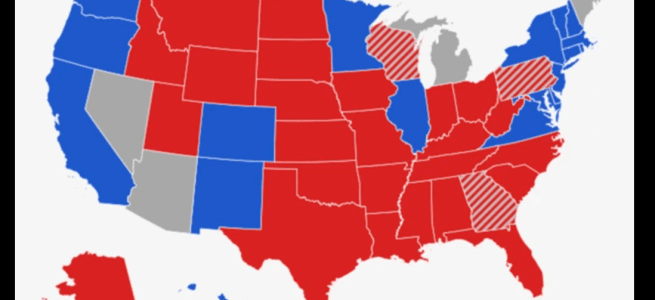
November 6, 2024
I have spent a few hours this morning reading analyses of the election. Hardly anything seems insightful to me. I am discouraged that some commentators I have appreciated for their critiques of American interventions in Ukraine and Israel/Palestine are happy about Trump’s win and seem to think Trump might move things in a different, more peaceful direction—I think there is exactly zero chance of that, though it is also hard to see how he can make things worse in that realm than they have been these past four years. I doubt anyone who was positive about Biden/Harris could hope to have much insightful analysis now—though I will keep looking.
I did find one piece that rang true to me. It is written by someone named Arun Gupta, previously unknown to me.
***********************************
From Arun Gupta, “Harris lost because of Gas, Groceries, and Gaza. But the underlying reason was Ukraine”:
Under Biden-Harris, staggering sums have been spent on the war. Congress has officially approved $175 billion, but I suspect it’s significantly higher given all sorts of other aid and weapons transfers not included in these bills. There are also huge amounts of aid to Taiwan and Israel.
The wars and overseas aid hurt Harris in many different ways, and she avoided them because she is the candidate of war and Wall Street.
1) Many people react viscerally to conflict overseas. They fear it could draw in American troops or result in domestic terrorism. It doesn’t matter if it’s true or not, many people believe it. No one likes war, not even Americans.
2) Most Americans are suffering from inflation, high grocery, gas, and housing costs. People are angry that hundreds of billions of dollars are going overseas while they are being squeezed. They think they are losing economically and foreign nations are benefiting from their tax dollars.
3) There is also rage about Gaza, Palestine, and Lebanon. Millions of voters, whether out of personal ties or principles, refused to vote for the party of genocide. I have been saying for months, “The Democrats care more about genocide than democracy, freedom, abortion, trans rights, climate change, healthcare, you name it.”
The most important effect of war is one almost no one realizes. After Russia invaded Ukraine, the U.S. imposed comprehensive sanctions. Biden officials crowed about imposing the toughest sanctions ever, or at least since the 1930s U.S. sanctions on Imperial Japan. The sanctions immediately caused a spike in commodity prices in early 2022.
Inflation was running hot in 2021 coming out of the pandemic, but sanctions added fuel to the fire. The sanctions hit Russia and Belarus, which are major producers of natural gas, crude oil, grains, and fertilizer. Plus Ukraine, a major grain and seed oil producer, was impacted by Putin’s criminal invasion. The sanctions failed. But they caused price spikes that led to skyrocketing gas and grocery prices in the U.S. On top of that, the Houthis have disrupted $1 trillion in commercial trade in attacks on cargo ships in solidarity with Gaza. This further disrupted supply chains and added to inflationary pressures.
Inflation hit nearly 10 percent in 2022, leading the Fed to raise interest rates, to engage in “demand destruction,” that is, reducing the wages of workers. That led to increases in mortgage payments and car loans, which hurt many consumers.
The incumbent party always gets the blame for high inflation, and Biden-Harris are tools of the ruling class. Biden was so cozy with the banking industry he was derided as “The senator from MBNA.” As soon as gas and grocery prices started to rise Biden and Harris should have attacked corporations for price-gouging. Biden should have directed the Justice Department, the Federal Trade Commission, the Commerce Department to go after food and grocery companies ripping off consumers. He should have attacked the Fed, just like Trump did. But Biden and Harris are such weak-willed creatures of a bankrupt system they were incapable of flexing Bernie-like populist muscles or understanding we live in a post-Trump political world.
Instead Harris enlisted the support of billionaire bankers, billionaire Hollywood moguls, and billionaire tech companies. She campaigned with billionaire celebrities, doubled down on war and genocide, embraced Biden instead of saying she was going to turn the page. Most important she did not provide credible and simple solutions for the economic woes afflicting most Americans. I wouldn’t be surprised if campaigning with Beyonce, Oprah, and the Boss turned off many Americans who were looking for a few more bucks in their pockets and not star power.
Even more appalling, Harris welcomed Dick and Liz Cheney into the fold. I was in Madison Square Garden during Trump’s full-house rally on Oct. 27. Trump and other speakers had a field day ridiculing Harris for joining forces with the architect of the disastrous Iraq War (far more for Iraqis of course). It’s an open question of whether Democrats are that dumb or incompetent to think they could win over a significant number of Republican women from what is a full-blown cult.
It’s the same disastrous strategy Clinton pulled in 2016. “For every blue-collar Democrat we lose in western Pennsylvania, we will pick up two moderate Republicans in the suburbs in Philadelphia,” Chuck Schumer proclaimed in 2016. Wrong.

 Thinking Pacifism
Though I think I agree with you quite fully on things political, economic, and theological, and I too did not think highly of the Harris/Democratic Party positions, I do wonder if you have sufficiently examined your words here for an “I told you so” vibe, even though I suspect and hope that was not your intent. Tough day for us all. God’s peace to you, and to the USA and world.
Thanks for posting a few of your thoughts and sharing the Gupta article.
To me, the most important thing implied in it (unfortunately, not directly stated, nor “pumped”) is that we cannot (!) expect the cycle of putting in one party’s candidate or control of congress, or the other party’s, to end or be improved unless we make both mental and structural changes. Part of that, of course, is education, community building, organizing, etc.
I wish Gupta had taken that additional step, IF he/she (I don’t know author’s gender) has any knowledge of or commitment to actual change processes. Possible they do. (And it seemed you were sharing the entire article.)
If you or others know of the author’s wider work including solutions, please let me know. I actively AM building allies (though I’m not a prominent activist or theorist myself). It’s relatively easy to analyze and come up with a critique like this article, and much harder to both lay out and ACT UPON ways of creating change… not just pushing the swinging duopoly pendulum back the other way.
Actually, Howard, what I shared was only part of the article. The title of the article in my post links to the entire article.
Thanks, Ted. I’ll go look at it.
I heard Gupta speak eight years ago at Oregon State University (blurb below). (Howard, he identified as male at that time, fyi.) I remember being impressed. He’s been back on campus at least once since then. The article Ted shares fits what I remember hearing from him.
Between Sanders and Trump: Paths for the Left Beyond Electoral Politics: Political journalist Arun Gupta discusses this historic Presidential campaign (note: 2016) and what it means for the future of progressive social movements in the United States. Gupta is a founding editor of the Indypendent magazine and was a founding editor of the Occupy Wall Street Journal. Tuesday, Feb. 23 at 7 p.m. in the Memorial Union, 208: La Raza Room.
Thanks, Dave.
Thanks, Dave. Good additional information.
I appreciate your insights, Ted. As we have discussed previously (4 years ago?), most elections are binary under our current 2-party system. My view is to vote for the lesser of 2 evils.
In my mind, there has never been and never will be a “perfect” candidate for President of the United States. I don’t see how a pacifist could agree to serve as Commander in Chief of the US armed forces, and take an oath to protect the United States and the Constitution.
I think the issues you mentioned as hurting Harris are correct, and there may be other issues as well. But that doesn’t mean I understand them. Just like you, my first election was 1972. I went door-to-door in Kansas City for McGovern, and he got absolutely tsunami’d by Nixon. McGovern was a WW2 vet advocating for an end to the Vietnam War, a deadlier conflict for the US than all of the various wars since then combined, and voters weren’t having it.
No rational person favors genocide. My belief is that the genocide in Gaza will not be stopped by Trump, nor will he stop shipping arms to Netanyahu, and in fact the situation for Gaza and Palestinians generally will continue to deteriorate after Jan. 20. I hope I am wrong.
I also don’t believe Trump will steer the US away from our country’s warism, or shut down any part of the vast military-industrial complex that feeds it. Again, I hope I am wrong.
Thanks for initiating this discussion.
Kurt
I hope you are wrong, too, Kurt. But I am almost sure that you are not. 😞
Thanks for these realistic thoughts, Kurt.
A key question I have that is broader than the upcoming administration, particularly the executive branch, is this:
What do you, Kurt, Ted, and others think is the best way to resist (or support those resisting) Russia’s militarism and what I’d call imperialism? (That may not be the best possible label, but I’m referring to not only Ukraine, but how they HAVE or seem to be intending to treat Georgia, some of the “Stan” countries, Moldova, Belarus, the Baltics, and perhaps more.)
Are any form of sanctions not appropriate? Is they’re not, are there any national policies that are legitimate ways of trying to support smaller, vulnerable nations in relation to Russian aggression?
(I’m also presuming that merely backing off of any further NATO expansion or added defensive measures on IT’S own soil would NOT do much to change Russia’s posture or behavior… and realize i could be wrong on that, but think the evidence supports the case of at least serious doubt.)
Howard, I would challenge several of the premises that are implied in your question.
(1) That what is going on is predominantly Russian aggression and imperialism. Without affirming Russia’s actions, I do believe that their general orientation has to do with their sense of being under “existential threat” by the US/NATO. This is the term used by John Mearsheimer of the University of Chicago who (along with Jeffrey Sachs) is by far the most reasonable and wise commentator from the American mainstream. I believe that the acceleration of the conflict between Russia and Ukraine would have been avoided had the US/NATO been willing to enter serious negotiations in the months before Feb. 2022. But it was because of the aggressive and imperialistic intentions of the US/NATO that Russia was provoked to accelerate the conflict—with the idea on the part of US/NATO that an accelerated conflict would lead to devastating consequences for Russia. Not only were the US/NATO leaders acting deceptively and immorally at the time, as it turns out they were incredibly stupid since the consequences since 2022 have much favored Russia over US/NATO.
(2) That the way to deal with conflicts such as the Russia/Ukraine conflict and other conflicts with Russia (and China and Iran) is through “resistance” and “sanctions”—i.e., coercion, even supporting military conflict. Even if successful, such resistance and sanctions still leaves us with implacable enemies who likely will not accept their fate. Of course, US/NATO resistance and sanctions are rarely successful and certainly have not been in the case of Russia/Ukraine. The terrible irony is that throughout the past 30 years (and, maybe most of all, over the past three years), the Russians have been very willing to use diplomatic means to seek to achieve their clearly stated interest of ending the eastward expansion of NATO and other factors that made them feel (accurately, I believe) that they were under threat by the US/NATO forces that have been part of the American imperial agenda seeking to achieve a genuinely unipolar world. One of the remarkable elements of the current conflict has been the US/NATO refusal even to attempt diplomatic processes to prevent or end the war. Most notoriously, Ukraine and Russia engaged in serious negotiations in the Spring of 2022 that achieved a tentative resolution before being scuttled by the US/NATO leaders.
(3) That the US may be seen as a force for good and capable of legitimately providing resistance and sanctions that might serve genuine peace in the world. The history of the post World War II is, in a nutshell, the history of US “aggression” and “militarism” that continues unabated—even as we may be nearing or already in a new era where American military might is losing its ability to shape world affairs (as seen in the deep trouble both Ukraine and Israel are in despite having at their disposal so many American resources). Just based on the history of the 21st century (thinking most obviously of American intervention in Iraq and Afghanistan) to imagine that US/NATO military and political leaders can be trusted to tell the truth seems pretty foolish.
For you to state that you think that to back off on NATO expansion would be unlikely to have an effect on “Russia’s posture and behavior” indicates to me that we may not have much hope of communicating successfully with each other. I am convinced (again, drawing on Mearsheimer and Sachs, as well as Aaron Maté) that that is precisely the step that would provide hope for a settlement. If US/NATO had allowed Ukraine to do that in the Spring of 2022 as had been agreed in the Russian/Ukrainian negotiations, hundreds of thousands of lives would have been saved as well as Ukrainian territorial integrity. By now, it is largely an academic issue. The facts on the ground (i.e., the inevitable smashing Russian victory) make it impossible to imagine Ukraine any more having any bargaining chips other than surrender.
Thanks for your responses, Howard and Ted. I know Ted is – and it appears you are as well, Howard – much more of a thoughtful and insightful person than I. And Ted certainly is much more of a Biblical scholar as well.
I can say that as a pacifist, I am opposed to opposing Russia’s aggression militarily, including providing Ukraine with the weapons of war. And in my view, sanctions ultimately are not effective, as end up hurting the common people, not the oligarchs or others in charge, who will obtain what they need through other channels. And given the common people’s limited ability to change anything, I don’t see them being able to overthrow the oligarchs’ tyranny regardless of how motivated they might be to do so.
I agree that the US supplying weapons to Israel without enforcing any restrictions is contributing to the genocide of the Palestinians. But the Zionists, AIPAC, and other Pro-Israel Americans, not to mention the US’s ever-increasing military-industrial complex, make it difficult politically to shut off the spigot of weapons to Israel. And frankly, had Harris announced during the campaign that she would restrict the arms provided to Israel if elected, it only would have added to Trump’s vote total.
I believe Jesus calls us to engage with the world, to speak truth to power, and to call attention to all injustice in the world. An example in my mind was the Menno Action protest for a Gaza/Israel ceasefire in the Cannon House Office Building last January. Jesus does NOT call us to advocate violence against anyone or any country, including by the US government.
Kurt
Ted, thanks for the detailed rejoinder. Much appreciated. I don’t know if it comes across, but I’m trying, in limited time available, to be as informed in my positions in all areas of my particular interest or judgment as highly important. That includes key elements of public policy and international relations policy.
I also share many of your perceptions and certainly your end goals, so I’m trying to join you (and others like you, especially Kathleen) wherever possible. But, as a “wannabe” logician (or careful analyst), I try to follow key principles, knowing that I’m not the grand exception to tendencies like confirmation bias or self-serving bias or “group think”, etc. I’ll spare further details on that all.
What I’m leading up to is to update you that I’ve listened to a good portion of a podcast by John Mearscheimer, and read a detailed New Yorker article interview with him. I wast to pursue more later, so too soon to pass judgment on what I’m hearing (on Ukraine specifically). But it IS good to hear someone who appears well informed and objective… so far I’d not found such a person. People like Scott Ritter, while often sounding well informed and certain, has proven to me he is NOT at all objective (or wise), any longer anyway…. And that is considering I respected his proven-true attempts to expose lies/bad analysis in regards to the Iraq War. I’d appreciated that effort, noting that most media figures were highly critical of him back then, in a way that I was not.
Just one thing to note for now: it was easy to miss, but an important inclusion in the Gupta article (which I went and read in entirety) is his statement “… impacted by Putin’s criminal invasion” (2nd para. below #3 in his list). So far, I’ve not heard Mearsheim use “criminal” or similar descriptors for the 2022 expanded/major invasion of Ukraine, but I’m still listening, looking for further evidence… so far seeming to be legitimately debated points, nothing very concrete or “aha”…. That is, evidence for what he’s claiming. I’m also seeking to gain broad enough context to either confirm or disconfirm my contention that the invasion WAS indeed criminal and unjustifiable, as likely was its beginning in 2014. (This, obviously, has implications for how to regard attempts for a cessation/settlement, and its aftermath.)
And all that is important to be as clear about and undisputed as possible, regardless whether or not we’d crossed Putin’s or Russia’s (more broadly) red lines re. NATO expansion, etc. If so, that may have been unwise or even ethically or strategically wrong for NATO/USA. But did such potential missteps by the US/NATO constitute breaking of treaties or international law, as did Russia’s actions, clearly to me? (I’ve heard Mearscheimer discussing the Minsk accord and I’m looking some into that, seeking to grasp that aspect as part of answering such questions as just stated.)
I have some further thoughts but need to get these off and hope to get to those later.
I think, Howard, that the main issue here is that you are trying to offer a moral evaluation of Russian actions, and I am concerned with a moral evaluation of American actions. Regardless of whether Russians acceleration of the conflict with Ukraine beginning in February 2022 was “criminal and unjustifiable,” the United States has no basis whatsoever to be the enforcer in resisting Russian actions. The US has been and continues to be many times more criminal and the perpetrator of many times more unjustifiable interventions.
I’m not interesting in an argument about what Russia has done and is doing. I am interested in discussing my own country’s actions and policies. I believe US actions set the context for February 2022—which could have been avoided of the US had wanted that. The main results of the US choices have been hundreds of thousands of Ukrainian people killed and billions of dollars poured into the pockets of war profiteers.
It seems to me that the American underwriting of the genocide in Gaza should end any question about our moral standing. Perhaps many people could have been fooled into thinking our engagement in the Russia/Ukraine conflict occupied some kind of moral high ground because the Russians could be portrayed as the bad guys. However, our supplying the means for the massacring of tens of thousands of Palestinian children and destroying most of Gaza’s hospitals and schools should open the blinders to make it more clear that our involvement in Ukraine is also about death and imperialism, not “democracy” or “Ukrainian self-determination.”
I had tried to post this over 24 hours ago, and thought it went through. But I’m not seeing it anywhere, and something… perhaps a length limit I’ve encountered before… has derailed it. Therefore, I’ll break the long comment into at least 2 parts.
And since it IS lengthy, I’ll give a quick summary first…
Ted, I understand and respect the approach of a sole focus on US actions (or lack of) and attitudes. What I was getting at below is that I believe at LEAST the officials involved in our foreign policy, ambassadorial relations, and such, HAVE to understand other nations, especially ones in strong competition and potential conflict with us or with other nations. By extension, any of us who want to play a prophetic role or even vote intelligently, must inform ourselves in some of the same ways said officials become informed, though at a less-detailed level, of necessity.
I’m definitely in agreement about US imperialism and militarism/weapons profiteering, etc., needing to be ended. But I’m also invested in what I believe is necessary to get us there, or even make progress in that direction. This requires, among other things, a deep and as-accurate-as-possible understanding of a very complex “chess board”. We (any 2 or more people) will inevitably differ some on who “started” something, or who escalated it, and how/why. So I will acknowledge the much greater knowledge you have than I do, Ted, and probably many others, like commenters here and other non-officials or non-specialists. But I’m finding it hard to get information or direction that backs up certain contentions that are important, with evidences of any if various kinds. Similarly, I’m not so far finding a laid-out philosophy or set of “operating principles” for guiding either a proper US role in nation-to-nation conflicts, or a case for complete non-engagement.
So, hopefully, that connects reasonably to what follows as the previously composed comment that I hope will post in two parts:
What you say about the US immoral actions and profiteering motives (whether that is primary or more a “nice” side-benefit, I’m not sure, but it does play in heavily) I did understand is your focus. I also realize that the “blame game” as to the reason a given tension/conflict becomes a war can go on endlessly and pointlessly. In fact, I’d been noting the parallels between the expression of the Mearsheimer/”conventional view” conflict and my experiences as a marriage counselor…. You can easily conclude (wrongly) that one party or the other is the instigator and ongoing offender, until you also hear from the other… and then get another clear reminder that it almost always “takes two to tango”. (Setting aside the cases of actual spousal abuse, which, thankfully, I rarely had to deal with.)
So yes, I’m with you on not spending much time on anything other than what WE, in the US, can potentially impact, as it’s at least somewhat in ALL of our control … our own national policies and actions. And even if we were/are not at all to blame, as unnecessarily provoking Russia into a war that they may genuinely see as self-defense vs. expansion or “conquest” (though Mearsheimer or others have not been convincing on this point), your point on Gaza is well taken. (And I realized that point all along in this discussion.) Gaza or other examples indicate our complicity, at least, in incredible unnecessary carnage there. So there are clearly things deeply amiss.
I’ll remind you, and not as “beating a dead horse” (though one perhaps close to death, unfortunately) that I see the actions climaxing on 9-11-2001 as a critical inflection point to greatly accelerate the complicity of most Americans in a massive increase in the military-industrial complex (profit and control motive) and overseas militarism. As a practical strategic/tactical matter, I do not think it is too late to yet have SOME shot at exposing both “things” done and WHO was involved in them, with accountability! Even now, 23 years later. But the window is closing, for sure. The 9-11 case is also one that shows, perhaps clearer than anything else, how our media, “right”, “left” and “center”, can be and is controlled.
If real progress were to be made in truth coming out with broad publicity on this, I believe it would far, far surpass the impact we can make with other approaches and on other issues, as important as they are currently, and need to be worked on. I certainly could be wrong, as 23 years back is a long time for people a lot younger than I.
So to conclude re. some of what I’m still concerned about in the “counter narrative” on Ukraine (and yes, as important in a way I’ll explain, although Gaza makes very clear the larger underlying problem)… Two main aspects:
First, that folks like Mearsheimer seriously weaken their argument as to what the US did, illegitimately (although his own focus seems to be strategic error, not what was either legally or morally wrong). It is hard NOT to fall into it, but to me, he weakens his case by not giving a “both perspectives” assessment. He mainly seems (perhaps not everywhere… my glance was just that) to explain how/why Russia was viewing NATO buildup, etc., and very little, if any, suspecting Putin/Russia of any guilt or even skewing of perspective as to what is actual “existential threat”. The implication seems to be that NATO was/is indeed a genuine threat in terms of not just a westward/European pull on Ukraine that would affect Russia perhaps both culturally and economically, but a valid threat toward invasion or as to Russia’s sovereignty. (Again a potential time waster would be my looking deeper into his claims on things like breaking of the Minsk Accord, again complex like a marital squabble… and even prior, the matter of the Budapest Memorandum of 1994 re. disposition of nuclear weapons in Ukraine, Belarus and Kazakhstan, in which he says he advised against Ukraine giving up their nuclear weapons.)
I don’t know if Mearsheimer is representing your views on the above, Ted. But I happen to believe, I think with adequate evidence, that NATO nations do not pose an actual sovereignty threat, and that, imperialistic as the US has been, its (our major officials in both parties) desire is an in-check Russia (not invading its neighbors, at the least), not one that cannot function and continue as a prosperous national state.
Second, and related to the US-only focus you mention, which I basically agree with, is that we cannot properly assess where our aims and actions are indeed imperialist or aggressive if we pay little or no attention to the aims of our competitors or opponents. I don’t think it is ultimately helpful or evidence-based to assume they (at least Russia and China) are much differently motivated than we are! (Pox on all our houses, not just the US, for reasons below.)
It is impossible for me to project out and predict what would be the results in world peace, in human prosperity overall, etc., if the US were to cease all support of other nations militarily, along with more direct “meddling” or worse, toward regime changes. (Btw, Mearsheimer directly says he believes one key aim of Russia, in the 2022 war expansion, was regime change in Ukraine.) I’m leaving the Israel/Palestinian issue aside re. this, just for present discussion purposes. But in the case of China/Taiwan, or China in relation to other claims it has or possible intentions, but mainly Taiwan, this:
What would be the likely outcome if the US were to cease military support to Taiwan and basically revoke its pledge to help it defend itself against a Chinese invasion? Perhaps China would never invade (although this looks unlikely, given stated positions and ongoing actions). If it did not, one might argue that we also should not oppose its potential economic or other pressures on Taiwan to unify with the Mainland. Just leave it to those parties. (I’m open to such a position, but not yet convinced, and my view is likely to have almost no impact, either way. Still, I feel it important to HAVE an informed position on that, and potentially to promote it.)
So both Ukraine and Taiwan are examples in which I believe it is important to give careful investigation/thought to what the “other side” is thinking and what motivates them, and generally on the presumption that our own flaws or wrongs are quite likely to apply to them, too… and thus we get to why these matters are so complex and difficult to manage. And anything less than in-depth, thorough analysis is likely to be as harmful as it is helpful.
—
It appears (at least) that my entire comment DID get posted. Hopefully that’s so!
Although “old news” now, I wanted to post something of an update. I desire to be at least relatively informed, if for nothing else, as a basis for future voting. Also as it may pertain to a more complete understanding of and efforts I’m already involved in toward more true and effective democracy. (Various levels of education are key here, and I don’t want to “preach” what I don’t “practice”.)
The small additional step I’ve taken, based on your references, Ted, is to listen to two presentations by Jeffrey Sachs, following on a couple by Mearsheimer (see above).
One was a slower paced discussion with a host I can’t recall now, the other a fairly quick-paced yet fairly lengthy interview with Piers Morgan. Both similar, covering his contention that it was basically US-sponsored NATO expansion (with breaking of various agreements in prior years, or meddling in Ukraine, around or since 2014) that prompted Russia to invade Ukraine, initially in 2014, and more massively in 2022, and that the invasion was preventable on our side.
I’d say his case seems a fairly strong one (I won’t go into details), and I did learn some things. But I also heard some things that I’m not sure he characterized objectively or accurately. I would need more research to better judge, but at times he sounded overly certain, suspiciously free of doubt or nuance. (He certainly has strong and relevant credentials and perspective on which to base his viewpoints.)
Those things said, a couple “take aways” that I would like to, but may not get to following up on: First, that I think I (and others) could make a much more informed judgment on the issues under discussion if I were able to see/hear/read a back-and-forth between Sachs and someone with an opposing viewpoint, perhaps a comparable person with direct involvement and experience… maybe Jake Sullivan, who he is particularly critical of in the Morgan interview. Or perhaps just read a basically apples-to-apples comparison (defense of) each person’s positions via articles or even books (who has the time for that, or, if so, is willing to spend it, though more of us should, especially if we work/serve in areas pertinent to such policy-making, diplomacy, etc.?)
Second, and finally, this: Morgan pressed Sachs as to his position on continuing US policy (or not) in reference to the defense of Taiwan. Although he avoided a direct answer (that I recall), he did say that he believes in a unified China position, supportive of the People’s Republic position, saying (or implying… again I don’t recall wording) that China has a right to pursue unification with Taiwan, and he didn’t put conditions on that. The discussion didn’t go further on that issue, so he didn’t express an opinion on just WHAT the US should do… but I think he implied no more military aid, and I would think he’d not be for military support or direct allyship to Taiwan in the event of anything China did, including a military invasion, bombing, etc.
So this raises again what I’ve expressed concern about before: It seems a complex and important issue as to US policy on whether to help Taiwan resist forced unification in whatever way that might come… not just for of their independence but for prevention of war. I imagine some might dispute this, but my sense is that if the US declared a reversal and would NOT support Taiwan either actively in warfare or even with weapons, intelligence, etc., then China would be much more likely to use military force, although perhaps not until a naval blockade or other less “kinetic” efforts failed. Or maybe they’d just give up unification efforts, but I doubt it.
I’m thinking China would expect (probably rightly) that Taiwan would not, even apart from US support, willingly submit to unification…. that they would offer military resistance, and that they would take advantage of the difficulty of subduing a fairly large and rugged island, even if they had little hope of fully fending off a Chinese invasion or heavy bombing, or both.
So, the argument, whether valid or not, from supporters of current US policy would be that “weakness” as to support of Taiwan would actually increase the likelihood of war, not decrease it. And perhaps a very, very costly war in terms of human suffering. So far, without some creativity I’m not aware of, it seems they might have a valid point. But please, anyone, present arguments to the counter if you think I’m wrong on that…. I have lots to learn. (And, btw, I’m generally NOT convinced of the “peace through strength” argument to justify massive weaponry. However, it’s not a black/white issue in the real world, seems to me.)