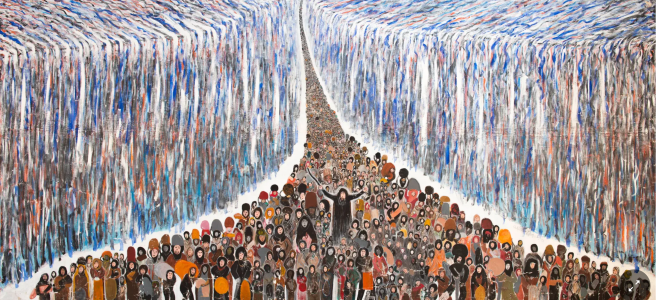
Ted Grimsrud—November 22, 2023
The story told in the book of Exodus of how God liberated the enslaved Hebrew people from the Egyptian empire is exciting, complicated, inspiring, troubling, and extremely important for both Jewish and Christian traditions. Liberation theologians especially like it and pacifists tend to have strongly mixed feelings about it. I know I share both of those orientations.
Was the liberation of the Hebrews due to terrorism?
I was struck recently with how interesting the exodus story is when I reflect on it in the context of considering what is in our day called “terrorism.” Let’s start with a simple (and admittedly imperfect) definition of terrorism: The use of violence to intimidate, frighten, and coerce non-combatants for political ends. I think it is important to recognize that terrorism is a tactic of both formal state-controlled militaries and non-state insurgents, even if in general usage the focus usually is on the latter type of actions.
In what follows I will especially have in mind “terrorism” in relation to non-state actors, especially those who do not have the firepower to directly take on the militaries of states and empires. I have some tentative thoughts that have arisen when I think of the story of the exodus in light of contemporary expressions of terrorism. It does seem as if there may be some parallels between the famous story of the ancient Hebrews and what’s been going in recent history. The Hebrews were an oppressed and essentially powerless group of people in the midst of an exploitive empire. They had little hope of directly bringing major changes. As it turns out, though, they did still try—and their tactics did include a great deal of violence that brought bloodshed and suffering onto the people of Egypt.
From the point of view of the storyteller, it seems clear that the violent actions of the Hebrews and their God were not the beginning of the violence in the story. Rather, the violence was already profound and widespread—the systemic violence of slavery and the more immediate violence of the actions of Pharaoh’s minions to grind the Hebrews into dust. As the Hebrews cried out for justice, the violence of the system bore down on them all the harder. Finally, though, the acts of resistance began to have an effect—which only accelerated the violence from the state.
The series of plagues got worse and worse as Pharaoh continued to resist the demands for justice. One way to interpret this process is to see the plagues as in large part the playing out of the dynamics of Egypt’s initial violence and its continued reliance on violence to resist the Hebrews’ demands. The final act of violence, the crashing down of the Red Sea on the soldiers of Pharaoh who pursued the escaping Hebrews, seems most clearly to be the elements of the physical world dealing the Egyptians the natural consequences of their oppressive and violent actions.
However, the entire process of demands for justice followed by intensified violence followed by the completion of the liberation process was clearly pushed forward by the actions of the Hebrews. A violent situation became more violent due to violence on the Hebrews’ side. Is it completely far-fetched to characterize that violence as “terrorism,” especially in the sense of the firepower-limited oppressed people seeking to hit the powerful kingdom where it hurts—ultimately the deaths of newborn children at the hand of “the angel of death”?
A justification for terrorism in our world?
I do not want to be read as suggesting that the exodus story should serve as a justification for present-day terrorism. In fact, I believe the opposite. Nonetheless, I do not find the inclination to find such a justification in the story far-fetched (for an example of a liberation theologian who does seem to make such an argument, see George Pixley, On Exodus: A Liberation Perspective). I do think we may see at least a few parallels that can help us in a descriptive sense to understand dynamics when oppressed groups seek to resist oppressive governments. The violence is first of all in the system, and it seems inevitable quite often in oppressive situations that the cycles of violence will at some point involve violent resistance on the part of the oppressed. That resistance, it seems to me, is most accurately understood as part of the playing out of the violent dynamics that are most of all the responsibility of the powers-that-be in the systemically violent social structures.
I believe, though, that we make a mistake when we accept that the on-going cycles of violence are inescapable, that domination leads to violent resistance that heightens the oppression that leads to more violent resistance and on and on. Even if we may say that the violent resistance that may lead to terrorist acts is understandable, the fact seems to be that it rarely ends well for the oppressed people. The parallels between the exodus story and our present-day revolutionary situations are somewhat limited. However, I do think there some suggestive elements of the exodus story that may have relevance today.
Clues in the exodus story for a different perspective on revolution
It does seem significant—though complicated—that Moses himself, the human leader of the Hebrews’ resistance to Pharaoh, did not actually engage in violent acts. He wasn’t a would-be general or a would-be king. From a strictly human perspective (which is not, of course, how the story was told—God was always part of the action), Moses could be seen to have been merely a catalyst, a weaponless prophet we could say, who stimulated the ever-increasing violence from the implacable oppressiveness of Pharaoh. The resistance was not shaped by human beings killing other human beings. The story makes a point of telling of Moses’s earlier effort to lead a violent revolution—that attempt failed and was repudiated. The emerging peoplehood was not based on a founding experience of inter-human violence.
The Hebrews did not have as their leaders a revolutionary vanguard group of violent actors who then became the militaristic core of the new community. All too often in more recent revolutionary movements, the work of such vanguard movements has led to the empowerment of a leadership group that itself is shaped by the violence and becomes an on-going purveyor of violence in the liberated community. The Hebrews did not create among themselves the context for the rising of a new Pharaoh, not Egyptian but just as violent and oppressive as the original. That is, the Hebrews changed the rules of the game of social organizing and governing.
The exodus story as it continues tells of the creation of a new kind of social dynamic. Moses did not become king; he did not become a new Pharaoh. There was not a revolutionary vanguard of powerful generals and economic elites who would provide the organizing dynamics that would end up keeping the people in an enslaved condition. Rather, what emerged was something quite different. The law codes (Torah) provided the blueprint for a community that placed at its center genuine justice and empowerment for the vulnerable and weak members of society. The leaders were explicitly required not to gather wealth, horses and chariots (the tools of militarism), wives (sealing political alliances), and servants. Built into the on-going social arrangement were the Sabbath laws that continually redirected wealth to prevent both the emergence of a wealthy elite and an impoverished underclass.
Now, as we know, this blueprint was only ever partially embodied. In time, the Hebrew peoplehood increasingly “returned to Egypt” with horrendous results—as the prophets make clear in their condemnation of corrupt social elites. However, the ideals remained present in the self-awareness of the community, and Torah remains a part of the peoplehood.
Lessons for today?
The exodus story became and continues to be a central motif in the traditions of Moses’s spiritual descendants. Its impact is massive in the biblical story as presented in both testaments. And it remains important today. Let me mention only a few of the ways that I believe the story has relevance for people of faith today.
Egypt is only the first of several domination-oriented empires that the Bible poses as embodiments of the political philosophy that God intervenes to overthrow. The exodus story is a story of resistance to human societies structured for oppression. As such, it remains a call for continual efforts to practice resistance against all systems of domination. One of the tragedies of the Christian tradition is that ever since the accommodation of the 4th century Christians with the Roman Emperor Constantine, most Christians have offered their various empires, kingdoms, and nation-states a blank check of support for wars and oppressive economics, not resistance. If we see the United States as at all present in the exodus story, it is as the enslaving empire, not as Pharaoh’s enemies.
As a story opposed to cultures of domination, the account of the exodus more explicitly is a story that affirms the humanity and God-supported character of those who are enslaved and otherwise exploited and disempowered. Again, tragically, the Christian tradition is complicit in the practice of slavery that until the 19th century was scarcely criticized in the churches. The legacies of slavery have continued long past the formal ending of its practice in the US. Even though many Christians have devoted creative energy to anti-racist work, a lot more remains to be done to transform the systemic exploitation our economic system continues to practice, especially toward people of color all over the world.
The exodus story tells of a revolution that indeed broke the cycle of domination that the Hebrews lived with in Egypt. We have a lot to learn from a deep analysis of that story. Here I will only mention the notion that at the heart of this story is a vision of a non-domination-oriented political order. The movement to break free from Egypt’s yoke of oppression was the opposite of a typical revolutionary movement that has at its center military might and various other “vanguardist” dynamics that insure a continuation of domination, even if under different leadership. We must include as part of our understanding of the exodus story its extension with the revelation of the law codes (Torah) that when read in relation to the dynamics of Egyptian politics envisioned a much more just, equitable, and decentralized political community.
Finally, I find the last allusion to the exodus story in the Bible to be suggestive. In Revelation 15, John reports seeing a vision of those who had defeated “the Beast” (a metaphor for the great empires who have opposed God): “They sing the song of Moses, the servant of God, and the song of the Lamb” (15:3). This is the most direct of several allusions in Revelation both to the exodus itself and to close link between the work of God among the Hebrews and the work of God in the ministry of Jesus, the Lamb. The liberation from enslavement in Egypt and the liberation from the oppressions of the Beast are seen to be of a piece. What do we come up with if we merge the central elements from the exodus story with the central elements of the story of Jesus? I hope to reflect on that more in posts to come. I will simply say here that I believe “the song of Moses and the Lamb” has to do with transformation of political life for people in this world and is thoroughly based on love and restorative justice—both elements are part of the witness of both Moses and Jesus.

 Thinking Pacifism
It is indeed mysterious, at least to any of us not raised in Judaism or practicing as Jews, to understand the genre of key Hebrew Bible stories. The Exodus may be the most central one, with the near sacrifice of Isaac, the wrestling of Jacob with the “angel of God”, the birth of Ishmael being core as well.
Although I’ve had “OT” courses in college and seminary and done a variety of reading over decades since, I have tons of questions. What IS clear to me is that most of the biblical account of the Exodus is symbolic. There’s probably a core of oral tradition on the most basic of facts… the general dating, the fact of enslavement, the likelihood of major conflict leading up to the departure of at least some Israelites. (But almost certainly not 2+ million all at once, to then wander 40 years as a massive group in desert and arid areas.)
Your points about the “invention” of new societal structures, along with further steps toward true monotheism, are important. It does seem likely they (whoever left initially) broke away from the Egyptian empire via some form of revolt, partly because the chroniclers were not reluctant to credit God and their ancestors with a LOT of violence (seemingly genocide) as they entered their “promised land”.