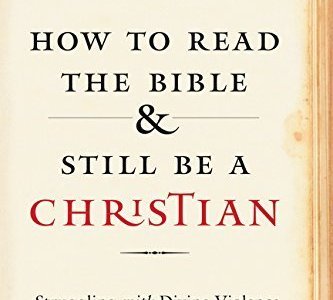
The Bible, violence, and John Dominic Crossan—with special attention to the book of Revelation

Ted Grimsrud—May 8, 2018

I have read with great appreciation many of the books John Dominic Crossan has written over the years and have heard him speak several times. A few years ago he published a book I found pretty helpful and relevant to my interests, How to Read the Bible and Still Be a Christian: Struggling with Divine Violence from Genesis Through Revelation (HarperOne, 2015). I don’t know for sure whether Crossan, who is Catholic, shares my pacifist convictions, but he clearly cares deeply about peace on earth.

The right agenda

I believe that Crossan has exactly the correct agenda for this book. He argues, “escalatory violence now directly threatens the future of our species and indirectly undermines solutions to other survival problems such as global warming, overpopulation, and resource management” (p. 244). He writes this book in order to address that problem, to show how the Bible can be used in ways that contribute to violence, and to suggest ways the Bible might be read that will actually help us move toward peace.

Crossan’s book may be read alongside Greg Boyd’s The Crucifixion of the Warrior God: Interpreting the Old Testament’s Violent Portraits of God in Light of the Cross (Fortress Press, 2017). Boyd and Crossan happily share deep convictions about helping Christians deal with the violence in the Bible in way that will empower Christians to be peaceable today. They approach the issues quite differently, though. The differences are significant, for sure. I would recommend reading both works as a way of getting a sense of the breadth of possibilities for Bible-centered peace theologies.

One big difference between these two thinkers is how they think of biblical inspiration. Boyd affirms what he understands to be a very high view of inspiration, and as a consequence he undertakes to construct a quite detailed and elaborate argument for how he can see the Bible as truthful throughout and yet also argue that the Bible is consistently a book of peace. I have written a lengthy critique of Boyd’s argument. I see it as way too convoluted. But I find his work enormously instructive.

Crossan, on the other hand, has no trouble with asserting that parts of the Bible simply are untrue. This makes his argument much simpler and more straightforward than Boyd’s—though not without problems of its own. I am not fully happy with Crossan’s approach, either. I think he too quickly accepts the presence of major internal contradictions within the Bible and thus misses some insights that an attempt to read the Bible’s overall message as largely coherent might provide. However, in this blog post I want to focus my criticisms of Crossan elsewhere. Continue reading “The Bible, violence, and John Dominic Crossan—with special attention to the book of Revelation”

Pacifism and violence in the struggle against oppression

Ted Grimsrud—October 29, 2017

Is pacifism a viable social philosophy? I believe that it is, though I also recognize that arguments in favor of the possibility that at times violence might be appropriate can seem pretty persuasive. Nevertheless, as I will outline later in this post, I think the moral and practical problems with violence are ultimately insurmountable.

The impact of Mohandas Gandhi and Martin Luther King, Jr., in the twentieth-century put principled nonviolence on the table as a possible option for those who desire social transformation. As well, the historic peace churches (Mennonites, Quakers, and Brethren) have sought in recent generations to apply their long tradition of Christian pacifism to social issues. But many have questioned whether pacifism is an adequate approach in the real world—whether it might even be unhelpful to the quest to overthrow injustice.

Principled pacifism may be defined as the conviction that it is never morally acceptable to use lethal violence against other people. This conviction has never been widely held, even though in the United States it has been present in a fairly prominent way dating back to the establishment of the Pennsylvania colony in the 1680s. The main impact of pacifist convictions in the US until the 20th century was the refusal of pacifists to join the military and fight in wars. The possibility of self-consciously nonviolent direct action did not gain widespread acceptance until the 20th century.

Changing notions of peacemaking

I write as a Mennonite Christian pacifist, though I believe that pacifism is a valid commitment for anyone. Several 20th century factors combined to transform the understandings and practices of principled pacifism among “peace church” Christians. World War I showed just how widespread and utterly destructive modern war could be (though much worse was soon to come), so a pragmatic case for rejection of war became more widespread. The philosophy and practice of nonviolent direct action as a means to bring about social change gained currency especially through the work of Gandhi in South Africa at the turn of the century and a couple of decades later in India. And peace church people became more acculturated and more likely to feel a sense of responsibility for having an impact in the wider world. Continue reading “Pacifism and violence in the struggle against oppression”

Exorcising the ghosts of fundamentalism

Ted Grimsrud—February 27, 2017

It is common in my circles of friends and acquaintances to encounter people who are former fundamentalist or evangelical Christians and who now distance themselves from that past faith perspective. Often, the rationales for the changes have to do with the Bible. For the sake of opposition to violence, to religious arrogance and exclusivism, to judgmentalism and the like, my friends will say the Bible is so hurtful, so damaging. Maybe they will add that they like Jesus but they see the Old Testament as profoundly problematic—and maybe Paul and Revelation too.

 I am sympathetic with such sentiments. I spent a period of my life in my late teens and early twenties as first a fundamentalist and then evangelical Christian. Starting with my embrace of pacifism at the time of my 22nd birthday, I fairly quickly came to distance myself from those traditions (I tell the story of that evolution here). And I agree that the way the Bible is used by many conservative Christians is problematic and helps underwrite violence and other hurtful attitudes and actions. And I do think it is true that there are materials in the Bible that do lend themselves to hurtful uses.

However, at the same time I love the Bible and most of my theological work consists of engaging the Bible as a positive resource for peace (several of my books focus on the Bible and peace: see, for example, Triumph of the LambGod’s Healing StrategyInstead of Atonement; and Arguing Peace). I often have been told by post-fundamentalist friends (and others) that while they admire my attempts to wring some peace from the Bible, they think I am engaged in spin, at times even in ways that seem dishonest or at least overly and misleadingly optimistic.

I had one such conversation just recently after preaching a sermon. As we talked, I realized that my friend was actually still reading the Bible in a quite conservative way. It’s just that now she disagrees with what she finds there. So I suggested that it would help if she could move past her fundamentalist hermeneutic. She agreed, but also noted that such a move is very difficult. Not so much because she still wants to believe in that approach, but that it is so deeply ingrained in her psyche that she can’t simply by a quick and easy decision get rid of it.

One small aid to help a post-fundamentaist move away from a fundamentalist biblical hermeneutic might be simply to articulate what a post-fundamentalist approach to affirming the Bible as a peace book might look like. Continue reading “Exorcising the ghosts of fundamentalism”