
Ancient Israel among the great powers. The Bible’s radical politics (part one)

Ted Grimsrud—June 10, 2025

I recently led a three-part adult Sunday School class on “The Bible’s radical politics.” This post is an expanded version of the first session. I will follow with the other two parts and then add a fourth post that reflects on lessons from these posts for politics today.

This first post will discuss ancient Israel among the great powers of the ancient near east. Israel’s entire existence in the Bible took place in the shadow of one great power or another, from Egypt on down to Rome. So, the politics of the Bible has a lot to do with navigating life in that shadow—resistance, subjection, imitation, alternative.

Then, the second post will zero in on Israel’s own attempt to be a territorial kingdom, a power in its own right. I call this, ancient Israel as a failed state—and will consider what follows after the failure. Israel’s time as a nation-state in the “promised land” was complicated, but ultimately ended in disaster—yet the peoplehood continued. What lessons came out of that experience that empowered the peoplehood to continue?

Third, I will turn to the New Testament and the story of Jesus, and his politics as told in the gospels with a glimpse at the book of Revelation. I call this “Jesus’s upside-down empire.” I will suggest that Jesus’s radical politics are best understood in terms of his continuity with the Old Testament.

I will conclude with a fourth post—not part of the original Sunday school class—that reflects on a Christian political agenda in light of the Bible’s radical politics. Most politically engaged people in the United States today recognize that we are facing crises of extraordinary difficulty and diversity. How might the Bible’s Big Story give us some perspective on navigating these crises?

Continue reading “Ancient Israel among the great powers. The Bible’s radical politics (part one)”
Listening to Moses [Jesus story #11]

Ted Grimsrud—May 10, 2021

As President Dwight Eisenhower was leaving office at the end of his second term, he delivered a famous speech. He warned of the power of what he called “the military-industrial complex,” the domination of our society by people and institutions and ideologies that make our nation’s priorities center on war and the preparation for war. In so many ways, things have only gotten worse since.

Thinking about this warning all these years later leaves one with a sense of urgency. Indeed, we do face political, environmental, moral, and spiritual crises that feel almost overwhelming. We hurtle toward disasters linked with global warming, and our corporate-funded media and federal government resist changes that might limit profits. Our political discourse normalizes hate speech and then insists that mass shootings are the acts only of isolated, mentally ill individuals. And, perhaps worst of all, the message of Jesus, a message of genuine peace, is linked with religiously-sanctioned violence to the extent that being self-identified as a Christian in this country means one is more likely than a non-Christian to support war and the death penalty.

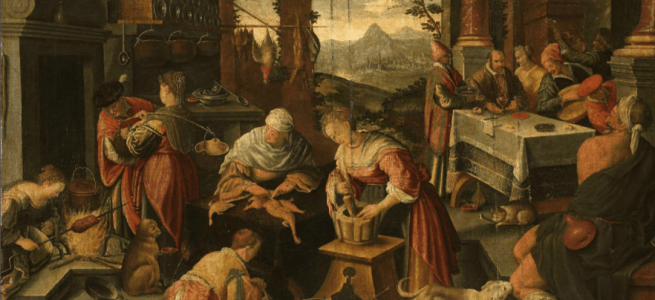
I thought about Eisenhower’s speech (and the urgency borne from all these years of a warning unheeded) as I spent some time with another message of urgency—the story of the rich man and Lazarus in Luke’s Gospel. I was struck with some parallels. Jesus tells of two men who die, one is rich, the other poor. The rich man suffers torment due to his cold-hearted life. He urges “father Abraham” to allow the poor man, Lazarus, to return to life to warn the rich man’s brothers of their likely fate. Talk about urgency!

A response to urgency: Listen to Moses

I was fascinated with the story’s implied message about how best to respond to this urgency. The point is simple: Listen to Moses, listen to Torah, listen to the prophets. You already have all the guidance you need. If people won’t listen to Moses and the prophets, an amazing and attention-grabbing miraculous warning to turn or burn won’t change their minds either.

Continue reading “Listening to Moses [Jesus story #11]”