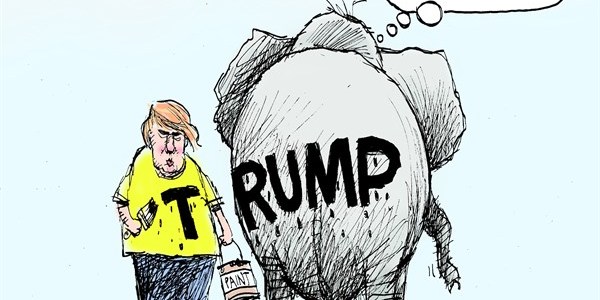
Misconstruing the Trump Crisis

Ted Grimsrud—September 5, 2016

We are in the middle of what seems certain to be one of the worst presidential campaigns in United States’ history. We have the two candidates with the highest negativity ratings in the history of measuring that indicator.

Trump as disaster

And the thing is, the negative ratings for Donald Trump are not nearly as high as they should be. In this blog post, I take it for granted that Trump is a terrible person, remarkably unsuited to be president of the USA. He’s dishonest, narcissistic, mean-spirited, bigoted, ignorant, irreverent, thin-skinned, controlling, sexist, racist, and surrounded by yay-sayers. A disaster in every way; a world-class con-man in the words of Matt Taibbi.

Something else I take for granted in this post is that Hillary Clinton’s negative ratings are too high. She’s not nearly as bad as her public image would imply—at least in the sense that she has been for years and continues to be unfairly vilified, disrespected, slandered, and the like in large part due to her being a woman. At the least, she is vilified often for the wrong reasons.

So, Trump is a disaster who shouldn’t be the candidate of a major political party and as his party’s candidate should not be nearly as close to leading the race as he is. And Clinton is unfairly discriminated against because she is a woman.

And yet, the way the campaign seems to be unfolding is quite troubling for other reasons. As awful as Trump is, he is not the reincarnation of Hitler. There is debate among “experts” whether the invocation of Hitler in relation to Trump violates Godwin’s Law (the idea that internet debates, if they go on long enough, tend to end with references to one’s opponent being like Hitler—a move that in some settings leads to a declaration that in invoking Hitler, one loses the debate).

Regardless, one could argue that the Trump-is-like-Hitler references exaggerate both Trump’s power and his darkness. Trump actually differs from Hitler in crucial ways—maybe most significantly in having nothing even remotely like Hitler’s Nazi Party to implement his inhumane ideology, not to mention also having nothing even remotely like Hitler’s coherent, long-standing, and well-articulated ideology.

Continue reading “Misconstruing the Trump Crisis”

The missing peace in the Democratic Party convention

Ted Grimsrud—August 1, 2016

It seems that the recently concluded Democratic Party convention (DNC) was a success. Clearly, the convention was orchestrated to show a direct contrast with the Republican Party convention the previous week—highlighting diversity, care for the poor, positive hope for the nation, and the like. And unity. The threat of major disruption from supporters of Bernie Sanders proved to be minimal—beyond some random “no more war” chants that were ignored by the people in charge. Sanders helped with his explicit support for Clinton.

Sanders’s speech was a model in how he affirmed Clinton’s candidacy going forward while he also reemphasized the core themes of his campaign. He received a kind of affirming echo from Clinton in her speech, as she lifted up many Sandersian points. Surely, the success of his insurgency campaign pulled her in his direction—and one can fantasize that Sanders and many others will help keep her to her word on many of the issues: vs. harmful free trade agreements, for economic justice, for greater access to higher education, for an increased minimum wage, for criminal justice reform, challenging the big banks, et al.

However, there was something crucial missing from Sanders’s speech—and he perhaps lost the one opportunity possible at the convention to challenge the worst of Clinton’s politics. Sanders said nothing about opposition to war and militarism. And, so, the empire continues to hurtle toward brokenness—and to take all of us with it. There are many angles one could take in decrying this lack of opposition—I write as a Christian theologian. Though it was indeed remarkable how visible explicit Christian faith was at the DNC, I take little comfort in a phenomenon I normally might have welcomed. This Christian presence runs the danger of being just another baptism of empire, even if “kinder and gentler” (ironic allusion to George H.W. Bush intended) than previous baptisms, if it won’t lead to an explicit commitment to “no more war.” Continue reading “The missing peace in the Democratic Party convention”

The case for Bernie Sanders

Ted Grimsrud—May 27, 2016

Yesterday on Facebook, a friend of mine, Jessica Penner, raised a question to me in a conversation about our current presidential campaign:

Okay, let’s say Bernie gets the nomination and wins the election. HOW will he get done half (or even a quarter) of what he plans with a congress that won’t vet a Supreme Court justice for the sitting president, with a congress that stripped Obamacare to a shadow of what the sitting president envisioned, with a congress that works to get rid of what good Obamacare does (and hurt people like me–a person working full-time but without benefits who also has pesky pre-existing conditions) that our sitting president created. HOW WILL HE DO IT? NO ONE HAS ANSWERED THIS QUESTION. I told your grandson several months ago that Bernie has my heart, but Hillary has my head. Tell me how he will do it, and maybe Bernie might creep into my head.

I don’t have a quick and decisive answer to this challenge, but I think it is worth taking a little time to respond. For me, both my heart and my head tell me that Sanders is the best serious presidential candidate that we have had since Jesse Jackson and that if he were elected at the least his presidency would be way less destructive than a Clinton presidency. I’m not sure Sanders would be all that effective in terms of his agenda, but I am sure Clinton would be devastatingly worse.

I think our current system is failing at an ever faster speed. I don’t have much hope that a Sanders presidency would prevent a catastrophe. However, I do see a glimmer of hope; on the other hand, to me the main difference between a Clinton presidency and a Trump presidency would be about levels of despair. So, really, the case for Sanders has mostly to do with the case against Clinton. However, Sanders is long committed to a positive agenda that truly would bring about major changes and might turn the direction of the system around. Even if he has little chance of implementing much his agenda, if he were president there would be some chance. A Clinton presidency would at best push us just a bit more slowly down the slide into catastrophe than a Trump presidency.

Some specific themes:

(1) I don’t think it’s fair to imply that Sanders couldn’t get his agenda approved by a Republican Congress while Clinton could. We can completely agree that the current Congress is set up to foil any legislative initiative any Democratic president would pursue. This is not, in any sense that I can see, a point in Clinton’s favor. She would go into office with a much deeper and longer-established level of antipathy from Republicans than Sanders would, so it seems at least as likely that she would not be able to get her goals passed.

The difference I see would be more on the level of the things the president can accomplish in spite of Congress. It seems like Obama finally at the end of his time in office has decided to push his agenda more forcefully and to some positive effect (e.g., stronger environmental oversight, the opening to Cuba). I’m more confident of Sanders being assertive in this way than Clinton. Plus, even more, I’m more confident of Sanders appointing a Cabinet that would pursue more progressive policies—most obviously with his commitment to resisting the domination of Wall Street we have seen among many of Obama’s appointees (and likely Clinton appointees). Continue reading “The case for Bernie Sanders”

The humane person’s dilemma regarding the “war on terror”

Ted Grimsrud—December 14, 2015

At the beginning of one of my classes the other day, a student asked me what I thought we should do about ISIS? He said he was writing a paper on the topic. My main response was to say that I didn’t have a quick answer ready that I could give in 30 seconds. I said I would get back to him.

Later that day I sent him a link to Juan Cole’s recent short essay that gives some sensible pointers—(1) Don’t accept that the best response to the actions of ISIS is to “declare war.” Actual states should not grant such legitimacy to small bands of violent criminals. (2) Welcome refugees. To characterize all Syrian refugees as potential combatants and to refuse to help them is to play into the hands of ISIS recruiters. (3) Take a public health response to the radicalization of youth in Europe’s bidenvilles—focus on community policing and proactive governmental intervention to improve the dignity of the people.

However, as I thought of about the question, I was troubled with the implications of how this kind of question is usually phrased. What should we do about ISIS? What should we do about Saddam Hussein? What should we do about the Communist threat? What should we do about Hitler?

Who is the “we”?

What troubles me is that this comfortable use of “we” raises what is often seen to be an irresolvable dilemma for pacifists and other people who prioritize peace. The implied answer to this kind of question is almost always that “we” must resort to military force.

We should pause to think about what “we” means here. Who are the possible “we’s” in such a question? (1) Certainly one “we” could refer to the leaders of the United States—after all, we live in a representative democracy and as citizens of this nation what our leaders choose to do does reflect on us. This is what “we” in this context usually seems to refer to.

But the “we” could also mean something such as: (2) we who as citizens of this country have a patriotic duty to advocate for what best serves the nation as a whole (with the recognition that most of the time the policies pursued by national leaders are not in the best interests of the nation as a whole, but more in the best interests of the power elite—the people who profit from war, such as the recent war on Iraq).

There are other possible “we’s” as well. I’m a Mennonite Christian. (3) Shouldn’t my “we” be centered more on my community of faith (which transcends national borders) and my sense of God’s will, not my nation-state? As well, I identify as an international citizen, a person who especially makes common cause with other people who share many of my convictions about pacifism, anarchism, egalitarianism, economic justice, and similar ideals. (4) Isn’t the sense of “we” I share with such other (let me suggest the term) “humane people” more important than particular national identities?

Continue reading “The humane person’s dilemma regarding the “war on terror””

Does the Bible teach anarchism?

Ted Grimsrud—August 25, 2014

I first learned about anarchism back in the 1970s. My wife Kathleen and I got involved with an activist group opposed to Jimmy Carter’s decision to reinstate registration for the draft in order to “show resolve” to the Soviet Union (this is one of the darker aspects of Carter’s presidential legacy—a cynical but failed attempt to hold off the political threat from the right that remains thirty-some years later an important element in the socialization of young people into our national security state). We met a young couple, Karl and Linda, who had just moved to our hometown, Eugene, Oregon, to be part of the rising anarchist movement there.

I had typical superficial stereotypes of anarchists as mindless terrorists (it was an “anarchist,” after all, who had shot President McKinley). I was disabused of that superficial antipathy in conversations with Karl and Linda and also in seeing their lives. They were compassionate, committed to social justice, and (Linda, at least) thoroughly nonviolent. They were pretty negative about Christianity, but were interested to learn to know about our Anabaptist convictions.

About the same time, I took a class on the history of political theory at the University of Oregon—and the professor treated anarchism as a serious political philosophy that needed to be considered alongside the other more mainstream approaches. It might have been as part of that class the I read George Woodcock’s fascinating book, Anarchism: A History of Libertarian Ideas and Movements.

I have not traveled very far down the anarchist path in these past decades, but I have remained interested in and sympathetic toward this political orientation. Writers such as James C. Scott, Noam Chomsky, and Rebecca Solnit, whose anarchistically-inclined books I have read for reasons other than direct articulation of anarchism, have kept my interest alive. And then, when I learned about the Jesus Radicals website and movement, I started to realize that there was some genuine compatibility between the evolving political perspective I have been constructing and at some articulations of anarchism.

Anarchism and the Bible

One of the new ideas for me has been to think that perhaps we could say that anarchistic sensibilities (in our present day sense of what those involve) are embedded in the biblical story from start to finish. I want in this post to begin to sketch an argument to support this idea. Continue reading “Does the Bible teach anarchism?”

Faith and Politics (Including Voting)

Ted Grimsrud

All this talking and thinking about voting (this post is part three: #1—Should a pacifist vote for a warmonger?; #2 —More thoughts about voting (or not) for a “warmonger”) has pushed me to think about what I understand politics to be about and what this has to do with my faith convictions. These are some thoughts.

Biblical politics

I find the Bible enormously helpful for thinking about politics. Not that it gives us a blueprint or an explicit political philosophy or even a list of principles for godly politics. Just that it tells a story (a complicated story, with many subplots) that we can share in—a story, ultimately, of people trying to join together to make the world more peaceable in light of their understanding of God’s will for their lives.

In a nutshell, I would define “biblical politics” as people working together for peace. “Peace” I would understand as “biblical shalom”—the wholeness of the community, all people living harmoniously with one another and with the rest of creation. The operative sense of “politics,” then, is people working together in community for the sake of shalom.

The Bible, thus, is intensely political as it tells both of how communities can operate in peaceable ways and of how communities violate shalom (and suffer the consequences). From Genesis’s account of the communal problems that emerge when people turn from shalom to Revelation’s account of a great city of peace (the New Jerusalem) being established on earth, the Bible focuses on politics done (or not) in light of the peaceable will of the creating and sustaining God of the universe.

Continue reading “Faith and Politics (Including Voting)”

Should a pacifist vote for a warmonger?

Ted Grimsrud

This election season is (or should be) an agonizing time for pacifists and other people in the United States who care deeply for peace on earth. Perhaps as much as any time in the history of this country, an uncritical embrace of militarism as a way of life is on display. We have a president running for re-election proudly trumpeting his success in one military intervention after another (including direct assassination of “national enemies”)—and being harshly criticized by his main opponent for being a wuss on national security issues.

Except for people like us on the fringes, Obama’s militarism is not seen as a problem in the national discussion. The country faces extreme economic difficulties and the two main options in this election are giving the military either a somewhat greater share of the national treasure or a much greater share.

Peace advocates’ discouragement with Obama

American peace advocates’ discouragement is heightened by the reality that we thought we might be getting something better four years ago. And we weren’t alone in the world—how else to explain Obama’s clearly premature Nobel Peace Prize (now a distant memory) other than as a statement of hope from the selectors that he truly would provide a new direction in American foreign policy? Yet, when all is said and done, what we see over the past four years is a slight decrease in the bellicose posturing that characterized the Bush administration, but overall a continuation of the trajectory of empire as a way of life.

So, it is understandable that many peace advocates who supported Obama in 2008 (with admittedly varying degrees of enthusiasm—no one I know or know of expected Obama to tack very far toward a truly new, peace-oriented national security agenda; but we did hope for some major positive shifts) are now asserting that they will not vote for him this time. None of these folks, of course, are remotely interesting in voting for Mitt Romney—they talk either of voting for a third (or fourth or fifth) party candidate or of abstaining. Continue reading “Should a pacifist vote for a warmonger?”

Are we living under totalitarianism?

Ted Grimsrud – 5/23/11

Well, probably not. In the United States today, we still are able to express ourselves freely. I don’t feel any anxiety about posting this essay, for example, even though it will end up being quite critical of the powers that be in our society.

We still have a lot of power, though more so on the local level, to practice participatory democracy. We still have freedom of the press, problematic as our media might be in practice. I am writing right now in Phoenix, Arizona, and will be traveling home to Virginia tomorrow—I may be annoyed at the airport “security” measures, but I have a great deal of freedom to come and go as I please, to travel thousands of miles across the continent whenever I want.

And yet… Continue reading “Are we living under totalitarianism?”