Why isn’t Protestantism’s Bible peaceable? [Peace and the Bible #2]

Ted Grimsrud—November 20, 2023

A big question arises for people who believe that the Bible is a book of peace, especially with how it tells the story of Jesus. The question is this: What about Christianity, which for most of its history in most of its manifestations has scarcely been a religion of peace? This is a complicated question and any possible answer will be contested (as, of course, are my assertions that the Bible is a book of peace, and that Christianity is not a religion of peace). In this post, all I will offer is a sketchy set of over-generalizations! I want to test a few thoughts.

The turns toward doctrine and toward Empire

One obvious place to look is at the changes among the Christian churches in the 4th and 5th centuries after Jesus. In a general sense, the early years of Christianity have been seen by many as an era of Christian pacifism (in the sense of non-participation in war). That was drastically transformed in the 4th and 5th centuries into an era where Christianity became the official religion of the decidedly non-pacifist Roman Empire. While Christianity’s status as an official state-religion has come and largely gone, the general sensibility where Christians with few dissenters support their own country’s wars seems as strong as ever.

At roughly the same time that Christianity became pro-Empire, it also established authoritative creeds and confessions as the core definers of the faith—bases for determining formal membership in Christian churches. Not coincidentally, these creeds and confessions easily lent themselves to non-pacifist interpretations and essentially sidelined the gospel stories about Jesus’s life and teaching (notoriously, for example, summarizing the story of Jesus as “born of a virgin” and “crucified under Pontius Pilate” without a word about his message in between).

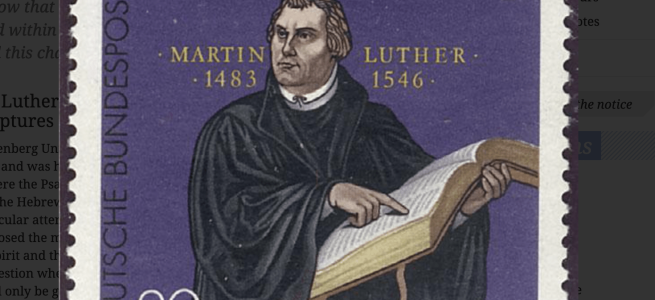
The roughly one thousand years after the establishment of creedal Christianity could be characterized as a long period of churches paying little attention to the peace message of the Bible—or to the Bible at all. We may note the continual emergence of small dissenting Christian groups that did place the story of Jesus at the center (for example, the Waldensians, the Franciscans, and the Hussites and Czech Brethren). However, these groups were often treated as heretics and viciously persecuted—or absorbed into the Catholic Church as monastic orders with little impact on the broader church. This dynamic of marginalizing the Bible did change, though, with the Protestant Reformation in the 16th century. Why, then, didn’t the new churches, as a rule, embrace the peace message of the Bible?

Continue reading “Why isn’t Protestantism’s Bible peaceable? [Peace and the Bible #2]”

A political reading of the New Testament (part 2): The apostolic witness

Ted Grimsrud—November 8, 2023

[Back in 2015, I posted a series of short essays in Thinking.Pacifism.net on an anarchistic reading of the Bible. The series included several pieces on the Old Testament and one on Jesus. At the time, I planned to conclude the series with a post on Paul and Revelation. For various reasons, I have only just now completed that post. Here is a link to the post on Jesus, “part one” of the two parts on the New Testament.]

One way to read the New Testament is essentially to go from the beginning to the end, reading the gospels as the main event and seeing the epistles as commentary on the story of Jesus and application of that story to the lives of the early Christians. In relation to our task of reading the Bible for its political content in light of an anarchistic sensibility, we will find that the apostolic witness reiterates the basic political content of the gospels—adding perspective on our reflections on politics as if Jesus matters. This short chapter will only scratch the surface of an anarchistic reading of the apostolic witness of the New Testament. I will touch very briefly on the book of the Acts of the Apostles, discuss a few texts from the Apostle Paul’s writings, and conclude with some reflections on the book of Revelation.

The story of early Christianity

The Acts of the Apostles, attributed to Luke, the same author of the gospel of that name and presented as a kind of sequel to the story of Jesus, has as its main agenda an account of the spreading of the message of Jesus from Jerusalem to “the ends of the earth” (Acts 1:8; in this case, from Jerusalem to Rome). The story reinforces the political message of Jesus—not an overt attempt to replace the Roman Empire with a different territorial kingdom but a political sensibility that de-centers the state and the nations and understands humane politics to involve grassroots, self-organized communities free from state domination that embody generosity, mercy, and restorative justice (these are elements of what I call an “an anarchistic sensibility” regarding politics)—and willingly accept the likelihood of suffering at the hand to authoritarian political and religious institutions.

The general tenor of social life in Acts shows a strong commitment on the part of the early Christians to defy human authority when it stands against the gospel (“we must obey God, not human authorities,” Acts 5:39-42). In Acts, as in the gospels, the “human authorities” who most commonly presented problems were leaders in the institutional religious arena (the Temple authorities and the Pharisees)—but in the Judaism in the period of Acts (the first 70 years of the Common Era) in Palestine operated as the political authorities as well as religious authorities.

The Roman Empire is a somewhat ambiguous presence in Acts. The hero of the book, the Apostle Paul, does at one point declare that he is a Roman citizen when that helps protect him from local authorities. Near the end of the book, Paul makes it to Rome and has not entirely negative encounters with Roman leaders. It appears that the writer of Acts wants to focus on the conflict with the religious leaders and minimize problems with Rome, perhaps to keep the book from being repressed by Roman authorities. However, we have good reasons to believe that Paul himself (along with the Apostle Peter) was executed by the Empire, following the path of Jesus. When read in light of the Jesus story (as well as other New Testament writings and the Old Testament), Acts mainly communicates a general suspicion of human authorities that would implicitly include the Roman Empire. The focus of the book, in any case, is on the constructive model of the early Christian communities as a counter-witness to the ways of authoritarian human structures—empires and oppressive religious institutions.

Continue reading “A political reading of the New Testament (part 2): The apostolic witness”

More critical thoughts on America’s proxy war [American politics #7]

Ted Grimsrud—October 5, 2023

[Early in 2022, after Russia greatly accelerated its military engagement with Ukraine, I wrote  several blog posts and then some shorter posts on Facebook  with my reflections. After many months, I decided to re-engage these issues as the war continues unabated. I posted several times recently on Facebook and consolidated those into a blog post, “And they call it democracy…. Critical thoughts on America’s proxy war.” Here are a couple more posts.]

History may not repeat itself but at times it sure rhymes (9.22.23)

I recently read a book from the late 1970s, The Washington Connection and Third World Fascism, by Noam Chomsky and Edward Herman. It is a detailed report on the carnage visited on various countries around the world (e.g., Indonesia, Thailand, the Dominican Republic, and—especially—Vietnam) by the American Empire in the 1960s and 1970s. The section on Vietnam especially caught my attention as I thought of America’s involvement in the current Russia/Ukraine war.

On the surface, the differences between the Vietnam War back then and the current war in Ukraine are obvious and significant. Back then, it was the US invading Vietnam with hundreds of thousands of our troops; now, we are mainly only offering military aid (no troops) to Ukraine as it is invaded by Russia.

However, I find it instructive to think of a few of the similarities. With the Vietnam War, the US military planners well knew by 1965 that it was a war they could not win. From that point on until the final withdrawal ten years later, the US pursued extraordinarily destructive military operations for purposes entirely separate from actually defeating their Vietnamese enemies. It was clear during that entire time that eventually the war would end with a US defeat. So, why did they continue? It had to do with broader American “strategic interests” in the world and with American “prestige.”

Is the same kind of dynamic present in our current conflict? The much-heralded Ukrainian “counteroffensive” seems not only to have failed; it seems quite likely that the US/NATO leaders who pushed for that effort knew it would fail from the beginning. Why would they do this? It is hard to imagine an alternative to the reality that it’s about “strategic interests” and “prestige” that have absolutely nothing to do with the wellbeing of the Ukrainian people.

Continue reading “More critical thoughts on America’s proxy war [American politics #7]”

A Christian pacifist in the American Empire, part 3: The American Empire without blinders

Ted Grimsrud—September 15, 2023

In the first post in this three-part Theological Memoir, “Embedded Theology,” I gave an account of my first two decades of life with a focus on how my “embedded theology” led me to accept the “blank check” regarding my loyalty to the American Empire, even to the point of being (reluctantly) willing to go to war if called. This acceptance of the blank check was, if anything, strengthened when I became a Christian and was taught that the “gospel” included an embrace of American patriotism.

The second post, “Jesus’s gospel of peace,” describes the circumstances around the transformation of my perspective due my encounter with Jesus—an embrace of Christian pacifism and a rejection of the blank check that involved a deeply critical disposition toward the American Empire. I also briefly sketch the Bible-oriented theology that undergirds that critical disposition.

My encounter with the gospel of peace has defined the rest of my life. Right away in 1976, I sought to bring together the two main elements of this new exciting vision for life and faith: First, an embrace of Jesus’s gracious and humane call that love of God and neighbor are the core meaning of life. Second, an ever-widening analysis in our social and political context of the vicious, expansionist, profoundly violent American Empire. From the very start, for me, these were two sides of a single coin. The call to love illuminated the realities of the Empire and the realities of the Empire continually challenged me to understand the practical and embodied character of the call to love. The more I studied the Bible, the more convinced I became of the radical nature of this story of God’s call of a people to bless all the families of the earth with their message of shalom. In this post I will outline my critique of the American Empire.

Continue reading “A Christian pacifist in the American Empire, part 3: The American Empire without blinders”

A Christian pacifist in the American Empire, Part 1: Embedded theology

Ted Grimsrud—September 13, 2023

At this stage in my life, retired but still trying to be productive with my research and writing, I find myself wanting to narrow my interests. I hope to find a level of focus that will enable me to reduce distractions and zero in on doing what I have left to do. The big theme that has my attention is trying better to understand why our world and, especially, the nation I live in are in such dire straits. I know that no matter how focused I might be enabled to be, this theme will be beyond me. But I hope that by putting my best energy into such a project I might be able to make at least a little progress.

So, I was happy to be invited to make a presentation on September 11, 2023, to the monthly meeting of the Anabaptist Center for Religion and Society at Eastern Mennonite University. I decided to share what I call a “theological memoir” that, I think, sets a personal context for my “Why is America in such dire straits?” project. By “theological memoir,” I mean reflections on what I believe are some of my important theological convictions in the context of the elements of my life that brought them forth.

I have divided the reflections I shared into three posts. This one is the first, and I will call it “Embedded theology.” It has to do with the context in which I grew up, both my family and my homeland in rural America, and what I inherited theologically. By “theology” I have in mind a sense of what matters the most, what rests at the top of our hierarchy of values. Certainly, our sense of “God” is theological, but even if we don’t self-consciously affirm God’s existence, we still have some kind of theology. All of us have a hierarchy of values, convictions about what matters the most, about what core beliefs shape our lives.

The second, “Jesus’s gospel of peace,” has to do with the transformation that happened in my theology in the mid-1970s. This was when some of the key elements of my embedded theology became crystalized, and I embraced them as a consequence of my encounter with Jesus and peace theology. I at that point came to an understanding of “peace” that I still have: Peace as having to do with the wholeness, with the health, with the wellbeing of the global community. This wholeness means the health and wellbeing of all creatures within the global community and of each sub-community. Such a sense of wholeness requires being attentive especially to the vulnerable and marginalized members of the community. It also requires a recognition that a peaceful outcome requires peaceful means at all stages—that is, violence, especially warfare, is not compatible with health and wholeness. The inspiration for my understanding of peace comes from the Bible, especially the biblical concept of “shalom.”

Then, third, I will touch on my political journey as a pastor and theology professor. I call that post, “The American Empire without blinders.” By the term “empire,” I have in mind a general sense of the United States as a superpower whose influence and engagement encompass a great deal of the world. I am not using “empire” in a particularly technical sense, but more in an everyday, general sensibility kind of way. By “American Empire,” I mainly mean, “America’s role as a dominant power far outside of its own boundaries.”

Continue reading “A Christian pacifist in the American Empire, Part 1: Embedded theology”

One pacifist’s reflections on the Russia/Ukraine war

Ted Grimsrud—September 4, 2023

I have a number of friends who are quite sympathetic to the plight of the Ukrainian people in the face of the terrible war that is going on in the eastern part of that nation. Along with that sympathy seems to exist a corresponding sympathy with the American military support for Ukraine and the account of this war given by US/NATO sources. I share the first sympathy but not the second.

As has famously been said, the “fog of war” renders clear understanding of the elements of any war very difficult—generally, this “fog” extends to the various stories that are told about the factors that led to a war and the factors that could resolve it. I certainly don’t claim to be able to pierce all these levels of fog in relation to the Ukraine war, but as I struggle to make what sense of the situation as I can, I have some reflections to offer. (I want to thank one of my doubly sympathetic friends, Howard Pepper, for some stimulating comments he made in response to my recent blog post on Philip Short’s biography of Vladimir Putin. What follows is meant not so much as an argument with Howard as simply a chance to spell out my position without an attempt to offer evidence or justifications.)

The Russian choice for war is morally wrong

As a pacifist, I *do* condemn Russia’s military engagement with Ukraine as immoral. I think it is wrong in principle, and I think in practice it does not and will not serve the wellbeing of Russia and its people. At the same time, I condemn as immoral Ukraine and its US/NATO backers for provoking that engagement and fueling it with weaponry and training. I condemn US/NATO for building up Ukraine’s military for many years and for helping to exacerbate the longstanding tensions among the Ukrainian-speaking and Russian-speaking residents of Ukraine. It is quite clear already that pursuing a military response to Russia is not and cannot hope to serve the wellbeing of Ukraine and its people. I don’t think one has to be a pacifist to express this condemnation on both sides, but certainly no pacifist should fail to do so.

I condemn the Russians for not working harder to find ways through diplomacy to address the concerns that led them to take the step of greatly accelerating the militarization of the conflict with Ukraine that had been simmering since at least 2014. Probably even more, though, I condemn the US/NATO and their allies in the Ukrainian leadership for not respecting what seem to be legitimate security fears on the Russians’ part in relation to the eastward expansion of NATO nor being willing to converse with Russia’s expressed concerns and expressed willingness to negotiate in the months leading up the Russia’s February 2022 invasion.

Continue reading “One pacifist’s reflections on the Russia/Ukraine war”

Trying to understand Putin and Russia better

Ted Grimsrud—August 28, 2023

I realized at the beginning of the current iteration of the Russia/Ukraine war that I knew very little about Vladimir Putin and present-day Russia. Since then, I have tried a bit to remedy my ignorance. However, I am uncomfortable with popular understandings of Putin in the US, characterized as they are by a tendency (in the words of historian Richard Hofstadter from the Cold War years) to view every enemy as “a perfect model of malice, a kind of amoral superman—sinister, ubiquitous, powerful, cruel who profits from the misery he has produced.” I found that tendency to be widespread in the treatments of Putin I have seen and heard.

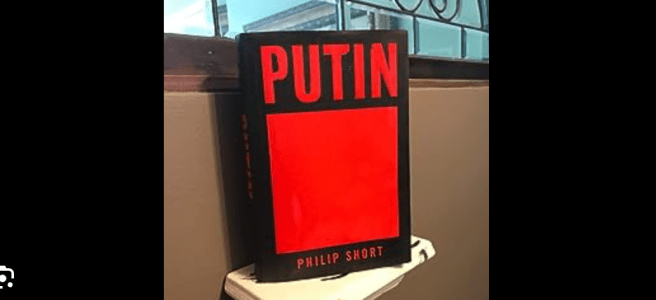
When I recently read a review of several recent biographies of Putin, I noticed one was praised for its relative objectivity. So, I decided to read it. The author is Philip Short, a British journalist who has written biographies of other American “enemies” such as Mao and Pol Pot. The book has a simple title: Putin (no subtitle) and was published by Henry Holt. The manuscript was completed in April 2022, so it does include a discussion of the lead up to and early months of the Russia/Ukraine war.

I would like to share a few thoughts stimulated by my reading. I was glad I read the book. I found it to be pretty carefully researched and reasonably objective. I didn’t love reading it, and it is very long (864 pages total, including 140 pages of end notes)—though the writing is clear and generally irenic. The book helped satisfy my curiosity and provided some useful knowledge and analysis to put the present situation in context.

I appreciate that Short does not treat Putin as “a kind of amoral superman.” Perhaps his relative objectivity will lead those who are US/NATO apologists to criticize him as a Putin defender—but I think that is far from the truth. In fact, I think in the end this book does still give too much of the benefit of the doubt to the US/NATO agenda, but I have no hesitation in recommending it to others who are interested in trying to understand Putin and Russia. It makes a good contribution. Let me share a few observations that follow from my reading.

Continue reading “Trying to understand Putin and Russia better”

And they call it democracy…. Critical thoughts on America’s proxy war

Ted Grimsrud—August 24, 2023

[Early in 2022, after Russia greatly accelerated its military engagement with Ukraine, I wrote several blog posts and then some shorter posts on Facebook with my reflections. After all these months, I decided to re-engage these issues as the war continues unabated. Here are several recent Facebook posts.]

War, what is it good for? Absolutely nothing! (August 3, 2023)

War almost always ends up way worse than those who initiate it expect. Classic examples are the American Civil War and World War I, in both cases famously entered into by all sides with the expectation the war would be quick and victorious. What followed were the two worst bloodbaths in human history up to the time with indecisive results. American history in the past 75 years is full of case after case of this dynamic (e.g., Korea, Vietnam, Iraq, Afghanistan).

Almost certainly, Russia expected its direct military intervention in the Ukrainian civil war to end quickly back a year and a half ago. There is a chance it might have had the negotiations of the Spring of 2022 managed to reach a conclusion. However, Ukraine pulled back, and the current devastating war of attrition accelerated with no happy ending in sight.

More controversially, some observers are suggesting that the US/NATO side of this conflict was also a miscalculation that is leading to profoundly negative unanticipated consequences for that side. One of these observers is the American political scientist John Mearsheimer, a professor at the University of Chicago. Mearsheimer is often categorized as a “realist” who, it could be said, believes in the American Empire but believes many of the past and current actions of the empire are ill-considered and self-defeating.

In a recent interview, he reemphasizes his perception that the Ukrainian counteroffensive against Russian forces in eastern Ukraine right now is essentially a hopeless operation and has been from the start. The West pushed Ukraine into this operation, but to Mearsheimer, it was “like encouraging them to launch a suicidal offensive that is completely counterproductive.” Why the push? “The West is very fearful that time is running out, that if the Ukrainians don’t show some significant success on the battlefield in the year 2023, public support for the war will dry up and the Ukrainians will lose—and the West will lose.”

Continue reading “And they call it democracy…. Critical thoughts on America’s proxy war”

Vindication (Revelation, chapters 17–22)

Ted Grimsrud—August 11, 2023

[This is the fourth in a series of four posts on the book of Revelation. The first is “Reading Revelation with an Anabaptist Sensibility.” The second is “The pattern of Jesus (Revelation, chapters 1–5).” The third is “Healing amidst the chaos (Revelation, chapters 6–16).” ]

I believe that one of the key points that Revelation consistently makes is that the victory of God has already been won—this is emphasized most clearly in the vision in chapter 5 of the Lamb who takes the scroll. However, the book nonetheless does play along with the idea that there still is something important to come. It does have a forward movement and a sense of culmination at the end. As we finish our look at Revelation in this post, I want to discuss two visions that portray some sort of final conflict (the judgment of Babylon in chapters 17 and 18 and the “battle” with the Rider on the white horse in chapter 19), and then end by looking at the end of the book, the vision of New Jerusalem.

The judgment of “Babylon” (17:1–18:24)

The visions in chapters 17–18 focus on the destruction of the city of the “destroyers of the earth” alluded to 11:18, where we read that the time has arrived to destroy those who destroy the earth. I think this sense of movement in the plot of Revelation leading up to the visions in 17–18 is meant to give a sense of how God is involved with the world, including overcoming the evil Powers and bringing healing. The destroyers of the earth are who God takes on, not the earth itself. The natural world in Revelation is the object of healing love—including human beings. Revelation makes a clear distinction between the evil Powers and the human beings who affiliate with them.

Chapters 17 and 18 portray how “great Babylon” (16:19) is taken down. We need to read these visions carefully to see that evil Powers are punished, not evil people. “Babylon” refers to the human city as organized against God. It is closely affiliated with the Beast, and hence, the Dragon, but not identical with it. For John, the Beast was seen in the Roman Empire, but the way the visions are presented makes it clear that the image is broader than simply that one manifestation. “Babylon” refers to all empires, all domination systems. Revelation tells us that it will be the Beast and Dragon that are destroyed in the lake of fire. Babylon’s ultimate fate, though, is left ambiguous. I note the presence of the kings of the earth in New Jerusalem; these are Babylon’s human leaders. So, may we hope that Babylon is not so much destroyed as transformed? Let’s think about that.

Continue reading “Vindication (Revelation, chapters 17–22)”

Healing amidst the chaos (Revelation 6–16)

Ted Grimsrud—August 9, 2023

[This is the third in a series of four posts on the book of Revelation. The first is “Reading Revelation with an Anabaptist Sensibility.” The second is “The pattern of Jesus (Revelation, chapters 1–5).” The fourth is “Vindication (Revelation, chapters 17–22).”]

In this post, I will focus on three passages from the middle section of Revelation, starting with the seal plagues in chapter six. Then, I will talk about how chapters 10,11, and 12 provide a counter-testimony to the plagues, a picture of how God actually does gain repentance. And third, I want to spend a bit of time looking at the famous vision of the Beast in chapter 13 and point out that that vision also includes the first part of chapter 14 and ends up being another version of the story about the Lamb’s victory.

I want to take just a second first, though, for a word about an approach to Revelation that is quite different from my approach. When I first became a Christian, I was taught to read Revelation as a book of prophecies about the future. The term “dispensationalism” describes the view that human history has been divided, by God, into seven distinct era or dispensations. We are currently in the fifth of the seven and may look ahead to the sixth (the millennium—by seeing the millennium in the future, dispensationalism has also been called “premillennialism”). The seventh dispensation will be the new heaven and new earth. As I learned more about this approach, I decided that I could not affirm it. I came to see Revelation as not being concerned with future prophecy (“foretelling,” we could say) but rather speaking to its present (“forthtelling”) and, like the rest of the Bible, by speaking to its present speaking to our present. Mennonites have long debated about this. I won’t say more about this view except that, again, I think Revelation is about the present world we live in and is most of all concerned with encouraging the following of Jesus in this life, not with what will happen in the future.

The patterns of human history (6:1–7:17)

So, let’s turn to Revelation 6. We note right away the vision of the Lamb breaking the seals in the chapter—an act that leads directly to the riding forth of the fabled “four horsemen of the Apocalypse,” bringing with them plagues of war, famine, and sickness. This comes as a shock given what we see in Rev 1–5, the Lamb’s peace witness. Let’s think carefully here.

We need to keep Revelation’s master vision, chapters 4–5 in mind as we turn to the rest of the book. The final vision of the book, New Jerusalem in chapters 21 and 22 brings a vision of the final healing. That is where the entire book is heading. But in between these two visions, we have others that offer what appear to be quite mixed messages about healing and judgment. First, we have the Lamb breaking the seals of the scroll. This is the scroll the Lamb was given by the One on the throne in chapter 5 that only he is worthy to open—and we should all want the scroll opened So, what’s going on? Note, first, that all the Lamb does is break the seals. The events that follow are not the contents of the scroll. The plagues are not the contents of the scroll; they simply accompany the seals to the scroll being broken. It would seem that, in some sense, to move toward the final healing (which surely is the actual content of the scroll) will involve going through these plagues.

Continue reading “Healing amidst the chaos (Revelation 6–16)”