Living in a broken world: Power, love and the plagues in Revelation [Peaceable Revelation #5]

Ted Grimsrud—January 15, 2021

I believe that the book of Revelation offers people in the contemporary world some helpful guidance—though not in the ways popular Christianity would have us think. Revelation is not a source of insights for fortune telling helping us to know the future before it happens. Rather, Revelation is, I believe, a meditation on the centrality of love as we seek to navigate a world in crisis. So, the argument I offer here goes against both those who think predictive prophecy is how Revelation is relevant and those who think the Bible as a whole—and certainly the Bible’s last book—is simply an ancient work with little to say that is relevant in any way today.

Two big problems

Let’s start with two general problems. The first is the problem of living humanely in our contemporary world. Such humane living seems to require that we seek to overcome, say, the brokenness of ever-present warism with its weapons of mass destruction, the all too present trauma of our nation’s legacy of white supremacy, the overwhelming impact of predatory capitalism and always worsening economic inequality, our emerging climate catastrophe and other ecological crises, and the curse of mass incarceration and its companion police brutality. How do we move ahead in such a world?

The second problem is more esoteric, but I believe significant, nonetheless. This is the problem of the visions in Revelation that portray a world undergoing several series of escalating catastrophes (or plagues). These visions seem to tell us that God initiates these plagues, and the standard interpretations across the theological spectrum generally understand these God-initiated plagues as acts of God’s punitive judgment. This very problematic view of God leads some to dismiss God and the Bible altogether and others to affirm a morally corrupt view of God. To believe that God brings punitive judgment often leads Christians themselves to become agents of the forces of destruction that exacerbate the crises mentioned above.

Is it possible that if we biblically interested Christians could resolve the problem of the plague visions that we would be better able to respond to the brokenness problem? I believe we are challenged to hold together our affirmations that (1) God is love, (2) Revelation is truthful, and (3) brokenness in our world is real. However, if the “truth” of Revelation is that God is the author of the plagues then we will have trouble being agents of healing.


Continue reading “Living in a broken world: Power, love and the plagues in Revelation [Peaceable Revelation #5]”

Hope and the embrace of our imperfect present [Theological memoir #8]

Ted Grimsrud—January 9, 2021

At some point when I was a child, perhaps seven or eight years old, I learned about the difference between a person called an “optimist” and one called a “pessimist.” Whoever explained this to me—it was probably one of my older sisters—used my mother as an example of an optimist. I didn’t really understand what I was being told very well, but from that time on I looked at my mom a bit differently. I hoped I could be like her.

“Optimistic” theology

It may be that my entire theological project—emphasizing peace, arguing for restorative as opposed to retributive justice, understanding salvation in terms of God’s mercy—has followed from the sense that I wanted to be an optimist too. I don’t really have a theory for why some people are optimists and others are not. I probably was inclined to be optimistic about life even before I learned what the word meant, saw it exemplified by my mother, and decided I wanted to affirm that approach. Still, I’d like to believe it is at least partly something we can choose, and that it is more compatible with the gospel to choose to be optimistic about life than not to.

At some point, about the time I finished college, I began to believe strongly in the importance of seeking social change—to oppose war and injustice and to try to move things in a peaceable direction. This belief especially took the shape for me of working in Christian communities and of researching and writing what I came to call “peace theology.” I tend to think that such work probably needs to rest on an optimism about life—we can change things, we can live peaceably, at least somewhat.

Continue reading “Hope and the embrace of our imperfect present [Theological memoir #8]”

A social gospel for the 21st century: Drew Hart’s creative synthesis

Ted Grimsrud—September 3, 2020

In his new book, Who Will Be a Witness? Igniting Activism for God’s Justice, Love, and Deliverance (Herald Press), Messiah College theology professor Drew Hart has given us a much-needed theological resource for embodying the way of Jesus in our troubled times.

A theology for Christian social engagement

The most attractive aspect of this engagingly written book is how Hart synthesizes three streams of Christian theology: (1) a Jesus-centered biblical radicalism that has a visionary suspicion of the mainstream Christian tradition, (2) a socially-engaged sensibility shaped by the black experience in America (a legacy Hart calls “the black prophetic tradition”), and (3) an Anabaptistic orientation that emphasizes the call to transformative nonviolence.

While Hart writes explicitly as a black theologian, what he provides is not a narrowly focused “contextual theology.” His first book, the well-received Trouble I’ve Seen: Changing the Way the Church Views Racism, focuses on the African American context. This new book, Who Will Be a Witness?, may in turn more accurately be understood as a much broader Christian theology of social engagement that Hart constructs through the lens of the black Christian tradition.

Thus, Hart’s book may be seen as a contemporary expression of what theological historian Gary Dorrien presents as “the black social gospel” in his recent magisterial two-volume history of that tradition in the United States. Dorrien argues that the black social gospel has been a perspective that speaks to all Christians with a profound awareness of the concrete relevance of the Christian gospel for life in this world. Like the great practitioners of the black social gospel such as Howard Thurman and Martin Luther King, Jr., Hart gives us a powerful challenge for all Christians to understand that at the very core of our faith lies a call to be an active presence in the world witnessing to God’s work of justice and healing. Continue reading “A social gospel for the 21st century: Drew Hart’s creative synthesis”

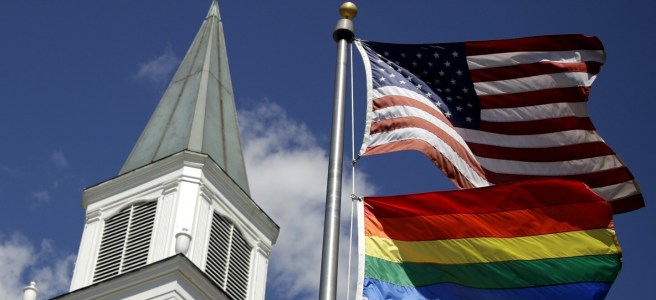
Is “schism” okay? What to make of the Methodist split [Theological memoir#7]

Ted Grimsrud—January 3, 2020

I just read a news report in the Washington Post, “United Methodist Church is expected to split over gay marriage disagreement, fracturing the nation’s third-largest denomination.” According to this article, the decision appears to have been a mutual one among the two major UMC factions, one that seemingly gives both sides much of what they want. That is, of course, if the new proposal is affirmed by the denomination’s legislative process.

I don’t have any close contacts in the UMC and have not been following the drama closely these past several years. So this article comes as a bit of a surprise to me. I don’t have any insights to offer on the Methodist drama. But the news strikes me as very interesting, and it has triggered a few reflections.

Can “schisms” be good?

I experienced first-hand, in a very small way, some of the anxiety related to churches splitting about 30 years ago. I began my first pastorate in a tiny Mennonite congregation in Eugene, Oregon, in 1987. After my first year, I was up for consideration for ordination. Conservative elements in the regional conference had an advocate on the conference leadership committee who blocked my ordination. One of the tools in his arsenal that gave him some power was the threat that a number of conference congregations would leave the conference if I were ordained.

After three years of painful deliberations, I was finally ordained. About the same time, two women pastors (one a congregational minister, the second a chaplain) were also ordained (the first women to be ordained in the conference, over the objections of many conservatives). As threatened, a couple of congregations did leave the conference. However, in a delicious irony, the congregation the leadership committee member pastored refused to leave the conference. Instead that pastor was asked to leave the congregation.

This was all pretty traumatic for me, and when the opportunity arose to pastor elsewhere, I did so—leaving Oregon in 1994. Over a quarter of a century later, I still deeply miss living in the state of my birth. However, I am grateful for the opportunities that opened up after we moved on. Continue reading “Is “schism” okay? What to make of the Methodist split [Theological memoir#7]”

Why the Bible need not be a problem for pacifists (Theological memoir #6)

Ted Grimsrud—December 16, 2019

I well remember the moment, though not the precise day. It was late in my final term of college in the spring of 1976. After quite a bit of thought and emotional struggle, I decided to affirm pacifism. I now find a bit surprising how little I knew about what it was I decided. I don’t remember having a serious discussion about the issue with anyone else, or hearing a sermon or lecture on the topic, or having read anything explicitly about pacifism.

The context for a conversion

Something was in the air, though, in our culture. The Vietnam War had just ended. I just escaped the draft as it was ended the year that I became eligible for it. I had learned to know several vets who told horror stories of their experience in the military. Perhaps more than any time before or since, precisely at the moment I became a pacifist the US military was unpopular. Society saw war as pretty problematic.

Both my parents served in World War II and my oldest sister married an Army officer—so I certainly did not grow up in an anti-military family. But I never wanted to join in. My dad, brother-in-law, and high school guidance counselor all urged me as a high school junior to try to get into a military academy. But I did not for one second have interest in that path. I knew nothing about the conscientious objection option, but I always dreaded the idea of going to war.

I had had a Christian conversion about a month after my 17th birthday. A huge event in my life, it shaped everything I did after it happened. Interestingly, at first, becoming a Christian moved me away from my vague anti-war sensibility. The church I soon joined viewed the military quite favorably. I heard sermon after sermon that presented going to war as a noble endeavor for a patriotic American Christian. For me, though, my seemingly innate reluctance to embrace violence kept me from internalizing that Christian warism. The fundamentalist theology that congregation taught me never did sink very deep into my soul, but it did dull my intellectual curiosity for my first several years of college.

Finally, during my senior year of college I began to expand my horizons. I discovered Dietrich Bonhoeffer and Jacques Ellul. Surely their pacifist sensibilities effected me even if I did out realize it. I did realize that I truly did want to have an intellectually rigorous faith and that I saw what Bonhoeffer called “discipleship” as the most faithful manifestation of biblically oriented Christianity. I also discovered Sojourners magazine and Francis Schaeffer and his acolytes, especially Os Guinness.

While reading Guinness’s book, The Dust of Death, I took the step of embracing pacifism. Later, I realized that Guinness did not actually advocate full blown pacifism. He drew on Ellul’s book, Violence (which actually does essentially espouse pacifism), to argue against a certain kind of violence—the revolutionary violence of the Left. So it wasn’t that Guinness persuaded me to be a pacifist so much as that his critique of violence served as a catalyst to crystallize various currents that had been coming together in my heart. Continue reading “Why the Bible need not be a problem for pacifists (Theological memoir #6)”

War of words: The key to understanding the book of Revelation (Peaceable Revelation #2)

Ted Grimsrud—July 22, 2019

A high percentage of people who are interested in the book of Revelation believe that it is a book about violence and God’s punitive judgment. They take, for example, the imagery of blood flowing for miles as high as a horse’s bridal (14:20) in some literal sense as a vision of a future total war that will destroy God’s enemies and lead to the coming of New Jerusalem. Some of those who interpret Revelation in this way are horrified by such imagery and believe that its presence is a good reason to dismiss Revelation out of hand. Part of the vehemence of this dismissal follows from the presence of many more interpreters who actually welcome this violent vision as evidence that they will be united with God in eternity and that God’s enemies will be condemned to everlasting torment.

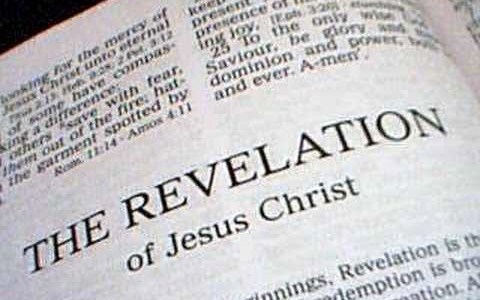
I think this future-prophetic approach is simply wrong. It fails to recognize the symbolic character of the imagery of Revelation. Partly this is due to a failure properly to understand the message of Jesus from the gospels as being a message of peace for this world. These interpretations then add another failure to that failure, which is to fail to recognize that the character of the Lamb in Revelation reveals that this imaginative book itself also brings a message of peace. I am convinced that we read Revelation appropriately as being in full harmony with the life and teaching of Jesus presented in the gospels. When Revelation 1:1 tells us that what follows is a “Revelation of Jesus Christ,” it makes a point that is indeed to be taken literally: the purpose of the account of this “revelation” is to help us better to follow the way of the Jesus of the gospels.

The “harshness” of Revelation

Of course, Revelation does contain some harsh appearing imagery (such as the flowing blood of 14:20, the devastating fall of the “Great Harlot” in chapter 17, the destructive sword of 19:11-21, and numerous others). However, the book makes it clear that its governing image is that of the Lamb, who wins the victory the book celebrates with his self-giving love (see especially 5:5-14 and 12:10-11). If we read the book in light of this governing image, then we will come to a different understanding of the “war” that is portrayed in the book—and of the means to fight that war that the book advocates.

The book does use the image of the “Lamb’s war” (17:14). When we note all the other violent imagery, it is understandable that peaceable people would find it difficult to embrace the war image. Several years ago I gave a paper on Revelation at a conference on “compassionate eschatology” (“Biblical Apocalyptic: What is being revealed?”) making the case for the Lamb’s war being a peaceable image. One audience member argued strongly with me, and I never did convince her. I respect her sense that we need to reject the use of war imagery of Jesus because that imagery is irredeemable in our modern world. At the same time, this is the imagery we have, and I tend to think that by embracing the imagery in Revelation and orienting it in light of how the book actually uses that imagery we may find important resources for actively resisting the domination system we live in the midst of. Continue reading “War of words: The key to understanding the book of Revelation (Peaceable Revelation #2)”

Losing inerrancy (Theological memoir #2)

Ted Grimsrud—July 10, 2019

When I was 17 years old, almost exactly 47 years ago, I made a decision to become a Christian. At the time, my motivation was that I wanted to know the truth. As a thoughtful, idealistic adolescent, I thought about truth a lot. I didn’t have many people to discuss this with, hardly any actually. But I was thinking and thinking.

I was ready to make a move, though, and I did get an explanation from one close friend that I found persuasive. So I took the step of asking Jesus to be my savior. I truly meant it, and my life did change—mainly, I’d say now, in terms of consciously thinking of myself as a Christian and getting involved in a local church and trying to follow the guidance I was then given in that church. I also began to pray and to read the Bible.

As I think about it now, I find it helpful to separate two basic ways of entering Christianity with a desire to “know the truth.” There may be others, perhaps many, but these are the two that come to mind now.

The first, is that Christianity offers a truthful explanation for the meaning of life that one accepts as authoritative. The Christian’s task is to grow in acceptance of that explanation, that authoritative teaching of what is true. This approach offers a sense of certainty and security along with the comfort of knowing that one is on God’s side and will spend eternity with God. The Bible works as a repository of facts, definitive commands, direct guidance, the way God speaks to human beings—a detailed blueprint that offers absolutes that are over against other truth claims.

The second way is to think of the truthfulness of Christianity as a prod to the imagination, a kind of lens for looking at life in the most perceptive way possible. In this approach, Christianity offers a story that helps connect with other stories. The Bible is perceived to be a master story that helps uncovers truths told in other stories.

Without realizing it at the time, I was looking for truthfulness in the second sense, I was looking for a way to feed my imagination—and I found myself in a community that presented Christianity as being truthful in the first sense. I’d say now that I experienced enough of the kind of truthfulness that I was looking for to keep my faith alive. However, my first four years or so as a Christian were pretty uninteresting, even stilted. These years included my senior year in high school and my first three years in college. I have a hard time remembering ever being excited about anything intellectual. I feel like I was kind of in a daze during that time, more or less sleepwalking through my classes and reading light stuff just for fun in my spare time. As I think of my experience of the Bible, it illustrates what my overall Christian experience was like. Continue reading “Losing inerrancy (Theological memoir #2)”

Revelation for post-Christians (Peaceable Revelation #1)

Ted Grimsrud—June 27, 2019

Let’s imagine a bright, compassionate, spiritual-not-religious churchgoer—I’ll call him “Justin.” “Justin” is a person who grew up in a fairly traditional Christian home. He experienced church as a relatively benign part of his life, though he never took the belief system very seriously. He got married fairly young to someone with a similar background, became a schoolteacher, and had a couple of kids. He’s politically progressive and likes hanging around with like-minded people.

“Justin” would not necessarily call himself a Christian—he’s repulsed by the current expression of popular conservative Christianity with its support for Trump. But he also wouldn’t call himself an atheist and he is comfortable being active in his local congregation. We could say he’s a “post-Christian” (in distinction from anti-Christian atheist, secular humanist, or even unaffiliated agnostic). What would you expect that “Justin’s” attitude about the book of Revelation would be?

If he has given it any thought, I would assume that “Justin” would think Revelation is pretty bad. He wouldn’t feel any obligation to give it the benefit of the doubt because he has no loyalty to each book in the Bible as inherently authoritative and normative. He may know about how Revelation is used as predictive prophecy by conservative Christians to, for example, justify blind support for Israel’s vicious policies toward Palestinians. He also may know that Revelation is often cited as a basis for belief in a near future terrible “Tribulation” that will lead to great punitive judgment for most of the world—and the miraculous rescue in the Rapture of conservative Christians. All this seems quite repulsive to “Justin,” and he has no reason to doubt that these views are an accurate interpretation of Revelation itself.

I would like to invite “Justin” to give Revelation a chance. I think there are good reasons for post-Christians (as well as pre-Christians and current Christians!) to look to Revelation for hopeful and inspiring guidance. I will sketch a few of those in this post, recognizing that a positive appreciation of Revelation is a learned disposition—and one that requires some nuanced reading. I can only be suggestive in the short space I have allotted myself here, and point to further explanations I have given elsewhere. Continue reading “Revelation for post-Christians (Peaceable Revelation #1)”

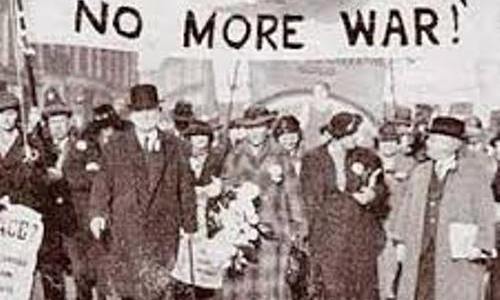
Pacifism in America, part one: The roots of war resistance

Ted Grimsrud—May 31, 2019

The United States has an extraordinarily ambivalent legacy when it comes to war and violence. On the one hand, we originated, in the view of many, as the victor in a war of rebellion against the British Empire; we have engaged in war and after war throughout our history; we are the only country ever to drop a nuclear weapon on another country; and now we are the world’s one “superpower” that spends more on its military than virtually all the other countries in the world combined.

Yet, on the other hand the United States has a long legacy of peace movements, acceptance of the rights of conscientious objectors, and the development of philosophies of nonviolent social action. The US from its early years provided a home for members of the “historic peace churches” and provided them a largely persecution free home in contrast to many other places in the world that had driven pacifists out.

I recently listened to an interesting series of podcasts on the history of nonviolence that reminded me of much of the peace legacy in the US. The third season of “The Thread” focused on the history of nonviolence. In six episodes, the series discussed key figures in that “thread,” moving backwards from Martin Luther King, Jr., to Bayard Rustin to Mohandas Gandhi to Leo Tolstoy to William Lloyd Garrison. There are many details in this series that I could nitpick about, but overall I found it interesting and inspiring—and I would recommend it.

One inspiration that emerged for me was to post some things I have learned about this history. I will share some thoughts in several installments about the history of pacifism in America, starting today with background to the emergence of pacifist opposition to World War II—opposition that obviously had little impact on the execution of that war but that planted seeds for a number of significant efforts to oppose war and injustice nonviolently in the decades that followed. Continue reading “Pacifism in America, part one: The roots of war resistance”