Why Pacifism?

Ted Grimsrud—August 12, 2012

[I just came across this sermon from just over nine years ago. It says some things I still want to say. Shalom Mennonite Congregation—July 6, 2003]

As I thought about this sermon, my dad came to mind. Next month will be nineteen years since he died. I have happy memories of my dad. He was a loving father, somebody I was always proud to be associated with. But my dad was a warrior. In 1940, as a recent college grad and aspiring history teacher and coach, he decided to enlist in the Army. This was more than a year before Pearl Harbor. My dad certainly wasn’t a warmonger, but he felt a strong sense of loyalty to his country.

My dad spent four years fighting against the Japanese. He was wounded, contracted malaria, and saw his best friend (whose name was Ted) killed before his eyes. Now, I knew my dad as a gentle person. He never owned a gun—and we lived in a rural area where almost everyone did have guns—because, he said, he had seen enough guns for a lifetime.

Nonetheless, he always valued his wartime experience, though he rarely talked about it (he actually didn’t talk much about anything). One time he did speak of the war to me. I was 17 and facing the possibility of being drafted. My dad told me what a good experience he had in the Army and encouraged me to attend a military academy so I could go in as an officer instead of a flunky enlisted man. I wasn’t tempted, he didn’t push me, and we never talked about it again.

The interesting thing to me as I reflect on all this now is that my father grew up in a good Christian home. His father and one of his grandfathers were Lutheran pastors. Apparently, my father never saw a tension between being a warrior and being a Christian. I can’t imagine that I ever could have asked him about that, but I wish I had. But this is what I think. I think that my father never questioned the legitimacy of patriotism. He saw no conflict between following his government and following Jesus. I think it never occurred to him that God and Caesar might be competitors for his allegiance…. I wish it had. Continue reading “Why Pacifism?”
Pacifist apologetics

Ted Grimsrud—June 20, 2012

Christian pacifism faces an uphill climb in contemporary America. Since 1940, our country has embarked on a massive effort at world domination based on military firepower. This could be seen as the logical progression for a country whose founding rests squarely on warfare and other forms of violent conquest. And the Christian churches have, as a rule, joined enthusiastically in this project. Hence, today in the United States people self-identified as Christians are more likely than non-Christians to support war and the death penalty.

And yet, American Christianity has always produced, or at least tolerated, counter-voices. The Religious Society of Friends (Quakers) established themselves in colonial Pennsylvania in a remarkable effort to try to operate a political system heavily influenced by pacifist convictions. The results were mixed, to say the least. One clear achievement, though, was to establish a haven for religious freedom that drew other Christian pacifists to Pennsylvania—most notably Mennonites, Amish, and Brethren.

In the nineteenth century, some of the world’s first peace societies emerged in Antebellum America, and these often linked with abolitionist efforts. The Civil War more or less put an end to such activist pacifism, but that war also saw pioneering efforts by the state to accommodate conscientious objectors. Still, part of the reason the state could be open to tolerance of pacifists was because their numbers were so small.

In the twentieth-century, in face of terrible, unbelievably destructive world wars, the numbers of Christian pacifists grew significantly, and well beyond the Historic Peace Churches (Quakers, Mennonites, Brethren). However, when the United States entered an enormously popular war against Germany and Japan in 1941, the numbers of legal conscientious objectors totaled about one per 1,000 young men who joined the military—and the large majority of all of these soldiers were Christians.

From the start, Quakers worked hard to convey their convictions to the wider world—one term they used of their work was “publishers of truth.” Other pacifists in more recent generations have also taken up the challenge to try to present attractive and persuasive arguments for their convictions. And some fine literature has been produced. But we always need more.

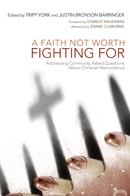
So this new collection of essays, Tripp York and Justin Bronson Barringer, eds., A Faith Not Worth Fighting For: Addressing Commonly Asked Questions about Christian Nonviolence (Peaceable Kingdom) (Cascade Books, 2012), is to be welcomed. I am not aware of any other single, relatively short, volume that tries to address as many challenges to pacifism. Several of the essays make particularly excellent contributions to the task of defending pacifism, and all the essays are well worth reading. Continue reading “Pacifist apologetics”

Christian attitudes toward war: Rethinking the typology

Ted Grimsrud—April 9, 2012

The challenge for Christians (and everyone else, of course) to think morally about warfare and the preparation for warfare remains as important, if not more important, than ever. Fortunately, Christian moral theologians have brought forth a bit of a revival of such moral reflection with a number of recent books after many years of relative quiet in this area.

These are a few of the books that I am aware of: Daniel M. Bell, Jr., Just War as Christian Discipleship (Brazos, 2009); Mark Allman, Who Would Jesus Kill? (Anselm, 2008); W. Michael Slatterly, Jesus the Warrior? (Marquette University, 2007); A. James Reimer, Christians and War (Fortress, 2010); J. Daryl Charles and Timothy J. Demy, War, Peace, and Christianity (Crossway, 2010); and Andrew Fiala, The Just War Myth (Rowman and Littlefield, 2008).

In general, though, writing about moral reflection on war and peace from Christian perspectives tends to repeat the general typology that was introduced by historian Roland Bainton over half a century ago in his Christian Attitudes Toward War and Peace. Bainton sees three categories: pacifism, the just war, and the crusade.

In a short discussion in a textbook I use in my introductory ethics course, Robert Stivers reiterates Bainton’s typology, though he somewhat confusingly uses the term “Christian realism” for the just war type (Robert Stivers, et al, Christian Ethics: A Case Method Approach, 3rd edition [Orbis, 2005]). Like Bainton does, Stivers presents the “crusade” type as essentially being a thing of the past for Christians, meaning that what we have to do with mainly is pacifism and just war.

The more I think about it, though, the more problematic I see this typology to be—at least in the sense that it leaves too much out and over-simplifies what is left. One of the main problems is that only a tiny minority of Christians would hold to either pacifism or the just war (as usually defined). Continue reading “Christian attitudes toward war: Rethinking the typology”

Our fathers’ war

Ted Grimsrud—December 26, 2010 

Several months ago, I embarked upon a big project of trying to make some sense of the moral impact of World War II on the United States. I have done quite a bit of reading, speaking, and writing so far—aided by the blessing of a sabbatical from my teaching responsibilities at Eastern Mennonite University. This lecture especially summarizes some of what I have been thinking about. Here is the link to the rough drafts of the chapters to this book.

One theme has arisen for me that I did not anticipate when I started. That is thinking a lot more about my own father’s involvement in this war and how that involvement might have had an impact on our relationship. I was the fourth of my parents’ five children, but the first and only son. On the surface, I can think of several ways the war shaped my life—I was named after a friend of my dad’s who died in combat during the war, my parents met each other because of the war, and the new medical technology that saved my life when I was born (blood transfusions) would likely not have been available had it not been for the war.

Something I had not really thought about until I started on my project, though, was the trauma the war inflicted on those who fought in it. It makes a lot of sense to imagine the terrible trauma on the people in the many parts of the world who endured the fighting first hand, and the trauma for those societies that poured heart and soul into the fight and lost, and the trauma for the loved ones of the millions upon millions who lost their lives in the war (including about 400,000 American soldiers).

But what about the soldiers who fought on the winning side, who returned home physically whole to a country largely unscathed by the conflict, and who went on to live successful lives? That is, what about people like my father? Continue reading “Our fathers’ war”