Conclusion: A Christian pacifist in the American Empire [part 2]

Ted Grimsrud—November 21, 2025

I have found Christian pacifism, properly understood, to be a most helpful framework as I try to understand the world I live in. In this series of 24 blogposts, I explain how I came to affirm pacifism and what it means for me. I have also showed how my pacifism shapes the questions I raise and criticisms I offer in relation to the American Empire. In this final post, I offer reflections on moving forward to live in the Empire in light of pacifist convictions.

Rethinking power

Christian pacifism posits two central affirmations— (1) We are called to resist and to seek to overcome evils in the world (“evil” most simply understood as that that harms life) and (2) We must work against evils in ways that do not add to the evil. The practice of pacifism helps us hold these two affirmations together. Committed to overcome evils, we engage the American Empire, the source of so many evils in our world. Committed not to add to the evil, we seek to find consistently nonviolent means as we strategize and act. One of the main ways human beings have tended to add to evil is to resist the wrong through the use of violence and coercion.

The American Empire cannot realistically be transformed in any immediate way. To try too hard to transform the Empire may lead us to take moral shortcuts that change us in ways that result to our actually adding to the evils that the Empire is doing. Violent resistance uses evil means to seek what might be good ends and may transform the effort into something that adds to the evil. On the other hand, many people try to reform the Empire through efforts that all too often actually result in compromise with the Empire on key issues and little genuinely changes.

We should recognize, then, the problematic character of conventional, top-down politics. Let’s use the term “Constantinianism” for politics that both tries to control history by making it turn out right and uses top-down power that is coercive and dominating. The embrace of such methods ensures that our efforts will add to evil, not overcome it. Pacifism understands power in a different way. It recognizes that we are not in control and that the only way to overcome evil is always to act consistently with love. One of the great insights of Gandhi and King was to recognize that ends and means must go together. We only achieve genuine healing when we act in healing ways. Violent and coercive means cannot achieve healing ends.

Continue reading “Conclusion: A Christian pacifist in the American Empire [part 2]”
23. Conclusion: A Christian pacifist in the American Empire [part one]

Ted Grimsrud—November 18, 2025

My journey as an American citizen may be characterized as a radical reversal. I switched from a young adult ready to take up arms to serve the wishes of my nation’s leaders to an advocate for unrelenting resistance to those wishes. The reversal happened quickly back in the mid-1970s due to an intense simultaneous immersion in both a pacifist reading of the message of Jesus and a critical reading of the American Empire in light of the American war on Vietnam.

My sincerity in wanting to follow Jesus helped me to turn from the uncritical nationalism I grew up with. Jesus’s message helped me be ready to see the immorality of my country when it became apparent in unprecedented ways at the end of the war on Vietnam. The timing was significant. The hold of my embedded theology of uncritical nationalism was weakened due to Vietnam at precisely the moment I encountered the pacifist Jesus for the first time.

These blog posts have traced how I have deepened both the biblical grounding for my peace theology and my critical interpretation of the history of the American Empire in the years since 1976. I read that history through the lenses of Christian pacifism. Those lenses helped me ask questions I never would have imagined as long as I affirmed the uncritical nationalism I grew up with. When I have learned how the dynamics of imperialism have always shaped US policies, I have seen an endless series of choices for domination and exploitation that have determined the character of my country—a character full of violence, domination, and exploitation. Such choices have put the country on what now seems like an irreversible path to self-destruction.

In this concluding set of reflections, I think about how Christian pacifist convictions might contribute to the task of moral engagement within our empire. As I accept this task with utmost seriousness, I also recognize the relative powerlessness of the Christian pacifist. We do not command a massive following that we might mobilize to transform society. And the kind of power we seek to exercise is the power of service, of presence with, of compassion and love. That is, it is a kind of powerless power.

Continue reading “23. Conclusion: A Christian pacifist in the American Empire [part one]”

A second conversion and a new community

Ted Grimsrud—September 30, 2025

War and peace concerns filled the air during my college years (1972-76). I had to face the possibility of being drafted. I would have gone if called but did not like the idea. The draft ended the year I turned 19 and saved me from that. Then, I learned to know several returning Vietnam War vets. Those encounters showed me how traumatic their experience had been. I never had any kind of discussion in any of my churches about a principled opposition to war. No one ever said in my presence, to quote a John Prine song of the time, “Jesus don’t like killing, no matter what the reason for.” I am not sure I could have said what “pacifism” even meant. But the idea of going to war did weigh on my mind.

A decisive step

All of a sudden, though, something clicked for me. I took a decisive step, once and for all, and decided against war. I realized that I could never take up arms, and that in fact Jesus always opposed violence no matter how it might be justified. I did not make this move due to careful, thorough conversations with like-minded friends. I simply, at the right moment, accepted this conviction. That move set the direction of the rest of my life.

Though my turn toward pacifism meant a decisive turn away from Francis Schaeffer, he had pointed me toward an influence that became the catalyst for my pacifist conversion. I had discovered that Schaeffer had interesting colleagues such as a British scholar, Os Guinness. Guinness’s book, The Dust of Death, offered a wide-ranging and sympathetic critique of the American counterculture of the 1960s. He did note with respect the problems with American culture that protesters cried out against. He recognized the need for social change as advocated by the civil rights movement, the emerging feminist movement, and the antiwar movement. He affirmed many countercultural concerns but brought into the picture a Christian sensibility.

In the Spring of 1976, I read Guinness’s chapter, “Violence: Crisis or Catharsis?” He critiqued of the counterculture’s advocacy of violent revolution. He drew heavily on a French sociologist, Jacques Ellul, whose book, Violence: Reflections from a Christian Perspective, gave a good critique of the self-defeating nature of violent revolutions. It came clear to me—Yes, violence does not work! I immediately thought of war. I realized that I could never go to war. I realized I was in principle opposed to all war, a pacifist. Happily, I was so unfamiliar with that term that I did not recoil against it. I accepted it, found it helpful, and still do.

Continue reading “A second conversion and a new community”

How does one step away from warism?

Ted Grimsrud—September 26, 2025

When I began college in the Fall of 1972, I had recently registered for the draft. I knew I’d go willingly if called. I accepted my place in the American warist environment—the willing conscript. By the time I finished college in the Spring of 1976, I rejected warism. I considered myself a pacifist and knew I would never go to war or support war in any way. This post will describe what led to this radical change. In the Fall of 1972 turmoil reigned in the United States. At that point I remained mostly oblivious to the currents that swirled as Richard Nixon wrapped up his presidential campaign and won a landslide victory—and planted the seeds that led to his fall with the Watergate break-in. I knew that the Vietnam War seemed to be winding down, though when I started my freshman year the draft remained a possibility.

I started at Oregon College of Education (OCE) in Monmouth, a small town about 15 miles west of Salem. OCE mainly focused on training schoolteachers, but it had evolved to be a general liberal arts college. About 3,000 students attended, mostly from small Oregon towns. Even though I knew hardly any other students, I felt surrounded by people like me. I found it to be a pleasant place to be, and I enjoyed my two years there. I felt fine with my classes. I could get by pretty easily, though nothing really caught my attention. Sports, not ideas or big questions, provided the connecting point with my new friends. In general, I experienced my first two years in college as a relaxed and congenial time. However, I did feel uneasy about my faith. I only cautiously brought up faith convictions with others. I had no luck in finding a church or fellowship group. I visited a few places but found nothing that seemed interesting or nurturing.

The ironic 1972 presidential election

I had exulted when Richard Nixon won the 1968 election. As far as I remember, I felt positive about Nixon during his first term. I certainly sympathized with him far more than his antiwar opponents. I rejoiced when the law changed to set the voting age at 18. I had long wanted to vote. I delighted that the first presidential election after the law changed would happen when I was 18. I proudly cast my ballot for Nixon and celebrated his resounding victory.

That I would have so unthinkingly supported Nixon indicates that my embedded theology of uncritical nationalism remained operative. I later learned of deeply problematic Nixon warist policies as well as of his many character flaws. Those flaws played out in ways that would have been in tension with the values of my familial embedded theology, but at the time I remained ignorant of them. Ironically, Nixon’s opponent, George McGovern, had more compatibility with most of my values. His integrity, genuine Christian faith, and convictions about helping life be better for vulnerable people should have rung true for me. In relation to the peace convictions I would later embrace, McGovern stands as the most attractive major party candidate in the entire 20th century. The mainstream media did not give McGovern a fair shake, but even if they had, I would not at that time have been attracted to the policies he advocated.

Continue reading “How does one step away from warism?”

Resistance to the American Empire

Ted Grimsrud—September 16, 2025

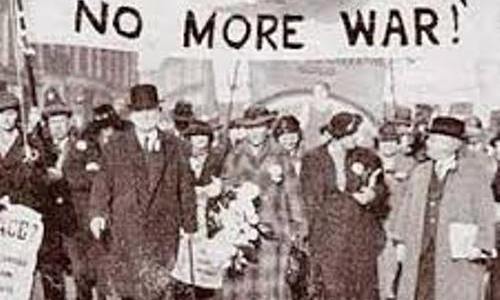
As the US embarked on a quest for world dominance after World War II, leaders’ quest for “full spectrum dominance” did not meet with total support from Americans. Opposition to newly expansive US warism received little media attention, though. It rarely effected policy makers. I knew nothing of the dissenters as a youth in my little corner of the world. For the story I tell in this series of posts, though, we should note the small pockets of dissent—both to indicate that American warism was not unanimous (people did dissent) and to recognize that the peace efforts that did shape my convictions beginning in the mid-1970s had important antecedents. 

Antiwar voices

In the late 1930s, many spoke in opposition to the US joining the War. Congress, which would not support a war declaration proposal from the president, did pass legislation for a draft in 1940, but only narrowly. Large movements of anti-war sentiment arose both from the right (the America First movement of traditional American isolationism) and the left (the popular antiwar movement that had arisen in the early 1930s after disillusionment with World War I). However, this war opposition almost immediately evaporated after the Pearl Harbor attack by the Japanese on December 7, 1941. With the Japanese attack the “America first” conservatives quickly jumped onboard in favor of what was widely perceived to be a war of national defense.

During negotiations in Congress on the draft, representatives from the various peace churches (led by the Quakers) managed to get alternative service for conscientious objectors included. With the popularity of the war and the government’s prowar propaganda, though, only a tiny fraction of draftees took the CO option. Most of the 12,000 draftees who performed alternative service were traditional, somewhat apolitical pacifists. Only a few thousand would have been opposed politically to the war effort. In addition to the legal COs, about 6,000 war opponents went to prison as draft resisters—though the large majority of those were Jehovah’s Witnesses whose refusal to cooperate with the draft had to do with the government refusing them ministerial exemptions, not their political opposition to the war effort.

Out of the tiny handful of COs that we could understand to be anti-empire did come important leadership for the resistance that found expression in years following. Imprisoned COs such as Dave Dellinger and Bayard Rustin developed their ideas about war resistance and nonviolent social change while spending the war years in prison and emerged afterwards as important peace movement leaders. It was also the case that the experience of many of the COs during the War had a significant formative impact. For example, numerous Mennonite COs shaped educational, service, and antiwar efforts among Mennonites and in the wider society in postwar years. Mennonite pacifism tried more to influence the wider world toward peacemaking.

Continue reading “Resistance to the American Empire”

Is pacifism relevant in the American Empire?

Ted Grimsrud—September 2, 2025

For the past fifty years, it seems, I have lived in increasing despair as an idealistic citizen of the United States. I have tried to think my way through what seems to be an irresolvable and terminal problem. As a child, I accepted that the US was a model society, guided by God to be a force for freedom and democracy in the world. This message formed a core part of my identity. Increased knowledge disabused my idealistic view of the US. I reached adulthood at the same time our military withdrew from Vietnam amidst many revelations of extraordinary injustices.

However, my idealism about freedom and democracy did not diminish. I turned my focus from the American nation to Christian communities. As I turned from blank-check nationalism (the willingness unquestioningly to let the state turn us toward war—what I call “warism”), I turned toward a strand of Christianity that understood the message of Jesus to be central for our social ethics. In the nearly half-century since those two decisive turns, I have struggled endlessly with a central dilemma. How do I live as an American citizen in the context of learning evermore of the injustices and idolatrous violence of the American Empire? I have developed a strong critique of this Empire based on Christian theology and a pacifist reading of the Bible. However, such work has placed me in the midst of another wrenching dilemma. I draw heavily on the convictions of a religion that is itself deeply implicated in the dynamics of the Empire.

I do not write in hopes of actually resolving these dilemmas. In offering a progress report, I mainly want to continue the struggle. I hope for more conversation on the issues I raise. I will present the case for Christian pacifism as a lens through which to view the Empire and the Christian faith. How does that make sense?

Continue reading “Is pacifism relevant in the American Empire?”

Pacifism in a time of war and chaos [American Politics #16]

Ted Grimsrud—March 10, 2025

I am deeply troubled by the wars and rumors of war, the social chaos, and the strong sense of pessimism that seem to be so much a part of our current situation. I also feel confused, uncertain, and relatively powerless. At such a moment, reflection on my core convictions is one way to steady my nerves, if nothing else. Almost exactly three years, a couple of weeks after Russia’s intensifying the conflict with Ukraine with their “special military operation,” I published a blog post on my Thinking Pacifism site that came out of such reflection, “Thinking as an American pacifist about the Russian invasion.” In this post, I want to update the thoughts I shared then.

“Pacifism” as a core conviction

It is challenging to be a pacifist in an environment with a strong cultural consensus in favor of military action. The United States has been deeply involved in the war that has been going on in Ukraine since 2014. When that conflict greatly intensified three years ago, the US prowar consensus also intensified, with both strong support for accelerated military aid for Ukraine and strong condemnation of Russia, usually couched as condemnation of Russian leader Vladimir Putin. It has been virtually impossible to find dissent from the insistence on support for war in the American mainstream media, among Democratic Party politicians, and in my social media circles. But this support for war is at odds with my pacifist convictions.

I do believe that being a minority, even a small minority, due to one’s convictions is not a good reason to weaken one’s convictions. We should, of course, always be open to testing the validity of our convictions in face of challenges. However, it is actually to be expected that pacifist convictions will not widely be shared when the cultural zeitgeist favors war. Rather than doubt the validity of my pacifist convictions, I want to ask how these convictions speak to my warist context.

I use “pacifism” here to refer to a fairly general belief. I use it as roughly equivalent to, say, being a humane person, a person who supports social and political self-determination for all people, a person who affirms the United Nations Universal Declaration of Human Rights. Pacifism affirms that to support war is antithetical to humane values, to the practice of self-determination, and to an affirmation of universal human rights. In what follows, when I use “we” I mean those of us who affirm these pacifist convictions (even if one may not like to use the term “pacifism” itself—I use this term as a convenient rubric for this set of convictions, but I care about the convictions more than the term itself).

Continue reading “Pacifism in a time of war and chaos [American Politics #16]”

The most important election? [American Politics #10]

Ted Grimsrud—September 16, 2024

I have always been interested in American politics and presidential elections. One of my oldest political memories is a dinner time conversation with my best friend’s family sixty years ago when we were lamenting that it looked like Barry Goldwater was going to win the Republican nomination over our more moderate favorites Nelson Rockefeller or William Scranton. I was ten years old. That was only the first of many disappointments for me about presidential politics.

Still, I feel like this current election is the worst in my lifetime. On the one hand, we have Donald Trump. Even with a long list of morally corrupt and warist predecessors, Trump seems to me to stand clearly as the worst person and worst leader ever to be president of this country. Yet, on the other hand we who cannot support Trump are given the major party alternative of a candidate who is up to her elbows in the administration of an overt and on-going genocide in Gaza and a US-initiated proxy war in Ukraine that is edging ever closer to a nuclear End Game.

The terrible irony for a peace-oriented citizen is that while we are being taught by the media that we live in a hyper-partisan age with extreme polarities between blue and red politics, on the issues that matter the most we face an implacable wall of bipartisan agreement. We don’t have the option of voting for peace. Both sides are all war, all the time. Probably the most disillusioning element of the consequences of Joe Biden’s 2020 victory over Trump has been the almost utter silencing of any kind of anti-war sentiment in the Democratic Party—certainly in relation to the proxy war in Ukraine and also largely in relation to the genocide in Gaza. The Democrats couldn’t even bring themselves to allow a short, innocuous, fully vetted speech from a pro-Palestinian speaker at their recent nominating convention.

Continue reading “The most important election? [American Politics #10]”

Did Jesus have a political philosophy? (Peace and the Bible #12)

Ted Grimsrud—February 2, 2024

I am finally returning from an extended break to continue my “Peace and the Bible” blog series. My most recent post, December 18’s “Peaceable politics and the story of Jesus” was the first that dealt with the New Testament after a number of Old Testament posts. I have several more planned on Jesus and then will consider some issues regarding both Paul’s writings and the book of Revelation. Before returning to my planned outline, though, I want to linger in this post on some issues that came up with my last one.

Politics, philosophy, and pacifism

I started by noting that the “Peace and the Bible” theme helps us focus on just how political the concerns of the Bible are. For most Christians, I imagine that point seems clearer in relation to the Old Testament than the New Testament. I suggested, though, that the New Testament actually “presents a kind of political philosophy” that has at its core “a commitment to pacifism, a commitment based on the centrality of Jesus Christ to the Big Story the Bible tells.” In thinking about this assertion, I decided I should reflect a bit more on what I am trying to say.

I pointed out that “Christians have tended to miss the social implications of the New Testament part of the story because of assumptions about both politics and Jesus.” One way to further analyze the issues is to suggest, in very much a general sense, that we might recognize two types of thinking about how to understand the cluster of issues related to (1) “political philosophy,” (2) “pacifism,” (3) “biblical faith,” and (4) “Jesus-oriented discipleship.” One way is to perceive that those items #1 and #2 belong to a certain kind of thinking and that #3 and #4 belong to a very different kind of thinking. The other way would be to argue for understandings of those terms that recognize that they all may (and should!) be understood together in a way that leads to redefining them all.

Continue reading “Did Jesus have a political philosophy? (Peace and the Bible #12)”

Arguments for a pacifist God [Peace and the Bible #6]

Ted Grimsrud—November 29, 2023

Ever since my “conversion” to pacifist convictions back in 1976, I have closely associated those convictions with my Christian faith. Early on I realized that pacifism was not a common conviction among Christians, but that never made me doubt what I had become convinced was true: The call to love our enemies and reject warfare should be something affirmed as a core and indispensable Christian commitment—for all Christians. I do accept that mine will almost certainly only ever be a viewpoint affirmed by just a tiny percentage of Christians. However, I still keep working at it—and hope for the best.

It took several years after my initial commitment to pacifism as a young adult to clarify the significance of that commitment for how I understood God. The faith community that I in time became a part of, the Mennonites, did not actually make belief in God as a pacifist a necessary part of its peace position. But I became convinced that for me it is. Let me explain why.

I will start with a simple definition for a complicated and contested term—pacifism. By “pacifism” I mean, in brief, the conviction that nothing matters as much as love for all human beings. And this love forbids using death-dealing violence (or supporting it) against anyone. To me, the term pacifism connotes a positive commitment to love, more than simply a tactical commitment to avoid violence. And, I believe, this commitment to love is grounded in a belief that God is love and that love is at the center of the meaning of the universe.

Argument #1: The biblical narrative

Certainly, the Bible gives us many images of God that are far from pacifist—angry, vengeful, even genocidal. However, it also gives us many peaceable images—merciful, forgiving, compassionate, deeply and universally loving. I think it is important to recognize that these various images are not all compatible. They cannot be harmonized. They have to be sorted through and weighed together. To me, the peaceable images are decisive. My first point, about the Bible, is that if we read it in light of its overarching narrative, what I call the Big Story, we will see that it presents God, ultimately, as pacifist.

Continue reading “Arguments for a pacifist God [Peace and the Bible #6]”