
The death of Jesus and the weakness of God [Peace and the Bible #14]

Ted Grimsrud—March 15, 2024

Christianity has focused a great deal of its theology on the death of Jesus and its purported cosmic significance. This emphasis has not had an altogether positive result. To mention just one of the problematic outcomes, viewing Jesus’s death as the necessary sacrifice that somehow enables God to offer salvation to sinful human beings has placed an act of terrible violence at the heart of Christian faith—thereby greatly weakening the peaceable impact of Jesus’s life and teaching. When some sort of punitive “justice” that needs to be “satisfied” by Jesus’s violent death is seen to be part of the essence of God’s character, it greatly increases the likelihood that Christians will also see themselves and their institutions as agents of such “justice”—that is, as agents of divinely approved violence. The long legacy in the “Christian” West of the state as the wielder of such violence in warfare and in criminal justice bears witness to the dark legacy of theological interpretations of Jesus’s death.

I suspect that part of the appeal for seeing Jesus’s death as salvific for Christian theology has been a large emotional investment in the notion of God being victorious and in control. If Jesus is God Incarnate and the Savior, how can it make sense that he would die such an ignominious death? How can it make sense that God would face such a defeat? How can it be that God’s control could be breached by such a horrendous and blasphemous act as executing the Christ? One way to understand traditional Christian atonement theology that makes Jesus’s death into such an efficacious act is to recognize it as a way to turn defeat into victory, to turn weakness into overwhelming power. But what if such a move actually has led to many problematic consequences—turning a peaceable story on its head and making it into a story that has underwritten a great deal of violence? And what if such a move actually misconstrues the story of Jesus’s death itself—and in doing so misses the main points of that story that would indeed have major peacemaking consequences? Perhaps it is no surprise that the truly peaceable and transformative message we find in Jesus’s life and teaching has been so seldom evident in the long history of Christianity these past 2,000 years.

Continue reading “The death of Jesus and the weakness of God [Peace and the Bible #14]”
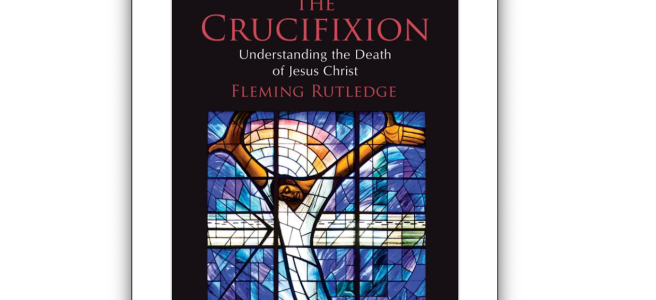
Why the cross of Christ is so hard to understand: A response to Fleming Rutledge’s The Crucifixion [Rethinking salvation #1]

Ted Grimsrud—August 10, 2021

When I was in seminary, with the help of my New Testament professor, I noticed and analyzed the connection between Jesus’s cross and the call to discipleship. It seemed like an obvious theme once I thought about it: Jesus taught directly, “Take up your cross and follow me.” What could he have meant but that his life of subversive peacemaking was our model, even as it led to his conflict to the death with the religious and political leaders? However, this was a new way of thinking for me—and it did not seem widely emphasized among Christians. The problem was that everything I had been taught about Jesus’s crucifixion had emphasized that it was a unique thing. He died so that we don’t have to.

Ever since then I have worked at trying to make sense out of this tension. Why is there such as difference between what Western Christianity (Catholic and Protestant) teaches about salvation, atonement, Jesus’s death on the one hand, and what the gospels themselves seem clearly to emphasize on the other? The difficulties pointed to by this question became even more acute for me when I read books such as Timothy Gorringe’s God’s Just Vengeance: Crime, Violence, and the Rhetoric of Salvation (Cambridge University Press, 1996) that show the historic connection between traditional atonement theologies that focus on God’s punitive disposition toward sinners and the actual devastating practice of punitive criminal justice in our world.

Fleming Rutledge’s The Crucifixion

This question was very much on my mind when I recently read Fleming Rutledge’s impressive book, The Crucifixion: Understanding the Death of Jesus Christ (Eerdmans, 2015). The book received great acclaim upon its publication. When I did a quick internet search, I found laudatory reviews from mainline Protestants in periodicals such as the Christian Century, a book of the year award from evangelical Christianity Today, and mostly positive reviews from conservative Reformed theologians. I noticed hardly any negative criticisms. The reviews present this book as an instant classic. As I worked my way through The Crucifixion, I could see why it was so well received and how it could appeal to such a wide array of readers. It is, in a nutshell, well-written, scholarly and pastoral, accessible and substantial.

Rutledge is a retired Episcopalian priest who writes with an evangelical sensibility. Her skill as a preacher shapes the book. She is deeply influenced by the core theological tradition—Augustine, Anselm, Luther, Calvin, and especially Barth. If anyone could help me make sense of my basic questions about the meaning of Jesus’s death, it would seem to be her. I suggest that The Crucifixion is the ideal one-stop account of the meaning of the crucifixion in the mainstream Protestant Christian tradition.

It’s a big book, over 600 pages of text, that to its great credit, reads relatively easily. I felt pulled along by Rutledge’s prose. And she marks the development of her argument with regular summaries and by linking back to earlier discussions as she moves along. Strictly on stylistic grounds, I would give the book a high grade and recommend it—though the final chapter disappointingly kind of petered out without achieving the apex of clarity and punch that the author had promised along the way (more on this below).

The point of my essay here, though, is to discuss why, in the end, I put the book down with some deep disappointments. I am disappointed, though, not so much with Rutledge as a writer and thinker as with the tradition that she actually represents so well. Her skill as an author actually would seem to make her the ideal guide. In just about every case, the points in the book that disappointed or frustrated me were due to her good work in articulating the issues. I think the reason that my starting question about the difference between the gospels’ story and the Christian theological tradition concerning Jesus’s death was not satisfactorily answered by this book is that the Western tradition simply is not set up to answer it.

Continue reading “Why the cross of Christ is so hard to understand: A response to Fleming Rutledge’s The Crucifixion [Rethinking salvation #1]”

Life in Death [Jesus story #13]

Ted Grimsrud—May 17, 2021

One of the great things about being around young kids is getting all these questions. I really enjoyed that when my grandkids were preschoolers. I guess the questions weren’t all always welcome—such as when you say it’s time to go home and one would say, “Why?!” But most of the questions are wonderful (even if sometimes hard to answer): What’s the difference between a fire engine and a pumper truck? Why are the lights off in the bank at night? How do they make fudgsicles? Why do we root for the Oregon Ducks? But the questions can also be a bit complicated. Why doesn’t Granny remember my name? What’s the earth? Why did G-Ma’s dog Trika die? Why don’t some children have beds to sleep in?

Questions are terrific. We need to encourage them. I am grateful to my parents for many things—one of the biggest ones is that they never made me think I shouldn’t be asking questions. Some great words for parents and grandparents to keep in mind come from British folksinger Ewan MacColl’s “Father’s Song,” that concludes with these lines: “Go on asking while you grow, child/ Go on asking till you know, child/ And then send the answers ringing through the world.”

One of the big questions

The grandchildren liked theological questions, too—I guess they came by those honestly. What’s the Bible? Where is God? What does salvation mean? We told them, well, these are good questions—and not just for four-year-olds. Then there’s our question for today: Why did Jesus die? Try explaining that to a four-year-old! Or to anyone else. However, like so many questions that are difficult to answer, we can learn by trying to come up with an answer—even if we know our answer will be weak or only partial.

Continue reading “Life in Death [Jesus story #13]”