Ted Grimsrud—October 28, 2025
In the posts that remain in this series, I want briefly to flesh out what we see when we describe without blinders the American Empire as it has emerged and functioned over the past 500 years. I consider this story with a critical perspective shaped by the biblical politics I have summarized above. I am especially concerned with how this Empire has embodied oppressive and violent sensibilities typically characteristic of the great empires of the world. A clear-eyed look at the American Empire may well lead one to recognize that it is not worthy of the kind of blank check loyalty it asks for.
The reasons that Europeans first moved to settle in North America varied greatly. Their impact, though, was to extend the newly emerging European empires with powerfully devasting effects on the inhabitants of the “new world.” Some Europeans stayed only temporarily, mainly having interest in profiting from their time away from home before they would return from the adventures and resettle in Europe. Many, though, intended the trip from the start to be one-way. Those who meant to stay in North America may be called “settler colonists.” Since they intended to stay, they needed to displace those already living on the land. Settler colonialism depended on violence. It reflected the basic assumptions of empire: The people not part of the core colonial community will be seen as “Others” who may be exploited, displaced, even eradicated.
Settler colonialism and Manifest Destiny
Imperialistic ideology had been central in the settling of North America and remained central to the identity of the newly established United States. The new nation continually expanded West, dominating and displacing the indigenous nations without pause. The land taken from the natives came to be worked by massive numbers of forcibly imported enslaved Africans.
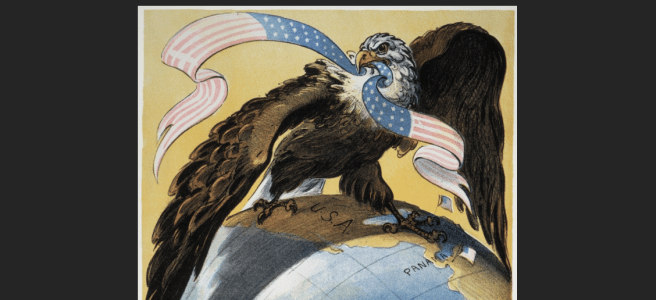
The term “Manifest Destiny” was not coined until 1845. However, its basic meaning that God willed the expansion of the US to the Pacific Ocean characterizes the intentions of the new settlers from early on. Throughout the colonial era and beyond, Americans simply assumed that God had called their nation into existence, a sense of divine calling that lent an air of inevitability to the expansionist efforts. God supported displacing the “heathen” indigenous populations and exploiting the “heathen” enslaved Africans. Once the drive to expand the US Empire across the continent took hold, it would not stop when the “frontier ended” in North America by the end of the 19th century. At that point, the empire was only getting started.
Continue reading “Empire as a way of life: The colonial era to World War II”
 Thinking Pacifism