Pacifism in America, part five: Opposing nukes and the Vietnam War

Ted Grimsrud—June 12, 2019

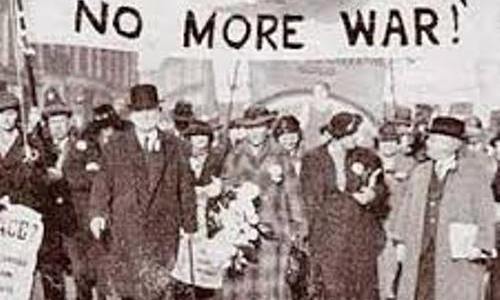
Pacifists in the United States in the mid-20th century sought to influence the world toward a more peaceable future following the massive destruction of World War II. We saw in Part Four of this series how this work took the form of widespread service work. In this post, we will look at a few large-scale efforts to resist war.

The initial response to nuclear weapons

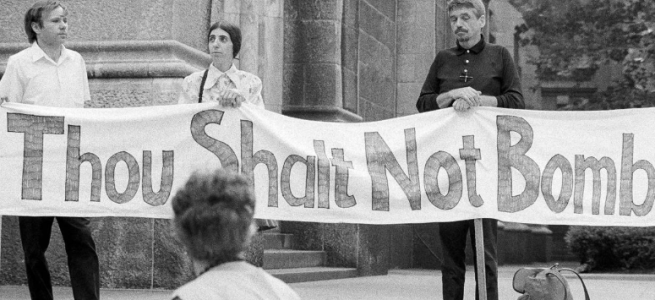
Except for the small handful of people involved in its creation, the advent of nuclear weaponry with the bombing of Hiroshima and Nagasaki in August 1945 came as a shock to everyone. Overall, the American public strongly affirmed the use of these bombs. Those few who had opposed the War itself responded to Hiroshima and Nagasaki with unqualified horror. Selling out to warfare, they argued, has led to the possibility that now we can bring an end to human life itself. However, at first the pacifists offered a somewhat muted outcry in that they tended to see the nuclear bombs, terrible as they were, mainly as the logical outworking of the war spirit, just one more step toward the abyss, but not necessarily something qualitatively new.

For a brief time, some “prowar liberals” expressed opposition to nuclear weapons. The nuclear weapons seemed to go beyond what was necessary. Lewis Mumford, a leading liberal pro-war advocate, stated, “our methods of fighting have become totalitarian; that is, we have placed no limits upon our capacity to exterminate or destroy. The result was moral nihilism, the social counterpart of the atomic bomb.” A report called “Atomic Warfare and the Christian Faith” prepared by liberal Protestant leaders came out in 1946 and expressed opposition to the use of nuclear bombs on Japan.

The other main expression of dissent about bombing Hiroshima and Nagasaki came from within the very community that had created these terrible weapons (see Lawrence Wittner, One World or None: A History of the World Nuclear Disarmament Movement Through 1953). The one scientist who left the top secret Manhattan Project over moral objections was Joseph Rotblat. “When it became evident, toward the end of 1944, that the Germans had abandoned their bomb project,” Rotblat wrote, “the whole purpose of my being in Los Alamos ceased to be, and I asked for permission to leave and return to Britain.” Rotblat helped found the Pugwash Conferences on Science and World Affairs. As part of the Pugwash organization, he won the 1995 Nobel Peace Prize. Continue reading “Pacifism in America, part five: Opposing nukes and the Vietnam War” →
Pacifism in America, part two: Refusing the “good war”

Ted Grimsrud—June 3, 2019

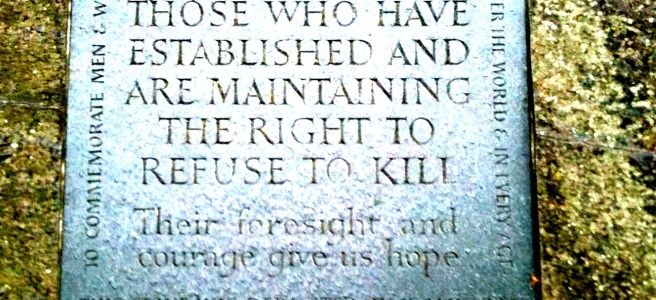
In the aftermath of the First World War, called at the time “the Great War” (but only briefly, since it was eclipsed by the war that soon followed), pacifism (as in the principled opposition to war) emerged with unprecedented prominence. Five new pacifist organizations were founded. Their influence remained small in the big picture of American society, but at the end of the 20th century each one remained active and fruitful.

Interwar pacifism

These five organizations—American Friends Service Committee, Catholic Worker, Fellowship of Reconciliation, Mennonite Central Committee, and War Resisters League—represented distinct streams of philosophy and practice. They do not exhaust the varieties of pacifism, but did reflect a wide spectrum—from the explicitly Christian and confessional character of the CW and MCC to the explicitly non-religious WRL with the more ecumenical AFSC and FOR somewhere in between.

Even with their diversity, these five pacifist streams shared important characteristics. Each of them, in its own way, rejected the assumption that the only two options in response to evildoing are to fight or to flee. At the heart of the appeal of America’s warist policymakers to their country’s citizens has been an implicit assumption that military force is the first-choice option for dealing with international conflicts. All too often it was the only option considered. The other part of the appeal for support and participation in warfare has been the articulation of high ideals for democracy and civilization and self-determination. These ideals provided the motivational bases for engaging in warfare—and tend to be linked with an assumption that military force is necessary to achieve those ideals.

Our pacifist groups challenged those war-supporting assumptions on several levels. They generally agreed with the ideals of democracy that underwrote the propaganda in favor of American participation in World War II. However, they rejected the assumptions of “fight or flee” in response to wrongdoing and of the necessity of using war in order to achieve the ideals of self-determination and disarmament. In fact, these pacifists argued that war is incompatible with democracy. They believed the ways democracy had been achieved in the past several centuries had been in spite of warfare, not because of it. Continue reading “Pacifism in America, part two: Refusing the “good war”” →

Pacifism in America, part one: The roots of war resistance

Ted Grimsrud—May 31, 2019

The United States has an extraordinarily ambivalent legacy when it comes to war and violence. On the one hand, we originated, in the view of many, as the victor in a war of rebellion against the British Empire; we have engaged in war and after war throughout our history; we are the only country ever to drop a nuclear weapon on another country; and now we are the world’s one “superpower” that spends more on its military than virtually all the other countries in the world combined.

Yet, on the other hand the United States has a long legacy of peace movements, acceptance of the rights of conscientious objectors, and the development of philosophies of nonviolent social action. The US from its early years provided a home for members of the “historic peace churches” and provided them a largely persecution free home in contrast to many other places in the world that had driven pacifists out.

I recently listened to an interesting series of podcasts on the history of nonviolence that reminded me of much of the peace legacy in the US. The third season of “The Thread” focused on the history of nonviolence. In six episodes, the series discussed key figures in that “thread,” moving backwards from Martin Luther King, Jr., to Bayard Rustin to Mohandas Gandhi to Leo Tolstoy to William Lloyd Garrison. There are many details in this series that I could nitpick about, but overall I found it interesting and inspiring—and I would recommend it.

One inspiration that emerged for me was to post some things I have learned about this history. I will share some thoughts in several installments about the history of pacifism in America, starting today with background to the emergence of pacifist opposition to World War II—opposition that obviously had little impact on the execution of that war but that planted seeds for a number of significant efforts to oppose war and injustice nonviolently in the decades that followed. Continue reading “Pacifism in America, part one: The roots of war resistance” →

What’s wrong with how we view the Civil War? [Civil War #5]

Ted Grimsrud—April 29, 2019

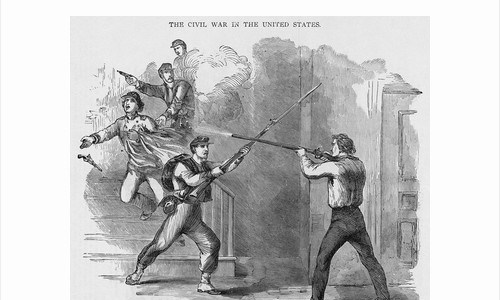
As I continue to read and think about the American Civil War, I am continually impressed with how little questioning of the legitimacy of warfare as the default way to resolve conflicts I have encountered. I have seen even less skepticism about the Civil War as a tool for the good than I found in relation to World War II. I tend to think that so long as people accept those wars, they will continue to accept our present-day warring and preparation for warring.

A representative view of the Civil War

I encountered a representative view of the Civil War that illustrates my concern when I listened to an April 16, 2019, interview with Andrew Delbanco, history professor at Columbia University and author of The War Before the War: Fugitive Slaves and the Struggle for America’s Soul from the Revolution to the Civil War, on a program called “Letters and Politics.”

I was impressed with Delbanco. He is knowledgeable and insightful about the Civil War era. He has good values and seems to be a reliable analyst. He makes helpful connections with the present. It is because he seems perceptive and humane that his comments about the “validity” of the Civil War seem especially useful (and troubling) for me. If someone with his general sensibility has these views, I think it is safe to imagine most other historians of the US do, too (and probably most people in the wider society). The comments that especially struck me came at the end of the interview as he was drawing some conclusions. Delbanco said:

In retrospect, I think most of us would say the price was worth paying. A million dead for the emancipation of four million human beings whose ancestors had been enslaved and whose descendants would have been enslaved if the war had not taken the course it took. But again I would suggest, how many of us today would willingly send our sons and brothers and friends to their deaths for any moral cause? How many of us on the progressive side of the political spectrum would be willing to contemplate war of that scale and savagery as a method to achieve a better society? I’m not sure I would. So, supporting the Civil War in retrospect is easy. Committing oneself to a war like that in prospect may not be so easy. Continue reading “What’s wrong with how we view the Civil War? [Civil War #5]” →

Trump and US Democracy (Looking West #2)

Ted Grimsrud—February 16, 2019

For some months I have been reading about the American Civil War. It’s been fascinating for many reasons, and I expect to be writing about what I am learning and thinking for a long time. One thread will be how sobering it is for me to read about the US past in relation to our current national political stormy waters. One of the premises of the Trumpian proclamation is that America used to be “great.” Well, it certainly wasn’t great in the middle part of the 19thcentury. And, painful as it is to realize this, many of the ways it wasn’t great back then are still with us—white supremacy, economic inequality, warism. And, of course, Trump’s agenda to “make America great again” seems only to exacerbate those problems from long ago.

Surreal, but not necessarily utterly exceptional?

It is surreal to have a president like Donald Trump, likely the most repellant person ever to hold that office. I don’t know of any president whose policies and philosophies I disagree with as much as Trump’s. I know of no other president who was as dishonest, as self-centered, as oblivious to other people’s feelings, as closely linked with the most corrupt elements of the broader American society. But at the same time, I realize that just about every other American president has also had disagreeable policies and philosophies, has been dishonest, self-centered, oblivious, and linked with corruption.

I think it is a mistake to view Trump as utterly exceptional. I get the sense, among people I talk with and read, that Trump is this foreign element in our political system and all we need to do is get rid of him or, at worst, wait him out for two more years, and then things will be ever so much better. I’m not so sanguine about our political system and about the state of democracy here. I wonder if the Trump presidency might be most useful not as a contrast to how things normally are but as a vulgar, veneer-stripped-away exposure of how broken the system has become (and maybe always has been). Continue reading “Trump and US Democracy (Looking West #2)” →

A Civil War Question: Can One Hate Both Slavery and War Equally? [Civil War #3]

Ted Grimsrud—January 7, 2019

I have long been interested in a quite challenging moral issue: How can we overcome evil without adding to the evil? This issue is central to the philosophy of nonviolence, and I think it should be central to any sense of ethical truthfulness. This is a good way to get at the heart of Gandhi’s philosophy as well as that of Martin Luther King, Jr. One of the big problems idealistic human beings have struggled with is the problem of working for social change or working to resist injustice and finding oneself actually contributing to making things worse.

Of course, our wider culture in North America (and presumably elsewhere) is not all that interested in this question. We Americans tend to take a pretty narrow and superficial view of social dynamics, constantly barraged as we are by American exceptionalism and corporate feel-goodism in our mass media. So, we have to stop and turn away in order to get a sense of what we actually face in terms of systemic brokenness and cycles of injustice.

But when we do pay attention, we realize that warism, racism, economic inequality, sexism, and many other problems remain all too present and each has a long history of intractability. Gandhi sought, with only partial success, to break a spiral that is all too apparent in liberation movements of responding to violence with violence in ways that have only led to more centralized power and continued injustice.

This moral question about evil lays at the heart of my energized interest in the American Civil War. This is how I would characterize the conventional wisdom in our society as I have encountered it: The Civil War was indeed a terrible thing with a lot of death and destruction. But slavery was an unacceptable evil that had to be stopped. It was costly, but ultimately worth the cost, to end that plague in our land. So, one of the lessons to be learned is that war can be a force to defeat evil. It is sad that it is necessary because it certainly is destructive. But sometimes war is our only option. Another lesson, then, that follows is that we have to prepare for such possibilities of a necessary war by maintaining the readiness of our military.

Questioning conventional wisdom

As a pacifist (one who denies the moral validity of war under any circumstances and who also rejects the preparation for war), I question this “wisdom” that accepts the acceptability of the Civil War. But I think anyone who desires to take a morally serious view towards war should also question that “wisdom”—even if they might not be as sure as I am about a negative assessment of the Civil War. The just war tradition at times has made the important claim (not taken nearly seriously enough) that humanity’s benefit of the doubt is against any particular war—in part simply because of the enormous destruction that each war causes. In thinking about any war—past, present, or future—according to this claim we have an obligation to assess its cost and to insist on a clear rationale for why that cost is worthy of being borne. If the costs are not worthy of being borne, almost certainly the war will once again be a matter of a response to evil that only adds to the net moral dynamics of evil. Continue reading “A Civil War Question: Can One Hate Both Slavery and War Equally? [Civil War #3]” →

Wondering about the American Civil War [Civil War #1]

Ted Grimsrud—June 25, 2018

I grew up in western Oregon. Until I was 17, the farthest east I had ever been was Wallowa Lake in the northeastern corner of the state. Then, the summer after my junior year in high school, my family took a road trip out to Virginia to meet my new niece. My dad, who was a history teacher with deep interest in the Civil War, was thrilled to get to visit battlefields, museums, and other key Civil War sites. It was pretty interesting, but we had to leave to return home way too soon and only scratched the surface.

Ever since Kathleen, Johan, and I moved to Harrisonburg, VA, in 1996, I have felt guilty that I have not given much thought to the Civil War. My dad (who died in 1984) would be furious if he knew how I had wasted my time here by not paying more attention to Civil War places and materials. My apathy might finally be ending.

Did slavery actually end?

In the past few years I have learned about the impressive work of Bryan Stevenson. In his book, Just Mercy: A Story of Justice and Redemption (2014), Stevenson details his work as an attorney who has devoted his energy to saving the lives of people treated unjustly by our criminal justice system. He established the Equal Justice Initiative in Montgomery, Alabama, as the headquarters for his work.

Living in Montgomery has exposed Stevenson to the long and deep history of American violence toward people of color. He led an effort to establish a museum that would recognize the terrible toll of lynching in our country. This museum, the National Memorial for Peace and Justice, and its accompanying Legacy Museum opened their doors in late April this year. With this opening, Stevenson has been asked to talk in various settings about the legacy of such terroristic violence. He is extraordinarily clear and straightforward in the story he tells. A few weeks ago, I listened to an extended interview he gave the Washington Post.

Stevenson made a comment that got my attention. He stated that slavery never actually ended in the United States. It only evolved. This statement came simply as an observation, not as a strong thesis that he laid out a detailed rationale for. But his discussion of the tradition of Jim Crow segregation and lynchings by the thousand in the generations following the legal ending of slavery following the Civil War and his allusions to the ongoing plague of mass incarceration that has especially targeted black Americans offer anecdotal support for his statement about slavery’s evolution (and correlate with Michelle Alexander’s arguments about the dynamics of mass incarceration, especially in her book, The New Jim Crow: Mass Incarceration in the Age of Colorblindness). Continue reading “Wondering about the American Civil War [Civil War #1]” →

Pacifism and violence in the struggle against oppression

Ted Grimsrud—October 29, 2017

Is pacifism a viable social philosophy? I believe that it is, though I also recognize that arguments in favor of the possibility that at times violence might be appropriate can seem pretty persuasive. Nevertheless, as I will outline later in this post, I think the moral and practical problems with violence are ultimately insurmountable.

The impact of Mohandas Gandhi and Martin Luther King, Jr., in the twentieth-century put principled nonviolence on the table as a possible option for those who desire social transformation. As well, the historic peace churches (Mennonites, Quakers, and Brethren) have sought in recent generations to apply their long tradition of Christian pacifism to social issues. But many have questioned whether pacifism is an adequate approach in the real world—whether it might even be unhelpful to the quest to overthrow injustice.

Principled pacifism may be defined as the conviction that it is never morally acceptable to use lethal violence against other people. This conviction has never been widely held, even though in the United States it has been present in a fairly prominent way dating back to the establishment of the Pennsylvania colony in the 1680s. The main impact of pacifist convictions in the US until the 20th century was the refusal of pacifists to join the military and fight in wars. The possibility of self-consciously nonviolent direct action did not gain widespread acceptance until the 20th century.

Changing notions of peacemaking

I write as a Mennonite Christian pacifist, though I believe that pacifism is a valid commitment for anyone. Several 20th century factors combined to transform the understandings and practices of principled pacifism among “peace church” Christians. World War I showed just how widespread and utterly destructive modern war could be (though much worse was soon to come), so a pragmatic case for rejection of war became more widespread. The philosophy and practice of nonviolent direct action as a means to bring about social change gained currency especially through the work of Gandhi in South Africa at the turn of the century and a couple of decades later in India. And peace church people became more acculturated and more likely to feel a sense of responsibility for having an impact in the wider world. Continue reading “Pacifism and violence in the struggle against oppression” →

What would Jesus say about the Russians?

Ted Grimsrud—January 29, 2017

“What would Jesus say?” is a common questions Christians ask when they are in the midst of discerning what they themselves should say or do. For it to be a helpful question, I think we do better to think in terms of Jesus’s general moral outlook more than looking for specific verses to apply directly to our time.

I’m not sure I would say that people of good will (not only professing Christians) must ask this question—but I think it would almost always serve us well. And, clearly, if we draw from Jesus’s general moral outlook, we retain a large measure of responsibility to think and reason and act for ourselves. Jesus’s moral outlook gives us guidance but it does not give us a direct blueprint.

Currently, in the United States, we are badly in need of careful moral discernment. We are badly in deed of a moral outlook that gives us a stable set of moral convictions that will resist our tendency to look for guidance that justifies our own actions or simply allows us to condemn our enemies because they are our enemies. That is, we are in need of moral guidance that demands that whatever criteria for morality we use apply equally to ourselves as they do to our opponents.

It is risky right now to appeal to Jesus because so many people in power present themselves as “Christians” while acting and speaking in ways that are very much in tension with the actual life and teaching of Jesus. So, to evoke Jesus makes one vulnerable to be dismissed as simply another pious-sounding hypocrite. At the same time, appealing to Jesus’s actual moral outlook might provide a basis for challenging the approaches of self-professing Christians. That is what I hope to do with this blog post.

Continue reading “What would Jesus say about the Russians?” →

The empire “breaks bad”—Christian faith in the Trump era, part one: What happened?

Ted Grimsrud—November 29, 2016

To “break bad” can mean to “go wild,” to “defy authority” and break the law, to be verbally “combative, belligerent, or threatening” or, followed by the preposition “on,” to “completely dominate or humiliate.” [from Wikipedia]

It is difficult to write about the election of Donald Trump to the presidency. It seems certain that the US is entering uncharted waters. It also seems certain, to me at least, that what is coming will be worse than what most of us can imagine. The American Empire is entering a new phase, likely with little pretense of self-restraint or of serving the general human welfare or the wellbeing of the natural world. We are about openly to become the rogue nation—”breaking bad” indeed.

The impending storm

A memory comes to mind. Many years ago, Kathleen and I were on a road trip. As evening neared, we approached Clovis, New Mexico from the west. To the east we saw a huge dark, dark purple horizon. As we got closer, the darkness grew. We clearly were heading into a storm. It turned out to be a big one. Hail, heavy rain. We inched into town and the streets were awash with several inches of water. We had a similar experience more recently, driving home from the northeast. Here the dark, dark purple horizon was near Harpers Ferry, West Virginia, where Maryland, Virginia, and West Virginia come together along the Potomac River.

In both cases, there was this strong uneasy, fearful, feeling as we approached the storm. We felt some wind but basically things were calm. But we knew we were heading into trouble and there was no place to go to avoid it. And, in both cases, the storm turned out to be worse than we even imagined.

This is how I feel right now. We’ve got these few weeks before the fury of the new Republican unified power on the federal level will hit us. I see no reason not to expect that the impact of that power won’t be even worse than the most fearful imaginings we might have right now.

Still, this is a time to try to think seriously and deeply—and I believe it is also a time to think theologically for those so inclined. The United States, the world’s one superpower, is in deep trouble. It is nearly impossible to imagine that the next four years won’t be a disaster in almost every sense of the word. And even should the nightmare end at that point, something that right now seems less than likely, the damage that will be done will be difficult to repair.

The importance of core convictions

I believe that one of things we should  be doing now—and this will remain important for as long as I can foresee—is think deeply about core convictions, about the meaning and purpose of life, about our orientation toward life. We are going to face severe stresses, and conflicts, and fears, and deep discouragement. What will guide us as we struggle to move ahead? Continue reading “The empire “breaks bad”—Christian faith in the Trump era, part one: What happened?” →