How the Old Testament story refutes the God-as-punisher assumption

Ted Grimsrud—May 25, 2014

I keep thinking of new angles for reflecting on the perennial question of how, as a Christian pacifist, to think about the portrayal of God in the Old Testament. What I will do in this post is think about how the main story line of the Old Testament does not work if we assume that the God portrayed there is fundamentally violently punitive.

Obviously, the Old Testament is a widely diverse collection of writings from many different times and places that reflects many different points of view. And equally obviously, some of these diverse writings tell us that God engages directly in violently punitive acts and directly commands some human beings violently to punish other human beings (both in the sense of general laws and in the sense of direct incidents). Modern critical biblical scholarship has strongly emphasized this diversity.

However, the writers of the Old Testament and the communities that gathered and utilize the writings have not approached this collection as mainly an inchoate accumulation of disparate texts. To the contrary, often in the Old Testament (as well in the New Testament), the writers themselves offer summaries of what they portray as the core story to which the collection as a whole witnesses. And the communities that have used these writings until quite recently have tended to read the Old Testament as containing a coherent story, one that offers clear guidance for those who see themselves as in continuity with the communities that created this collection.

The precise content of this “core story” of course has been and continues to be debated. What I offer is only one way to construe the story. I won’t make the case here that it’s the best one, though I do think it reflects the general orientation of the various summaries of the story line in the Bible itself. My main point is to suggest that looking at the story line is a better way to approach the God-as-violent-punisher theme than simply reporting and struggling with various specific incidents and commands.

My approach is to say that the most meaningful (or, one could say, the most authoritative) element of the biblical writings is the big story—the specifics should be understood in light of the whole. At some point soon I hope to spend more time reflecting on how this approach works in helping us use those texts that portray God as a violent punisher. For now, though, I simply plan to explain why I think the story line does not work if the God of the story actually is a violent punisher. Continue reading “How the Old Testament story refutes the God-as-punisher assumption”
“Othering” and Mennonite sexuality struggles

Ted Grimsrud

I came across a quote in the book Empire by Michael Hardt and Antonio Negri that helped me think a bit more about our current discussions about sexuality in the Mennonite world. I’ll share the quote in a bit, but first I want to set the context.

Othering and the Cold War

Several years ago, as I was working on my book on World War II’s moral legacy, I struggled to understand how the phenomenon of “global communism” could justify the American commitment to its national security state and military interventions around the world. I realized that a key moment was President Harry Truman’s “Truman Doctrine” speech in 1947 that stated, in effect, that there is only one communism, that this communism is behind a vast system of anti-American actions around the world, and the presence of such anti-American actions requires swift and decisive American military intervention. To label people communists was effectively to signify them as the “other” who are different and are inherently a threat to our security. So, military actions (public and secret) in such disparate locations as Greece, Korea, Vietnam, Nicaragua, Indonesia, Guatemala, and Iran followed over the next few decades.

I was struck by how this dynamic insured that little effort would be exercised actually to understand the specific, on-the-ground context for the “anti-American” dynamics. It was a simple process: if there was a lack of support for American interests it was because of global communism. If the lack of support could be labeled as communist-inspired, then everything needed to be known was obvious. There is only one “communist practice”—all communists are essentially the same (and, even more pernicious, all “anti-Americans” are communists). It is quite remarkable to take even a cursory look at the series of conflicts that U.S. engaged in and see an almost identical pattern over and over again where the “enemies” of the U.S. were labeled as “communist” (i.e., definitely labeled as immoral and worthy of violent opposition) and responded to with often devastating force.

The end of the Soviet Union deprived the U.S. of the “global communism” label as a justification of militarism. However, surely not coincidentally, at about the same time as the end of the Soviet empire, the spectre of global terrorism arose and in many ways, down to our present day, successfully played the same role. Again, there seems to be only one terrorism. When we apply that label to resistance to American interests, we know all we need to know and proceed accordingly. Continue reading ““Othering” and Mennonite sexuality struggles”

Does the Bible have a coherent peace message?

Ted Grimsrud

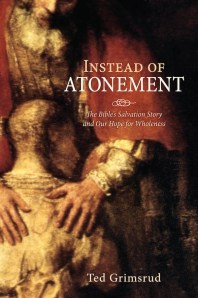
I wrote my book, Instead of Atonement: The Bible’s Salvation Story and Our Hope for Wholeness, out of a conviction that the Bible does contain a coherent peace message (or, I could say, a coherent healing message or a coherent mercy message). Surprisingly to me, I wonder now whether this conviction is shared by all Mennonite academics.

While I would have preferred a more sympathetic reviewer, I appreciate the issues raised by Mennonite Old Testament scholar Derek Suderman’s review of Instead of Atonement in the January 2014 Mennonite Quarterly Review. I want to reflect on several of those issues, not mainly to argue with Suderman but more to take the opportunity offered by his review to address some key elements of how we wrestle with the Bible in face of our call to be agents of healing in the world today.

There will be five issues that I will write about: (1) Is the best way to approach “biblical concepts” through focusing on the big picture or on analyses of specific words? (2) How do we understand God’s judgment in relation to God’s mercy? (3) How seriously should we take the Bible’s own way of summarizing its salvation story? (4) Is suggesting that the Bible has a coherent message actually making an inappropriate “universalized claim”? (5) What kind of assumptions should we have as we approach the Bible? Continue reading “Does the Bible have a coherent peace message?”

Salvation and the way of peace—(1) The problem

Ted Grimsrud

[This is the first in a series of six posts that will summarize the argument of my recent book, Instead of Atonement: The Bible’s Salvation Story and Our Hope for Wholeness (Cascade Books, 2013).]

CASCADE_Template

In our present time in the United States, being a self-identified Christian makes a person more likely than a non-Christian to support warfare, punitive criminal justice practices including the death penalty, and corporal punishment of children. It seems likely that one reason American Christians are more pro-violence is because of their acceptance of a theology that understands salvation in terms of God’s retributive justice.

The logic of retribution

This salvation theology is based on a certain view of the “atonement”: The atonement is seen to  be how Christ accomplished our justification (i.e., being found righteous before God) through his sacrifice on the cross. Implied in this understanding of atonement is that God’s ability to provide salvation is constrained pending the offering of an appropriate sacrifice. It seems inevitable that violence play a role in satisfying the demands of God’s character—and that violence is part of God’s response when the satisfaction is not forthcoming.

As a rule, to act violently toward, especially to kill, other human beings is serious business, undertaken because some other value or commitment overrides our normal tendency not to be violent. Most socially accepted uses of violence (such as war, capital punishment, and corporal punishment) follow a fairly self-conscious logic. At the core of this logic usually rests a commitment to the necessity of retribution; using violence is justified as the appropriate response to wrongdoing. When the moral order is violated by wrongdoing, “justice” requires retribution (usually defined as repayment of wrongdoing with violent punishment, pain for pain).

We may call this the “logic of retribution.” In this logic, people understand God in terms of impersonal, inflexible holiness. They see God’s law as the unchanging standard by which sin is measured, and believe God responds to violation of God’s law with justifiable violence. Most violence is justified as being in some sense an expression of this deserved punishment. Continue reading “Salvation and the way of peace—(1) The problem”

Reflections from a chagrined “Yoderian” (part four—Yoder’s theology)

Ted Grimsrud—August 4, 2013

A great deal of my energy for “thinking aloud” here about John Howard Yoder’s sexual violence stems from how important Yoder’s theology has been for my life and work. I can’t really put into words how important that theology has been for me. So, how do I reconcile this influence with such deeply problematic behavior? I have been reflecting on the behavior, and now I want to take some time to reflect on the theology—to sketch why I have found it so important. It’s not just that Yoder is famous and important and widely read and cited. It’s that his work has had a profound effect on my own life and thought in many, many ways.

I can probably pinpoint pretty much the exact moment when John Howard Yoder became my most formative thinker. I was a recent graduate of the University of Oregon and in the winter of 1976-7 worked swing shift at a Eugene, Oregon plywood mill. For about two months I had “lunch” all by myself. During those thirty minutes, six days a week, I got a lot of reading done. I read The Lord of the Rings and The Politics of Jesus—a fascinating juxtaposition.

After that winter, I read everything by Yoder I could get my hands on and a few years later, Kathleen and I moved out to Indiana to study with Yoder at the Mennonite seminary where he taught. One of the highlights of that eventful year was receiving copies of two sets of Yoder’s at the time unpublished lectures, “Christian Attitudes Toward War, Peace, and Revolution” and “Christology and Theological Method.” I also photocopied numerous unpublished articles that were in the library.

I have continued to read Yoder and absorb his theological insights. I would like to believe, though, that I have followed a path he would have approved of, which is using his ideas as stimulants to develop my own. Yoder himself did very little writing where he focused in detail on other people’s theology. He mostly referred to the Bible, history, and to the practical outworking of the ideas. It was not theology about theology but theology about life.

As my friend Earl Zimmerman presents it in his fine book on Yoder’s intellectual development, Practicing the Politics of Jesus: The Origin and Significance of John Howard Yoder’s Social Ethics, Yoder’s decision to become a theologian came a young adult working in post-World War II Western Europe. He became convinced that the epic disaster of that war was an indictment on Western Christianity. What the world needs is a different way to think about faith and social life. Yoder believed that the 16th century Anabaptists provided a good model, but that what was needed was something more universal—which he found in the life and teaching of Jesus.

So, what I see as the model Yoder provided was an approach to theology that cares deeply about contributing to peaceable social life in the world for the sake of the world and draws deeply on the Bible and the Anabaptists. Yoder’s theology was anything but “sectarian.” The on-going power and influence of his work witnesses to the perceptiveness of his insights. I have been inspired to follow his method and construct theology that is socially engaged based especially on the Bible and inspired by the Anabaptists. Yoder’s ideas are catalytic for my own constructive work—which I would call “peace theology,” not “Yoderian theology.” Continue reading “Reflections from a chagrined “Yoderian” (part four—Yoder’s theology)”

What’s to be done about John Howard Yoder? (guestpost)

[My friend and former Eastern Mennonite University faculty colleague Barbra Graber would like to invite theologians and others who utilize the work of John Howard Yoder into further discussion. So I have agreed to post a recent essay she wrote reflecting on Yoder’s hurtful sexual behavior and its continuing legacy. I invite responses in the “comment” section at the end of this post and hope we can think together a bit in response to Barbra’s provocative thoughts. After a couple of days, I plan to post a longer set of my reflections in response to Barbra’s post [here’s part 1; part 2; part 3; part 4; part 5]. This version of Barbra’s essay has been revised from what she recently posted on Rachel Halder’s website Our Stories Untold and at Young Anabaptist Radicals. Each of those postings has a lively set of comments. — Ted Grimsrud]

By Barbra Graber

July 30, 2013

(Note: This is an opinion piece from the perspective of a lay-person in the Mennonite church who has never been privy to inside information regarding the disciplinary processes of JHY and left to make sense of something that has made no sense in light of the church’s stated guidelines, mission and purpose. I don’t pretend that my limited perspective encompasses the whole. My intention is to provide impetus and fodder for more discernment and discussion on the larger topic of known and widespread sexual abuses of power by Mennonite church leaders, most powerfully symbolized by JHY. Hopefully others from inside the JHY story will be encouraged to come forward with new information. My issue is not with a deceased man, but the living and beloved church of my birth.)

I remember the Sunday morning two MYF (Mennonite Youth Fellowship) friends who were dating got up in front of the congregation to publicly confess their sins. They were pregnant out of wedlock.  Meanwhile John Howard Yoder, the most acclaimed Mennonite peace theologian and symbol of male power in the church, sexually assaulted and harassed untold numbers of women of the church over decades, and never publicly confessed.  And the Mennonite seminary, as well as many other Mennonite church agencies that hired him, were somehow unable or unwilling to ultimately fix the problem. Years of institutional silence ensued while files of complaint letters accumulated. In 1984, the Mennonite Seminary announced that Yoder “had resigned in order to teach full time at Notre Dame.” But no mention of JHY’s known sexually deviant behavior was made and students were left to wonder why their brilliant professor suddenly flew the coop. Since that time, no one has asked and the Mennonite Church at large has not explained or acknowledged its decades of apparent complicity.

Quite the opposite.

After public exposure of his abuses in 1992, followed by a highly secretive disciplinary process, he was declared reconciled with the church and encouraged to return to “teaching and writing.” The promise of a public statement of apology to the victims whose lives he upended, and the wider ecumenical community whose trust he betrayed, somehow never materialized. And no one seems to know why. Today John Howard Yoder continues to be lauded, his books roll off the presses, and there’s pressure from all sides to go back to business as usual. I wonder if the same would be true if he’d been busted for selling drugs or accused of grand theft. Continue reading “What’s to be done about John Howard Yoder? (guestpost)”

John Howard Yoder and anarchism

Ted Grimsrud—July 10, 2013

A number of years ago when I read George Woodcock’s classic history of AnarchismI found the thinking he described quite attractive. I spent some time considering how compatible anarchism would be with my Christian pacifism. I have believed it would be, but never quite found time to pursue the issue in more depth. At some point, though, I was struck with the thought that John Howard Yoder’s “politics of Jesus” could perhaps be understood as a version of anarchism.

I have resolved to spend some time pursuing this line of thought in the months to come. I just started reading a massive, well-written, wide-ranging and fascinating history of anarchism, Peter Marshall’s Demanding the Impossible: A History of AnarchismI plan to write more about that book as I read through it. This fall, when I teach my “Biblical Theology of Peace and Justice” class (which includes reading Yoder’s Politics and Walter Wink’s Engaging the Powers: Discernment and Resistance in a World of Domination), I expect to devote quite a bit of attention to thinking about anarchism in relation to Yoder’s and Wink’s ways of reading the Bible.

Happily, I encountered a recent article that encourages me to pursue this project. This article (Ted Troxell, “Christian Theology: Postanarchism, Theology, and John Howard Yoder,” Journal for the Study of Radicalism 7.1 [2013], 37-59) came to my attention at just the right time. It’s already one of my favorite essays on Yoder’s thought.

Troxell helps me understand quite a bit about the current terrain in discussions about anarchism, and better yet confirms my sense that bringing Yoder and anarchism together is a good idea. Continue reading “John Howard Yoder and anarchism”

The disaster that was World War II: Could things have been different? (Part II)

[This is the second of a two-part post. I am just about done with a book I have written about World War II: The Good War That Wasn’t—And Why It Matters: World War II’s Moral Legacy. My last step is writing a conclusion. One part of the conclusion will be to speculate a little about what choices the U.S. could have made to avoid what became (I argue in the book) a moral disaster. Yesterday I posted Part I that discusses five aspects of the lead up to World War II that could have been different—and less disastrous. This post will discuss five more aspects.

Several earlier blog posts will also be incorporated into the conclusion (“Was World War II a Just War?” “Why World War II was a Moral Disaster for the United States—part 1” “Why World War II was a Moral Disaster for the United States—part 2”). I will conclude the conclusion with some reflections on what this all means for us today. I hope to post some of those reflections within the next several days. Earlier, I posted rough drafts of the other ten chapters of the book.]

Ted Grimsrud—May 30, 2013

(6) Overtly work to aid threatened Jews in Germany after the Nazis came to power. The plight of Europe’s Jews actually had little effect on the American entry into the conflict nor on the way that the War was prosecuted once the U.S. became a full participant. So more early efforts to help threatened Jews would not have themselves provided an alternative to going to war in the actual event.

However, to the extent that the War is at least after the fact justified as necessary for the sake of the Jews, we could say that earlier intervention would have made the war less necessary. One of the great ironies of the events in the lead-up to the War is that it was in fact the principled pacifists who worked the hardest to try to address the emerging crises for Europe’s Jews. Some Quakers even intervened directly, drawing on their positive reputation in Germany due to post-World War I relief efforts to lobby with Nazi leaders for openness for Jewish emigration. The hold up came not from the Nazis but from the American and British leaders who refused to make allowance for more than a tiny number of Jewish immigrants and, later, refugees.

It would seem that hundreds of thousands of Jews who perished in the Holocaust could have escaped that fate had the nations of the world been willing to allow them refuge. The tone-setters for the refusal to do so were the Americans and British.

Even more ironic, then, is that the main response America had to German tyranny was military-centered, ultimately total war. This response pushed the Nazis toward genocide rather than deportation as their means of dealing with the “Jewish problem.” Even after it became known on the outside that the genocide was happening, America’s war leaders insisted on ignoring that set of atrocities in favor of focusing on simply winning the war and achieving “unconditional surrender”—making it possible for the Nazis to come much closer to their goal of total eradication of Europe’s Jews. Continue reading “The disaster that was World War II: Could things have been different? (Part II)”

The disaster that was World War II: Could things have been different? (Part I)

[I am just about done with a book I have written about World War II: The Good War That Wasn’t—And Why It Matters: World War II’s Moral Legacy. My last step is writing a conclusion. One part of the conclusion will be to speculate a little about what choices the U.S. could have made to avoid what became (I argue in the book) a moral disaster. This blog post (Part I) contains some of that speculation. Here is Part II.

Several earlier blog posts will also be incorporated into the conclusion (“Was World War II a Just War?” + “Why World War II was a Moral Disaster for the United States—part 1” + “Why World War II was a Moral Disaster for the United States—part 2”). I will conclude the conclusion with some reflections on what this all means for us today. I hope to post some of those reflections within the next several days. Earlier, I posted rough drafts of the other ten chapters of the book.]

Ted Grimsrud—May 29, 2013

I have tried in this book to focus on the actual events that happened in the lead up to World War II, in the War itself, and in its aftermath. I have argued that what did actually happen was a moral disaster for the United States—both the War itself and its aftermath. Here I want to spend a bit of time on a thought experiment. I will imagine various events leading up to and during World War II that could have been handled differently and possibly led to a morally better result.

I hope to make the point here that nothing was inevitable, that the disastrous events need not have happened like they did. More than make a case concerning the moral failures of decision makers, though, I want more simply to emphasize that we need not continue on the same spiral toward continuing disasters that the U.S. seems stuck in. If those decisions could have been different, so too could current and future decisions.

As well, I argue in this book against the mythology that valorizes World War II as a necessary war, a good war, that was fought in the morally most just way possible. To suggest a number of ways things could have been different might lead us even more to question the necessity, goodness, and justness of the War in ways that could lead us to reject the logic that links the “goodness” of World War II to the need today to prepare for future possible “necessary” wars.

Finally, this exercise might also stimulate we who are not directly involved in foreign policy decision-making to recognize our need to treat with suspicion  claims by the foreign policy elite. We should especially doubt the claims they make that decisions to resort to violence are necessary or even pragmatically appropriate. If we treat such claims for necessary violence with skepticism we might be freed to refuse consent and to seek both to challenge the elite to less violent policies and to seek ways outside of the governmental structures to further self-determination and disarmament.

I have chosen ten examples of how things could have been different—with less disastrous results. I tried to avoid series of hypotheticals where one is dependent upon one or more earlier hypothetical. Generally, each example accepts that earlier alternative scenarios did not happen. I focus mainly on decisions Americans made (or did not).

Almost all of these follow from just war criteria and ideals. None assume pacifism. All would have been pragmatically preferable for American interests (that is, the interests of the American people, if not the American business and political elite). Continue reading “The disaster that was World War II: Could things have been different? (Part I)”

How Pacifists Should Read Christian Sources (Part Two)

[Ted Grimsrud—March 3, 2013]

I wrote in the first part of this post several weeks ago (“How Pacifists Should Read Christian Sources [Part One]”) that even though most Christians are not pacifists—and in fact being a Christian seems to make it less likely that a person would oppose war, at least in the United States—we “Christian pacifists should double down and intensify our emphasis on the pacifist aspects of our belief systems.” I went on to mention eight areas where too many Christian pacifists (it seems to me) accept non-pacifist ways of approaching key sources for our theology and ethics.

I promised a sequel where I would briefly discuss how these areas could be viewed in more consistently pacifist ways. I don’t have time or space to develop these alternative perspectives very fully, but I will go through the list. I don’t even have time to cite examples of how these alternative perspectives have been articulated except to point to several of my own writings.

Let me quote from my introduction to the first post: “My main concern in this two-part post is to suggest that Christian pacifists should actively resist the tendency to see our pacifism as something extraneous to our core theological convictions, as a kind of overlay in relation to the ‘common beliefs’ we share with other non-pacifist Christians. Part one [gave] examples of how pacifists read Christian sources non-pacifistically.” Now, part two will give examples of how we might read Christian sources pacifistically.

What I offer here is a bare outline of what may in the not-too-distant future expand into a more carefully detailed essay. I would greatly appreciate responses that could help me in developing the piece.

Reading Christian Sources as Pacifists

(1) Old Testament. Too often pacifists simply accept as a given the assumption that the Old Testament contradicts Christian pacifism. The task then becomes a defensive one, trying to make a case for pacifism in spite of the Old Testament. Continue reading “How Pacifists Should Read Christian Sources (Part Two)”