How does one step away from warism?

Ted Grimsrud—September 26, 2025

When I began college in the Fall of 1972, I had recently registered for the draft. I knew I’d go willingly if called. I accepted my place in the American warist environment—the willing conscript. By the time I finished college in the Spring of 1976, I rejected warism. I considered myself a pacifist and knew I would never go to war or support war in any way. This post will describe what led to this radical change. In the Fall of 1972 turmoil reigned in the United States. At that point I remained mostly oblivious to the currents that swirled as Richard Nixon wrapped up his presidential campaign and won a landslide victory—and planted the seeds that led to his fall with the Watergate break-in. I knew that the Vietnam War seemed to be winding down, though when I started my freshman year the draft remained a possibility.

I started at Oregon College of Education (OCE) in Monmouth, a small town about 15 miles west of Salem. OCE mainly focused on training schoolteachers, but it had evolved to be a general liberal arts college. About 3,000 students attended, mostly from small Oregon towns. Even though I knew hardly any other students, I felt surrounded by people like me. I found it to be a pleasant place to be, and I enjoyed my two years there. I felt fine with my classes. I could get by pretty easily, though nothing really caught my attention. Sports, not ideas or big questions, provided the connecting point with my new friends. In general, I experienced my first two years in college as a relaxed and congenial time. However, I did feel uneasy about my faith. I only cautiously brought up faith convictions with others. I had no luck in finding a church or fellowship group. I visited a few places but found nothing that seemed interesting or nurturing.

The ironic 1972 presidential election

I had exulted when Richard Nixon won the 1968 election. As far as I remember, I felt positive about Nixon during his first term. I certainly sympathized with him far more than his antiwar opponents. I rejoiced when the law changed to set the voting age at 18. I had long wanted to vote. I delighted that the first presidential election after the law changed would happen when I was 18. I proudly cast my ballot for Nixon and celebrated his resounding victory.

That I would have so unthinkingly supported Nixon indicates that my embedded theology of uncritical nationalism remained operative. I later learned of deeply problematic Nixon warist policies as well as of his many character flaws. Those flaws played out in ways that would have been in tension with the values of my familial embedded theology, but at the time I remained ignorant of them. Ironically, Nixon’s opponent, George McGovern, had more compatibility with most of my values. His integrity, genuine Christian faith, and convictions about helping life be better for vulnerable people should have rung true for me. In relation to the peace convictions I would later embrace, McGovern stands as the most attractive major party candidate in the entire 20th century. The mainstream media did not give McGovern a fair shake, but even if they had, I would not at that time have been attracted to the policies he advocated.

Continue reading “How does one step away from warism?”

Resistance to the American Empire

Ted Grimsrud—September 16, 2025

As the US embarked on a quest for world dominance after World War II, leaders’ quest for “full spectrum dominance” did not meet with total support from Americans. Opposition to newly expansive US warism received little media attention, though. It rarely effected policy makers. I knew nothing of the dissenters as a youth in my little corner of the world. For the story I tell in this series of posts, though, we should note the small pockets of dissent—both to indicate that American warism was not unanimous (people did dissent) and to recognize that the peace efforts that did shape my convictions beginning in the mid-1970s had important antecedents. 

Antiwar voices

In the late 1930s, many spoke in opposition to the US joining the War. Congress, which would not support a war declaration proposal from the president, did pass legislation for a draft in 1940, but only narrowly. Large movements of anti-war sentiment arose both from the right (the America First movement of traditional American isolationism) and the left (the popular antiwar movement that had arisen in the early 1930s after disillusionment with World War I). However, this war opposition almost immediately evaporated after the Pearl Harbor attack by the Japanese on December 7, 1941. With the Japanese attack the “America first” conservatives quickly jumped onboard in favor of what was widely perceived to be a war of national defense.

During negotiations in Congress on the draft, representatives from the various peace churches (led by the Quakers) managed to get alternative service for conscientious objectors included. With the popularity of the war and the government’s prowar propaganda, though, only a tiny fraction of draftees took the CO option. Most of the 12,000 draftees who performed alternative service were traditional, somewhat apolitical pacifists. Only a few thousand would have been opposed politically to the war effort. In addition to the legal COs, about 6,000 war opponents went to prison as draft resisters—though the large majority of those were Jehovah’s Witnesses whose refusal to cooperate with the draft had to do with the government refusing them ministerial exemptions, not their political opposition to the war effort.

Out of the tiny handful of COs that we could understand to be anti-empire did come important leadership for the resistance that found expression in years following. Imprisoned COs such as Dave Dellinger and Bayard Rustin developed their ideas about war resistance and nonviolent social change while spending the war years in prison and emerged afterwards as important peace movement leaders. It was also the case that the experience of many of the COs during the War had a significant formative impact. For example, numerous Mennonite COs shaped educational, service, and antiwar efforts among Mennonites and in the wider society in postwar years. Mennonite pacifism tried more to influence the wider world toward peacemaking.

Continue reading “Resistance to the American Empire”

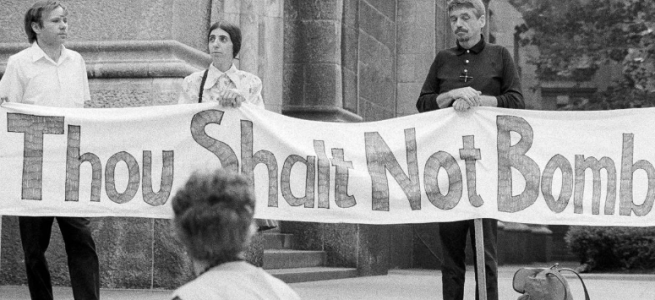
Pacifism in America, part five: Opposing nukes and the Vietnam War

Ted Grimsrud—June 12, 2019

Pacifists in the United States in the mid-20th century sought to influence the world toward a more peaceable future following the massive destruction of World War II. We saw in Part Four of this series how this work took the form of widespread service work. In this post, we will look at a few large-scale efforts to resist war.

The initial response to nuclear weapons

Except for the small handful of people involved in its creation, the advent of nuclear weaponry with the bombing of Hiroshima and Nagasaki in August 1945 came as a shock to everyone. Overall, the American public strongly affirmed the use of these bombs. Those few who had opposed the War itself responded to Hiroshima and Nagasaki with unqualified horror. Selling out to warfare, they argued, has led to the possibility that now we can bring an end to human life itself. However, at first the pacifists offered a somewhat muted outcry in that they tended to see the nuclear bombs, terrible as they were, mainly as the logical outworking of the war spirit, just one more step toward the abyss, but not necessarily something qualitatively new.

For a brief time, some “prowar liberals” expressed opposition to nuclear weapons. The nuclear weapons seemed to go beyond what was necessary. Lewis Mumford, a leading liberal pro-war advocate, stated, “our methods of fighting have become totalitarian; that is, we have placed no limits upon our capacity to exterminate or destroy. The result was moral nihilism, the social counterpart of the atomic bomb.” A report called “Atomic Warfare and the Christian Faith” prepared by liberal Protestant leaders came out in 1946 and expressed opposition to the use of nuclear bombs on Japan.

The other main expression of dissent about bombing Hiroshima and Nagasaki came from within the very community that had created these terrible weapons (see Lawrence Wittner, One World or None: A History of the World Nuclear Disarmament Movement Through 1953). The one scientist who left the top secret Manhattan Project over moral objections was Joseph Rotblat. “When it became evident, toward the end of 1944, that the Germans had abandoned their bomb project,” Rotblat wrote, “the whole purpose of my being in Los Alamos ceased to be, and I asked for permission to leave and return to Britain.” Rotblat helped found the Pugwash Conferences on Science and World Affairs. As part of the Pugwash organization, he won the 1995 Nobel Peace Prize. Continue reading “Pacifism in America, part five: Opposing nukes and the Vietnam War”