Is there an end in sight? The US Empire sinks ever lower [American Politics #9]

Ted Grimsrud—April 22 2024

“Rage, rage against the dying of the light.” (Dylan Thomas)

I have come to feel one little sliver of gratitude for the current devastating violence that Israel (with the backing of the United States) is visiting on Gaza. It helps us see more clearly the reality of the US/NATO backing of the doomed Ukrainian war against Russia and the reality of the scaling up of American war cries in relation to China. The US Congress’s recently passed spending bill to fund billions for war and war preparation in Israel, Ukraine, and Taiwan makes obvious the actual dynamics.

The motives of the US Empire: Corporate profit and domination

I’d say first of all, the US/NATO pursues these wars and possible wars in order to redistribute money from their taxpayers to corporate war profiteers. And, then, second, these wars and possible wars are justified as necessary to further the empire’s obviously failing agenda of being the dominant power in a “unipolar” world. This agenda, of course, is framed in terms of resisting the expansionist intentions of Russia and China. However, when we look at the whole picture in light of the destruction of Gaza, we see more clearly that there is nothing defensive about any of these situations—Gaza is simply about conquest and devastation. To see that about Gaza in turn helps us see what, in reality, the others are about as well.

A recent, typically insightful essay by Aaron Maté helps make all of this clear. He points out, first, that this new bill is all about directing money to the war corporations. He quotes House Armed Service Chair Mike Rogers: “Nearly all the money we’re spending to arm Ukraine [and, I may add, Israel and Taiwan] doesn’t leave this country,” but instead “goes directly to US companies and American workers to produce more weapons at a faster pace.” As it turns out, a lot of the money in this particular bill won’t even go to Ukraine or Israel in any direct way but rather will be spent simply to rebuild the American store of weaponry.

Continue reading “Is there an end in sight? The US Empire sinks ever lower [American Politics #9]”
Healing amidst the chaos (Revelation 6–16)

Ted Grimsrud—August 9, 2023

[This is the third in a series of four posts on the book of Revelation. The first is “Reading Revelation with an Anabaptist Sensibility.” The second is “The pattern of Jesus (Revelation, chapters 1–5).” The fourth is “Vindication (Revelation, chapters 17–22).”]

In this post, I will focus on three passages from the middle section of Revelation, starting with the seal plagues in chapter six. Then, I will talk about how chapters 10,11, and 12 provide a counter-testimony to the plagues, a picture of how God actually does gain repentance. And third, I want to spend a bit of time looking at the famous vision of the Beast in chapter 13 and point out that that vision also includes the first part of chapter 14 and ends up being another version of the story about the Lamb’s victory.

I want to take just a second first, though, for a word about an approach to Revelation that is quite different from my approach. When I first became a Christian, I was taught to read Revelation as a book of prophecies about the future. The term “dispensationalism” describes the view that human history has been divided, by God, into seven distinct era or dispensations. We are currently in the fifth of the seven and may look ahead to the sixth (the millennium—by seeing the millennium in the future, dispensationalism has also been called “premillennialism”). The seventh dispensation will be the new heaven and new earth. As I learned more about this approach, I decided that I could not affirm it. I came to see Revelation as not being concerned with future prophecy (“foretelling,” we could say) but rather speaking to its present (“forthtelling”) and, like the rest of the Bible, by speaking to its present speaking to our present. Mennonites have long debated about this. I won’t say more about this view except that, again, I think Revelation is about the present world we live in and is most of all concerned with encouraging the following of Jesus in this life, not with what will happen in the future.

The patterns of human history (6:1–7:17)

So, let’s turn to Revelation 6. We note right away the vision of the Lamb breaking the seals in the chapter—an act that leads directly to the riding forth of the fabled “four horsemen of the Apocalypse,” bringing with them plagues of war, famine, and sickness. This comes as a shock given what we see in Rev 1–5, the Lamb’s peace witness. Let’s think carefully here.

We need to keep Revelation’s master vision, chapters 4–5 in mind as we turn to the rest of the book. The final vision of the book, New Jerusalem in chapters 21 and 22 brings a vision of the final healing. That is where the entire book is heading. But in between these two visions, we have others that offer what appear to be quite mixed messages about healing and judgment. First, we have the Lamb breaking the seals of the scroll. This is the scroll the Lamb was given by the One on the throne in chapter 5 that only he is worthy to open—and we should all want the scroll opened So, what’s going on? Note, first, that all the Lamb does is break the seals. The events that follow are not the contents of the scroll. The plagues are not the contents of the scroll; they simply accompany the seals to the scroll being broken. It would seem that, in some sense, to move toward the final healing (which surely is the actual content of the scroll) will involve going through these plagues.

Continue reading “Healing amidst the chaos (Revelation 6–16)”

Satan in the book of Revelation—and today [Peaceable Revelation #6]

Ted Grimsrud—January 20, 2021

As we struggle to comprehend the various large-scale social problems that we face today, we might do well to do some thinking about the book of Revelation. Although the word “evil” is not used in Revelation, the concept of evil is quite present. I find myself thinking that reflection on evil is part of what we need to do as we seek social healing.

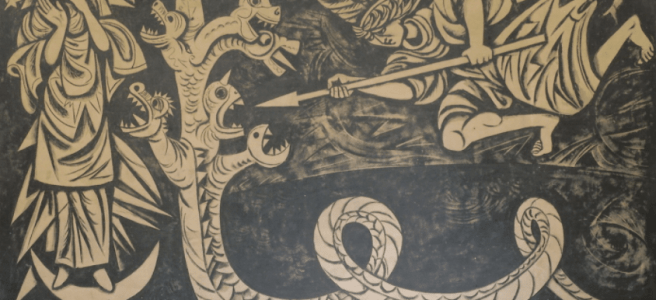
Revelation features the spiritual forces of evil quite prominently. And it presents us with the character of the Dragon as the mastermind behind those forces—this Dragon “who is called the Devil and Satan, the deceiver of the whole world” (Revelation 12:9). Now, the character of Satan is a deeply problematic figure in our culture’s history. Without engaging the bigger issues about why Satan is so problematic, in this post I want to focus on the use of “Dragon,” “Satan,” and “the devil” in Revelation and how those images might actually be helpful for us today, though in somewhat complicated ways.

What do we learn about Satan in Revelation?

Though the Dragon character is not explicitly introduced in Revelation until chapter 12, it does cast a shadow back over the earlier part of the book and remains central for what follows in chapters 13 and following. I think that because the Dragon will be closely linked with the Beast, who in turn has a close connection with the Roman Empire, all the allusions from the beginning of the book to the Empire and to the kings of the earth and to the conflicts that John’s readers have with their wider world point to the importance of the Dragon. Revelation presents the environment its readers lived in (and, by implication, the environment that we live in) as plague filled: wars and rumors of wars, environmental devastation, economic injustices, and on and on. In my interpretation, the Dragon will prove to be the immediate force behind the plagues. So, the entire agenda of Revelation has to do with living faithfully in a Dragon-infused world.

At the same time, it is crucial that we recognize that Revelation does not have the agenda of presenting an open-ended war between near equally powerful protagonists. The Lamb is victorious over the Dragon from the very beginning of the book. The struggle lies in the embodiment of that victory. Satan in Revelation is actually quite similar to Satan in the gospels. There is a sense in both places that the battle is Jesus vs. Satan. The words from the letter to the Ephesians describe the situation: “Our struggle is not against enemies of blood and flesh, but against the rulers, against the authorities, against the cosmic power of this present darkness, against the spiritual forces of evil in the heavenly places” (Eph 6:12). Or, in the words in Revelation: the struggle is about “destroying the destroyers of the earth” (11:18). Let’s equate “Satan” with the “spiritual forces of evil” and the “destroyers of the earth.” The struggle against the “spiritual forces of evil” is what the “war of the Lamb” in Revelation is about.

Continue reading “Satan in the book of Revelation—and today [Peaceable Revelation #6]”