The politics of Paul and the way of Jesus as seen in Romans 13 [Peace and the Bible #17]

Ted Grimsrud—March 25, 2024

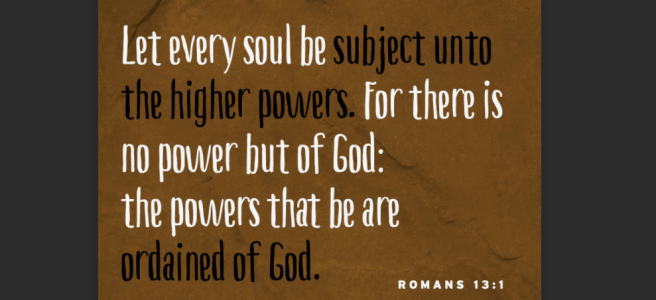
The Apostle Paul was a follower of Jesus. And his social views actually complement Jesus’s rather than contradict them, contrary to what many Christians have believed. In this post I offer a detailed look at the infamous passage in Paul’s letter to the Romans that, one could say, has launched many ships and other weapons of war. Romans 13:1-7 often serves as a counter-testimony in Christianity to the idea that Paul may have taught a principled nonviolence in agreement with Jesus. As well, Romans 13 is often seen to go against the idea that Paul understood Jesus’s peaceable way as normative for Christian social ethics.In reading a number of writings where Christian thinkers argue against pacifism, I discovered that in every single case—across a wide spectrum of theological positions—those who reject pacifism cite Romans 13:1-7 as a major reason. I will show why this text should not be read as counter to pacifism.

Setting the context for Romans 13:1-7

Our interpretation of Romans 13:1-7 should begin with reading these verses in light of their broader biblical context. Our passage is not the only place in the Bible where the political Powers are addressed. From Egypt in Genesis and Exodus, then Assyria, Babylon, Persia, and down to Rome in the book of Revelation, the Bible shows empires rebelling against God and hindering the healing vocation of God’s people. The entire Bible could appropriately be read as a manual on how people who follow Torah in seeking to love God and neighbor negotiate the dynamics of hostility, domination, idolatry, and violence that almost without exception characterize the world’s empires.

Romans 13:1-7 stands within this broader biblical context of antipathy toward the empires. If we take this context seriously, we will turn to these Romans verses and assume that their concern is something like this: given the fallenness of Rome, how might we live within this empire as people committed uncompromisingly to love of neighbor? Paul has no illusions about Rome being in a positive sense a direct servant of God. Paul, of course, was well aware that the Roman Empire had unjustly executed Jesus himself (and, according to tradition, in time executed Paul as well). As evil as these Powers might be, though, we know from biblical stories that God nonetheless can and does use the corrupt nations for God’s purposes—nations that at the same time remain under God’s judgment.

In his letter to the Romans, Paul surely had this biblical sensibility in mind as he addresses Jesus’s followers in the capital city of the world’s great superpower—the entity that had executed Jesus. Paul begins with a focus on the perennial problem related to empires—idolatry (see my previous post, “Paul’s critique of idolatry”). He discusses two major strains of idolatry in chapters 1–3: (1) the Empire and its injustices that demand the highest loyalty and (religious) devotion and (2) a legalistic approach to Torah that leads to its own kind of violence (witness Paul’s own death-dealing zealotry).
Continue reading “The politics of Paul and the way of Jesus as seen in Romans 13 [Peace and the Bible #17]”

A political reading of the New Testament (part 2): The apostolic witness

Ted Grimsrud—November 8, 2023

[Back in 2015, I posted a series of short essays in Thinking.Pacifism.net on an anarchistic reading of the Bible. The series included several pieces on the Old Testament and one on Jesus. At the time, I planned to conclude the series with a post on Paul and Revelation. For various reasons, I have only just now completed that post. Here is a link to the post on Jesus, “part one” of the two parts on the New Testament.]

One way to read the New Testament is essentially to go from the beginning to the end, reading the gospels as the main event and seeing the epistles as commentary on the story of Jesus and application of that story to the lives of the early Christians. In relation to our task of reading the Bible for its political content in light of an anarchistic sensibility, we will find that the apostolic witness reiterates the basic political content of the gospels—adding perspective on our reflections on politics as if Jesus matters. This short chapter will only scratch the surface of an anarchistic reading of the apostolic witness of the New Testament. I will touch very briefly on the book of the Acts of the Apostles, discuss a few texts from the Apostle Paul’s writings, and conclude with some reflections on the book of Revelation.

The story of early Christianity

The Acts of the Apostles, attributed to Luke, the same author of the gospel of that name and presented as a kind of sequel to the story of Jesus, has as its main agenda an account of the spreading of the message of Jesus from Jerusalem to “the ends of the earth” (Acts 1:8; in this case, from Jerusalem to Rome). The story reinforces the political message of Jesus—not an overt attempt to replace the Roman Empire with a different territorial kingdom but a political sensibility that de-centers the state and the nations and understands humane politics to involve grassroots, self-organized communities free from state domination that embody generosity, mercy, and restorative justice (these are elements of what I call an “an anarchistic sensibility” regarding politics)—and willingly accept the likelihood of suffering at the hand to authoritarian political and religious institutions.

The general tenor of social life in Acts shows a strong commitment on the part of the early Christians to defy human authority when it stands against the gospel (“we must obey God, not human authorities,” Acts 5:39-42). In Acts, as in the gospels, the “human authorities” who most commonly presented problems were leaders in the institutional religious arena (the Temple authorities and the Pharisees)—but in the Judaism in the period of Acts (the first 70 years of the Common Era) in Palestine operated as the political authorities as well as religious authorities.

The Roman Empire is a somewhat ambiguous presence in Acts. The hero of the book, the Apostle Paul, does at one point declare that he is a Roman citizen when that helps protect him from local authorities. Near the end of the book, Paul makes it to Rome and has not entirely negative encounters with Roman leaders. It appears that the writer of Acts wants to focus on the conflict with the religious leaders and minimize problems with Rome, perhaps to keep the book from being repressed by Roman authorities. However, we have good reasons to believe that Paul himself (along with the Apostle Peter) was executed by the Empire, following the path of Jesus. When read in light of the Jesus story (as well as other New Testament writings and the Old Testament), Acts mainly communicates a general suspicion of human authorities that would implicitly include the Roman Empire. The focus of the book, in any case, is on the constructive model of the early Christian communities as a counter-witness to the ways of authoritarian human structures—empires and oppressive religious institutions.

Continue reading “A political reading of the New Testament (part 2): The apostolic witness”

The politics of Paul and the way of Jesus, part 2 (Romans 13) [Peaceable Romans #7]  

Ted Grimsrud—February 22, 2022

The Apostle Paul was a follower of Jesus. And his social views actually complement Jesus’s rather than stand in tension with them, contrary to how many Christians have believed. Part 1 of this two-part series of posts sketches a summary of key elements of Paul’s views, leaving for this second part a more detailed look at the infamous passage in Paul’s letter to the Romans that, one could say, has launched many ships and other weapons of war. Romans 13, specifically 13:1-7, often serves as a counter-testimony in the Christian tradition to the idea that Paul may have taught nonviolent resistance to the Roman Empire. As well, Romans 13 is often seen to go against the idea that Paul understood Jesus’s peaceable way as normative for Christian social ethics.

Setting the context for Romans 13:1-7

However, I will show that those verses actually are fully compatible with the peaceable way of Jesus. Our interpretation of Romans 13:1-7 should begin with reading these verses in light of their broader biblical context. From Egypt in Genesis and Exodus, then Assyria, Babylon, Persia, and down to Rome in the book of Revelation, the Bible shows empires rebelling against God and hindering the healing vocation of God’s people. The entire Bible could appropriately be read as a manual on how people who follow Torah in seeking to love God and neighbor negotiate the dynamics of hostility, domination, idolatry, and violence that almost without exception characterize the world’s empires.

Romans 13:1-7 stands in this general biblical context of antipathy toward the empires. If we take this context seriously, we will turn to these Romans verses assuming that their concern is something like this: given the fallenness of Rome, how might we live within this empire as people committed uncompromisingly to love of neighbor? Paul has no illusions about Rome being in a positive sense a direct servant of God. Paul, of course, was well aware that the Roman Empire had unjustly executed Jesus himself. As evil as the they might be, though, we know from biblical stories that God nonetheless can and does use the corrupt nations for God’s purposes—nations that also remain under God’s judgment.

In his letter to the Romans, Paul surely had this biblical sensibility in mind as he addresses Jesus followers in the capital city of the world’s great superpower—the entity that had executed Jesus. Paul begins with a focus on the perennial problem related to empires—idolatry. He discusses two major strains of idolatry in chapters 1–3: (1) the Empire and its injustices that demand the highest loyalty and (religious) devotion and (2) a legalistic approach to Torah that leads to its own kind of violence (witness Paul’s own death-dealing zealotry). Continue reading “The politics of Paul and the way of Jesus, part 2 (Romans 13) [Peaceable Romans #7]  “