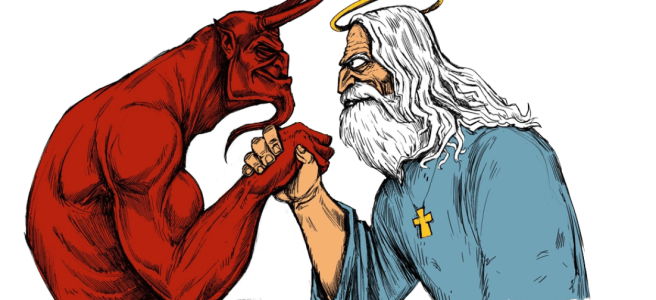
Can we trust in a good God in a world full of evil? [Questioning faith #17]

Ted Grimsrud—March 31, 2023

I still remember the intensity of one of my college Philosophy of Religion class sessions from nearly 50 years ago. We were reading the novel, The Blood of the Lamb, by Peter DeVries. It tells of the impact of the tragic death of his daughter on the ex-Christian protagonist. It was an agonizing book and elicited some agonized questions from our professor. How can one believe in God in the midst of such suffering? I only learned many years later when I read his obituary, that our professor, a man named Arnulf Zweig, was a Holocaust survivor. As a child in the 1930s, he had escaped the Nazis, though almost all of his extended family had not. No wonder he was so intense in raising these issues.

I think of Professor Zweig’s agony now as I reflect on what we may call “the problem of evil.” How do we understand the reality of evil in our world—and how does this reality fit with our belief in God? These are not simply brain teasers; they are for many people matters at the very heart of human existence.

Good but weak God?

Rabbi Harold Kushner in his famous book, When Bad Things Happen to Good People, sets up the problem in this way: We have three possibilities—God is good, God is all-powerful, and evil is real (bad things do happen to good people). He suggests that only two of these three affirmations can be true. Logically, it could be any combination, but all three cannot be true. He goes on to say that based on the evidence of the world we live in; we can’t deny the reality of evil. So, we must choose between “God is good” and “God is all-powerful”. Kushner believes that we should choose the former. He believes that God is not all-powerful. To insist that God is all-powerful in a world where evil is real, would require us to believe that God is evil (or at least allows evil while also having the power to stop it). In other words, Kushner’s is a weak God.

As I have made clear in my earlier posts in my Questioning Faith series, I agree with Kushner. While I recognize the reality of evil in our world, I also affirm that we have a lot of good in the world as well. This kind of world, I think, is what we should expect in a world where God is love. Love is weak; it is non-controlling, non-coercive, and non-interventionist. But it is also powerful; it is creative, healing, and pervasive.

The idea of God as good but weak is not simply a concession to the logical difficulty of Kushner’s dilemma. Nor is it simply a desperate attempt to salvage some kind of (admittedly anemic) faith. I suggest it is the logical result of recognizing that God is love. If we start with a quite optimistic and positive sense of God’s reality in the world, we will see God at work all around us, God the go-between-God who empowers connections of love and creativity and beauty. We may find strong evidence to support such an optimistic and positive view. But let’s think through how this kind of God would be present in the world. If God loves everyone and love is non-controlling and non-coercive, would not that mean that God does not exert power-over in a controlling or coercive way toward anyone? That is to say, does it not seem that a God of love will by definition be a weak God (or should we say, “a weakly powerful God?” or “a powerfully weak God?”—or, if we don’t like the term “weak,” a “profoundly vulnerable God?”)?

Continue reading “Can we trust in a good God in a world full of evil? [Questioning faith #17]”

Is love weak? [Questioning faith #16]

Ted Grimsrud—March 28, 2023

[After a break from writing, I am returning to my blog post series on Questioning Faith. Over the next month or so, I hope to post a number of reflections on some of the questions I have had about Christian faith—picking up on the series from last winter. My general sensibility is that we need to feel free to be honest with all the questions we have, but with the expectation that such questioning will actually strengthen and deepen our faith, leading to a stronger and deeper “questioning faith.”]

In a recent conversation about some of the ideas I have written about in this blog series (see especially posts #2 and #6 in the series, “Why is the typical Christian understanding of ‘God’ such a Problem?” and “Is there a place for prayer in a world with a weak God?”), a friend asked me, “So, is love weak?” I realized that I have a hard time giving a straight answer to that question. It’s a good question, though, and one that directly follows from some claims I have made.

God is love

We may start with a relatively uncontroversial, seemingly simple assertion: “God is love.” This is biblical, widely stated, and a key conviction of Christian faith. Perhaps, more literally, most people mean “God is loving.” I assume that statement is acceptable for all Christians. We agree, I assume, that God does loving things or loves us and the rest of the world.

To say, “God is love,” though, may be a stronger and more complicated assertion than “God is loving.” This seems to be describing a fundamental aspect of God’s character—I would suggest, the fundamental aspect. Is that what we believe? Not all of us, surely. I think saying “God is love” is a different kind of understanding of God than to say, “God is mystery” or “God is perfect” or “God is all-powerful” or “God is Other” or, even, “God is just.”

To say “God is love” means, for me, that God desires the wellbeing of all people—and the rest of creation as well. There are certainly mysterious elements to how God’s love might be expressed and how it relates to so many elements of life that are broken and hurtful. But a God who is love is not mysterious in terms of what matters most in life and in terms of what God’s will might be for human beings. Such a God’s intentions are consistently in favor of the flourishing of life, not mysteriously life-enhancing at one point and life-denying at another point. Intentions that are not in favor of the flourishing of life often have been attributed to God. I would say, though, that if God is love (as I believe), those negative intentions are not actually God’s. A God who actually does intend violence or the infliction of brokenness at times may be loving (at other times), but I would say such a God is not love (all the time).

Continue reading “Is love weak? [Questioning faith #16]”

Living in a broken world: Power, love and the plagues in Revelation [Peaceable Revelation #5]

Ted Grimsrud—January 15, 2021

I believe that the book of Revelation offers people in the contemporary world some helpful guidance—though not in the ways popular Christianity would have us think. Revelation is not a source of insights for fortune telling helping us to know the future before it happens. Rather, Revelation is, I believe, a meditation on the centrality of love as we seek to navigate a world in crisis. So, the argument I offer here goes against both those who think predictive prophecy is how Revelation is relevant and those who think the Bible as a whole—and certainly the Bible’s last book—is simply an ancient work with little to say that is relevant in any way today.

Two big problems

Let’s start with two general problems. The first is the problem of living humanely in our contemporary world. Such humane living seems to require that we seek to overcome, say, the brokenness of ever-present warism with its weapons of mass destruction, the all too present trauma of our nation’s legacy of white supremacy, the overwhelming impact of predatory capitalism and always worsening economic inequality, our emerging climate catastrophe and other ecological crises, and the curse of mass incarceration and its companion police brutality. How do we move ahead in such a world?

The second problem is more esoteric, but I believe significant, nonetheless. This is the problem of the visions in Revelation that portray a world undergoing several series of escalating catastrophes (or plagues). These visions seem to tell us that God initiates these plagues, and the standard interpretations across the theological spectrum generally understand these God-initiated plagues as acts of God’s punitive judgment. This very problematic view of God leads some to dismiss God and the Bible altogether and others to affirm a morally corrupt view of God. To believe that God brings punitive judgment often leads Christians themselves to become agents of the forces of destruction that exacerbate the crises mentioned above.

Is it possible that if we biblically interested Christians could resolve the problem of the plague visions that we would be better able to respond to the brokenness problem? I believe we are challenged to hold together our affirmations that (1) God is love, (2) Revelation is truthful, and (3) brokenness in our world is real. However, if the “truth” of Revelation is that God is the author of the plagues then we will have trouble being agents of healing.

Continue reading “Living in a broken world: Power, love and the plagues in Revelation [Peaceable Revelation #5]”

Why God doesn’t intervene (theological memoir #5)

Ted Grimsrud—November 18, 2019

You would think that given how important most people think God is that it would be easier to talk about God. But it often seems that people act as though, of course, God is real and we all know what we mean by God, very people are very articulate when they actually try to talk about God. It’s even difficult to find good jokes about God—when I searched the internet, this is the best I could do:

God was talking to an angel and said, “I just figured out how to rotate the Earth so it creates this really incredible 24-hour period of alternating light and darkness.” The angel said, “That’s great. So, what are you going to do next?” God says, “I think I’ll call it a day.”

Talking about God

I suppose for most of us, our understanding of God has evolved quite a bit as we have gone through life. I know mine has. One of the things I have come to believe is that we too easily forget that our language about God is always metaphorical. We are saying what we think God is like, not what God for a fact is. It is our concept of God that we talk about. But we have the habit of saying simply, “God is this or God is that.” I will share about the evolution of my thinking about God—and it seems more authentic to use the kind of language about God that I used in the past. But I recognize that all I say here is metaphorical, even if I don’t use qualifiers such as “God is like…”.

I was stimulated to think about how my thinking about has changed recently when I heard a helpful sermon on God from a Unitarian minister, Paul Britner. What do I think about God, especially about God’s power?

As a starting point, I think most of us would actually agree that God hardly ever (if ever) directly intervenes in the affairs of human beings. Even most pious Christians have experienced enough tragedy and brokenness to know that God simply does not step in and stop bad things from happening. My buddy Rod getting killed in a car wreck at age 17. My dad dying suddenly of a brain aneurism at age 67. My mom’s sister having a fatal appendicitis attack when she was four. Not to mention wars, famines, pestilences.

We know God lets things go. So, the question, then, for many of us is: Why? Why does God allow so much terrible stuff to happen? At least this is the question for those who believe that God is loving and good. And most of us who believe in God do believe that. I suspect as well that for most of those who don’t believe in God, the God that is not believed in is a God who allows terrible things to happen.  My thinking about this issue has evolved a lot…. Continue reading “Why God doesn’t intervene (theological memoir #5)”