Conclusion: A Christian pacifist in the American Empire [part 2]

Ted Grimsrud—November 21, 2025

I have found Christian pacifism, properly understood, to be a most helpful framework as I try to understand the world I live in. In this series of 24 blogposts, I explain how I came to affirm pacifism and what it means for me. I have also showed how my pacifism shapes the questions I raise and criticisms I offer in relation to the American Empire. In this final post, I offer reflections on moving forward to live in the Empire in light of pacifist convictions.

Rethinking power

Christian pacifism posits two central affirmations— (1) We are called to resist and to seek to overcome evils in the world (“evil” most simply understood as that that harms life) and (2) We must work against evils in ways that do not add to the evil. The practice of pacifism helps us hold these two affirmations together. Committed to overcome evils, we engage the American Empire, the source of so many evils in our world. Committed not to add to the evil, we seek to find consistently nonviolent means as we strategize and act. One of the main ways human beings have tended to add to evil is to resist the wrong through the use of violence and coercion.

The American Empire cannot realistically be transformed in any immediate way. To try too hard to transform the Empire may lead us to take moral shortcuts that change us in ways that result to our actually adding to the evils that the Empire is doing. Violent resistance uses evil means to seek what might be good ends and may transform the effort into something that adds to the evil. On the other hand, many people try to reform the Empire through efforts that all too often actually result in compromise with the Empire on key issues and little genuinely changes.

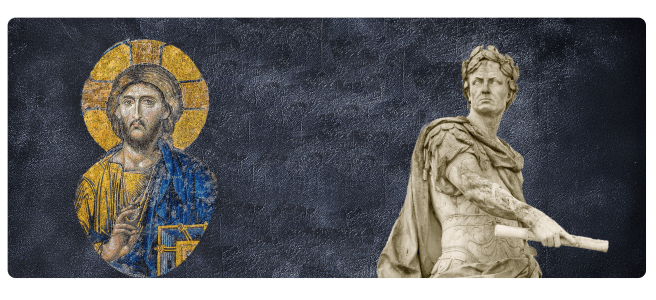
We should recognize, then, the problematic character of conventional, top-down politics. Let’s use the term “Constantinianism” for politics that both tries to control history by making it turn out right and uses top-down power that is coercive and dominating. The embrace of such methods ensures that our efforts will add to evil, not overcome it. Pacifism understands power in a different way. It recognizes that we are not in control and that the only way to overcome evil is always to act consistently with love. One of the great insights of Gandhi and King was to recognize that ends and means must go together. We only achieve genuine healing when we act in healing ways. Violent and coercive means cannot achieve healing ends.

Continue reading “Conclusion: A Christian pacifist in the American Empire [part 2]”

Jesus’s political alternative

Ted Grimsrud—October 14, 2025

Christian pacifism challenges mainstream Christianity by arguing that Jesus’s life and teaching actually do provide direct guidance for politics. Jesus, like the rest of the Bible, offers a direct alternative to the politics of empire and domination. Christians have misrepresented the Bible insofar as they have embraced uncritical nationalism. My realization that Jesus does give us a realistic peaceable direction caused me to turn away from my nationalistic embedded theology and never look back. In this post I will offer a summary of that peaceable direction.

Jesus affirmed that Torah and the prophets reveal God’s will for the world. When he taught with authority, showed love with his healing, and called together a community to embody the justice of God in the world, he fulfilled the Old Testament. Jesus’s life incurred the deadly wrath of the religious and political leaders. God raising Jesus from the dead in defiance of the leaders’ verdict of condemnation vindicated Jesus’s message. Jesus culminates the political message of the Old Testament when he critiques empire, rejects territorial kingdom as the channel for God’s promise to bless all the families of the earth, and the embodies Torah as the alternative to the ways of the nations. Like Torah and the prophets, Jesus practices power as service, offers compassion and justice for the vulnerable, and resists the powers of domination.

Politics and the gospels

The gospels present Jesus as a king. The gospel of Matthew begins with “an account of the genealogy of Jesus the Christ, the son of David, the son of Abraham” (Matthew 1:1). Christians tend to think of “Christ” as a religious term having to do with the divine identity of Jesus Christ, the savior. However, it literally means “king,” a political leader. The descriptor of Jesus that follows in Matthew 1:1, “son of David” confirms the political sense of “Messiah.” David stands as the paradigmatic king in ancient Israel, a kind of ideal king.

The rejection of the OT territorial kingdom points ahead to an alternative way to imagine the peoplehood. God never revoked Abraham’s vocation to bless all the families of the earth. If not as a territorial kingdom, then how will the promise be embodied? Jesus will be in continuity with David’s role in carrying on the promise (a great leader for the peoplehood). However, he will be in discontinuity in that his political path will not be to lead a territorial kingdom like David. The gospels provide an account for this alternative political path.

Continue reading “Jesus’s political alternative”

Breaking the hold of territorial kingdoms

Ted Grimsrud—October 10, 2025

Peace theology centers on Jesus’s life and teaching. Jesus’s life and teaching, though, make the most sense in relation to the bigger story of the Bible. In two posts, I will emphasize a few elements of the story. First, in my previous post, we note the Bible’s strong antipathy toward the big empires. Those empires powerfully challenged the Bible’s faith community—due both to the empires’ violence directed at the community and to the empires’ demands (often met) for loyalty and even idolatrous trust. The Bible offers a counter-empire vision for human life in the teaching of Torah and Jesus. These teachings explicitly offer alternatives to empire ideologies.

Second, Torah politics differ from state politics. Territorial kingdoms and nation states imitate the empires. They use coercion, exploit the vulnerable, protect boundaries, and demand absolute loyalty. The Bible’s faith community, called to bless all the earth’s families, sought to carry out that vocation as a territorial kingdom. The story shows the eventual incompatibility between the vocation to bless and identifying too closely with a territorial kingdom.

Abraham and Sarah and a new intervention from God

Genesis 12 tells of God calling Abraham and his spouse Sarah to parent this community. God gave them a child even though Sarah thought herself too old to bear children. The story that follows in the rest of the Bible presents the community in both success and failure. It offers guidance for the faithful practice of a politics of blessing. The continuation of the promise will be risky and tenuous. The human actors always risk derailing the process by their injustice, violence, and turning toward other gods. The channels for the blessing will always be imperfect human beings. The process will often be surprising. Key actors consistently will not be the people we would expect to be heroes. God’s hand in the dynamics is often difficult to discern, but somehow the promise and the blessing remain alive.

At the end of Genesis, the family of the promise moves to Egypt in order to survive a terrible famine. Then, in the book of Exodus, we learn the family does survive and multiplies, but in a condition of enslavement in the Egyptian Empire. These suffering, enslaved people cry out in their pain. God remembers the promises to Abraham and resolves to intervene. God will guide them into a recovery of faith and a new resolve to embody the promise to be a blessing.

Continue reading “Breaking the hold of territorial kingdoms”

The Bible’s suspicion of the empires

Ted Grimsrud—October 7, 2025

In the years from 1987 through 1996, I preached several hundred sermons. Almost all had to do with biblical bases for peace theology. Then I began college teaching and most of my classes were relevant for how Christian pacifist convictions could inform living in the American Empire. In what follows, I will present the message of the Bible that relates to peace theology. This message provides the grounding for an unblinkered look at the American Empire from the perspective of Christian pacifism—something I offer in the series’ final posts. The story I have told in my previous posts describes how I got to my commitment to peace theology. Now, I will turn to the story of where that commitment has led me, first theologically and then politically.

Holding the Bible loosely, but with respect

I view the Bible as a conversation partner. The big picture that comes from all its stories read together gives me a perspective from which to engage the world. To me, it is not a source of normative, explicit commands nor a miraculously accurate source of information about the past of God’s people. Yet, it is not simply ancient writings from a distant time. I see it as a fascinating collection of various kinds of literature. It reflects various human perspectives that hang together, loosely, to guide and inspire. The authors’ moral commitments give the Bible its coherence.

When read in light of Jesus’s message that centers on the call to love neighbors, the Bible serves that call. It presents a worldview shaped by love. Jesus does not originate this worldview but echoes and reinforces the Old Testament message of Torah and the prophets. The Bible tells a “Big Story” where all its parts hang together and convey a vision for life shaped by God’s love.

I discovered the Bible’s Big Story through my struggle with American warism. I found a way out of my embedded warist view of the world through an encounter with the story of Jesus. That encounter shaped how I have read the Bible ever since. In asking questions of the Bible about war, justice, and social transformation, I discovered that the Bible truly cares about politics and social transformation. It provides a powerful framework for interpreting the world.

Continue reading “The Bible’s suspicion of the empires”

Jesus’s upside-down empire. The Bible’s radical politics (part three)

Ted Grimsrud—June 12, 2025

As a Christian, I read the Bible with two assumptions. (1) The Old Testament has its own integrity and tells its own story. It is not simply, or mainly, or even at all relevant only in relation to events far in the future of the story being told. (2) Jesus is the center of the Bible when read as a whole. He embraced the Old Testament as scripture and affirmed the messages of Torah and the prophets as revealing God’s will for the world.

Jesus as the center of the Bible means his story clarifies and reinforces the basic message of the Old Testament. These two parts of the Big Story complement each other. Jesus embodies the political message of the Old Testament: critique of empire, rejection of territorial kingdom as the channel for God’s promise to bless all the families of the earth, and the embodiment of Torah as the alternative to the ways of the nations—including power as service, compassion and justice for the vulnerable and exploited, and resistance to the powers of domination. [This is the third in a series the Bible’s radical politics. Part one is “Ancient Israel among the great powers” and part two is “Ancient Israel as a failed state.”]

Politics and the gospels

One of the key terms in the gospels that signals their political agenda comes at the beginning: Matthew’s gospel tells “of Jesus the Messiah, the son of David, the son of Abraham” (1:1). “Messiah” equals “Christ.” Its literal meaning is “king,” a political leader.

Continue reading “Jesus’s upside-down empire. The Bible’s radical politics (part three)”

Ancient Israel as a failed state: The Bible’s radical politics (part two)

Ted Grimsrud—June 11, 2025

After considering ancient Israel among the great powers, I now want to focus on ancient Israel as what I will call a “territorial kingdom” (i.e., a political community that has boundaries and exercises sovereignty within those boundaries). The Bible’s politics start in enslavement in Egypt. The community coalesced as a people liberated by God, instructed in counter-empire living by Torah, and provided a territory wherein to live out Torah.

The story takes it for granted that the Hebrew people needed a Land where they could establish a permanent home and embody Torah. Between the time of liberation (the exodus) and of entrance to the Land, the people spent decades moving about in the “wilderness.” They struggled to maintain fidelity to Yahweh. In the end, only a handful of the original community that escaped Egypt were allowed to enter the Land with the children and grandchildren of the original community members.

The descendants of the original Hebrews faced the challenge: Overcome the hostility from surrounding nations and remain faithful to Torah in face of temptations to conform to the religious and social practices of those nations. This struggle, sadly, would be so difficult that the territorial kingdom would not be a viable arrangement for the way of Torah. The Bible actually offers a different option. You don’t have to be a territorial kingdom to embody God’s kingdom.

Continue reading “Ancient Israel as a failed state: The Bible’s radical politics (part two)”

Finding peace in the Old Testament [Peace and the Bible #19]

Ted Grimsrud—September 23, 2024

One of the first things that came up for me back nearly fifty years ago when I first thought of myself as a Christian pacifist was the question of the Old Testament. How can we reconcile all the violence of the Old Testament with the idea that Jesus calls us to be peacemakers? The first step for me at the time, and I think the first step for many, is to acknowledge that this is a problem but to emphasize the clarity of Jesus’s message for me. I’m not sure what the OT says, but I do know what Jesus says. The effect of this step, though, can easily be simply to set the Old Testament aside as being mainly a problem and not a good guide. I always felt uneasy about such a move.

So, one of my interests has been to work at reading the Old Testament as a positive resource for my peace convictions. I have done some recent thinking that has provided a sense of clarity about one particular angle that I want to outline in this post. I have long believed, and still do, that my pacifism does not depend on the Old Testament. However, I think pacifism is compatible with the Old Testament—and even benefits greatly from taking the Old Testament seriously.

Benefits from losing the promised land?

Lately I have read several helpful books about the Old Testament and Christian theology. At one point, I paused and thought about something I had read over and over. That was that it was such a terrible thing when the ancient Hebrews were driven from their territorial kingdom, having their temple destroyed and king dethroned. The entire story, it seems, revolves around that loss and an accompanying, long-lasting desire to restore this territorial kingdom and get their king back.

I was struck, though, with a sense that these assumptions might not be the best way to read the story. One of the books I read noted that the faith of the ancient Hebrews was established in a normative way before the people entered the promised land and established a territorial kingdom. The core elements of the faith—as found in the creation story, the exodus story, and the gift of Torah—existed independently of the territorial kingdom. As the story continues, the people enter the promised land, seek to embody Torah, establish a territorial kingdom, and, in time, lose that kingdom. Yet the peoplehood continued, based on that earlier foundation. And in the thousands of years since, the peoplehood has continued without (until very recently) a territorial kingdom. So, was losing that kingdom actually such a bad thing? In fact, might it be part of the story that territorial kingdoms are inherently problematic? Maybe the peace message of the Bible has a lot to do with precisely the point that faithful living is best pursued apart from taking responsibility for territorial kingdoms or nation-states.

Continue reading “Finding peace in the Old Testament [Peace and the Bible #19]”

What did Jesus mean by the “Kingdom of God”? [Peace and the Bible #13]

Ted Grimsrud—February 5, 2024

I believe that one important indicator that Jesus had a “political” agenda (as I have discussed in my previous two blog posts, “Peaceable politics and the story of Jesus” and “Did Jesus have a political philosophy?”) is simply his prominent use of the term “kingdom of God” (or its equivalent in Matthew’s gospel, “kingdom of heaven”). This seems actually to be a complicated metaphor—it’s not obvious exactly what Jesus meant. But that “kingdom” has political connotations cannot be questioned. As a simple definition of “kingdom,” we may say it is a stable community of people that is led by a queen- or king-like ruler. In whatever sense Jesus had in mind of “community” and “ruler,” he did have in mind some sort of political entity.

I have long been ambivalent about our using the “kingdom of God” metaphor today. It seems hopelessly archaic, not to mention patriarchal. It breathes of a world of domination and hierarchies. Yet, Jesus—as I understand him—opposes patriarchy, domination and hierarchies. Is there a better way to understand his metaphor, then? I think so, though I am still not fully comfortable making the term a regular part of the faith language. But rather than simply dismissing the metaphor, I think we would be well served to try to figure out what Jesus himself meant by it. What was he trying to convey? May we affirm his intent even if we seek to find more contemporary language to articulate it? To work at answering these questions, let’s look at the biblical history of the notion of the “kingdom of God.”

The failed territorial kingdom of the Old Testament

The initial picture of the kingdom of God in the Old Testament is of Abraham’s descendants, a community of freed slaves who God led out of Egypt. After the exodus from slavery, God provides the people with a set of laws (Torah) that calls for a social order that in many ways would be an alternative type of politics in contrast to the domination-style politics of the Egyptian empire. The liberation was led by Moses, whose role was to be a kind of extemporaneous prophet, not a permanent king-like leader and not a military leader sitting atop a permanent war-making machine. God is presented as the true king of the people; that is what makes the community an expression of the “kingdom of God.”

Continue reading “What did Jesus mean by the “Kingdom of God”? [Peace and the Bible #13]”

Did Jesus have a political philosophy? (Peace and the Bible #12)

Ted Grimsrud—February 2, 2024

I am finally returning from an extended break to continue my “Peace and the Bible” blog series. My most recent post, December 18’s “Peaceable politics and the story of Jesus” was the first that dealt with the New Testament after a number of Old Testament posts. I have several more planned on Jesus and then will consider some issues regarding both Paul’s writings and the book of Revelation. Before returning to my planned outline, though, I want to linger in this post on some issues that came up with my last one.

Politics, philosophy, and pacifism

I started by noting that the “Peace and the Bible” theme helps us focus on just how political the concerns of the Bible are. For most Christians, I imagine that point seems clearer in relation to the Old Testament than the New Testament. I suggested, though, that the New Testament actually “presents a kind of political philosophy” that has at its core “a commitment to pacifism, a commitment based on the centrality of Jesus Christ to the Big Story the Bible tells.” In thinking about this assertion, I decided I should reflect a bit more on what I am trying to say.

I pointed out that “Christians have tended to miss the social implications of the New Testament part of the story because of assumptions about both politics and Jesus.” One way to further analyze the issues is to suggest, in very much a general sense, that we might recognize two types of thinking about how to understand the cluster of issues related to (1) “political philosophy,” (2) “pacifism,” (3) “biblical faith,” and (4) “Jesus-oriented discipleship.” One way is to perceive that those items #1 and #2 belong to a certain kind of thinking and that #3 and #4 belong to a very different kind of thinking. The other way would be to argue for understandings of those terms that recognize that they all may (and should!) be understood together in a way that leads to redefining them all.

Continue reading “Did Jesus have a political philosophy? (Peace and the Bible #12)”

Peaceable politics and the story of Jesus (Peace and the Bible #11)

Ted Grimsrud—December 18, 2023

In my blog series on “Peace and the Bible,” I am showing just how political the concerns of the Bible are. Most people I know find it easier to see that in the Old Testament than the New. In the second half the series, I will argue that the New Testament presents a kind of political philosophy. This philosophy has at its core a commitment to pacifism, a commitment based on the centrality of Jesus Christ to the Big Story the Bible tells. Christians have tended to miss the social implications of the New Testament part of the story because of assumptions about both politics and Jesus.

Politics have been seen as directly tied to running governments and the necessary use of violence. Jesus indeed did not talk about running governments or using violence. However, if we define politics more broadly as the way human beings order their lives together in social groups, perhaps Jesus and the rest of the New Testament were engaging in political behavior. Once we think of politics in this wider sense, we will be more open to recognizing that Jesus indeed was interested in politics—and, actually, very little else. When Jesus spoke of the “Kingdom of God,” perhaps what he had in mind was not some other-worldly existence but a reimagining of politics in this life—in line with the political dynamics in his Bible (what we call the Old Testament). The notion that Jesus spoke only of the personal sphere actually has little support in the texts.

If Jesus did indeed care about politics, then that Christians understand him to be the model human being and the definitive revelation of God would seem to require them to take seriously Jesus’s political witness. If we do take the story of Jesus seriously as an account of a peaceable way of ordering our social lives, our other question will be how relevant that account should be for our present-day political convictions and practices.

Who was Jesus?

At the very beginning of the story of Jesus in Luke’s gospel—the song of Mary in 1:46-55 upon her learning of the child she will bear—we learn that this child will address social reality. He will challenge the power elite of his world and lift up those at the bottom of the social ladder. This child, we are told, will bring succor to those who desire the “consolation of Israel.” Those who seek freedom from the cultural domination of one great empire after another that had been imposed upon Jesus’s people for six centuries will find comfort. From the beginning, the story presents this child in social and political terms.

Continue reading “Peaceable politics and the story of Jesus (Peace and the Bible #11)”