Conclusion: A Christian pacifist in the American Empire [part 2]

Ted Grimsrud—November 21, 2025

I have found Christian pacifism, properly understood, to be a most helpful framework as I try to understand the world I live in. In this series of 24 blogposts, I explain how I came to affirm pacifism and what it means for me. I have also showed how my pacifism shapes the questions I raise and criticisms I offer in relation to the American Empire. In this final post, I offer reflections on moving forward to live in the Empire in light of pacifist convictions.

Rethinking power

Christian pacifism posits two central affirmations— (1) We are called to resist and to seek to overcome evils in the world (“evil” most simply understood as that that harms life) and (2) We must work against evils in ways that do not add to the evil. The practice of pacifism helps us hold these two affirmations together. Committed to overcome evils, we engage the American Empire, the source of so many evils in our world. Committed not to add to the evil, we seek to find consistently nonviolent means as we strategize and act. One of the main ways human beings have tended to add to evil is to resist the wrong through the use of violence and coercion.

The American Empire cannot realistically be transformed in any immediate way. To try too hard to transform the Empire may lead us to take moral shortcuts that change us in ways that result to our actually adding to the evils that the Empire is doing. Violent resistance uses evil means to seek what might be good ends and may transform the effort into something that adds to the evil. On the other hand, many people try to reform the Empire through efforts that all too often actually result in compromise with the Empire on key issues and little genuinely changes.

We should recognize, then, the problematic character of conventional, top-down politics. Let’s use the term “Constantinianism” for politics that both tries to control history by making it turn out right and uses top-down power that is coercive and dominating. The embrace of such methods ensures that our efforts will add to evil, not overcome it. Pacifism understands power in a different way. It recognizes that we are not in control and that the only way to overcome evil is always to act consistently with love. One of the great insights of Gandhi and King was to recognize that ends and means must go together. We only achieve genuine healing when we act in healing ways. Violent and coercive means cannot achieve healing ends.

Continue reading “Conclusion: A Christian pacifist in the American Empire [part 2]”

Resistance to the American Empire

Ted Grimsrud—September 16, 2025

As the US embarked on a quest for world dominance after World War II, leaders’ quest for “full spectrum dominance” did not meet with total support from Americans. Opposition to newly expansive US warism received little media attention, though. It rarely effected policy makers. I knew nothing of the dissenters as a youth in my little corner of the world. For the story I tell in this series of posts, though, we should note the small pockets of dissent—both to indicate that American warism was not unanimous (people did dissent) and to recognize that the peace efforts that did shape my convictions beginning in the mid-1970s had important antecedents. 

Antiwar voices

In the late 1930s, many spoke in opposition to the US joining the War. Congress, which would not support a war declaration proposal from the president, did pass legislation for a draft in 1940, but only narrowly. Large movements of anti-war sentiment arose both from the right (the America First movement of traditional American isolationism) and the left (the popular antiwar movement that had arisen in the early 1930s after disillusionment with World War I). However, this war opposition almost immediately evaporated after the Pearl Harbor attack by the Japanese on December 7, 1941. With the Japanese attack the “America first” conservatives quickly jumped onboard in favor of what was widely perceived to be a war of national defense.

During negotiations in Congress on the draft, representatives from the various peace churches (led by the Quakers) managed to get alternative service for conscientious objectors included. With the popularity of the war and the government’s prowar propaganda, though, only a tiny fraction of draftees took the CO option. Most of the 12,000 draftees who performed alternative service were traditional, somewhat apolitical pacifists. Only a few thousand would have been opposed politically to the war effort. In addition to the legal COs, about 6,000 war opponents went to prison as draft resisters—though the large majority of those were Jehovah’s Witnesses whose refusal to cooperate with the draft had to do with the government refusing them ministerial exemptions, not their political opposition to the war effort.

Out of the tiny handful of COs that we could understand to be anti-empire did come important leadership for the resistance that found expression in years following. Imprisoned COs such as Dave Dellinger and Bayard Rustin developed their ideas about war resistance and nonviolent social change while spending the war years in prison and emerged afterwards as important peace movement leaders. It was also the case that the experience of many of the COs during the War had a significant formative impact. For example, numerous Mennonite COs shaped educational, service, and antiwar efforts among Mennonites and in the wider society in postwar years. Mennonite pacifism tried more to influence the wider world toward peacemaking.

Continue reading “Resistance to the American Empire”

Peaceable politics and the story of Jesus (Peace and the Bible #11)

Ted Grimsrud—December 18, 2023

In my blog series on “Peace and the Bible,” I am showing just how political the concerns of the Bible are. Most people I know find it easier to see that in the Old Testament than the New. In the second half the series, I will argue that the New Testament presents a kind of political philosophy. This philosophy has at its core a commitment to pacifism, a commitment based on the centrality of Jesus Christ to the Big Story the Bible tells. Christians have tended to miss the social implications of the New Testament part of the story because of assumptions about both politics and Jesus.

Politics have been seen as directly tied to running governments and the necessary use of violence. Jesus indeed did not talk about running governments or using violence. However, if we define politics more broadly as the way human beings order their lives together in social groups, perhaps Jesus and the rest of the New Testament were engaging in political behavior. Once we think of politics in this wider sense, we will be more open to recognizing that Jesus indeed was interested in politics—and, actually, very little else. When Jesus spoke of the “Kingdom of God,” perhaps what he had in mind was not some other-worldly existence but a reimagining of politics in this life—in line with the political dynamics in his Bible (what we call the Old Testament). The notion that Jesus spoke only of the personal sphere actually has little support in the texts.

If Jesus did indeed care about politics, then that Christians understand him to be the model human being and the definitive revelation of God would seem to require them to take seriously Jesus’s political witness. If we do take the story of Jesus seriously as an account of a peaceable way of ordering our social lives, our other question will be how relevant that account should be for our present-day political convictions and practices.

Who was Jesus?

At the very beginning of the story of Jesus in Luke’s gospel—the song of Mary in 1:46-55 upon her learning of the child she will bear—we learn that this child will address social reality. He will challenge the power elite of his world and lift up those at the bottom of the social ladder. This child, we are told, will bring succor to those who desire the “consolation of Israel.” Those who seek freedom from the cultural domination of one great empire after another that had been imposed upon Jesus’s people for six centuries will find comfort. From the beginning, the story presents this child in social and political terms.

Continue reading “Peaceable politics and the story of Jesus (Peace and the Bible #11)”

Are we inherently violent? [Questioning faith #21]

Ted Grimsrud—April 16, 2023

One of the difficult issues that often comes up in discussions about pacifism is the widely held view that human beings are inherently violent. A common version of this view holds that we are born with a disposition toward violence that is part of our genetic makeup, in part because violence is necessary to successfully compete in the dynamics of survival of the fittest that is characteristic of the human project. Hence, violence is natural, and pacifism is unnatural and unrealistic—and untenable.

Not all pacifists agree with what I will argue for about human nature here. In fact, I first developed the ideas about human nature that I believe fit best with pacifist convictions for a public debate with a pacifist who argued for what I describe below as the “hard-wired view.” My debate partner believed that the call to pacifism that Jesus made was actually a call to defy our basic human nature and make a conscious choice to embrace love. I admire people who take this approach, but I also think that most people who take the hard-wired view draw from it bases for anti-pacifist conclusions. More importantly, I think the more pacifism-friendly view of human nature I will sketch actually fits the evidence we have about human existence better than the other options.

Views of human nature

I will summarize three general viewpoints concerning human nature that I think represent the main options: the “hard-wired view,” the “blank-slate view,” and the “flexible view.”

(1) The hard-wired view posits that human behavior is largely determined by a quite thick reality of human nature. One main focus of many with this view is on our genetic make-up, asserting that our behavior is profoundly shaped by our genes. As concerns violence, the “hard-wired view” tends to see human beings as naturally violent. We are born violent, we tend toward violence, our work of minimizing violence should focus on finding relatively non-harmful outlets for these naturally violent tendencies. At best, we may redirect violent tendencies, but we cannot hope to live without violence.

(2) At the opposite end of the spectrum from the hard-wired view, we may speak of the blank slate view. This view asserts that it is meaningless to posit a “human nature;” we are all born with blank slates, and human behavior is totally shaped by our environments and is variable and non-determined.

(3) A second alternative to the hard-wired view we may call the flexible view. This view, which I hold, agrees with the hard-wired view that human nature is a meaningful concept, but would differ from that view by denying that human behavior is in any meaningful sense determined by genetics or, really, by any other unchanging element of human nature.

Continue reading “Are we inherently violent? [Questioning faith #21]”

How does Christian pacifism work? [Questioning faith #15]

Ted Grimsrud—January 29, 2023

My definition of pacifism starts with the conviction that no belief or commitment or loyalty matters more than loving all others. It follows from such a conviction that participating in or preparing for or supporting warfare would never be acceptable. A key element, then, of this kind of conviction is that it requires a break from the widely held assumption that we should allow our nation to decide for us when war is okay. This assumption I call the “blank check”—the willingness (generally simply assumed more than self-consciously chosen) to do what our nation calls upon us to do, to give it—in effect—a blank check.

I have studied the responses American citizens had to their nation’s all-in call for fighting World War II. Only a tiny handful refused to take up arms, and I would say that almost universally those “conscientious objectors” shared a sense of loyalty to some higher moral conviction than accepting the blank check—and those who weren’t COs did not share that loyalty. Those who went to war did accept that their highest loyalty was owed to their nation.

If I add the modifier “Christian” to the term pacifism, the basic definition remains the same, but it adds the source of the conviction about the centrality of love. “Christian pacifism,” I would say, is the conviction that loving others is our never to be subordinated moral commitment, and this is due to the message of Jesus. Christians who aspire to have love be their central moral conviction (that is, “Christian pacifists”) look especially to Jesus’s teaching that love of God and neighbor is the heart of God’s will for human beings.

Why self-consciousness about pacifism matters

The two main inter-related reasons for why it is so important actually to understand Christian pacifism are: (1) in the long history of Christianity, hardly any Christian groups have in fact been committed to pacifism despite it being so central to Jesus’s message and (2) in the long history of human civilization hardly any Christians seem to have seriously questioned the validity of giving the state a blank check when it comes to warfare despite war being so obviously a violation of Jesus’s core message.

Continue reading “How does Christian pacifism work? [Questioning faith #15]”

Pacifism and saying no to the state: Various motives for refusal [Pacifism today #7]

Ted Grimsrud—April 15, 2022

With a breathtaking rapidity, the United States in the last couple of months has moved decisively in a militaristic direction. As historian Andrew Bacevich recently wrote, many American leaders “welcome the Ukraine War as the medium that will reignite an American commitment to the sort of assertive and muscular approach to global policy favored in militaristic quarters…. Putin … has handed the United States ‘a historic opportunity to regroup and reload for an era of intense competition’—with not only Russia but also China meant to be in our crosshairs.”

The delight of these militarist leaders and the arms dealers who also are profiting so greatly from the new conflict should give people who actually care about peace on earth pause before believing the spin our government and corporate media are giving things right now. We will almost certainly face a continued ratcheting up of militaristic dynamics in our society for the foreseeable future. The warism of our culture has always been bubbling just below the surface even as other crises have demanded attention. For it to move front and center hopefully will clarify that militarism is the problem that must be resolved if we are to make progress in overcoming the climate crisis, the curse of white supremacy, the violence of our policing and mass incarceration regimes, environmental collapse, the functioning of our democracy, and many others.

Effective opposition to the warism seems far from possible at this moment, though. The one single issue that seems to unite Democrats and Republicans is expansion of our war-making capabilities. The apparent impossibility of opposition does not diminish what may be a fact—we turn from warism as a society, or we all go down.  

In face of all this, the witness of pacifism seems more relevant than ever. When there is such uncritical support for pouring weapons of war into Ukraine, Germany greatly expanding its military spending, and the dynamics of confrontation rather than reconciliation with Russia and China, it seems pacifists are some of the few who voice opposition. One hope we might have is that with our nation’s warism so front and center, more people will question whether we actually do want our nation to be so committed to military “solutions” after all. Maybe this will lead to more interest in pacifism.

Continue reading “Pacifism and saying no to the state: Various motives for refusal [Pacifism today #7]”

A social gospel for the 21st century: Drew Hart’s creative synthesis

Ted Grimsrud—September 3, 2020

In his new book, Who Will Be a Witness? Igniting Activism for God’s Justice, Love, and Deliverance (Herald Press), Messiah College theology professor Drew Hart has given us a much-needed theological resource for embodying the way of Jesus in our troubled times.

A theology for Christian social engagement

The most attractive aspect of this engagingly written book is how Hart synthesizes three streams of Christian theology: (1) a Jesus-centered biblical radicalism that has a visionary suspicion of the mainstream Christian tradition, (2) a socially-engaged sensibility shaped by the black experience in America (a legacy Hart calls “the black prophetic tradition”), and (3) an Anabaptistic orientation that emphasizes the call to transformative nonviolence.

While Hart writes explicitly as a black theologian, what he provides is not a narrowly focused “contextual theology.” His first book, the well-received Trouble I’ve Seen: Changing the Way the Church Views Racism, focuses on the African American context. This new book, Who Will Be a Witness?, may in turn more accurately be understood as a much broader Christian theology of social engagement that Hart constructs through the lens of the black Christian tradition.

Thus, Hart’s book may be seen as a contemporary expression of what theological historian Gary Dorrien presents as “the black social gospel” in his recent magisterial two-volume history of that tradition in the United States. Dorrien argues that the black social gospel has been a perspective that speaks to all Christians with a profound awareness of the concrete relevance of the Christian gospel for life in this world. Like the great practitioners of the black social gospel such as Howard Thurman and Martin Luther King, Jr., Hart gives us a powerful challenge for all Christians to understand that at the very core of our faith lies a call to be an active presence in the world witnessing to God’s work of justice and healing. Continue reading “A social gospel for the 21st century: Drew Hart’s creative synthesis”

Pacifist questions during an uprising [Pacifism/Peace Theology #1]

Ted Grimsrud—June 25, 2020

Since we are in the midst of the turmoil, we don’t yet fully understand just how earthshaking this first half of 2020 will turn out to be. Right now, though, it feels as if we are in the midst of rapid and dramatic events that will change the world as we know it. It’s exciting but also unnerving. I wonder what thoughts those with pacifist convictions might have to offer.

What do I mean by “pacifist convictions”? I think of pacifism as an aspiration to live and think as if nothing matters as much as love. This leads on the one hand, to a commitment to resist domination and injustice, and on the other hand, to a commitment to avoid violence. I don’t think of pacifism as a quest for purity and total consistency so much as holding ahead of us the goals of healing, of justice, of compassion and recognizing, with Gandhi (perhaps our most important theorist of pacifism), that the means of achieving those goals must be consistent with the goals themselves.

This blog post will be the first of many as I try to return to more regular blog activity during our time of upheaval. I am being challenged to revisit my core convictions and try to imagine their relevance to the world I am observing. It’s a good time to try to think one’s thoughts through. Let me reflect on three pacifism-inspired questions: (1) What about the impact of property destruction during the current demonstrations? (2) Is it possible for people seeking change to resist the polarization that seems so pervasive in American society right now? (3) Is it important to raise issues related to our nation’s warism even as we deal with more immediate crises? Continue reading “Pacifist questions during an uprising [Pacifism/Peace Theology #1]”

Is violence necessary to win freedom? The resistance to American slavery [Civil War #6]

Ted Grimsrud—September 4, 2019

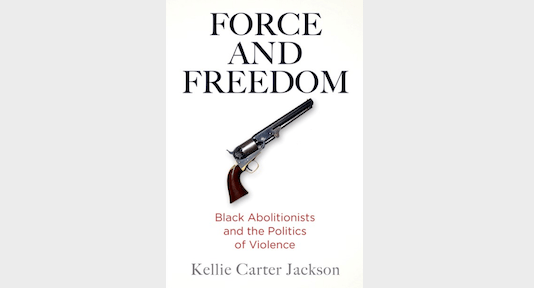
A new book challenges many of my assumptions about the role of violence and nonviolence in resistance to white supremacy and enslavement in American history. Kellie Carter Jackson, a historian who teaches at Wellesley College, in Force and Freedom: Black Abolitionists and the Politics of Violence (University of Pennsylvania Press, 2019) argues for the centrality of necessary violence in the work of resisting and ending slavery. Though she alludes only briefly to the more recent Civil Rights Movement, she seems to believe that violence was a necessary part of the positive gains made in the 1950s and 1960s as well.

An interesting book

I found this book quite interesting—which, unfortunately, is a comment I make only partly as a compliment. One of Carter Jackson’s achievements that I fully affirm is how she draws attention to the numerous black advocates for abolition in the several decades prior to the Civil War. All too often, the story of the abolitionist movement has focused almost exclusively on the white leaders with the addition of Frederick Douglass. Carter Jackson helps us see how vital and widespread the movement among black activists in the North actually was.

As well, Carter Jackson provides an insightful account of the evolution of the abolitionist movement in face of the extraordinary intransigence of white supremacists in the South and the North. At the beginning of the William Lloyd Garrison-led “formal” abolitionist movement in the early 1830s, the emphasis was on “moral suasion” that was self-consciously opposed to the use of violence to effect liberation for the enslaved. Over the following several decades, as the regime of enslavement became more entrenched—with the deep-seated collaboration of Congress, various pro-slavery presidents, and the Supreme Court—those committed to its eradication became increasingly impatient with the emphasis only on “suasion.” Belief in the necessity of violence for the liberation of the enslaved became increasingly widespread.

However, I do not believe that Carter Jackson has successfully made the case for her more wide-ranging claims (albeit usually only implicitly stated) that violence was indeed necessary, then and ever since, for achieving both liberation from slavery and social equality. In her epilogue she tellingly quotes Cynthia Washington of the Student Nonviolent Coordinating Committee from the 1960s, “I was never a true believer in nonviolence.” Washington “carried a handgun in her bag. And though she never fired it, she made it clear that she was willing to do so” (p. 160). Carter Jackson clearly sees Washington’s views on nonviolence as reflecting her own—that is, she doesn’t really give nonviolence a chance. Continue reading “Is violence necessary to win freedom? The resistance to American slavery [Civil War #6]”