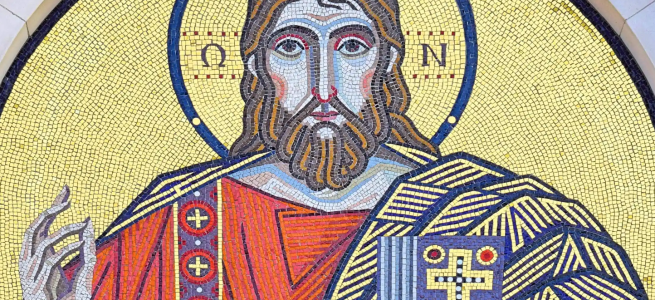
Jesus’s political alternative

Ted Grimsrud—October 14, 2025

Christian pacifism challenges mainstream Christianity by arguing that Jesus’s life and teaching actually do provide direct guidance for politics. Jesus, like the rest of the Bible, offers a direct alternative to the politics of empire and domination. Christians have misrepresented the Bible insofar as they have embraced uncritical nationalism. My realization that Jesus does give us a realistic peaceable direction caused me to turn away from my nationalistic embedded theology and never look back. In this post I will offer a summary of that peaceable direction.

Jesus affirmed that Torah and the prophets reveal God’s will for the world. When he taught with authority, showed love with his healing, and called together a community to embody the justice of God in the world, he fulfilled the Old Testament. Jesus’s life incurred the deadly wrath of the religious and political leaders. God raising Jesus from the dead in defiance of the leaders’ verdict of condemnation vindicated Jesus’s message. Jesus culminates the political message of the Old Testament when he critiques empire, rejects territorial kingdom as the channel for God’s promise to bless all the families of the earth, and the embodies Torah as the alternative to the ways of the nations. Like Torah and the prophets, Jesus practices power as service, offers compassion and justice for the vulnerable, and resists the powers of domination.

Politics and the gospels

The gospels present Jesus as a king. The gospel of Matthew begins with “an account of the genealogy of Jesus the Christ, the son of David, the son of Abraham” (Matthew 1:1). Christians tend to think of “Christ” as a religious term having to do with the divine identity of Jesus Christ, the savior. However, it literally means “king,” a political leader. The descriptor of Jesus that follows in Matthew 1:1, “son of David” confirms the political sense of “Messiah.” David stands as the paradigmatic king in ancient Israel, a kind of ideal king.

The rejection of the OT territorial kingdom points ahead to an alternative way to imagine the peoplehood. God never revoked Abraham’s vocation to bless all the families of the earth. If not as a territorial kingdom, then how will the promise be embodied? Jesus will be in continuity with David’s role in carrying on the promise (a great leader for the peoplehood). However, he will be in discontinuity in that his political path will not be to lead a territorial kingdom like David. The gospels provide an account for this alternative political path.
Continue reading “Jesus’s political alternative”

Jesus’s upside-down empire. The Bible’s radical politics (part three)

Ted Grimsrud—June 12, 2025

As a Christian, I read the Bible with two assumptions. (1) The Old Testament has its own integrity and tells its own story. It is not simply, or mainly, or even at all relevant only in relation to events far in the future of the story being told. (2) Jesus is the center of the Bible when read as a whole. He embraced the Old Testament as scripture and affirmed the messages of Torah and the prophets as revealing God’s will for the world.

Jesus as the center of the Bible means his story clarifies and reinforces the basic message of the Old Testament. These two parts of the Big Story complement each other. Jesus embodies the political message of the Old Testament: critique of empire, rejection of territorial kingdom as the channel for God’s promise to bless all the families of the earth, and the embodiment of Torah as the alternative to the ways of the nations—including power as service, compassion and justice for the vulnerable and exploited, and resistance to the powers of domination. [This is the third in a series the Bible’s radical politics. Part one is “Ancient Israel among the great powers” and part two is “Ancient Israel as a failed state.”]

Politics and the gospels

One of the key terms in the gospels that signals their political agenda comes at the beginning: Matthew’s gospel tells “of Jesus the Messiah, the son of David, the son of Abraham” (1:1). “Messiah” equals “Christ.” Its literal meaning is “king,” a political leader.

Continue reading “Jesus’s upside-down empire. The Bible’s radical politics (part three)”

Ancient Israel as a failed state: The Bible’s radical politics (part two)

Ted Grimsrud—June 11, 2025

After considering ancient Israel among the great powers, I now want to focus on ancient Israel as what I will call a “territorial kingdom” (i.e., a political community that has boundaries and exercises sovereignty within those boundaries). The Bible’s politics start in enslavement in Egypt. The community coalesced as a people liberated by God, instructed in counter-empire living by Torah, and provided a territory wherein to live out Torah.

The story takes it for granted that the Hebrew people needed a Land where they could establish a permanent home and embody Torah. Between the time of liberation (the exodus) and of entrance to the Land, the people spent decades moving about in the “wilderness.” They struggled to maintain fidelity to Yahweh. In the end, only a handful of the original community that escaped Egypt were allowed to enter the Land with the children and grandchildren of the original community members.

The descendants of the original Hebrews faced the challenge: Overcome the hostility from surrounding nations and remain faithful to Torah in face of temptations to conform to the religious and social practices of those nations. This struggle, sadly, would be so difficult that the territorial kingdom would not be a viable arrangement for the way of Torah. The Bible actually offers a different option. You don’t have to be a territorial kingdom to embody God’s kingdom.

Continue reading “Ancient Israel as a failed state: The Bible’s radical politics (part two)”

Ancient Israel among the great powers. The Bible’s radical politics (part one)

Ted Grimsrud—June 10, 2025

I recently led a three-part adult Sunday School class on “The Bible’s radical politics.” This post is an expanded version of the first session. I will follow with the other two parts and then add a fourth post that reflects on lessons from these posts for politics today.

This first post will discuss ancient Israel among the great powers of the ancient near east. Israel’s entire existence in the Bible took place in the shadow of one great power or another, from Egypt on down to Rome. So, the politics of the Bible has a lot to do with navigating life in that shadow—resistance, subjection, imitation, alternative.

Then, the second post will zero in on Israel’s own attempt to be a territorial kingdom, a power in its own right. I call this, ancient Israel as a failed state—and will consider what follows after the failure. Israel’s time as a nation-state in the “promised land” was complicated, but ultimately ended in disaster—yet the peoplehood continued. What lessons came out of that experience that empowered the peoplehood to continue?

Third, I will turn to the New Testament and the story of Jesus, and his politics as told in the gospels with a glimpse at the book of Revelation. I call this “Jesus’s upside-down empire.” I will suggest that Jesus’s radical politics are best understood in terms of his continuity with the Old Testament.

I will conclude with a fourth post—not part of the original Sunday school class—that reflects on a Christian political agenda in light of the Bible’s radical politics. Most politically engaged people in the United States today recognize that we are facing crises of extraordinary difficulty and diversity. How might the Bible’s Big Story give us some perspective on navigating these crises?

Continue reading “Ancient Israel among the great powers. The Bible’s radical politics (part one)”

What did Jesus mean by the “Kingdom of God”? [Peace and the Bible #13]

Ted Grimsrud—February 5, 2024

I believe that one important indicator that Jesus had a “political” agenda (as I have discussed in my previous two blog posts, “Peaceable politics and the story of Jesus” and “Did Jesus have a political philosophy?”) is simply his prominent use of the term “kingdom of God” (or its equivalent in Matthew’s gospel, “kingdom of heaven”). This seems actually to be a complicated metaphor—it’s not obvious exactly what Jesus meant. But that “kingdom” has political connotations cannot be questioned. As a simple definition of “kingdom,” we may say it is a stable community of people that is led by a queen- or king-like ruler. In whatever sense Jesus had in mind of “community” and “ruler,” he did have in mind some sort of political entity.

I have long been ambivalent about our using the “kingdom of God” metaphor today. It seems hopelessly archaic, not to mention patriarchal. It breathes of a world of domination and hierarchies. Yet, Jesus—as I understand him—opposes patriarchy, domination and hierarchies. Is there a better way to understand his metaphor, then? I think so, though I am still not fully comfortable making the term a regular part of the faith language. But rather than simply dismissing the metaphor, I think we would be well served to try to figure out what Jesus himself meant by it. What was he trying to convey? May we affirm his intent even if we seek to find more contemporary language to articulate it? To work at answering these questions, let’s look at the biblical history of the notion of the “kingdom of God.”

The failed territorial kingdom of the Old Testament

The initial picture of the kingdom of God in the Old Testament is of Abraham’s descendants, a community of freed slaves who God led out of Egypt. After the exodus from slavery, God provides the people with a set of laws (Torah) that calls for a social order that in many ways would be an alternative type of politics in contrast to the domination-style politics of the Egyptian empire. The liberation was led by Moses, whose role was to be a kind of extemporaneous prophet, not a permanent king-like leader and not a military leader sitting atop a permanent war-making machine. God is presented as the true king of the people; that is what makes the community an expression of the “kingdom of God.”

Continue reading “What did Jesus mean by the “Kingdom of God”? [Peace and the Bible #13]”