Guardians of God’s shalom: The Old Testament prophets (Peace and the Bible #10)

Ted Grimsrud—December 15, 2023

The Old Testament tells us that God provides salvation for God’s people as a gift—given out of God’s healing love, unearned, even unmerited by the people. The story presents two institutions linked with salvation, Torah and sacrifice. Both initially served as responses to the gift. First, the people received God’s acts of deliverance, then came gratitude. Such gratitude led to responses of obedience to God’s will for social life. These found expression in Torah and in ritualized expressions of commitment to God via sacrifice.

As the Hebrews’ political structures expanded and became centralized under the office of the king, their religious structures also became centralized around the Temple. With this, the original purposes of the Law and sacrifices were mostly forgotten. Torah originated as the framework for the Hebrews to concretize their liberation. Torah arranges for the economic viability of each household, resisting social stratification. Torah’s inheritance legislation, Sabbath year laws, and the ideal of the Year of Jubilee all pushed in the direction of widespread participation in economic wellbeing. The Law also placed special emphasis on the community tending to the welfare of vulnerable people—widows, orphans, and aliens (“for you too were aliens in Egypt before God delivered you,” Leviticus 19).

The idea of what we could call “God’s preferential option for the poor” in many ways defines what ancient Israel said about God. It arose as a core part of the understanding from the very beginning. The sacrificial practices, above all else, were intended to be linked with the faithful responses of the people, in gratitude, to God’s liberating work.

Problems with law and sacrifices

Torah meant neither the Law nor the sacrifices to be means to salvation but rather responses to the saving works of God. Torah meant for the Law and sacrifices to enhance justice in the community. Once they were established, though, the danger inevitably arose that either or both would be separated from their grounding in God’s merciful liberating works. As memory of the intent of the Law faded, the story tells of the community’s tendency to focus on external expressions, easily enforced and susceptible to becoming tools of people in power. These tendencies led to legalism and, eventually, in the prophets’ views, to removing the Law from its living heart of liberation from slavery and concern for the wellbeing of vulnerable people.

Continue reading “Guardians of God’s shalom: The Old Testament prophets (Peace and the Bible #10)”

Paul’s critique of idolatry, part 3 — Liberation from idolatry [Peaceable Romans #5]

Ted Grimsrud—January 31, 2022

As we have seen in the previous two blog posts in this three-part series, Paul begins his letter to the followers of Jesus in Rome with a two-part analysis of the dynamics of idolatry—first, political idolatry and then religious idolatry. He concludes that “all are under the power of sin” (Romans 3:9)—that is, both types of idolatry keep us from living the free and fruitful lives God intends for us. Paul’s intent, though, is not emphasizing the total depravity of humankind. Rather, he sets up the problem in order to provide a solution—liberation for sinners.

He states this solution beginning at 3:21. His statement is dense and open to different interpretations. I believe that if we read Paul in light of Jesus’s life and teaching and if we assume that Paul’s agenda is to empower his readers to live lives of service and healing justice, we will be best suited to discern the meaning of his theologically and ethically potent emphases in 3:21-31. Of course, fully to understand the content and implications of what he writes in those verses, we will need to analyze the chapters that follow in Romans—a task for future blog posts.

The true revelation of Jesus as savior (liberator)

Our starting point in analyzing Romans 3 should be a recognition that Paul’s theology here was decisively shaped by his own experience before he met Jesus. When Saul the Pharisee made “works of the law” central (i.e., when he focused on the boundary markers that protected the core of religious identity that for him found expression in strict adherence to rituals of separation [such as circumcision and dietary restrictions]), he had zealously devoted himself to violent persecution of the followers of Jesus. After he met Jesus, Saul renamed as Paul realized with a shock that instead of serving God, he had been serving an idol—and was guilty of blasphemy rather than faithfully serving God. So, Paul himself when he was Saul the Pharisee was stuck right in the middle of idolatry that enslaved him under the power of sin. In his trust in works of the law, he himself had been enslaved. He had been part of the dynamic of slavery to idols that concludes the negative part of his argument at 3:20.

So, when we turn to the next step in the argument, we remember that it is a personal testimony for Paul. He affirms that God’s healing justice, God’s transformative love, has been made known to humanity (and, specifically, to Paul himself) “apart from the law” (3:21). Paul’s response to the problem of idolatry flows from his own liberation. This is how the problem is solved: “Now, apart from the law, the justice of God has been disclosed, and is attested by the law and the prophets, the justice of God through the faithfulness of Jesus Christ for all who believe” (3:21-22).

Continue reading “Paul’s critique of idolatry, part 3 — Liberation from idolatry [Peaceable Romans #5]”

The Bible, violence, and John Dominic Crossan—with special attention to the book of Revelation

Ted Grimsrud—May 8, 2018

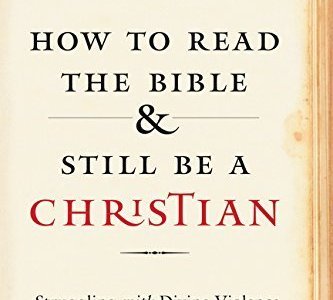
I have read with great appreciation many of the books John Dominic Crossan has written over the years and have heard him speak several times. A few years ago he published a book I found pretty helpful and relevant to my interests, How to Read the Bible and Still Be a Christian: Struggling with Divine Violence from Genesis Through Revelation (HarperOne, 2015). I don’t know for sure whether Crossan, who is Catholic, shares my pacifist convictions, but he clearly cares deeply about peace on earth.

The right agenda

I believe that Crossan has exactly the correct agenda for this book. He argues, “escalatory violence now directly threatens the future of our species and indirectly undermines solutions to other survival problems such as global warming, overpopulation, and resource management” (p. 244). He writes this book in order to address that problem, to show how the Bible can be used in ways that contribute to violence, and to suggest ways the Bible might be read that will actually help us move toward peace.

Crossan’s book may be read alongside Greg Boyd’s The Crucifixion of the Warrior God: Interpreting the Old Testament’s Violent Portraits of God in Light of the Cross (Fortress Press, 2017). Boyd and Crossan happily share deep convictions about helping Christians deal with the violence in the Bible in way that will empower Christians to be peaceable today. They approach the issues quite differently, though. The differences are significant, for sure. I would recommend reading both works as a way of getting a sense of the breadth of possibilities for Bible-centered peace theologies.

One big difference between these two thinkers is how they think of biblical inspiration. Boyd affirms what he understands to be a very high view of inspiration, and as a consequence he undertakes to construct a quite detailed and elaborate argument for how he can see the Bible as truthful throughout and yet also argue that the Bible is consistently a book of peace. I have written a lengthy critique of Boyd’s argument. I see it as way too convoluted. But I find his work enormously instructive.

Crossan, on the other hand, has no trouble with asserting that parts of the Bible simply are untrue. This makes his argument much simpler and more straightforward than Boyd’s—though not without problems of its own. I am not fully happy with Crossan’s approach, either. I think he too quickly accepts the presence of major internal contradictions within the Bible and thus misses some insights that an attempt to read the Bible’s overall message as largely coherent might provide. However, in this blog post I want to focus my criticisms of Crossan elsewhere. Continue reading “The Bible, violence, and John Dominic Crossan—with special attention to the book of Revelation”