Questioning faith: Blogging through key convictions [Questioning faith #1]

Ted Grimsrud—November 2, 2022

I will be posting a series of short essays where I will reflect on some of the main questions I have had about the world I live in and Christian faith’s relationship to it. These questions indeed are concerned with “the faith”—that is, the Christianity I have been immersed in for my entire adult life. They reflect a great deal of the doubt and critical stance I now have toward my received Christianity. So, they are about “questioning the faith.” Ultimately, though, my reflections will be more affirmative than simply challenging things. These questions, and my reflections on them, my attempts to answer them, are expressions of a faith that sees questioning as a core component. That is, I will present the fruit of living with a “questioning faith.” The reflections are from a standpoint of a person with faith. Going back to when I was 17 years old, I have never actually questioned whether to have faith or not; it is always about the shape of that faith.  

Somehow, for my entire life I have always loved to ask questions, to try to understand. My initial attraction to Christianity arose out a desire to understand life, to try to find the truth. I have come to think of “understanding” and “truth” quite differently than I did when I was a teen-ager. Still, that quest I embarked on over 50 years ago remains at the center of my life. I expect my forthcoming blog posts to be elements of the ongoing journey.

Liberated by Francis Schaeffer

A turning point in my faith—and my life—came when I was 21 years old. At that moment (Summer 1975), I started attending a new church. I still accepted most of what I had been taught in the theologically very conservative Baptist church I had joined after my conversion four years earlier. In my new church, I almost immediately joined a book study group engaging Francis Schaeffer, an American living in Europe who was becoming known as “the evangelist for intellectuals.” Like many others, I found Schaeffer to be a formative influence in moving away from fundamentalism.

In my case, I rather quickly moved past Schaeffer and have never really stopped moving. As I learned later, Schaffer had been deeply immersed in the world of fundamentalism during the heyday of the famous fundamentalist/modernist conflicts that were probably their most bitter and consequential in Schaeffer’s own Presbyterian tradition. He ultimately became a victim of the battle himself and moved to Europe in part to separate himself from the faith-traumatizing struggles. But he never actually moved much in his own theology and ended his life as a key player in the emergence of the politically focused Christian Right in the United States in the late 1970s and early 1980s.

Continue reading Questioning faith: Blogging through key convictions [Questioning faith #1]

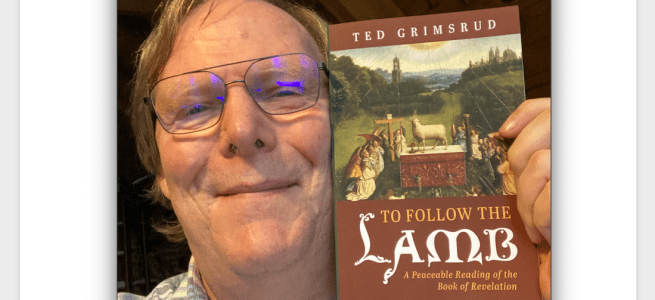
New Book—To Follow the Lamb: A Peaceable Reading of the Book of Revelation

I am happy to announce the publication of my most recent book: To Follow the Lamb: A Peaceable Reading of the Book of Revelation (Cascade Books, 2022), ix + 278pp.

To Follow the Lamb is a commentary of the entire book of Revelation that places a special emphasis on the peace message of Revelation. Revelation is not a book that portrays a violent, vengeful God but rather than shows God to be most profoundly revealed in the gracious Lamb. The key to reading Revelation is to take seriously the opening words of the Book that tell us it is a”revelation of Jesus Christ.”

Revelation is an exhortation to discipleship—follow the Lamb wherever he goes! It offers a sharp critique of the world’s empires and a sharp critique of how people of faith all too easily find ways to be comfortable within the empires. Revelation portrays God as merciful and peaceable—but engaged in a battle against the spiritual powers of evil that energize the nations’ domination systems.This battle, though, is fought with the weapons of love, not worldly violent weapons.

Available online from:

Amazon (the Kindle version is only $9.99)

Wipf and Stock Publishers

Both sites have previews that show the first part of the book.

Also available at: Bookshop.org

Endorsements:

“Ted Grimsrud is a worthy and capable guide through the often misread and confusing images laid out by John of Patmos to the churches of Roman Asia. Anyone who has ever wondered how to make sense of this powerful narrative will find a great companion in To Follow the Lamb. Go form a study group and dig in!”—WES HOWARD-BROOK, Seattle University, author of Unveiling Empire: Reading Revelation Then and Now

“In this important book, Ted Grimsrud clears away decades of misunderstanding and misuse to reveal the beauty and power of the Apocalypse. Writing with deep insight and lucid prose, Grimsrud forcefully challenges violent interpretations of Revelation and fixes our gaze on the nonviolent Jesus. A treasure trove for peacemakers and justice seekers, To Follow the Lamb is accessible, relevant, and sorely needed. Guaranteed to deepen your appreciation of Revelation—I highly recommend it!”—ERIC SEIBERT, Messiah University, author of Disarming the Church: Why Christians Must Forsake Violence to Follow Jesus and Change the World

“In the midst of the sometimes violent rhetoric of Revelation, Grimsrud makes abundantly clear that Revelation features the nonviolent victory by the slain and resurrected Lamb, who reveals a nonviolent God, over the powers of evil, represented by the Roman empire. One of the most valuable contributions of this comprehensive theological analysis of Revelation is how it applies the book’s nonviolent resistance to empire to our call to challenge the American empire.”—J. DENNY WEAVER, Bluffton University, author of God Without Violence

More posts on Peaceable Revelation

God and warism: The dilemma [Theological memoir #12]

Ted Grimsrud—June 7, 2021

I can’t seem to escape the reality that people’s beliefs in and about the divine and their attitudes about war seem to be closely related. On the one hand, it seems obvious that belief in God often underwrites war. Yet, on the other hand, in studying the history of pacifism I am struck with how important religious faith has been for quite a few of war’s most committed opponents. So, this is the dilemma: How do we find a way to navigate this centrality of religious faith in ways that lead to peace and resist warism? Let me illustrate these issues with my story.

“God” and radical politics

When I began my political awakening back in the mid-1970s, I believed very intensely in “God” (meaning the personal, all-powerful, all-knowing, transcendent deity of conservative Protestant Christianity). My belief in “God” gave me the sense that truth in light of this “God” mattered more than anything else. I also believed that Jesus was the incarnation of this “God,” and that we know best what “God” wants through “God’s” revelation in Jesus.

These beliefs gained political significance for me due, first of all, to paying attention to the war in Vietnam that had been destroying so many lives for no good, life-giving reason (I had faced the genuine possibility of being drafted to fight in this war and missed out by being a bit too young). When my disenchantment with the US was emerging, I happened upon a newly arrived sensibility expressed by various younger evangelical Christians that in the name of radical discipleship critiqued the American Empire and called for alternatives (most significant for me was the Sojourners community in Washington, DC, and their monthly magazine). These radical evangelicals helped me see that loyalty to “God” actually stood in tension with loyalty to the nation of my birth.

So, “God” was very important in helping me step outside the lines of the received sense of security and comfort that comes with being a loyal American. Once I did step outside the lines, I easily came to see the profoundly corrupting nature of the American Empire. Vietnam was surely the most egregious case of imperial violence on an incomprehensible scale—but only one case out of many dating back to the very settling of the Western Hemisphere by Europeans (I learned a lot from William Appleman Williams’s book, Empire as a Way of Life). I have become ever more certain about the deeply problematic nature of the United States. Still, I realize that my initial step outside the lines was definitely not inevitable. It had a lot to do with being in the right place at the right time. The Vietnam War, the possibility of being drafted, becoming friends with several returning war vets, entering the evangelical world at precisely the same time as the emergence of the radical evangelicals, gaining a theology that connected “God” with engaged pacifism—all these factors and more coalesced at just the right time for me.

As I think about it now, I am especially intrigued with the significance of the “God” part of this constellation of influences. I tend to think that I never quite believed in “God” in the way I was taught during my fundamentalist and evangelical years (about 8 or so years from the time when I was 17 [1971]). Certainly, it was easy and painless to evolve away from that belief. At the same time, I do think that the belief in “God” that I had was crucial for me having the wit and courage to step away from the Americanness I was raised with and surrounded by.

Continue reading “God and warism: The dilemma [Theological memoir #12]”

Why I am not (quite) an atheist [theological memoir #9]

Ted Grimsrud—January 17, 2021

I flirted with atheism for a while when I was a teenager. I realize now that that happened because I was very interested in God, not because I was rejecting God. Unlike most of my current friends, I did not grow up in the church or with a detailed embedded theology. I wasn’t exposed to theology or philosophy, but I liked to think. I didn’t think the God I had superficially heard about made a lot of sense, so I tried on the idea of rejecting God’s existence.

It wasn’t any kind of argument that got me to accept the existence of God, nor was it some sort of crisis or sense of need. Initially, it was simply an experience of presence at a friend’s funeral. But I also wanted to understand, to make sense of things. It happened that I turned to a trusted friend, a kind of mentor who was several years older. He guided me toward a personal conversion, educating me in what I in time came to recognize as a Christian fundamentalist orientation toward God and salvation.

My conversion when I was 17 was genuine, I believe. But I was driven more by a desire for intellectual coherence than a profound personal encounter with the personal God of American evangelicalism. I tried to believe in that God. The first couple of years I absorbed the doctrines of my faith community. These especially centered around belief that Jesus was returning at any moment and that the most important expression of Christian faith was the necessary conversion where a sinner turns to Christ as one’s personal savior.

When I was about 21, I began to get quite interested in theology and rather drastically to revise my belief system. The first steps were to reject both the future-prophetic theology of the End Times and the personal conversion centered understanding of faith. I experienced those moves as steps toward God even as they were decisive steps away from the God I had been presented with after my conversion. But the movement has never stopped, and it has left me with a notion of God that is incompatible with what I was first taught when I affirmed Christian faith.

Continue reading “Why I am not (quite) an atheist [theological memoir #9]”

Why God doesn’t intervene (theological memoir #5)

Ted Grimsrud—November 18, 2019

You would think that given how important most people think God is that it would be easier to talk about God. But it often seems that people act as though, of course, God is real and we all know what we mean by God, very people are very articulate when they actually try to talk about God. It’s even difficult to find good jokes about God—when I searched the internet, this is the best I could do:

God was talking to an angel and said, “I just figured out how to rotate the Earth so it creates this really incredible 24-hour period of alternating light and darkness.” The angel said, “That’s great. So, what are you going to do next?” God says, “I think I’ll call it a day.”

Talking about God

I suppose for most of us, our understanding of God has evolved quite a bit as we have gone through life. I know mine has. One of the things I have come to believe is that we too easily forget that our language about God is always metaphorical. We are saying what we think God is like, not what God for a fact is. It is our concept of God that we talk about. But we have the habit of saying simply, “God is this or God is that.” I will share about the evolution of my thinking about God—and it seems more authentic to use the kind of language about God that I used in the past. But I recognize that all I say here is metaphorical, even if I don’t use qualifiers such as “God is like…”.

I was stimulated to think about how my thinking about has changed recently when I heard a helpful sermon on God from a Unitarian minister, Paul Britner. What do I think about God, especially about God’s power?

As a starting point, I think most of us would actually agree that God hardly ever (if ever) directly intervenes in the affairs of human beings. Even most pious Christians have experienced enough tragedy and brokenness to know that God simply does not step in and stop bad things from happening. My buddy Rod getting killed in a car wreck at age 17. My dad dying suddenly of a brain aneurism at age 67. My mom’s sister having a fatal appendicitis attack when she was four. Not to mention wars, famines, pestilences.

We know God lets things go. So, the question, then, for many of us is: Why? Why does God allow so much terrible stuff to happen? At least this is the question for those who believe that God is loving and good. And most of us who believe in God do believe that. I suspect as well that for most of those who don’t believe in God, the God that is not believed in is a God who allows terrible things to happen.  My thinking about this issue has evolved a lot…. Continue reading “Why God doesn’t intervene (theological memoir #5)”

What grief teaches us about God (Theological memoir #4)

August 18, 2019—Ted Grimsrud

As I reflect back on how I have understood God, I have recently noticed a connection that I had not thought of before. Though I have not thought of there being a lot of continuity between how I thought of God fifty years ago and the present, the moment that got me started back then turns out to be closer to what I think now than I have realized. The key connecting point is grief.

Questions and faith

I grew up in Oregon in rural Oregon. Though conservative and very rural, it was quite a non-church oriented environment. As a kid, I always had questions; I always wanted to understand better. That quest led to a Christian conversion when I was a teenager that dropped me into a fundamentalist Baptist congregation that, ironically, didn’t welcome questions. But I began a long process of learning and opening up, and I moved on quickly from fundamentalism. I eventually found Mennonites and had a career as a Mennonite pastor and theology professor. I have continued to “open up” and have moved right to the very margins of the Mennonite world.

I started my journey in my mid-teens with a sense of the presence of the divine that came to me in the midst of grief—as I was attending the funeral of a friend who had died in his late twenties of cancer. In a time of prayer, I felt that God was real and was with us. I had been thinking a lot about whether I believed in God or not, and from that point on I affirmed that I did. I find it interesting now, that what could have been an insight into the characteristics of God (as one especially present in sharing our grief) essentially passed by me. For years, I would look back at the moment and say that my sense of God was pretty vague and needed my education in Christian theology (such as it was in those years) to understand who God is. Now I think it is too bad that I couldn’t have pursued the insight about God’s close connection with grief.

From that funeral on, I was trying to understand what to believe about God. The Baptists gave me some answers. I never quite felt comfortable with what they told me, but they did help me begin. I have gone in directions I would never have expected back fifty years ago. Now I think grief is one of the best ways to get a sense of how to think about God. Continue reading “What grief teaches us about God (Theological memoir #4)”