The book of Revelation and peace, part I: The peace of the Lamb [Peace and the Bible #18]

Ted Grimsrud—March 28, 2024

The book of Revelation has a pretty bad reputation among many people—not least because it is easily interpreted as portraying quite a bloodthirsty God. And many Christians have affirmed that interpretation. I first decided to study Revelation after hearing a teacher argue against pacifism by claiming that Revelation teaches that divinely initiated violence is part of Revelation’s End-Times scenario. This teacher coupled Revelation’s violence with the violence of the Old Testament stories such as Joshua to argue that sometimes God does want war.

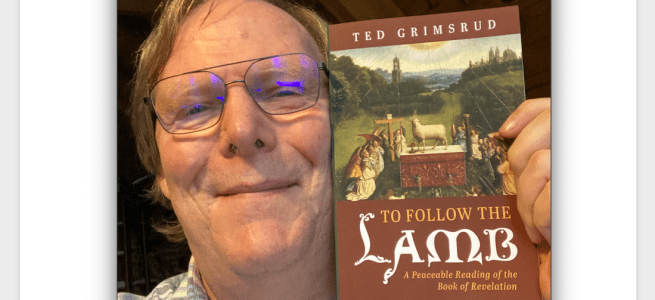
I knew in my heart (though not yet my mind) that the Bible should not be read in such a pro-violence way. So, I decided to look closely at Revelation for myself. I discovered that indeed Revelation may be read in a very pro-peace way. My recent book, To Follow the Lamb: A Peaceable Reading of the Book of Revelation (Cascade Books, 2022), articulates my latest understandings about Revelation’s peace message. In this post and one to follow I will share some of the key ideas in that peaceable reading.

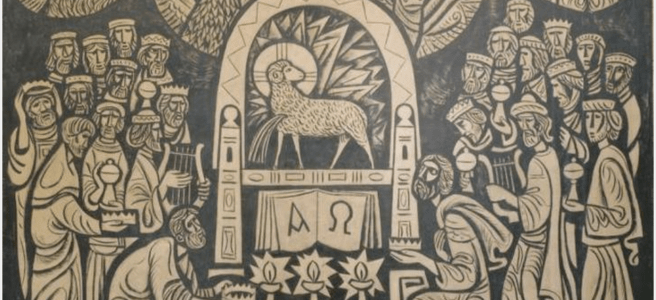
The key step for me was my starting point in reading Revelation. I took very seriously the opening words of the book, “the revelation of Jesus Christ” and read the book expecting it to complement the story of Jesus in the gospels. I was open to be proven wrong about Revelation’s Jesus-linked orientation, but I first wanted to see if indeed Revelation did further Jesus’s own message. That is, I read Revelation asking, “What (if anything) does Revelation teach us about peace?” rather than “What does Revelation teach us about the future?” or “What does Revelation teach us about a violent, pro-war God?” Along with the opening words that refer to Jesus, I also quickly recognized that the key image (in a book full of images, symbols, and metaphors) in the entire book was the image of the Lamb. Clearly, this Lamb image was meant to evoke Jesus and, as I came to recognize, to keep the various visions and imagery anchored in Jesus’s message.

I will develop two aspects of the Lamb image in what follows. In this post I will discuss “the peace of the Lamb.” With the Lamb’s peaceable orientation in mind, I will then turn to “the war of the Lamb” in the next post and show that Revelation’s “war” is actually a struggle for peace on earth that uses thoroughly peaceable methods.
Continue reading “The book of Revelation and peace, part I: The peace of the Lamb [Peace and the Bible #18]”

Vindication (Revelation, chapters 17–22)

Ted Grimsrud—August 11, 2023

[This is the fourth in a series of four posts on the book of Revelation. The first is “Reading Revelation with an Anabaptist Sensibility.” The second is “The pattern of Jesus (Revelation, chapters 1–5).” The third is “Healing amidst the chaos (Revelation, chapters 6–16).” ]

I believe that one of the key points that Revelation consistently makes is that the victory of God has already been won—this is emphasized most clearly in the vision in chapter 5 of the Lamb who takes the scroll. However, the book nonetheless does play along with the idea that there still is something important to come. It does have a forward movement and a sense of culmination at the end. As we finish our look at Revelation in this post, I want to discuss two visions that portray some sort of final conflict (the judgment of Babylon in chapters 17 and 18 and the “battle” with the Rider on the white horse in chapter 19), and then end by looking at the end of the book, the vision of New Jerusalem.

The judgment of “Babylon” (17:1–18:24)

The visions in chapters 17–18 focus on the destruction of the city of the “destroyers of the earth” alluded to 11:18, where we read that the time has arrived to destroy those who destroy the earth. I think this sense of movement in the plot of Revelation leading up to the visions in 17–18 is meant to give a sense of how God is involved with the world, including overcoming the evil Powers and bringing healing. The destroyers of the earth are who God takes on, not the earth itself. The natural world in Revelation is the object of healing love—including human beings. Revelation makes a clear distinction between the evil Powers and the human beings who affiliate with them.

Chapters 17 and 18 portray how “great Babylon” (16:19) is taken down. We need to read these visions carefully to see that evil Powers are punished, not evil people. “Babylon” refers to the human city as organized against God. It is closely affiliated with the Beast, and hence, the Dragon, but not identical with it. For John, the Beast was seen in the Roman Empire, but the way the visions are presented makes it clear that the image is broader than simply that one manifestation. “Babylon” refers to all empires, all domination systems. Revelation tells us that it will be the Beast and Dragon that are destroyed in the lake of fire. Babylon’s ultimate fate, though, is left ambiguous. I note the presence of the kings of the earth in New Jerusalem; these are Babylon’s human leaders. So, may we hope that Babylon is not so much destroyed as transformed? Let’s think about that.

Continue reading “Vindication (Revelation, chapters 17–22)”

The pattern of Jesus (Revelation, chapters 1–5)

Ted Grimsrud—August 8, 2023

[This is the second of a series of four posts on the book Revelation. The first is “Reading Revelation with an Anabaptist Sensibility.” The third is “Healing amidst the chaos (Revelation, chapters 6–16).]

If we take up the book of Revelation expecting it to present a case for the truthfulness of the peaceable way of Jesus, we will find plenty of evidence to confirm that expectation. The first five chapters introduce us to Jesus and his presence among Christian congregations of the late first century. These chapters make it clear that Jesus’s way stands in opposition to the domination system of the Roman Empire of the time—and all empires since.

The pattern of Jesus (1:1-6)

The first six verses of the book set the stage for what the book as a whole will be about. This is the “revelation of Jesus Christ.” That is, this is the Jesus of the gospels. We may accurately say this revelation comes from Jesus. More so, though, I think the meaning is that this book is about Jesus. And about interpreting life in light of Jesus. Once we look for it, we will see throughout the book allusions to the way of Jesus—or, as I want to say, “the pattern of Jesus.”

The word translated “revelation” is apocalypsis, may also be translated “apocalypse.” I think that latter translation may be misleading for us, though. It often has the connotation of future oriented, catastrophe oriented, kind of magical. Revelation is all too often seen as a different kind of writing than the rest of the Bible (“apocalyptic” literature). We should note that the word is not used again in Revelation. The book does not seem to want to make a point of being different. I think the best meaning is that this is a book of insight about Jesus and applying his message to life. This book is about our world, both the 1st century and the 21st century.

The statement, the “time is near” is not about predicting the future but rather urgency about the importance of the message of the book. To say “near” is a rhetorical flourish that has to do with the importance of choosing between Jesus and the Empire as the bases for one’s approach to life. We see an increased sense of urgency as we move through the three sets of plagues that come later in the book—going from 1/4 destruction to 1/3 to full, not to signify chronology but to say with increased intensity that this stuff really matters.

Continue reading “The pattern of Jesus (Revelation, chapters 1–5)”

Why don’t we know how things will end? [Questioning faith #27]

Ted Grimsrud—May 31, 2023

I have published two books that offer interpretations of the book of Revelation—in 1987 and 2022. I learned a lot during those 35 years, and I think that is reflected in the more recent book, To Follow the Lamb, being the better one. At the same time, I am happy that I still agree with most of what I wrote in Triumph of the Lamb, the first book. There is one issue, though, about which my views very definitely changed.

Triumph of the Lamb, the 1987 book, self-consciously provided an alternative reading of Revelation to the End Times-focused view I had been taught as a new Christian. That future-prophetic view has for a long time been very popular and remains so. I set out to refute that view and present what I believed was a better approach. I think I did a pretty good job of that and still affirm most of what I wrote. However, while rejecting the details of looking into the future, I still expressed hope for a happy outcome to human history. My views now are more explicitly uncertain about the End.

I concluded Triumph of the Lamb with these words: “From start to finish, the Bible records the fulfillment of God’s purpose in creation. There has always been a longing for a time to come when true peace shall reign over all the earth. Fear, hatred, and bitter tears will be no more. The affirmation of Revelation 21 and 22 is that this fulfillment, the conclusion of history, will be worth all the pain and struggle which humankind has experienced throughout the ages. The completion of God’s work is the New Jerusalem—the establishment of the holy city—within which God’s people will reign for ever and ever. If the city of Babylon is characterized by terror, deception, and injustice, the New Jerusalem is the exact opposite. There the nations walk in harmony and justice and peace, where the light of the glory of God guides everyone’s path” (Triumph of the Lamb, p. 164).

While I did not think that Revelation, or anywhere else in the Bible, taught a timeline for the End Times with specific predictions of the final events of history, I did believe that the Bible gives trustworthy promises that we will experience a genuine New Jerusalem at the end of time. I believed that Revelation was predicting that much about the future—and that we should believe that that prediction will happen.

So, I had quite a bit of confidence that we could know from the Bible that the human project will have happy ending. I no longer have such confidence. These are the final words of my 2022 book: “The peaceable message that Revelation proclaims, I suggest, is not a message the everything will turn out okay in the end. It is not a message of an interventionist God who is in control of history. It is a message of the sovereignty of love. It is a message of the call to let love shape our lives and ideals and convictions and loyalties in all areas of life” (To Follow the Lamb, p. 269).

Continue reading “Why don’t we know how things will end? [Questioning faith #27]”

Did Jesus (and the early Christians) actually expect him to return soon? [Questioning faith #13]

Ted Grimsrud—December 23, 2022

Many New Testament scholars and others influenced by them assert that Jesus (and, following him, other New Testament writers such as Paul and the writer of Revelation) believed that he would return within a relatively short time after his death. This return would be tied with an end to history and the inauguration of a new heaven and new earth.

The people who advocate this view go on to point out that Jesus (and the others) were obviously wrong. Christianity thus quickly evolved to be a more conservative, more doctrine-oriented—and less radical-ethics-oriented—religion. Christians linked themselves with political structures (e.g., the Roman Empire) that would allow them to sustain their structures so long as Christians would contribute to the wellbeing of the political status quo. Over time, various small renewal movements would arise that would hearken back to the radical message of Jesus (and, in some interpretations, of Paul and Revelation). These movements could be dismissed because they were basing their visions on a message from Jesus that was meant for the short time between his life and his return. That message was not meant for the long haul of coming generations who were tasked with sustaining the faith over a much, much longer period of time than Jesus had anticipated. This work of sustaining the faith, thus, in the real world, required accommodation to the political systems of the world.

But is this true?

I have the impression that many of the people who accept the idea that Jesus (and the others) expected a soon end of history have not scrutinized the evidence very carefully. The first thing that I note is how ambiguous and peripheral most of the references are that seem to voice such an expression. We don’t have a clear, straightforward statement that Jesus will return soon. We do have various statements that seem to allude to something major happening in the near future without explaining what that would be and what would be the consequences. And there are more vague statements of hope about God’s victory to come. How should these be understood?

It could be that they are indeed predicting a soon end to human history and the inauguration of a new age of pure salvation. But such a predication does not have support in the overall message of Jesus and the rest of the New Testament that emphasizes the call to faithful living in a broken world. A key value in the New Testament is perseverance, the sense that followers of Jesus have a long haul ahead of them that will require strength, a commitment to resist the ways of the world, and an acceptance of the likelihood of suffering for the sake of their faith.

Continue reading “Did Jesus (and the early Christians) actually expect him to return soon? [Questioning faith #13]”

New Book—To Follow the Lamb: A Peaceable Reading of the Book of Revelation

I am happy to announce the publication of my most recent book: To Follow the Lamb: A Peaceable Reading of the Book of Revelation (Cascade Books, 2022), ix + 278pp.

To Follow the Lamb is a commentary of the entire book of Revelation that places a special emphasis on the peace message of Revelation. Revelation is not a book that portrays a violent, vengeful God but rather than shows God to be most profoundly revealed in the gracious Lamb. The key to reading Revelation is to take seriously the opening words of the Book that tell us it is a”revelation of Jesus Christ.”

Revelation is an exhortation to discipleship—follow the Lamb wherever he goes! It offers a sharp critique of the world’s empires and a sharp critique of how people of faith all too easily find ways to be comfortable within the empires. Revelation portrays God as merciful and peaceable—but engaged in a battle against the spiritual powers of evil that energize the nations’ domination systems.This battle, though, is fought with the weapons of love, not worldly violent weapons.

Available online from:

Amazon (the Kindle version is only $9.99)

Wipf and Stock Publishers

Both sites have previews that show the first part of the book.

Also available at: Bookshop.org

Endorsements:

“Ted Grimsrud is a worthy and capable guide through the often misread and confusing images laid out by John of Patmos to the churches of Roman Asia. Anyone who has ever wondered how to make sense of this powerful narrative will find a great companion in To Follow the Lamb. Go form a study group and dig in!”—WES HOWARD-BROOK, Seattle University, author of Unveiling Empire: Reading Revelation Then and Now

“In this important book, Ted Grimsrud clears away decades of misunderstanding and misuse to reveal the beauty and power of the Apocalypse. Writing with deep insight and lucid prose, Grimsrud forcefully challenges violent interpretations of Revelation and fixes our gaze on the nonviolent Jesus. A treasure trove for peacemakers and justice seekers, To Follow the Lamb is accessible, relevant, and sorely needed. Guaranteed to deepen your appreciation of Revelation—I highly recommend it!”—ERIC SEIBERT, Messiah University, author of Disarming the Church: Why Christians Must Forsake Violence to Follow Jesus and Change the World

“In the midst of the sometimes violent rhetoric of Revelation, Grimsrud makes abundantly clear that Revelation features the nonviolent victory by the slain and resurrected Lamb, who reveals a nonviolent God, over the powers of evil, represented by the Roman empire. One of the most valuable contributions of this comprehensive theological analysis of Revelation is how it applies the book’s nonviolent resistance to empire to our call to challenge the American empire.”—J. DENNY WEAVER, Bluffton University, author of God Without Violence

More posts on Peaceable Revelation

How Revelation’s non-predictive prophecy speaks to our pandemic (Peaceable Revelation #7)

Ted Grimsrud—January 29, 2021

I am sure that it is no coincidence that the emergence of mass crises in the 20th and 21st centuries (world wars, pandemics, famines, environmental devastations, et al) has corresponded with increased interest in the book of Revelation and other materials in the Bible that are said to have prophetic importance. Sadly, the assumption that “biblical prophecy” has mainly to do with predicting the future has blinded many Christians to the wisdom that prophecy understood in a non-predictive sense has to offer for our difficult times.

One way to get insights into the wisdom of Revelation is to try to apply it to our present pandemic—but not in the sense that Revelation directly predicted what is happening now nor even in the sense of thinking of our current events as in some sense related to the End Times. Instead, I will reflect a bit on how Revelation’s insights into the world of the first century might be helpful for us in the same ways that the stories of the gospels or the theological analyses of Paul’s letter might be helpful.

Revelation as non-predictive prophecy

I begin with an assumption that we should read Revelation in the same way as we read other books in the New Testament. We understand it to be written by a person of the first century addressing readers in the first century about issues that mattered in the first century. It is indeed prophetic writing—in the same sense that Paul’s writings were prophetic writing. These writings follow the Old Testament prophets in speaking on behalf of God to people of their own time, offering challenges and exhortations that their readers live faithfully in light of the message of Torah and (in Paul’s context) the message of Jesus.

So, I do not read Revelation to be offering predictions about the long-distant future. It is “non-predictive prophecy.” As a “revelation of Jesus Christ,” it is basing its critique and exhortation on the message of Jesus. Too often, interpreters of Revelation have (and still do) miss the ways that the book is oriented around Jesus—missing, that is, the relevance of its first verse that gives a self-identification as the revelation of Jesus Christ.

Continue reading “How Revelation’s non-predictive prophecy speaks to our pandemic (Peaceable Revelation #7)”

Living in a broken world: Power, love and the plagues in Revelation [Peaceable Revelation #5]

Ted Grimsrud—January 15, 2021

I believe that the book of Revelation offers people in the contemporary world some helpful guidance—though not in the ways popular Christianity would have us think. Revelation is not a source of insights for fortune telling helping us to know the future before it happens. Rather, Revelation is, I believe, a meditation on the centrality of love as we seek to navigate a world in crisis. So, the argument I offer here goes against both those who think predictive prophecy is how Revelation is relevant and those who think the Bible as a whole—and certainly the Bible’s last book—is simply an ancient work with little to say that is relevant in any way today.

Two big problems

Let’s start with two general problems. The first is the problem of living humanely in our contemporary world. Such humane living seems to require that we seek to overcome, say, the brokenness of ever-present warism with its weapons of mass destruction, the all too present trauma of our nation’s legacy of white supremacy, the overwhelming impact of predatory capitalism and always worsening economic inequality, our emerging climate catastrophe and other ecological crises, and the curse of mass incarceration and its companion police brutality. How do we move ahead in such a world?

The second problem is more esoteric, but I believe significant, nonetheless. This is the problem of the visions in Revelation that portray a world undergoing several series of escalating catastrophes (or plagues). These visions seem to tell us that God initiates these plagues, and the standard interpretations across the theological spectrum generally understand these God-initiated plagues as acts of God’s punitive judgment. This very problematic view of God leads some to dismiss God and the Bible altogether and others to affirm a morally corrupt view of God. To believe that God brings punitive judgment often leads Christians themselves to become agents of the forces of destruction that exacerbate the crises mentioned above.

Is it possible that if we biblically interested Christians could resolve the problem of the plague visions that we would be better able to respond to the brokenness problem? I believe we are challenged to hold together our affirmations that (1) God is love, (2) Revelation is truthful, and (3) brokenness in our world is real. However, if the “truth” of Revelation is that God is the author of the plagues then we will have trouble being agents of healing.

Continue reading “Living in a broken world: Power, love and the plagues in Revelation [Peaceable Revelation #5]”

Are we living in “the Great Tribulation”? (Peaceable Revelation #3)

Ted Grimsrud—August 13, 2019

I first became interested in theology when I was in high school and began attending our small town’s Baptist church. My early education in theology included at its center the conviction that we were living in the End Times, the period shortly before Christ’s return. Virtually every sermon I heard and every Bible study I participated in touched on Jesus’s second coming. Someday I’d like to figure out why this was such a popular topic in that context.

One of the big ideas in this future-prophetic take on Christianity is the expectation of a catastrophic time just before Jesus’s return filled with massive violence and destruction. This event has often been called “the Great Tribulation.” I was taught that, happily, genuine Christians would be raptured out of their present life in order to be with God and to miss this terrible ordeal. In this view, the Tribulation would be a just act of God’s judgment against sinful and corrupt humanity—regardless of the carnage that would ensue.

I was taught to be attentive to the downward spiral of human history, looking for signs that the Great Tribulation was at hand. This was all pretty heavy stuff, and it does not surprise me that I, a young man about to head out into the big, scary world, would have taken all the teaching quite seriously. I read Hal Lindsey’s The Late, Great Planet Earth over and over again, along with numerous other similarly themed books.

Rethinking the End Times

Then I went away to college. It was easy enough to live a kind of compartmentalized life —my fundamentalist theology in one compartment, my non-religious academic studies in another. However, that separation actually left me quite passionless about both compartments. When I was a junior in college, I found a congregation that started me on the path of bringing things together.

One of the key moments was a conversation with a mentor about our shared future-prophetic theology. With my minimal exposure to Christianity, I had assumed that what I was taught about the End Times was simply what all Christians believed. My friend said no, actually, the majority of Christians don’t believe the same thing I do. I was kind of stunned. That realization opened up everything. Almost immediately I encountered other views and soon dropped the future-prophetic schema. And during my senior year, I did find a strong passion for integrating my theology and my academic studies. Continue reading “Are we living in “the Great Tribulation”? (Peaceable Revelation #3)”