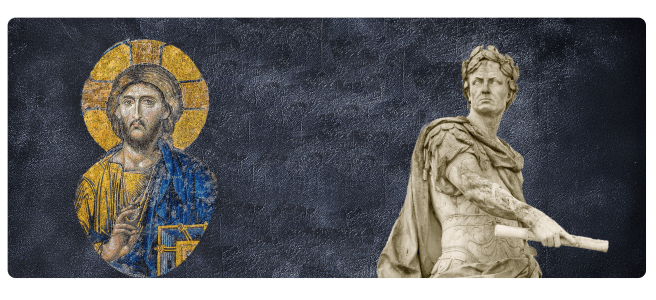
Jesus’s upside-down empire. The Bible’s radical politics (part three)

Ted Grimsrud—June 12, 2025

As a Christian, I read the Bible with two assumptions. (1) The Old Testament has its own integrity and tells its own story. It is not simply, or mainly, or even at all relevant only in relation to events far in the future of the story being told. (2) Jesus is the center of the Bible when read as a whole. He embraced the Old Testament as scripture and affirmed the messages of Torah and the prophets as revealing God’s will for the world.

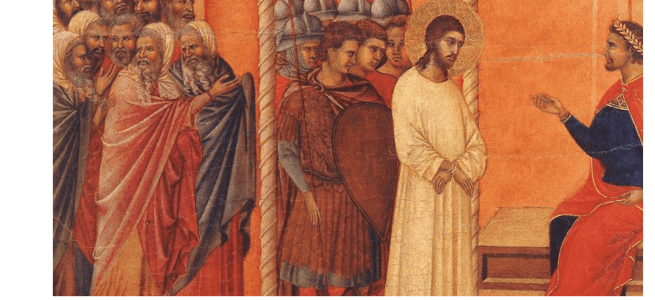
Jesus as the center of the Bible means his story clarifies and reinforces the basic message of the Old Testament. These two parts of the Big Story complement each other. Jesus embodies the political message of the Old Testament: critique of empire, rejection of territorial kingdom as the channel for God’s promise to bless all the families of the earth, and the embodiment of Torah as the alternative to the ways of the nations—including power as service, compassion and justice for the vulnerable and exploited, and resistance to the powers of domination. [This is the third in a series the Bible’s radical politics. Part one is “Ancient Israel among the great powers” and part two is “Ancient Israel as a failed state.”]

Politics and the gospels

One of the key terms in the gospels that signals their political agenda comes at the beginning: Matthew’s gospel tells “of Jesus the Messiah, the son of David, the son of Abraham” (1:1). “Messiah” equals “Christ.” Its literal meaning is “king,” a political leader.

Continue reading “Jesus’s upside-down empire. The Bible’s radical politics (part three)”

The death of Jesus and the weakness of God [Peace and the Bible #14]

Ted Grimsrud—March 15, 2024

Christianity has focused a great deal of its theology on the death of Jesus and its purported cosmic significance. This emphasis has not had an altogether positive result. To mention just one of the problematic outcomes, viewing Jesus’s death as the necessary sacrifice that somehow enables God to offer salvation to sinful human beings has placed an act of terrible violence at the heart of Christian faith—thereby greatly weakening the peaceable impact of Jesus’s life and teaching. When some sort of punitive “justice” that needs to be “satisfied” by Jesus’s violent death is seen to be part of the essence of God’s character, it greatly increases the likelihood that Christians will also see themselves and their institutions as agents of such “justice”—that is, as agents of divinely approved violence. The long legacy in the “Christian” West of the state as the wielder of such violence in warfare and in criminal justice bears witness to the dark legacy of theological interpretations of Jesus’s death.

I suspect that part of the appeal for seeing Jesus’s death as salvific for Christian theology has been a large emotional investment in the notion of God being victorious and in control. If Jesus is God Incarnate and the Savior, how can it make sense that he would die such an ignominious death? How can it make sense that God would face such a defeat? How can it be that God’s control could be breached by such a horrendous and blasphemous act as executing the Christ? One way to understand traditional Christian atonement theology that makes Jesus’s death into such an efficacious act is to recognize it as a way to turn defeat into victory, to turn weakness into overwhelming power. But what if such a move actually has led to many problematic consequences—turning a peaceable story on its head and making it into a story that has underwritten a great deal of violence? And what if such a move actually misconstrues the story of Jesus’s death itself—and in doing so misses the main points of that story that would indeed have major peacemaking consequences? Perhaps it is no surprise that the truly peaceable and transformative message we find in Jesus’s life and teaching has been so seldom evident in the long history of Christianity these past 2,000 years.

Continue reading “The death of Jesus and the weakness of God [Peace and the Bible #14]”

Peaceable politics and the story of Jesus (Peace and the Bible #11)

Ted Grimsrud—December 18, 2023

In my blog series on “Peace and the Bible,” I am showing just how political the concerns of the Bible are. Most people I know find it easier to see that in the Old Testament than the New. In the second half the series, I will argue that the New Testament presents a kind of political philosophy. This philosophy has at its core a commitment to pacifism, a commitment based on the centrality of Jesus Christ to the Big Story the Bible tells. Christians have tended to miss the social implications of the New Testament part of the story because of assumptions about both politics and Jesus.

Politics have been seen as directly tied to running governments and the necessary use of violence. Jesus indeed did not talk about running governments or using violence. However, if we define politics more broadly as the way human beings order their lives together in social groups, perhaps Jesus and the rest of the New Testament were engaging in political behavior. Once we think of politics in this wider sense, we will be more open to recognizing that Jesus indeed was interested in politics—and, actually, very little else. When Jesus spoke of the “Kingdom of God,” perhaps what he had in mind was not some other-worldly existence but a reimagining of politics in this life—in line with the political dynamics in his Bible (what we call the Old Testament). The notion that Jesus spoke only of the personal sphere actually has little support in the texts.

If Jesus did indeed care about politics, then that Christians understand him to be the model human being and the definitive revelation of God would seem to require them to take seriously Jesus’s political witness. If we do take the story of Jesus seriously as an account of a peaceable way of ordering our social lives, our other question will be how relevant that account should be for our present-day political convictions and practices.

Who was Jesus?

At the very beginning of the story of Jesus in Luke’s gospel—the song of Mary in 1:46-55 upon her learning of the child she will bear—we learn that this child will address social reality. He will challenge the power elite of his world and lift up those at the bottom of the social ladder. This child, we are told, will bring succor to those who desire the “consolation of Israel.” Those who seek freedom from the cultural domination of one great empire after another that had been imposed upon Jesus’s people for six centuries will find comfort. From the beginning, the story presents this child in social and political terms.

Continue reading “Peaceable politics and the story of Jesus (Peace and the Bible #11)”

The key to a peaceable reading of the Bible: The single-story approach [Peace and the Bible #8]

Ted Grimsrud—December 7, 2023

I have what may seem like a counter-intuitive impression about how Christians tend to read the Bible. They make Jesus Christ too central to how they read scripture and as a consequence make the Bible less peaceable. That is, by making Jesus Christ too central in the way that they do, many Christians actually misinterpret his message. In a nutshell, I believe that the Bible as a whole is a book of peace. When it is not read as a somewhat coherent whole, even the seemingly peaceable parts may actually become less peaceable.

The typical Christian way of reading the Bible assumes a major turning point in the message that comes with Jesus’s entry into the story, a turning point that in practice turns the Bible into two stories. I believe that we are better off to think more in terms of a single story, what I call the “Big Story,” that encompasses both the Old Testament and the New Testament. This single-story approach allows us better to appreciate the peaceable elements of the Old Testament and the political elements of the New Testament. With the single-story approach, we do still have an important turning point. It comes sooner, though, and may be the key to a thoroughly peaceable reading of the whole. Let me explain.

Problems with the typical Christian reading

Christian approaches to the Bible tend to assume that something qualitatively new happens with Jesus. This new thing does not simply intensify what was already present in the Old Testament but is something categorically unprecedented. This newness, it is said, may be seen is in terms of salvation. Whatever was practiced before Jesus was not adequate to make salvation fully available. The main “new thing” is that Jesus’s death provides the definitive atoning sacrifice that was necessary for God to be able to offer salvation.

To read the Bible in light of this atonement theology results is what we could call a “two-story” understanding of the Bible. The Old Testament provides the first story, one that ultimately ends in failure because the means for salvation were not fully available. The second story, told in the New Testament, does depend upon the first story for establishing the problem for which Jesus’s sacrificial death provides the solution—hence, a two-story Bible. But the second story is the necessary and authoritative one.

Continue reading “The key to a peaceable reading of the Bible: The single-story approach [Peace and the Bible #8]”

The pattern of Jesus (Revelation, chapters 1–5)

Ted Grimsrud—August 8, 2023

[This is the second of a series of four posts on the book Revelation. The first is “Reading Revelation with an Anabaptist Sensibility.” The third is “Healing amidst the chaos (Revelation, chapters 6–16).]

If we take up the book of Revelation expecting it to present a case for the truthfulness of the peaceable way of Jesus, we will find plenty of evidence to confirm that expectation. The first five chapters introduce us to Jesus and his presence among Christian congregations of the late first century. These chapters make it clear that Jesus’s way stands in opposition to the domination system of the Roman Empire of the time—and all empires since.

The pattern of Jesus (1:1-6)

The first six verses of the book set the stage for what the book as a whole will be about. This is the “revelation of Jesus Christ.” That is, this is the Jesus of the gospels. We may accurately say this revelation comes from Jesus. More so, though, I think the meaning is that this book is about Jesus. And about interpreting life in light of Jesus. Once we look for it, we will see throughout the book allusions to the way of Jesus—or, as I want to say, “the pattern of Jesus.”

The word translated “revelation” is apocalypsis, may also be translated “apocalypse.” I think that latter translation may be misleading for us, though. It often has the connotation of future oriented, catastrophe oriented, kind of magical. Revelation is all too often seen as a different kind of writing than the rest of the Bible (“apocalyptic” literature). We should note that the word is not used again in Revelation. The book does not seem to want to make a point of being different. I think the best meaning is that this is a book of insight about Jesus and applying his message to life. This book is about our world, both the 1st century and the 21st century.

The statement, the “time is near” is not about predicting the future but rather urgency about the importance of the message of the book. To say “near” is a rhetorical flourish that has to do with the importance of choosing between Jesus and the Empire as the bases for one’s approach to life. We see an increased sense of urgency as we move through the three sets of plagues that come later in the book—going from 1/4 destruction to 1/3 to full, not to signify chronology but to say with increased intensity that this stuff really matters.

Continue reading “The pattern of Jesus (Revelation, chapters 1–5)”

What are Christians saved from? [Questioning faith #11]

Ted Grimsrud—December 15, 2022

“Salvation” is one of those Christian words that we use a great deal but aren’t always clear about what we mean by it. In my recent posts, I have focused on how we might find salvation without really addressing what it is. One way to work at understanding what salvation is is to reflect on what we are saved from. Other words in the Bible that seem to be rough synonyms with salvation include “liberation,” “redemption,” and “ransom.” All of these seem to have in mind being delivered or freed from something. What are we saved from?

The old story

My first encounter with Christianity came when I joined a Baptist church when I was 17 years old. The main message about salvation I heard was that, in reality, we are saved from God. More specifically, we are saved from God’s judgment, God’s punitive justice, God’s wrath. Or, we could say, we are saved from hell, from eternal torment in separation from God. The means to gain this salvation was very narrow and particular. We must accept Jesus as our personal savior, which means to believe in the efficacy of his sacrificial crucifixion on my behalf, a death he took upon himself in order to receive, as our substitute, the punishment that we deserve.

Because I did not grow up with this theology and had a much more positive sense of my place in the world, that salvation story did not scare me in the way that it has so many other people. I didn’t have the deep-seated anxiety about whether I was okay or not that many lifelong Christians seem to have. Despite not feeling that anxiety, I did try to believe that story—though I was always uneasy about it—until a few years into my journey when I began to learn of another way to read and apply the story.

I won’t go into all the problems here with the kind of atonement theology I was taught. I’ll just note that from the beginning I sensed that the story of Jesus and his love was not fully compatible with belief in an angry and punitive God. Though I don’t remember thinking of the issue in these terms, I would say now that part of my problem with what I was taught was that my sense of the human problem was not that God was displeased with us so much as that too many human beings gave allegiance to oppressive and hurtful ideologies and institutions.

In retrospect, I think it is important to remember that the period in my life that I became a Christian, left home for college, and initially worked out my theology coincided with the final years of the Vietnam War and the Watergate scandal that drove President Richard Nixon from office. I became much more interested in social issues during this time and discovered and embraced Christian pacifism. I was eager for a theology that would help me make sense of the world I was living in and that would empower peaceable social ethics. I realized the salvation story I had been told wasn’t doing that. The key for me came when I realized that Jesus himself talked about his cross as a model for his followers, not as a necessary sacrifice to satisfy God’s punitive justice. How do we best understand salvation in light of Jesus’s cross as a model?

Continue reading “What are Christians saved from? [Questioning faith #11]”

Is Jesus God? [Questioning faith #9]

Ted Grimsrud—December 8, 2022

Many years ago, I had a friend who was probably the most principled person I have ever known. As a young college professor, he was denied tenure in large part because he sided with a student in a dispute with one of the school’s high administrators. My friend and his family then moved to a new town on the other side of the country.

A few years later, he was offered a teaching job at another college. However, he didn’t take the job because he could not sign the school’s doctrinal statement. The school dean argued with my friend—“Nobody takes this statement seriously. Just sign it; we don’t care if you agree with it or not.” What was the issue? The divinity of Jesus Christ. The doctrinal statement said something to the effect that “we believe Jesus Christ is God Incarnate.”

Now, my friend was hardly a liberal. He was kind of a biblical literalist, and he didn’t think the Bible itself taught that Jesus is God. He didn’t give much weight to the later creeds and confessions that make that affirmation. At that point in my life, I hadn’t really questioned the standard “orthodox” view, but my friend’s costly commitment to his belief system impressed me. So, I started thinking about this question, “is Jesus God?” I still haven’t figured it all out, though.

What’s the question?

One of the difficulties I have is that I can’t quite figure out what the statement “Jesus is God” actually means. It seems a bit like saying that in the 4th quarter of a close basketball game, Steph Curry is a cold-blooded killer. You have a sense of what the statement means, but it’s a metaphor. A person playing basketball is not in any literal sense a killer. But Curry can be like a cold-blooded killer when he ignores the pressure and makes a crucial shot that leads to his opponent’s defeat.

Continue reading “Is Jesus God? [Questioning faith #9]”