The book of Revelation and peace, part I: The peace of the Lamb [Peace and the Bible #18]

Ted Grimsrud—March 28, 2024

The book of Revelation has a pretty bad reputation among many people—not least because it is easily interpreted as portraying quite a bloodthirsty God. And many Christians have affirmed that interpretation. I first decided to study Revelation after hearing a teacher argue against pacifism by claiming that Revelation teaches that divinely initiated violence is part of Revelation’s End-Times scenario. This teacher coupled Revelation’s violence with the violence of the Old Testament stories such as Joshua to argue that sometimes God does want war.

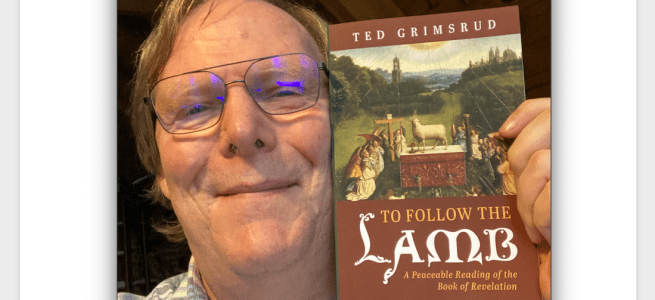
I knew in my heart (though not yet my mind) that the Bible should not be read in such a pro-violence way. So, I decided to look closely at Revelation for myself. I discovered that indeed Revelation may be read in a very pro-peace way. My recent book, To Follow the Lamb: A Peaceable Reading of the Book of Revelation (Cascade Books, 2022), articulates my latest understandings about Revelation’s peace message. In this post and one to follow I will share some of the key ideas in that peaceable reading.

The key step for me was my starting point in reading Revelation. I took very seriously the opening words of the book, “the revelation of Jesus Christ” and read the book expecting it to complement the story of Jesus in the gospels. I was open to be proven wrong about Revelation’s Jesus-linked orientation, but I first wanted to see if indeed Revelation did further Jesus’s own message. That is, I read Revelation asking, “What (if anything) does Revelation teach us about peace?” rather than “What does Revelation teach us about the future?” or “What does Revelation teach us about a violent, pro-war God?” Along with the opening words that refer to Jesus, I also quickly recognized that the key image (in a book full of images, symbols, and metaphors) in the entire book was the image of the Lamb. Clearly, this Lamb image was meant to evoke Jesus and, as I came to recognize, to keep the various visions and imagery anchored in Jesus’s message.

I will develop two aspects of the Lamb image in what follows. In this post I will discuss “the peace of the Lamb.” With the Lamb’s peaceable orientation in mind, I will then turn to “the war of the Lamb” in the next post and show that Revelation’s “war” is actually a struggle for peace on earth that uses thoroughly peaceable methods.

Continue reading “The book of Revelation and peace, part I: The peace of the Lamb [Peace and the Bible #18]”

How the story of Jesus’s resurrection points toward peace [Peace and the Bible #15]

Ted Grimsrud—March 18, 2024

Christianity, it seems, owes its existence to on-going presence of Jesus among his followers after he was executed by the Romans. Against all expectations including their own, Jesus’s disciples within a few days of his death proclaimed that God had raised Jesus from the dead. Ever since, Jesus’s resurrection has been a rallying cry for Christian faith. It was quite a turnaround, because in the immediate aftermath of Jesus’s arrest and execution, it appeared that his movement had met its end.

The shock for Jesus’s followers

Jesus’s arrest and crucifixion were a devastating blow to his followers’ hopes. They “had hoped he was the one to redeem Israel” (Luke 24:21); in the days that followed the shattering of those hopes they scattered and wandered around Judea. Jesus’s most prominent disciple, Peter, led the desertion by Jesus’s followers. They concluded that God had abandoned their leader—in line with Deuteronomy 21:23: “For a hanged man is accursed by God.” Jesus’s mission seemed to have ended up for naught. His message about God’s mercy, it appeared, proved to be no match for the forces of powers-that-be in their society. Whatever the disciples may have thought about the possibility of resurrection from the dead at the end of time, they clearly seemed not to have imagined that it would apply to Jesus in the immediate aftermath of his death.

A few of Jesus’s followers did remain close to him—Mary Magdalene, Jesus’s mother, a couple of others. They seem to have remained simply out of love for him and as an expression of solidarity in their grief, not that they expected his resurrection. Though the story tells that Jesus alluded to resurrection as he spoke of his likely death, it seems that no one actually understood him to mean his personal resurrection prior to the general resurrection at the end of time. The events of Easter Sunday took everyone by surprise.

Continue reading “How the story of Jesus’s resurrection points toward peace [Peace and the Bible #15]”

Vindication (Revelation, chapters 17–22)

Ted Grimsrud—August 11, 2023

[This is the fourth in a series of four posts on the book of Revelation. The first is “Reading Revelation with an Anabaptist Sensibility.” The second is “The pattern of Jesus (Revelation, chapters 1–5).” The third is “Healing amidst the chaos (Revelation, chapters 6–16).” ]

I believe that one of the key points that Revelation consistently makes is that the victory of God has already been won—this is emphasized most clearly in the vision in chapter 5 of the Lamb who takes the scroll. However, the book nonetheless does play along with the idea that there still is something important to come. It does have a forward movement and a sense of culmination at the end. As we finish our look at Revelation in this post, I want to discuss two visions that portray some sort of final conflict (the judgment of Babylon in chapters 17 and 18 and the “battle” with the Rider on the white horse in chapter 19), and then end by looking at the end of the book, the vision of New Jerusalem.

The judgment of “Babylon” (17:1–18:24)

The visions in chapters 17–18 focus on the destruction of the city of the “destroyers of the earth” alluded to 11:18, where we read that the time has arrived to destroy those who destroy the earth. I think this sense of movement in the plot of Revelation leading up to the visions in 17–18 is meant to give a sense of how God is involved with the world, including overcoming the evil Powers and bringing healing. The destroyers of the earth are who God takes on, not the earth itself. The natural world in Revelation is the object of healing love—including human beings. Revelation makes a clear distinction between the evil Powers and the human beings who affiliate with them.

Chapters 17 and 18 portray how “great Babylon” (16:19) is taken down. We need to read these visions carefully to see that evil Powers are punished, not evil people. “Babylon” refers to the human city as organized against God. It is closely affiliated with the Beast, and hence, the Dragon, but not identical with it. For John, the Beast was seen in the Roman Empire, but the way the visions are presented makes it clear that the image is broader than simply that one manifestation. “Babylon” refers to all empires, all domination systems. Revelation tells us that it will be the Beast and Dragon that are destroyed in the lake of fire. Babylon’s ultimate fate, though, is left ambiguous. I note the presence of the kings of the earth in New Jerusalem; these are Babylon’s human leaders. So, may we hope that Babylon is not so much destroyed as transformed? Let’s think about that.

Continue reading “Vindication (Revelation, chapters 17–22)”

Why don’t we know how things will end? [Questioning faith #27]

Ted Grimsrud—May 31, 2023

I have published two books that offer interpretations of the book of Revelation—in 1987 and 2022. I learned a lot during those 35 years, and I think that is reflected in the more recent book, To Follow the Lamb, being the better one. At the same time, I am happy that I still agree with most of what I wrote in Triumph of the Lamb, the first book. There is one issue, though, about which my views very definitely changed.

Triumph of the Lamb, the 1987 book, self-consciously provided an alternative reading of Revelation to the End Times-focused view I had been taught as a new Christian. That future-prophetic view has for a long time been very popular and remains so. I set out to refute that view and present what I believed was a better approach. I think I did a pretty good job of that and still affirm most of what I wrote. However, while rejecting the details of looking into the future, I still expressed hope for a happy outcome to human history. My views now are more explicitly uncertain about the End.

I concluded Triumph of the Lamb with these words: “From start to finish, the Bible records the fulfillment of God’s purpose in creation. There has always been a longing for a time to come when true peace shall reign over all the earth. Fear, hatred, and bitter tears will be no more. The affirmation of Revelation 21 and 22 is that this fulfillment, the conclusion of history, will be worth all the pain and struggle which humankind has experienced throughout the ages. The completion of God’s work is the New Jerusalem—the establishment of the holy city—within which God’s people will reign for ever and ever. If the city of Babylon is characterized by terror, deception, and injustice, the New Jerusalem is the exact opposite. There the nations walk in harmony and justice and peace, where the light of the glory of God guides everyone’s path” (Triumph of the Lamb, p. 164).

While I did not think that Revelation, or anywhere else in the Bible, taught a timeline for the End Times with specific predictions of the final events of history, I did believe that the Bible gives trustworthy promises that we will experience a genuine New Jerusalem at the end of time. I believed that Revelation was predicting that much about the future—and that we should believe that that prediction will happen.

So, I had quite a bit of confidence that we could know from the Bible that the human project will have happy ending. I no longer have such confidence. These are the final words of my 2022 book: “The peaceable message that Revelation proclaims, I suggest, is not a message the everything will turn out okay in the end. It is not a message of an interventionist God who is in control of history. It is a message of the sovereignty of love. It is a message of the call to let love shape our lives and ideals and convictions and loyalties in all areas of life” (To Follow the Lamb, p. 269).

Continue reading “Why don’t we know how things will end? [Questioning faith #27]”

Is love weak? [Questioning faith #16]

Ted Grimsrud—March 28, 2023

[After a break from writing, I am returning to my blog post series on Questioning Faith. Over the next month or so, I hope to post a number of reflections on some of the questions I have had about Christian faith—picking up on the series from last winter. My general sensibility is that we need to feel free to be honest with all the questions we have, but with the expectation that such questioning will actually strengthen and deepen our faith, leading to a stronger and deeper “questioning faith.”]

In a recent conversation about some of the ideas I have written about in this blog series (see especially posts #2 and #6 in the series, “Why is the typical Christian understanding of ‘God’ such a Problem?” and “Is there a place for prayer in a world with a weak God?”), a friend asked me, “So, is love weak?” I realized that I have a hard time giving a straight answer to that question. It’s a good question, though, and one that directly follows from some claims I have made.

God is love

We may start with a relatively uncontroversial, seemingly simple assertion: “God is love.” This is biblical, widely stated, and a key conviction of Christian faith. Perhaps, more literally, most people mean “God is loving.” I assume that statement is acceptable for all Christians. We agree, I assume, that God does loving things or loves us and the rest of the world.

To say, “God is love,” though, may be a stronger and more complicated assertion than “God is loving.” This seems to be describing a fundamental aspect of God’s character—I would suggest, the fundamental aspect. Is that what we believe? Not all of us, surely. I think saying “God is love” is a different kind of understanding of God than to say, “God is mystery” or “God is perfect” or “God is all-powerful” or “God is Other” or, even, “God is just.”

To say “God is love” means, for me, that God desires the wellbeing of all people—and the rest of creation as well. There are certainly mysterious elements to how God’s love might be expressed and how it relates to so many elements of life that are broken and hurtful. But a God who is love is not mysterious in terms of what matters most in life and in terms of what God’s will might be for human beings. Such a God’s intentions are consistently in favor of the flourishing of life, not mysteriously life-enhancing at one point and life-denying at another point. Intentions that are not in favor of the flourishing of life often have been attributed to God. I would say, though, that if God is love (as I believe), those negative intentions are not actually God’s. A God who actually does intend violence or the infliction of brokenness at times may be loving (at other times), but I would say such a God is not love (all the time).

Continue reading “Is love weak? [Questioning faith #16]”

Did Jesus (and the early Christians) actually expect him to return soon? [Questioning faith #13]

Ted Grimsrud—December 23, 2022

Many New Testament scholars and others influenced by them assert that Jesus (and, following him, other New Testament writers such as Paul and the writer of Revelation) believed that he would return within a relatively short time after his death. This return would be tied with an end to history and the inauguration of a new heaven and new earth.

The people who advocate this view go on to point out that Jesus (and the others) were obviously wrong. Christianity thus quickly evolved to be a more conservative, more doctrine-oriented—and less radical-ethics-oriented—religion. Christians linked themselves with political structures (e.g., the Roman Empire) that would allow them to sustain their structures so long as Christians would contribute to the wellbeing of the political status quo. Over time, various small renewal movements would arise that would hearken back to the radical message of Jesus (and, in some interpretations, of Paul and Revelation). These movements could be dismissed because they were basing their visions on a message from Jesus that was meant for the short time between his life and his return. That message was not meant for the long haul of coming generations who were tasked with sustaining the faith over a much, much longer period of time than Jesus had anticipated. This work of sustaining the faith, thus, in the real world, required accommodation to the political systems of the world.

But is this true?

I have the impression that many of the people who accept the idea that Jesus (and the others) expected a soon end of history have not scrutinized the evidence very carefully. The first thing that I note is how ambiguous and peripheral most of the references are that seem to voice such an expression. We don’t have a clear, straightforward statement that Jesus will return soon. We do have various statements that seem to allude to something major happening in the near future without explaining what that would be and what would be the consequences. And there are more vague statements of hope about God’s victory to come. How should these be understood?

It could be that they are indeed predicting a soon end to human history and the inauguration of a new age of pure salvation. But such a predication does not have support in the overall message of Jesus and the rest of the New Testament that emphasizes the call to faithful living in a broken world. A key value in the New Testament is perseverance, the sense that followers of Jesus have a long haul ahead of them that will require strength, a commitment to resist the ways of the world, and an acceptance of the likelihood of suffering for the sake of their faith.

Continue reading “Did Jesus (and the early Christians) actually expect him to return soon? [Questioning faith #13]”

Was Jesus raised from the dead in history? [Questioning faith #12]

Ted Grimsrud—December 19, 2022

Of all the questions I have related to Christianity, I suspect that the question of whether Jesus’s resurrection was a historical fact may be the most vexing. To keep it simple, I’ll just say that what I am referring to is the belief that Jesus actually fully died and was buried and then, a couple of days later God raised his body from the dead and for several weeks Jesus walked on earth as a living human being. A related belief, of course, is that 40 days after he was raised, Jesus ascended to the heavens to be with God. I will focus on the resurrection here, though I find the factuality of the ascension to be a vexing question as well.

What is the problem?

On the one hand, the stories in the gospels and in Paul’s writings seem clear in reporting that Jesus was raised—and that this is a key aspect of Christian faith. The beliefs that God is victorious and that salvation is real appear to depend upon Jesus’s resurrection. Over the past 2,000 years, acceptance of Jesus’s bodily resurrection possibly has been the most non-negotiable Christian affirmation.

It is clear that something real appears to have happened. Reading the gospels carefully, we learn that Jesus’s followers were devastated when he was arrested and ultimately executed. They ran away and some even denied that they knew Jesus when they were confronted. These are the kinds of stories that seem unlikely to have been invented by later Christians as they put the disciples in a very unflattering light. Then things dramatically changed. Those people who had scattered in fear regathered and began risking their lives to proclaim that the Jesus who had been crucified was alive. This proclamation was at the core of the movement of Jesus’s followers that grew and spread in the coming years.

The historical reality of the resurrection itself may be unverifiable (no one saw it happen), but the transformation of Jesus’s followers does itself seem to be historically likely. And how could that transformation have happened without the story of Jesus being raised being true? The gospels don’t claim that anyone saw the actual event of Jesus being raised, but they do claim that many of Jesus’s followers did see the raised Jesus. That must have been why they embraced and witnessed to his teachings and way of life even at great risk to their own lives.

And yet, on the other hand, many of us find it difficult to believe that Jesus could literally have been killed and then days later restored to life.

Continue reading “Was Jesus raised from the dead in history? [Questioning faith #12]”

More thoughts about Ukraine and the American Empire [Pacifism Today #8]

Ted Grimsrud—June 23, 2022

[In early March, as the conflict in Ukraine gained the world’s attention, I began to write about that conflict, especially in relation to the American Empire. I posted a blog entry, “Thinking as an American pacifist about the Russian invasion” on March 3. On April 10, I posted “Reflecting morally on the conflict in Ukraine,” a collection of four shorter Facebook posts from the previous month. This current post also collects Facebook posts and leaves them essentially unchanged.]

So, what’s going on with Russia/Ukraine? [5.10.22]

I have struggled with how best to understand the current conflict in Ukraine and, especially, the American role in it—especially in light of Jesus and his biases toward peace and against the power elite. These are some brief points about which I have developed some clear impressions (subject to revision):

1. The US has been seeking a unipolar world at least since 1945 (for example, note the size of the American military budget in relation to the rest of the world and its extensive set of military bases around the world). This quest for global dominance has led to the US relationship with the Soviet Union/Russia to be very adversarial. Russia has a long history of facing aggression from the West going back to Napoleon.

2. Ukraine was the site of armed conflict before the Russian invasion in early February 2022, with thousands dying since 2014. What happened in February was an acceleration of the conflict, not an initiating of it.

3. There are great profits for arms dealers (war profiteers) in the deepening of this conflict. These profits come on top of the great profits throughout the Cold War era and the resistance to a post-Cold War “peace dividend.” These profits have been a key factor driving American policies.

4. Our mainstream (corporate) media are mainly repeating what they are being fed by government. Note the lack of dissenting voices in relation to the militarized American response in the core national media (e.g., Times, Post, NPR, CNN, MSNBC, New Yorker, Atlantic).

Continue reading “More thoughts about Ukraine and the American Empire [Pacifism Today #8]”

New Book—To Follow the Lamb: A Peaceable Reading of the Book of Revelation

I am happy to announce the publication of my most recent book: To Follow the Lamb: A Peaceable Reading of the Book of Revelation (Cascade Books, 2022), ix + 278pp.

To Follow the Lamb is a commentary of the entire book of Revelation that places a special emphasis on the peace message of Revelation. Revelation is not a book that portrays a violent, vengeful God but rather than shows God to be most profoundly revealed in the gracious Lamb. The key to reading Revelation is to take seriously the opening words of the Book that tell us it is a”revelation of Jesus Christ.”

Revelation is an exhortation to discipleship—follow the Lamb wherever he goes! It offers a sharp critique of the world’s empires and a sharp critique of how people of faith all too easily find ways to be comfortable within the empires. Revelation portrays God as merciful and peaceable—but engaged in a battle against the spiritual powers of evil that energize the nations’ domination systems.This battle, though, is fought with the weapons of love, not worldly violent weapons.

Available online from:

Amazon (the Kindle version is only $9.99)

Wipf and Stock Publishers

Both sites have previews that show the first part of the book.

Also available at: Bookshop.org

Endorsements:

“Ted Grimsrud is a worthy and capable guide through the often misread and confusing images laid out by John of Patmos to the churches of Roman Asia. Anyone who has ever wondered how to make sense of this powerful narrative will find a great companion in To Follow the Lamb. Go form a study group and dig in!”—WES HOWARD-BROOK, Seattle University, author of Unveiling Empire: Reading Revelation Then and Now

“In this important book, Ted Grimsrud clears away decades of misunderstanding and misuse to reveal the beauty and power of the Apocalypse. Writing with deep insight and lucid prose, Grimsrud forcefully challenges violent interpretations of Revelation and fixes our gaze on the nonviolent Jesus. A treasure trove for peacemakers and justice seekers, To Follow the Lamb is accessible, relevant, and sorely needed. Guaranteed to deepen your appreciation of Revelation—I highly recommend it!”—ERIC SEIBERT, Messiah University, author of Disarming the Church: Why Christians Must Forsake Violence to Follow Jesus and Change the World

“In the midst of the sometimes violent rhetoric of Revelation, Grimsrud makes abundantly clear that Revelation features the nonviolent victory by the slain and resurrected Lamb, who reveals a nonviolent God, over the powers of evil, represented by the Roman empire. One of the most valuable contributions of this comprehensive theological analysis of Revelation is how it applies the book’s nonviolent resistance to empire to our call to challenge the American empire.”—J. DENNY WEAVER, Bluffton University, author of God Without Violence

More posts on Peaceable Revelation

The prophet’s vindication [Jesus story #14]

Ted Grimsrud—May 20, 2021

I was a teenager when I became a Christian. As western Oregon was pretty unchurched, I didn’t grow up with any peer pressure to be religious. So, in many ways I was a blank slate as far as faith goes when I first walked into Elkton Bible Baptist Church with my friend David. It’s interesting to me as I look back because the driving force for me was a desire to understand, to get help with my questions, to move towards discerning truth. And I happened into a church which had this basic stance: “The Bible says it, I believe it, and that settles it!” We’ll answer your questions, but just one time. Though treated with kindness, I was certainly not encouraged to keep asking questions.

I was taught a bunch of things as true without really being given too many reasons why. So, as a result, when I went to college and by my junior year started getting pretty serious about the whys and wherefores of my faith, a whole bunch of beliefs quickly dropped by the wayside: No more rapture and Great Tribulation doctrine, no more creationism, no more inerrant Bible, no more substitutionary atonement. But for some reason, one of the really big beliefs, the bodily resurrection of Jesus, remained pretty much unscathed for quite some time. Like so many other beliefs, it was simply presented to me as factual, not open for negotiation, absolutely necessary. Don’t ask why; don’t ask what it’s based on, that is; don’t question it.

Questioning Jesus’s bodily resurrection?

Unlike the rapture, creation/evolution, and the perfection of the Bible, I didn’t mind not questioning the resurrection. But it seems to me that theological beliefs are kind of like a slot machine—different ones come up at different times. And, for various reasons, about 20 years ago or so, the resurrection came up for me. So, I started really thinking about it, and realized that, indeed, there are lots of questions.

Continue reading “The prophet’s vindication [Jesus story #14]”