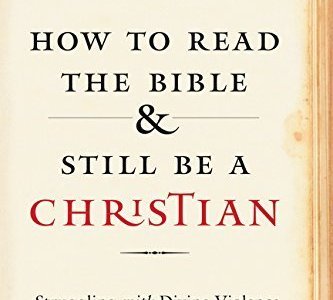
The Bible, violence, and John Dominic Crossan—with special attention to the book of Revelation

Ted Grimsrud—May 8, 2018

I have read with great appreciation many of the books John Dominic Crossan has written over the years and have heard him speak several times. A few years ago he published a book I found pretty helpful and relevant to my interests, How to Read the Bible and Still Be a Christian: Struggling with Divine Violence from Genesis Through Revelation (HarperOne, 2015). I don’t know for sure whether Crossan, who is Catholic, shares my pacifist convictions, but he clearly cares deeply about peace on earth.

The right agenda

I believe that Crossan has exactly the correct agenda for this book. He argues, “escalatory violence now directly threatens the future of our species and indirectly undermines solutions to other survival problems such as global warming, overpopulation, and resource management” (p. 244). He writes this book in order to address that problem, to show how the Bible can be used in ways that contribute to violence, and to suggest ways the Bible might be read that will actually help us move toward peace.

Crossan’s book may be read alongside Greg Boyd’s The Crucifixion of the Warrior God: Interpreting the Old Testament’s Violent Portraits of God in Light of the Cross (Fortress Press, 2017). Boyd and Crossan happily share deep convictions about helping Christians deal with the violence in the Bible in way that will empower Christians to be peaceable today. They approach the issues quite differently, though. The differences are significant, for sure. I would recommend reading both works as a way of getting a sense of the breadth of possibilities for Bible-centered peace theologies.

One big difference between these two thinkers is how they think of biblical inspiration. Boyd affirms what he understands to be a very high view of inspiration, and as a consequence he undertakes to construct a quite detailed and elaborate argument for how he can see the Bible as truthful throughout and yet also argue that the Bible is consistently a book of peace. I have written a lengthy critique of Boyd’s argument. I see it as way too convoluted. But I find his work enormously instructive.

Crossan, on the other hand, has no trouble with asserting that parts of the Bible simply are untrue. This makes his argument much simpler and more straightforward than Boyd’s—though not without problems of its own. I am not fully happy with Crossan’s approach, either. I think he too quickly accepts the presence of major internal contradictions within the Bible and thus misses some insights that an attempt to read the Bible’s overall message as largely coherent might provide. However, in this blog post I want to focus my criticisms of Crossan elsewhere. Continue reading “The Bible, violence, and John Dominic Crossan—with special attention to the book of Revelation”
Can an evangelical support gay marriage—and remain an evangelical? Responding to David Gushee’s Changing Our Mind, 3rd edition

Ted Grimsrud—July 20, 2017

David Gushee, professor of Christian Ethics at Mercer University in Atlanta, is a prominent and prolific writer who a number of years ago, like most other evangelical theologians who ever wrote about the issue, was on record opposing the full inclusion of LGBTQ Christians in the churches. He opposed same-sex marriage. Probably his most notable statement came in a chapter he wrote in what was at the time the standard text book on Christian ethics for evangelical students—Kingdom Ethics: Following Jesus in a Contemporary Context (InterVarsity Press, 2003). The co-authors of this book were Gushee and the late Glen Stassen.

Gushee’s change of mind

More recently, though, Gushee changed his views and became an advocate for the churches being much more inclusive—and blessing same-sex marriage. He wrote a series of blog posts in the Fall of 2014 where he “came out” as an advocate and followed that series almost immediately with a book version called Changing Our Mind. In 2016, he published a revised edition of Kingdom Ethics (now published by Eerdmans rather than InterVarsity) that reflected that change of perspective (that I know from a conversation I had with Stassen not long before his death would have reflected the views of both authors).

Just a few months after Changing Our Mind was published, it was followed by a somewhat expanded second edition. As would be expected, this book met with intense responses. Gushee has decided to bring into print a third, significantly expanded, edition of Changing Our Mind (the final one, he asserts).

I had been eager to read the first edition of Changing Our Mind. I was familiar with Gushee’s work and knew of his stature as a highly regarded evangelical thinker. I had responded quite positively to Kingdom Ethics when it came out and wrote a glowing review of it, though I did not discuss why I was quite disappointed with their treatment of “homosexuality.” I had learned from my conversation with Stassen that Gushee was the main author of that section, so to hear that he had changed his mind intrigued me.

So I read Changing Our Mind as soon as I could and immediately wrote a quite positive review. As the bulk of this third edition is made up of the only slightly revised chapters of the first volume, I will refer readers to that review for my thoughts about Gushee’s main arguments. I want to focus here more on the additions to the third edition, with a couple of brief comments about his overall argument. Continue reading “Can an evangelical support gay marriage—and remain an evangelical? Responding to David Gushee’s Changing Our Mind, 3rd edition”

A short review of Greg Boyd’s Crucifixion of the Warrior God

Ted Grimsrud—July 18, 2017

I recently finished reading a fascinating, challenging book, Crucifixion of the Warrior God: Interpreting the Old Testament’s Violent Portraits of God in Light of the Cross (Fortress Press, 2017). I have invested a lot of energy in this book because I think the subject matter is extremely important, and not only for Christian pacifists such as myself. And I think Boyd has done an impressive job of examining the issues related to violence in the Old Testament.

I am pretty sure I spent more time reading this book than anything since I read Ernst Troeltsch’s Social Teaching of the Christian Churches in grad school 30 years ago. Crucifixion of the Warrior God (henceforth, CWG) is a huge book—it actually takes up two large volumes, 1,487 pages in all. I have gotten so absorbed with this book, that I decided to blog my way through it. I have written an essay per chapter (I’m through chapter 10 so far) and have posted them at my Peace Theology site. I started on that before I had actually finished the whole book. Since I just now finished, I thought I would take a moment and write a quick reflection on the book as a whole. When I finish with my detailed, chapter-by-chapter critique, I will write a comprehensive review of the whole.

Initial excitement

I started reading feeling very excited. Here was someone who promised to give this important question of how to deal with the “violent portraits of God” the attention it deserved. I was also excited because I knew that Boyd would be working from a pacifist perspective.

I’ll admit that the book became a bit of a slog at times. I’m looking forward to seeing how he boils things down when he publishes his much shorter, “popular” volume on the same topic, Cross Vision: How the Crucifixion of Jesus Makes Sense of the Old Testament (due out August 15, 2017). Though Boyd writes clearly, as a rule, his argument is complicated and the detail with which he examines the various issues make it a hard to follow at times.

I remain delighted with Boyd’s consistent commitment to affirming that God is a God of humble, self-giving, nonviolent love—period. That commitment makes me want to recommend this book highly and to express my gratitude to him taking the huge risks and devoting the huge amount of energy to putting this volume together and to following it up with a more accessible version that will widen the book’s reach.

A different approach

And yet, on just about every point, I have concluded that I would make the case for reading the Bible as a consistent witness to this humble, self-giving, nonviolent, loving God in a different way. I strongly agree with Boyd that followers of Jesus must imitate God and always turn away from violent acts. But I don’t really think he makes as good case for this conviction as I had hoped he would. Continue reading “A short review of Greg Boyd’s Crucifixion of the Warrior God

Engaging Greg Boyd’s new book

I have launched on my PeaceTheology.net site what will hopefully be a long, detailed series of blog posts. I will reflect on what I have been learning from a close reading of a new book, Greg Boyd, Crucifixion of the Warrior God: Interpreting the Old Testament’s Violent Portraits of God in Light of the Cross (Fortress Press, 2017), xlii + 1445 pages.

You can go to the first (long) post by following this link. I’d encourage you to subscribe to that site if you want to follow my posts.