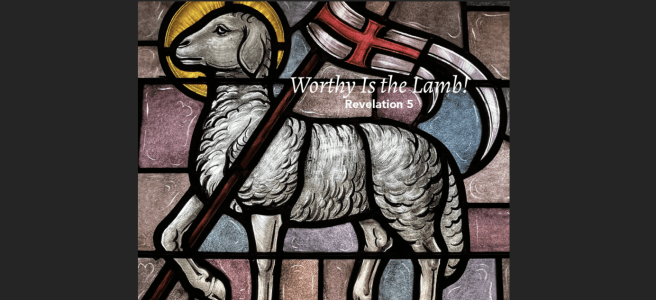
Jesus the Lamb challenges empire

Ted Grimsrud—October 17, 2025

The Bible has a reputation of being pretty pro-violence. Some Christians want the Bible to approve of violence—that helps them justify the violence they currently support. I decided back when I first embraced pacifism that I wanted to try to read the Bible as pro-peace as much as I could. I still do. An early test for me came with trying to understand the book of Revelation. Is it truly about visions of future God-approved warfare and violent judgment?

I had heard because God wants wars in Revelation, God may also want wars in our time. I decided to study Revelation to see what it actually says. I soon discerned Revelation may be read as a book of peace. I also realized that Revelation is not about predicting the future; it is about applying Jesus’s message of peace and healing in our present. A key concern in Revelation has to do with following Jesus while living in the idolatrous Roman Empire. Thus, Revelation becomes for us an essential text for reflection of the relation between Christian faith and empire.

Revelation as part of Jesus’s peace agenda

For Jesus, to resist the Empire means: Love our neighbors, say no to idolatry, give our loyalty to the God of mercy, and recognize the empire as the enemy of God, not God’s servant. Early Christians faced constant temptation to conform to Rome. It could be costly to resist. Many also found the imperial claims to be seductive. This struggle with conformity to the empire had a tragic ending for Christianity; we will see in our next post that it became an empire religion. In the early years, though, the struggle led to a sharp critique of the Empire—see Revelation.

Revelation does not collect predictions about “End Times” but describes the dynamics of imperial seduction. It describes the deep conflict between the ways of empire and the ways of the gospel. This “war of the Lamb” can only be successfully waged in one way. Wage this war with what the New Testament letter to the Ephesians described as the “whole armor of God”: The belt of truth, the breastplate of justice, the gospel of peace, the shield of faith, the helmet of salvation, and sword of the Spirit (which is the word of God) (Eph 6:13-17).

Continue reading “Jesus the Lamb challenges empire”

Jesus’s political alternative

Ted Grimsrud—October 14, 2025

Christian pacifism challenges mainstream Christianity by arguing that Jesus’s life and teaching actually do provide direct guidance for politics. Jesus, like the rest of the Bible, offers a direct alternative to the politics of empire and domination. Christians have misrepresented the Bible insofar as they have embraced uncritical nationalism. My realization that Jesus does give us a realistic peaceable direction caused me to turn away from my nationalistic embedded theology and never look back. In this post I will offer a summary of that peaceable direction.

Jesus affirmed that Torah and the prophets reveal God’s will for the world. When he taught with authority, showed love with his healing, and called together a community to embody the justice of God in the world, he fulfilled the Old Testament. Jesus’s life incurred the deadly wrath of the religious and political leaders. God raising Jesus from the dead in defiance of the leaders’ verdict of condemnation vindicated Jesus’s message. Jesus culminates the political message of the Old Testament when he critiques empire, rejects territorial kingdom as the channel for God’s promise to bless all the families of the earth, and the embodies Torah as the alternative to the ways of the nations. Like Torah and the prophets, Jesus practices power as service, offers compassion and justice for the vulnerable, and resists the powers of domination.

Politics and the gospels

The gospels present Jesus as a king. The gospel of Matthew begins with “an account of the genealogy of Jesus the Christ, the son of David, the son of Abraham” (Matthew 1:1). Christians tend to think of “Christ” as a religious term having to do with the divine identity of Jesus Christ, the savior. However, it literally means “king,” a political leader. The descriptor of Jesus that follows in Matthew 1:1, “son of David” confirms the political sense of “Messiah.” David stands as the paradigmatic king in ancient Israel, a kind of ideal king.

The rejection of the OT territorial kingdom points ahead to an alternative way to imagine the peoplehood. God never revoked Abraham’s vocation to bless all the families of the earth. If not as a territorial kingdom, then how will the promise be embodied? Jesus will be in continuity with David’s role in carrying on the promise (a great leader for the peoplehood). However, he will be in discontinuity in that his political path will not be to lead a territorial kingdom like David. The gospels provide an account for this alternative political path.

Continue reading “Jesus’s political alternative”

Breaking the hold of territorial kingdoms

Ted Grimsrud—October 10, 2025

Peace theology centers on Jesus’s life and teaching. Jesus’s life and teaching, though, make the most sense in relation to the bigger story of the Bible. In two posts, I will emphasize a few elements of the story. First, in my previous post, we note the Bible’s strong antipathy toward the big empires. Those empires powerfully challenged the Bible’s faith community—due both to the empires’ violence directed at the community and to the empires’ demands (often met) for loyalty and even idolatrous trust. The Bible offers a counter-empire vision for human life in the teaching of Torah and Jesus. These teachings explicitly offer alternatives to empire ideologies.

Second, Torah politics differ from state politics. Territorial kingdoms and nation states imitate the empires. They use coercion, exploit the vulnerable, protect boundaries, and demand absolute loyalty. The Bible’s faith community, called to bless all the earth’s families, sought to carry out that vocation as a territorial kingdom. The story shows the eventual incompatibility between the vocation to bless and identifying too closely with a territorial kingdom.

Abraham and Sarah and a new intervention from God

Genesis 12 tells of God calling Abraham and his spouse Sarah to parent this community. God gave them a child even though Sarah thought herself too old to bear children. The story that follows in the rest of the Bible presents the community in both success and failure. It offers guidance for the faithful practice of a politics of blessing. The continuation of the promise will be risky and tenuous. The human actors always risk derailing the process by their injustice, violence, and turning toward other gods. The channels for the blessing will always be imperfect human beings. The process will often be surprising. Key actors consistently will not be the people we would expect to be heroes. God’s hand in the dynamics is often difficult to discern, but somehow the promise and the blessing remain alive.

At the end of Genesis, the family of the promise moves to Egypt in order to survive a terrible famine. Then, in the book of Exodus, we learn the family does survive and multiplies, but in a condition of enslavement in the Egyptian Empire. These suffering, enslaved people cry out in their pain. God remembers the promises to Abraham and resolves to intervene. God will guide them into a recovery of faith and a new resolve to embody the promise to be a blessing.

Continue reading “Breaking the hold of territorial kingdoms”

The Bible’s suspicion of the empires

Ted Grimsrud—October 7, 2025

In the years from 1987 through 1996, I preached several hundred sermons. Almost all had to do with biblical bases for peace theology. Then I began college teaching and most of my classes were relevant for how Christian pacifist convictions could inform living in the American Empire. In what follows, I will present the message of the Bible that relates to peace theology. This message provides the grounding for an unblinkered look at the American Empire from the perspective of Christian pacifism—something I offer in the series’ final posts. The story I have told in my previous posts describes how I got to my commitment to peace theology. Now, I will turn to the story of where that commitment has led me, first theologically and then politically.

Holding the Bible loosely, but with respect

I view the Bible as a conversation partner. The big picture that comes from all its stories read together gives me a perspective from which to engage the world. To me, it is not a source of normative, explicit commands nor a miraculously accurate source of information about the past of God’s people. Yet, it is not simply ancient writings from a distant time. I see it as a fascinating collection of various kinds of literature. It reflects various human perspectives that hang together, loosely, to guide and inspire. The authors’ moral commitments give the Bible its coherence.

When read in light of Jesus’s message that centers on the call to love neighbors, the Bible serves that call. It presents a worldview shaped by love. Jesus does not originate this worldview but echoes and reinforces the Old Testament message of Torah and the prophets. The Bible tells a “Big Story” where all its parts hang together and convey a vision for life shaped by God’s love.

I discovered the Bible’s Big Story through my struggle with American warism. I found a way out of my embedded warist view of the world through an encounter with the story of Jesus. That encounter shaped how I have read the Bible ever since. In asking questions of the Bible about war, justice, and social transformation, I discovered that the Bible truly cares about politics and social transformation. It provides a powerful framework for interpreting the world.

Continue reading “The Bible’s suspicion of the empires”

Trying to figure out peace theology

Ted Grimsrud—October 4, 2025

In the Fall of 1980, Kathleen and I looked forward to our year at Associated Mennonite Biblical Seminaries with little idea what to expect. We hoped for inspiration and to understand better our Christian pacifist convictions. We learned more than we imagined we could. And by the end of the school year, I had a new goal I had not imagined before—to study for a PhD in peace theology. When we returned home to Oregon, we began a fifteen-year period that would include more education for both of us, culminating in my doctorate from the Graduate Theological Union in Berkeley, California. I would also spend about ten years as a pastor in three settings. This period culminated when I became a college professor in peace theology. Those fifteen years proved to be a time of learning what peace theology would mean to me.

Taking the first steps

In 1981, I could imagine three different directions. I could focus on the intellectual arena and become a professor, teaching and writing. Or I could turn toward direct action and be a full-time peace activist. I found both options attractive but unlikely to be possible. A third option seemed a more realistic way to combine intellectual and on-the-ground work—to serve as a pastor. We planned for Kathleen to return to college for a couple of years. I would complete my work for a masters degree in peace studies from AMBS.

As it turned out, a couple of unexpected developments caused us to adapt our plans. An unplanned, and joyful, pregnancy meant Kathleen would have her hands full with her college classes and becoming a new mother. Also, I was offered an interim pastorate when the Eugene Mennonite Church pastor took a sabbatical. So, my hands were full, too, with my coursework, the arrival of our son Johan, and serving as a half-time pastor. This left little time for peace activism work, so it fell to the side.

Kathleen loved her studies. Each class gave her an opportunity to learn new things and to work on integrating her peace convictions, philosophical inclinations, and her rapidly evolving faith convictions. Johan arrived midway through the first of Kathleen’s two years as a full-time student. We struggled to find time and energy for everything. The baby’s presence required numerous choices of priorities that meant our lives did not unfold quite like we had expected. However, we generally successfully managed to juggle all the elements of our lives.

Continue reading “Trying to figure out peace theology”

A second conversion and a new community

Ted Grimsrud—September 30, 2025

War and peace concerns filled the air during my college years (1972-76). I had to face the possibility of being drafted. I would have gone if called but did not like the idea. The draft ended the year I turned 19 and saved me from that. Then, I learned to know several returning Vietnam War vets. Those encounters showed me how traumatic their experience had been. I never had any kind of discussion in any of my churches about a principled opposition to war. No one ever said in my presence, to quote a John Prine song of the time, “Jesus don’t like killing, no matter what the reason for.” I am not sure I could have said what “pacifism” even meant. But the idea of going to war did weigh on my mind.

A decisive step

All of a sudden, though, something clicked for me. I took a decisive step, once and for all, and decided against war. I realized that I could never take up arms, and that in fact Jesus always opposed violence no matter how it might be justified. I did not make this move due to careful, thorough conversations with like-minded friends. I simply, at the right moment, accepted this conviction. That move set the direction of the rest of my life.

Though my turn toward pacifism meant a decisive turn away from Francis Schaeffer, he had pointed me toward an influence that became the catalyst for my pacifist conversion. I had discovered that Schaeffer had interesting colleagues such as a British scholar, Os Guinness. Guinness’s book, The Dust of Death, offered a wide-ranging and sympathetic critique of the American counterculture of the 1960s. He did note with respect the problems with American culture that protesters cried out against. He recognized the need for social change as advocated by the civil rights movement, the emerging feminist movement, and the antiwar movement. He affirmed many countercultural concerns but brought into the picture a Christian sensibility.

In the Spring of 1976, I read Guinness’s chapter, “Violence: Crisis or Catharsis?” He critiqued of the counterculture’s advocacy of violent revolution. He drew heavily on a French sociologist, Jacques Ellul, whose book, Violence: Reflections from a Christian Perspective, gave a good critique of the self-defeating nature of violent revolutions. It came clear to me—Yes, violence does not work! I immediately thought of war. I realized that I could never go to war. I realized I was in principle opposed to all war, a pacifist. Happily, I was so unfamiliar with that term that I did not recoil against it. I accepted it, found it helpful, and still do.

Continue reading “A second conversion and a new community”

How does one step away from warism?

Ted Grimsrud—September 26, 2025

When I began college in the Fall of 1972, I had recently registered for the draft. I knew I’d go willingly if called. I accepted my place in the American warist environment—the willing conscript. By the time I finished college in the Spring of 1976, I rejected warism. I considered myself a pacifist and knew I would never go to war or support war in any way. This post will describe what led to this radical change. In the Fall of 1972 turmoil reigned in the United States. At that point I remained mostly oblivious to the currents that swirled as Richard Nixon wrapped up his presidential campaign and won a landslide victory—and planted the seeds that led to his fall with the Watergate break-in. I knew that the Vietnam War seemed to be winding down, though when I started my freshman year the draft remained a possibility.

I started at Oregon College of Education (OCE) in Monmouth, a small town about 15 miles west of Salem. OCE mainly focused on training schoolteachers, but it had evolved to be a general liberal arts college. About 3,000 students attended, mostly from small Oregon towns. Even though I knew hardly any other students, I felt surrounded by people like me. I found it to be a pleasant place to be, and I enjoyed my two years there. I felt fine with my classes. I could get by pretty easily, though nothing really caught my attention. Sports, not ideas or big questions, provided the connecting point with my new friends. In general, I experienced my first two years in college as a relaxed and congenial time. However, I did feel uneasy about my faith. I only cautiously brought up faith convictions with others. I had no luck in finding a church or fellowship group. I visited a few places but found nothing that seemed interesting or nurturing.

The ironic 1972 presidential election

I had exulted when Richard Nixon won the 1968 election. As far as I remember, I felt positive about Nixon during his first term. I certainly sympathized with him far more than his antiwar opponents. I rejoiced when the law changed to set the voting age at 18. I had long wanted to vote. I delighted that the first presidential election after the law changed would happen when I was 18. I proudly cast my ballot for Nixon and celebrated his resounding victory.

That I would have so unthinkingly supported Nixon indicates that my embedded theology of uncritical nationalism remained operative. I later learned of deeply problematic Nixon warist policies as well as of his many character flaws. Those flaws played out in ways that would have been in tension with the values of my familial embedded theology, but at the time I remained ignorant of them. Ironically, Nixon’s opponent, George McGovern, had more compatibility with most of my values. His integrity, genuine Christian faith, and convictions about helping life be better for vulnerable people should have rung true for me. In relation to the peace convictions I would later embrace, McGovern stands as the most attractive major party candidate in the entire 20th century. The mainstream media did not give McGovern a fair shake, but even if they had, I would not at that time have been attracted to the policies he advocated.

Continue reading “How does one step away from warism?”

Competing embedded theologies

Ted Grimsrud—September 23, 2025

In these posts, I wrestle with why so many Americans, including so many Christians, have such an uncritical attitude about the violent behavior of our country. Uncritical acceptance of a deep-seated warism flies in the face of the peaceable values most Americans and just about all Christians understand themselves to have. How can this be? To address this question, I reflect on my own life, especially my transition from an American patriot to an antiwar pacifist. I have focused on what I call the “embedded theology” of uncritical acceptance that I grew up. As I grew, though, I also absorbed a different kind of embedded theology that made my transition to a pacifist possible. This different embedded theology played an even more decisive role in the evolution of my convictions than the patriotic embedded theology. However, while I find the patriotic embedded theology difficult to name in clear ways, I find this different kind of embedded theology even more difficult to bring to the surface. I attempt to do that in this post.

Looking for a sense of coherence

When I first became a Christian, I sought to make sense of life. The Christianity I initially embraced offered a coherent worldview but ended up being at odds with what I actually sought. I took several years to figure that out. Even as I realized I needed a different kind of Christianity; I still needed more time to put the pieces together. The catalyst for the shift had to do with war and peace. However, that I could make the shift and that I make it quickly and free from trauma had mostly to do with the general orientation toward life provided by what I will call my familial embedded theology (distinct from the societal embedded theology I discussed in previous posts).

My new orientation became quite distinct from and, in time, antagonistic toward my old one. The way the transition happened—and its continued viability for me—makes me believe that all along I did not actually care that much about the certainty offered by fundamentalist Christianity. Rather, I sought the coherence that only an embrace of our essential human connectedness and love-centeredness offers. It just took some time for me to figure this out.

Growing up in the US during the 1950s and 1960s, I experienced the embedded theology of uncritical nationalism as pervasive. However, when it hit turbulence during the Vietnam War era, I readily replaced it. Something more basic to the way of being in the world that I got from my family took its place. As revised and applied through my new learnings and experiences, this different embedded theology actually provided the kind of coherence I sought.

Continue reading “Competing embedded theologies”

Fundamentalism and warism

Ted Grimsrud—September 19, 2025

The connection between American Christianity and the preparing for and fighting wars has been long-standing. In this post, I will recount my own somewhat unusual path in navigating this connection. Growing up in the late 1950s and 1960s, I knew little of the wider world. The social and political currents I described in earlier posts certainly shaped the general sensibility of the world I grew up with. However, the impact on me was at most indirect. A key factor for me, in time, proved to be religious faith. Surprisingly, because my family had little religious involvement and my home community would have been considered largely irreligious. Yet….

On the margins of Christianity

I grew up on the margins of Christianity. In my small hometown, Elkton, Oregon, my family attended a tiny Methodist congregation until I was eight years old, when the congregation closed its doors. Our town hosted only one other congregation at that time, a community church. After our Methodist church closed, we would go to Sunday School at that church most weeks.

As a child, I was on my own in terms of faith convictions. I had a lot of curiosity and talked about religion with friends though I do not know why I was so interested. I don’t remember anything from my experience of going to church that ever piqued my interest. I didn’t get challenged by my parents to think about such things. I suspect I had a natural curiosity about the meaning of life and the religious dimension. My interest in God and the big issues intensified as I got older. I had a self-conscious perspective when I entered my teen years inclined to conclude that God did not exist. But it was an open question that I had a keen interest in.

The first move for me came during the Spring of my sophomore year in high school. A friend of mine died of cancer when he was in his twenties. His death left the community grief-stricken. During his funeral, I felt for the first time a strong sense of the presence of God. From then on, I no longer thought of myself as an atheist. About a year later, I started spending time with a somewhat older friend who had became active in a Baptist congregation that had recently started in town. My friend gently engaged me in conversations about faith. He mainly conveyed a general message of God’s love and a simple process to gain salvation. That process mainly involved the seeker praying to God a prayer of repentance for one’s sinfulness and of a desire to trust in Jesus Christ as the savior whose death on the cross opened the path to God’s forgiveness. Finally, one evening in June 1971, I offered the prayer my friend had described to me. I experienced this as a moment of genuine change.

Continue reading “Fundamentalism and warism”

Resistance to the American Empire

Ted Grimsrud—September 16, 2025

As the US embarked on a quest for world dominance after World War II, leaders’ quest for “full spectrum dominance” did not meet with total support from Americans. Opposition to newly expansive US warism received little media attention, though. It rarely effected policy makers. I knew nothing of the dissenters as a youth in my little corner of the world. For the story I tell in this series of posts, though, we should note the small pockets of dissent—both to indicate that American warism was not unanimous (people did dissent) and to recognize that the peace efforts that did shape my convictions beginning in the mid-1970s had important antecedents. 

Antiwar voices

In the late 1930s, many spoke in opposition to the US joining the War. Congress, which would not support a war declaration proposal from the president, did pass legislation for a draft in 1940, but only narrowly. Large movements of anti-war sentiment arose both from the right (the America First movement of traditional American isolationism) and the left (the popular antiwar movement that had arisen in the early 1930s after disillusionment with World War I). However, this war opposition almost immediately evaporated after the Pearl Harbor attack by the Japanese on December 7, 1941. With the Japanese attack the “America first” conservatives quickly jumped onboard in favor of what was widely perceived to be a war of national defense.

During negotiations in Congress on the draft, representatives from the various peace churches (led by the Quakers) managed to get alternative service for conscientious objectors included. With the popularity of the war and the government’s prowar propaganda, though, only a tiny fraction of draftees took the CO option. Most of the 12,000 draftees who performed alternative service were traditional, somewhat apolitical pacifists. Only a few thousand would have been opposed politically to the war effort. In addition to the legal COs, about 6,000 war opponents went to prison as draft resisters—though the large majority of those were Jehovah’s Witnesses whose refusal to cooperate with the draft had to do with the government refusing them ministerial exemptions, not their political opposition to the war effort.

Out of the tiny handful of COs that we could understand to be anti-empire did come important leadership for the resistance that found expression in years following. Imprisoned COs such as Dave Dellinger and Bayard Rustin developed their ideas about war resistance and nonviolent social change while spending the war years in prison and emerged afterwards as important peace movement leaders. It was also the case that the experience of many of the COs during the War had a significant formative impact. For example, numerous Mennonite COs shaped educational, service, and antiwar efforts among Mennonites and in the wider society in postwar years. Mennonite pacifism tried more to influence the wider world toward peacemaking.

Continue reading “Resistance to the American Empire”