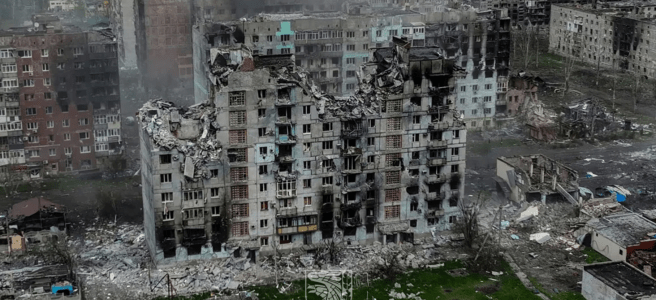
Ted Grimsrud—August 20, 2025
I found what seems to me to be to be a good, short analysis of the current status of the war in Ukraine, an article “The Peace Delusion,” by a political analyst named Thomas Fazi, who writes regularly for the web-based magazine UnHerd. In a nutshell, Fazi suggests that the core issue in the struggle is the question of whether the United States will remain the single global hegemon or if we will transition to what many are calling a multipolar world order, where there will be several great powers that can manage to co-exist in relative peace.
Peace in Ukraine will require Ukraine and its US/NATO backers to acquiesce to Russia’s demands. It’s not simply recognizing Russia’s control over the various parts of eastern Ukraine that they have or will soon have taken over. “It’s about addressing the ‘primary roots of the conflict,’ as Putin repeated in Anchorage: that Ukraine will never join NATO, that the West will not transform it into a de facto military outpost on Russia’s border, and that a broader ‘balance of security in Europe’ be restored.”
Were those demands to be met, Fazi argues, the result would be “a wholesale reconfiguration of the global security order—one that would reduce NATO’s role, end US supremacy, and acknowledge a multipolar world in which other powers can rise without Western interference.” These demands have been stated clearly and consistently by the Russians since before the February 2022 invasion of Ukraine. The reason why peace remains impossible in Ukraine is that such demands (and the resultant “reconfiguration of the global security order”) is simply something that “Trump—and more fundamentally the US imperial establishment, which operates largely independent of whoever occupies the White House—cannot concede to.”
According to Fazi, Trump does seem to recognize that Russia has all but won the war in Ukraine and inevitably will complete that task in the near future. Hence, his apparent willingness to abandon the insistence on a “cease fire” voiced by Ukrainian and European leaders. Russia has no interest in such a temporary pause that would serve their opponent’s interests but not benefit them. Russia is saying there are only two options for the West: a genuine negotiated peace where Russia’s demands are met or the completion of the Russian victory on the ground. Trump, to his credit in Fazi’s view, seems to be acknowledging that those two are truly the only possible options.
However, “the US imperial establishment” simply cannot accept a negotiated peace that Russia would find acceptable. Thus, the likelihood of the war continuing until it meets its grisly endgame in the collapse of the Ukrainian forces. Trump’s possible acquiescence to Russia’s peace requirements would only be tactical, though, in Fazi’s perspective. This is because, “for all his rhetoric about ending ‘forever war,’ [he] continues to embrace a fundamentally supremacist vision of America’s role in the world—albeit a more pragmatic one than that of the liberal-imperialist establishment…. Trump’s policies toward China, Iran, and the broader Middle East confirm that Washington still sees itself as an empire whose global dominance must be preserved at all costs.”
Fazi is one of a number of analysts who argue that a Russian victory is inevitable, and that the US/NATO are simply constitutionally unable to accept that reality or give up on what is proving to be a futile effort to sustain their world domination. These analysts have no voice in the American mainstream media but through the wonders of the internet have been gaining a growing global audience. Let me name just a few of the ones I have been paying attention to. The interviews conducted by Judge Andrew Napolitano on his “Judging Freedom” You Tube channel and Norwegian political scientist Glenn Diesen on “The Greater Eurasia Podcast” are both excellent sources. Typical guests include American academics John Mearsheimer and Jeffrey Sachs, former CIA analysts Larry Johnson and Ray McGovern, retired diplomats Alister Cooke and Chas Freeman, and Canadian journalist Aaron Maté. I also appreciate the work of several bloggers I read regularly: Julian McFarlane (a Canadian living in Japan), Mark Wauck, Moon of Alabama (German), Caitlin Johnstone (Australian), and Indrajit Samarajiva (Sri Lankan). Finally, I will mention two young American analysts currently living in East Asia, Brian Berletic and Ben Norton.
These various voices are diverse in many ways, but they almost all view our current circumstances with great pessimism. They say, in effect, that a new world is struggling to be born (noting especially the emergence of BRICS as a manifestation of the drive for a multipolar world order) but is meeting with deadly resistance from the current hegemonic powers of the US and NATO. The hegemon seems incapable of recognizing that the world is changing.

 Thinking Pacifism
Ted,
Thanks for your recent blog. I think you have concisely articulated what “the” issue is in the Ukraine/Russian situation. It is the insistence of the United States to be “The World Power.
The OG
It’s difficult to see where things are going. But the question of whether the disastrous policy of American global hegemony continues is a key issue. Trump himself seems to go back and forth on this. He is not known for consistent policy. He always wants to be #1, but he has on numerous occasions indicated a move towards a multipolar policy and some adversity to foreign military intervention. There are a number of people in the MAGA camp with this approach, including Vance. I can’t see him agreeing to the powers all being equal, but he’s shown more interest in recognizing them (Russia and China) as true powers to not universally oppose as the foreign policy establishment has traditionally wanted.
Russia does not seem interested in any peace deal that Ukraine would conceivably agree to, and Ukraine has the backing of most of Europe, which continues to see NATO dominance as essential. It seems doubtful that Russia could fully conquer Ukraine, but Ukraine is clearly the weaker party. It is uncertain if the European countries in NATO might consider a world war.
Fixed it, Bill. Sorry for the trouble.
Thank you for introducing us so well to Thomas Fazi, Ted! I hope to pay more attention to Fazi over time.
Thanks for this, Ted. I appreciate knowing of Fazi and the others you listed, a couple of them being new to me. I’ve now read the full “The Peace Delusion” article by Fazi.
I’m too deeply involved, with time available, in helping secure and greatly improve US democracy (we do have a “good shot”, right now particularly) to spend much time on deep analysis of international affairs and US foreign policy, vital as that is.
But I happened, just-prior to reading your article, to have watched Jeffrey Sachs’ presentation recently to the EU Parliament. I definitely consider his much-experienced input.As to where the US is headed, via views and actions of the Trump administration, or whatever is to follow him, I have little idea. I’m skeptical, as is Fazi, that we are very close to accepting a truly multipolar world order. And we have no actually functional (for practical purposes) international body to help create/preserve order and peace among nations.
As to specifics of settling the Ukraine war and what would come after, I don’t have sufficient knowledge to form any solid opinions. However, I’ve noted repeatedly now, that pundits from almost every angle keep prematurely (to my sense) concluding that Russia will ultimately wear down Ukraine and “win” the war… it is inevitable.
In addition to this is the observation that Fazi, as well as the vastly more experienced and broadly accomplished Sachs, gives Russia, at least under Putin or a conceivable successor, too much “benefit of the doubt”.
That seems to discount the developments for over three years now, and the ingenuity, resilience and determination of the majority of Ukrainians. It also discounts the present and future unknowns in any situation of armed conflict.
The more nuanced and well-informed position of a top historian/thinker (in my view) like Timothy Snyder makes more sense… mainly in that it recognizes the hegemony of Putin (probably representing Russia’s oligarchy pretty closely) as well as that of the USA. (I have read his “On Tyranny” and hope to get to his “On Freedom”.) [Continued…]
[continued due to length limitation]…
Here is a short section of what ChatGPT gave me on a query of his position on the Ukraine-Russia war, as to one aspect of Snyder’s view on it:”The idea that empires tend to lose their wars, and that losing an “imperial war” can be a turning point toward becoming a rule-of-law society. This applies both to Russia’s war on Ukraine and America’s historical trajectory.”
Very interesting piece, Ted! I certainly don’t oppose the US becoming less imperialistic, and do not have a problem in theory with a multipolar world order, and agree with many that the time is right (in the US, at least) for the birth of a New Reformation. But I am curious about your thoughts on how a multipolar world order would work in practice.
What will prevent one or more of the new world powers from seeking to expand their power and becoming the new world policeman? Will mutually-assured destruction act as a deterrent against such power-expansion?
There are historians who argue that Hitler only wanted hegemony on the European continent as security against what happened to Germany following World War I (of course, he subsequently went off the rails). Is that the kind of security that Putin is insisting on when he rejects Ukraine joining NATO and wants veto power over security guarantees for Ukraine?
Would most of these new world powers be (or become) authoritarian in nature because we common folks are too stupid to know what is best for us and have to be told? Are we entering a period where God allows the Egyptians, Assyrians, Babylonians, etc., to conquer His “chosen people”?
Kurt