Ted Grimsrud—October 22, 2024
We live in a time of great uncertainty. I find it difficult not to be quite discouraged about the direction the world seems to be going. What kind of future do we have? The presidential election in the United States that we are in the middle of (I mailed in my ballot the other day) is considered by many to be one of the most important we have ever faced.
No matter the outcome, warism will win the election
One of the outcomes of this election, though, that does seem fairly certain is that the American military and American militarism in general will remain engaged and expansive regardless of who is elected. We all know that Trump is all for militarism even if his (empty) rhetoric at times may seem to claim otherwise. Likewise, the Harris campaign has made it clear that she will be committed to continue on the warist path followed by the Biden administration in both Ukraine and Western Asia. So, with regard to what I believe is the most important issue facing our country—our involvement in global wars and preparations for war—this election will change nothing no matter how it turns out.
The two big wars we currently are fighting—in Ukraine and in Israel/Palestine—have not been going all that well for our side. In both cases, we see that American might seems to count for much less than what has been assumed. Simply the fact that both continue to be unresolved in itself tells us a great deal about the ineffectiveness of our weapons and leadership. Could it be that we are nearing the end of the post-World War II era of American military domination? Has the US quest for global dominance finally failed? If so, what will be the consequences?
Is American dominance coming to an end?
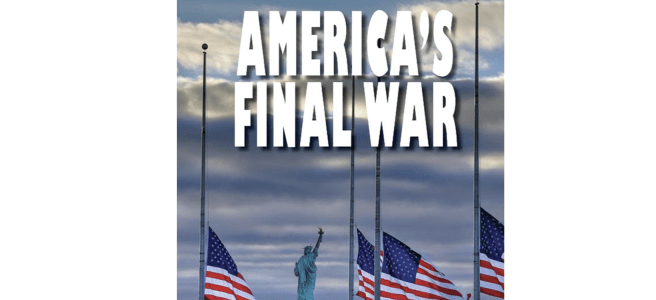
I recently read a challenging and surprising book that argues that indeed the end of an era is at hand. America’s Final War by Andrei Martynov (Clarity Press, 2024) argues that the US military is facing a failure in Ukraine that signals a profound shift in the balance of power and a certain descent into loss of power and influence by the American Empire. I thought that the failure to achieve quick victory in these two wars might indicate that American dominance is no longer what it once was. Martyanov goes further—the end is actually at hand. Is this possible?
I don’t know much about Martyanov. He is described on the book’s cover as having grown up and been educated in the Soviet Union and serving as an officer in the Soviet military before moving to the US in the mid-1990s and becoming an American citizen. In recent years he has written a great deal about military issues, focusing on criticisms of the American military. It appears, from America’s Final War, that he has become disillusioned with his adopted country. He has a sympathetic disposition toward Russia, and he actually argues that Russia has surpassed the US as a military power—in part as displayed in the Ukraine War.
I don’t know enough to evaluate Martyanov’s arguments with any confidence. However, much of what he says tracks with my perceptions of the trajectory of the American military system. Throughout the period since the end of World War II, American military engagements have rarely if ever been clearly successful—and many of them have been clearly unsuccessful. It is definitely the case that the system operates mainly as a way to funnel billions of dollars from American taxpayers to arms manufacturers and other corporations—effectiveness on the ground seems more like an afterthought.
The history of American military engagements in the past nearly eighty years is a history of one-sided operations where American military might is used against opponents with few resources. Martyanov suggests that in fact the Ukraine War is one of the first conflicts since World War II where American intervention has faced a “peer-level opponent”—and the result has been a decisive defeat for US allies and proxies.
Russia’s success
Martyanov believes that the defeat of the Ukraine/US/NATO forces signals the emergence of Russia as the most powerful and effective military force in the world. He is scornful of the American military—both in terms of its technology and its leadership. And he believes that what we see in Ukraine is indicative of deep-seated problems with the American military that are almost certainly unresolvable.
This book only briefly alludes to the current conflict in Israel/Palestine, but in his blog, Reminiscence of the Future, Martyanov draws a direct connection with the war in Ukraine, asserting that the Israel military’s inability to successfully conclude the engagements with Hamas and Hezbollah reflect the same failures of the American warist regime.
While I am uncertain how far to follow Martyanov’s analysis, I certainly accept the likelihood that we are in the midst of a sea-change in the American place in the world. What I don’t like about this book is its framing the issues strictly in militaristic terms. Martyanov seems to imply that the spiral toward ever-increasing military confrontation is inevitable. The reader of this book is being led to conclude that the only answer for the US to improve its security is to respond to the Russian growth in military power by enhancing its own military power. I would much rather turn my imagination toward considering how to enhance security through diplomacy and turning from militarism.
Is there a de-escalation path?
Martyanov does not consider a de-escalation path, though he hints at one direction we could look toward. One of main differences between Russia and the United States is that the Russian military is formed around a commitment to self-defense. He suggests that the Russians have become so effective in our time because, as always before, they face existential threats to their nation’s survival. They are fighting to defend their homeland. In contrast, the Americans have never been seriously threatened in the modern era. Americans in recent generations have never had to fight to defend their homeland. America’s military is formed around a commitment to enhance corporate profit and extend American global hegemony—neither motivation actually conducive to military effectiveness.
Might it be the case that if somehow the United States could turn from its current warist dynamics, the need for a spiral of greater and more effective warmaking would be rendered unnecessary? If Russia was no longer facing an existential threat (and assuming, as I do, that the Russians are mainly motivated by self-preservation not a quest for global [or even regional] hegemony), might it not be possible actually to de-escalate, carefully, the conflictual dynamics. I wonder, too, if this possibility might also be relevant in relation to the other great potential military confrontation the US faces—the relationship with China. Might it not also be the case that China’s increasing military capability is mainly driven by a need for self-defense against American imperial assertiveness?
Coming to terms with America’s diminishment
Part of what I draw from Martyanov’s writings (and a few other somewhat likeminded analysts such as John Mearsheimer, Larry Johnson, Aaron Maté, and Caitlin Johnstone) is a sense that the American Empire simply cannot hope to continue on the path it has taken since 1945. Russia is showing that it is more than our match. China likely is, too. We will lose direct conflicts with either. This reality has ironically been severely exacerbated by our misguided effort to isolate and diminish Russia through sanctions and attempts to undermine Russia’s relationships with Western European countries. These efforts seem to be profoundly failing. Russia may be emerging from these past several years of conflict as a strengthened nation, including enjoying a much closer relationship with China.
Along with the Russia/China rapprochement, the emergence of the BRICS (Brazil, Russia, India, China, and South Africa) alliance also promises to diminish the standing of the US in global politics and to make our tradition of dominating the world with our military and economic might less possible. Not only are Russia and China moving closer together, but erstwhile enemies Saudi Arabia and Iran have become more friendly in ways that weaken the American position. Iran and Russia also seem to be growing closer as do Iran and China. Also, Brazil and India, both major economic powers, seem to be distancing themselves from the US a bit in the context of the BRICS alliance. BRICS may be reformulating the vision of the Non-Aligned Movement of the 1950s and 1960s that was essentially undermined by American power. This time, though, the US seems less able to prevent a multi-polar world order emerging.
Clouding the horizon, of course, loom the possibilities of nuclear wars—right now in Ukraine and in West Asia. If the American position continues to disintegrate, the likelihood of extraordinarily destructive conflicts increases. We may draw hope from the possibility (hard as it might be for Americans to imagine this) that neither of the two most powerful opponents to America’s quest for unipolar dominance of the world order (China and Russia) actually themselves seek that same kind of hegemony. Maybe, just maybe, if the US stepped back some other dynamic other than competition to the death for the spot on top of the hill might emerge.
In any case, it seems increasingly possible that we face the end of the deadly post World War II era of American’s quest for world domination. All people of good will should want that end and should do whatever we can to hasten it. And hope, and strive, to prevent the American Empire from taking everyone down with it as it falls.

 Thinking Pacifism
Thanks for the thought-provoking article, Ted, including some references (although my time to pursue them is very limited… I’ll try to at least sample some more, as I did Johnstone earlier).
I’m short on time now and hope to reply further later… very important topic! But a quick referral for now. I don’t know a lot about his foreign policy / militarism philosophy, but I learned a lot, especially re Japan and China, from Rahm Emmanuel as interviewed by Fareed Zakaria on his show on CNN, I believe this past Sunday morning, possibly week prior. Not long at all, but was packed with facts that Emmanuel seems very well versed in. He MAY be among the kind of “expansionists” or American domination folks we need to replace (or see moderated seriously), but I couldn’t tell that from the interview, and I think his knowledge is worth gleaning from, even if we don’t buy everything.
I’ve got a little time now to respond further, after having written quite a bit in reply to Bill Samuel (below, is where I think that will be arranged… it is now anyway).
I’d like to respond mainly to one key statement, Ted: “… I would much rather turn my imagination toward considering how to enhance security through diplomacy and turning from militarism.” Heartily agreed.
Now, I’m not spending much time in activism or study on that effort directly, but I consider it vital and am working on it indirectly… by advancing deep reforms to our electoral and accountability systems, in ways already well-thought-out, and at least partially proven as able to be implemented. They can indeed work to discover and implement wise solutions via the serious consideration of “all voices”. One of the problem areas to produce better solutions for is the proper place of America in the world and how we should be conducting international relations. I also have a tiny presence and role in interfaith cooperation, which is one key area through which our systems and governing policies can be influenced.
That said, let me return to the statement I quoted. My hope is that at least a fair percentage among those joining the several thousand (or a bit more) activists in the above efforts will focus on understanding foreign relations. They’ll study our proper role and opportunities in diplomacy, support services, and in the US moving increasingly away from militarism. (It seems to me that it will have to be a gradual process, with nothing happening super fast.)
It also seems clear that any transitioning will have to happen in the midst of current active wars and high tension points. This makes things all the harder, of course.
A key case in point is one related to the discussion of the Ukraine war and Russian aggression. However much it may be related to moves by NATO or opportunities lost… Russia has invaded a sovereign country (see my remarks to Bill), not Ukraine or an ally of it having invaded Russia (except 2+ years after being invaded, in a countering small move). Now, the Baltic states, which neighbor Russia, Moldova, and a couple others at least, are countries which fear aggression by Russia.
The Baltic states are part of NATO, so have that likely “protection” by treaty. So does Finland now. It has joined, it says, precisely because of Russia’s aggression against Ukraine, and Sweden similarly. Finland, like the Baltics, has historical reason to fear Russia, seeming at least as much as Russia has reason to fear invasion… All these countries (Baltics, Finland) probably much more so in being so vastly overmatched with Russia. So, if the US downsizes militarily, can we get Russia to do it in parallel, in order to help reassure nations like these and others? It did happen that way, in a limited form, in the nuclear reduction treaty (or treaties?) of decades past. So let’s not give up hope!
What we have seen is the Global South is now almost completely united against cooperating with American hegemony. This is true of both of the big current wars. We’re also beginning to see a lower degree of acceptance from some of our traditional allies. The Western imperialist alliance is beginning to fall apart. Some of our major allies have voted against us on key votes related to the Gaza War and some of them have stopped providing arms to Israel. And the UN annually votes to condemn U.S. sanctions against Cuba, and only Israel votes with the U.S. on that. Some of our major allies abstain, but some of them vote against us.
In fact, the U.S. is losing the battle for global hegemony. The political class even is getting more divided about it, with the New Republicans mostly against foreign military intervention (except for support of Israel) and a handful of Democratic politicians sometimes opposing (although not a single one on Ukraine). The U.S. strategy has shifted. The elite no longer dares to risk American casualties in ground wars, knowing the American people would not stand for it. So its strategy now is to send arms to others fighting and do air strikes. This strategy faces certain failure.
I agree that neither Russia or China is seeking global hegemony in the same way the U.S. has. Putin would like to expand, but is very reluctant to use armed force to do so. His only real demand before invading Ukraine was that it agree not to join NATO. And its military is not all that powerful, as has been shown by the stalemate with Ukraine. China wants to achieve hegemony through economic means, not military means.
The foreign policy establishment still mostly supports the same old rubbish, but there is more dissent, which can be seen in Foreign Policy, their major journal. The political movement changes much more slowly than the reality. Particularly the Democratic elite refuses to give up making global domination the first priority, but they are getting increasing resistance from those who have traditionally voted Democrat. Harris faces a real possibility of her unrelenting warism stance losing her the election. If she does lose, it may result in more hope for future Democratic candidates being less warist. And, while Trump would be a disaster domestically, he is probably not as bad as Harris on warism.
Thanks for the meaty comment, Bill. A lot of what you say makes sense. And I’ll be quick to admit that you seem more deeply informed, at least on the current status of international affairs and militarism, than I am.
But I would like to push back a bit on some things. Starting at the end, you said this: “And, while Trump would be a disaster domestically, he is probably not as bad as Harris on warism.” I consider that to be likely an irrelevant point. I’ll assume for now (correct me if wrong) that “not as bad…” means less likely to lead or stumble us into a war, particularly, or supporting one side or another in international conflicts. I can’t make an extensive case here but a couple “bullet points” that make me say the statement may become irrelevant if he is President again, and that he IS at least as likely to cause problems as is Harris….
It may be correct that China and Russia are not “… seeking global hegemony in the same way…”, or perhaps in any way except China’s economic hegemony. However, I remain convinced, and am asking here if anyone can show this in error, that eventually, China plans (and possibly fairly soon) to militarily force Taiwan into unification if feasible to accomplish. (Whether Taiwan should or should not submit to unification peacefully is a separate question.) So, to turn now to just Russia, which I know a bit more about:
Russia may not be interested in GLOBAL hegemony. But it doesn’t like to LOSE significant power/influence either! Thus, as the geographically largest country, by far, it can be massively aggressive on and near its borders (as it has over the last 30+ years!) in an attempt to prosper and feel secure. And not just from NATO countries, but others from former Soviet days, or along its Caucasus and Central Asia borders. (And what about now enlisting North Korean soldiers in its aggression against sovereign Ukraine?)…
Oh… that’s IF Putin even recognizes Ukraine as a sovereign nation! I’m no expert on his views, but it has seemed that he views Ukraine as validly still part of Russia, NOT recognizing its sovereignty. If that’s the case, PERHAPS he has a valid argument, but he’s not so far convinced many other nations or the UN of it. So his contentions should have remained legal and diplomatic, not military aggression, even IF the implication is valid that he “only” wanted a guarantee of Ukraine not joining NATO, to avoid war.
Given that, it doesn’t seem right for other nations to merely stand back and let Ukraine defend its sovereignty alone. Or perhaps even pressure it to surrender to Russia with few if any conditions. Is this misguided thinking? (I ask honestly… I’ll listen as objectively as possible if someone thinks it is.)