Peaceable politics and the story of Jesus (Peace and the Bible #11)

Ted Grimsrud—December 18, 2023

In my blog series on “Peace and the Bible,” I am showing just how political the concerns of the Bible are. Most people I know find it easier to see that in the Old Testament than the New. In the second half the series, I will argue that the New Testament presents a kind of political philosophy. This philosophy has at its core a commitment to pacifism, a commitment based on the centrality of Jesus Christ to the Big Story the Bible tells. Christians have tended to miss the social implications of the New Testament part of the story because of assumptions about both politics and Jesus.

Politics have been seen as directly tied to running governments and the necessary use of violence. Jesus indeed did not talk about running governments or using violence. However, if we define politics more broadly as the way human beings order their lives together in social groups, perhaps Jesus and the rest of the New Testament were engaging in political behavior. Once we think of politics in this wider sense, we will be more open to recognizing that Jesus indeed was interested in politics—and, actually, very little else. When Jesus spoke of the “Kingdom of God,” perhaps what he had in mind was not some other-worldly existence but a reimagining of politics in this life—in line with the political dynamics in his Bible (what we call the Old Testament). The notion that Jesus spoke only of the personal sphere actually has little support in the texts.

If Jesus did indeed care about politics, then that Christians understand him to be the model human being and the definitive revelation of God would seem to require them to take seriously Jesus’s political witness. If we do take the story of Jesus seriously as an account of a peaceable way of ordering our social lives, our other question will be how relevant that account should be for our present-day political convictions and practices.

Who was Jesus?

At the very beginning of the story of Jesus in Luke’s gospel—the song of Mary in 1:46-55 upon her learning of the child she will bear—we learn that this child will address social reality. He will challenge the power elite of his world and lift up those at the bottom of the social ladder. This child, we are told, will bring succor to those who desire the “consolation of Israel.” Those who seek freedom from the cultural domination of one great empire after another that had been imposed upon Jesus’s people for six centuries will find comfort. From the beginning, the story presents this child in social and political terms.

Continue reading “Peaceable politics and the story of Jesus (Peace and the Bible #11)”

Guardians of God’s shalom: The Old Testament prophets (Peace and the Bible #10)

Ted Grimsrud—December 15, 2023

The Old Testament tells us that God provides salvation for God’s people as a gift—given out of God’s healing love, unearned, even unmerited by the people. The story presents two institutions linked with salvation, Torah and sacrifice. Both initially served as responses to the gift. First, the people received God’s acts of deliverance, then came gratitude. Such gratitude led to responses of obedience to God’s will for social life. These found expression in Torah and in ritualized expressions of commitment to God via sacrifice.

As the Hebrews’ political structures expanded and became centralized under the office of the king, their religious structures also became centralized around the Temple. With this, the original purposes of the Law and sacrifices were mostly forgotten. Torah originated as the framework for the Hebrews to concretize their liberation. Torah arranges for the economic viability of each household, resisting social stratification. Torah’s inheritance legislation, Sabbath year laws, and the ideal of the Year of Jubilee all pushed in the direction of widespread participation in economic wellbeing. The Law also placed special emphasis on the community tending to the welfare of vulnerable people—widows, orphans, and aliens (“for you too were aliens in Egypt before God delivered you,” Leviticus 19).

The idea of what we could call “God’s preferential option for the poor” in many ways defines what ancient Israel said about God. It arose as a core part of the understanding from the very beginning. The sacrificial practices, above all else, were intended to be linked with the faithful responses of the people, in gratitude, to God’s liberating work.

Problems with law and sacrifices

Torah meant neither the Law nor the sacrifices to be means to salvation but rather responses to the saving works of God. Torah meant for the Law and sacrifices to enhance justice in the community. Once they were established, though, the danger inevitably arose that either or both would be separated from their grounding in God’s merciful liberating works. As memory of the intent of the Law faded, the story tells of the community’s tendency to focus on external expressions, easily enforced and susceptible to becoming tools of people in power. These tendencies led to legalism and, eventually, in the prophets’ views, to removing the Law from its living heart of liberation from slavery and concern for the wellbeing of vulnerable people.

Continue reading “Guardians of God’s shalom: The Old Testament prophets (Peace and the Bible #10)”

May the Joshua story be read peaceably? [Peace and the Bible #9]

Ted Grimsrud—December 11, 2023

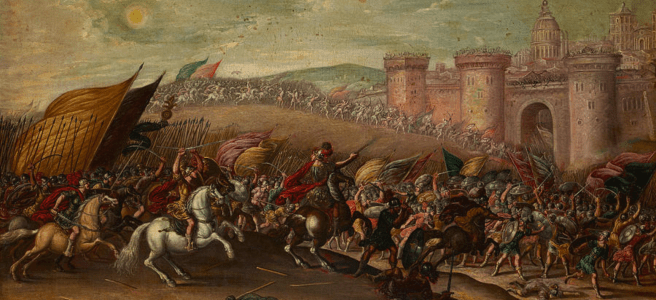
One of the more challenging passages in the Bible is the story told in the book of Joshua. God’s chosen people enter the “promised land,” meet with opposition from the nations living there, and proceed—with God’s direction and often miraculous support—to kill or drive out the previous inhabitants. The book ends with a celebration that now the Hebrew people are in the Land, poised to live happily ever after.

Probably the most difficult aspect of the story to stomach is the explicit command that comes several times from God to the Hebrews to kill every man, woman, and child as part of the conquest. This element of the story is horrifying, even more so in light of the afterlife of the story where it has been used in later times to justify what are said to be parallel conquests—such as the conquest of Native Americans and native southern Africans. I wonder as a Christian pacifist what to do with this story. But, really, even for Christians who are not pacifists, how could any moral person want to confess belief in such a genocidal God—or accept as scripture a book that includes such a story?

Exhortation not history

I want to see if we can find meaning in the story that will help us put it in perspective and protect us from uses that find in the story support for our violence. More than defending Joshua per se, I want to defend the larger biblical story of which it is a part—an essential story for faith-based peacemakers. So, the first step for me is to recognize the type of literature, in a general sense, that Joshua is. I will call it “exhortation,” not “history.” It was an account likely written many years later than the events that inspired it may have happened. It was shaped in order to offer exhortation to its readers and hearers to seek faithfully to embody the teaching of Torah. I do not think it was meant to tell the people precisely what happened in the Joshua years.

I would characterize the Joshua story, then, as a kind of parable, a story (mostly if not totally fictional) that makes a point. To see the Joshua story as kind of a parable does not take away the troubling elements of the story—however, I think such a view changes what is at stake for we who believe in the Bible. What is at stake for us, most of all, is to try to discern the lesson the story is meant to make—not to feel bound to believe that the details are factual. Thus, for one thing, believing the Joshua story conveys important truths does not require us to accept its portrayal of God (or of the vicious character of the “conquest” of the promised land) as normative for us.

Continue reading “May the Joshua story be read peaceably? [Peace and the Bible #9]”

The key to a peaceable reading of the Bible: The single-story approach [Peace and the Bible #8]

Ted Grimsrud—December 7, 2023

I have what may seem like a counter-intuitive impression about how Christians tend to read the Bible. They make Jesus Christ too central to how they read scripture and as a consequence make the Bible less peaceable. That is, by making Jesus Christ too central in the way that they do, many Christians actually misinterpret his message. In a nutshell, I believe that the Bible as a whole is a book of peace. When it is not read as a somewhat coherent whole, even the seemingly peaceable parts may actually become less peaceable.

The typical Christian way of reading the Bible assumes a major turning point in the message that comes with Jesus’s entry into the story, a turning point that in practice turns the Bible into two stories. I believe that we are better off to think more in terms of a single story, what I call the “Big Story,” that encompasses both the Old Testament and the New Testament. This single-story approach allows us better to appreciate the peaceable elements of the Old Testament and the political elements of the New Testament. With the single-story approach, we do still have an important turning point. It comes sooner, though, and may be the key to a thoroughly peaceable reading of the whole. Let me explain.

Problems with the typical Christian reading

Christian approaches to the Bible tend to assume that something qualitatively new happens with Jesus. This new thing does not simply intensify what was already present in the Old Testament but is something categorically unprecedented. This newness, it is said, may be seen is in terms of salvation. Whatever was practiced before Jesus was not adequate to make salvation fully available. The main “new thing” is that Jesus’s death provides the definitive atoning sacrifice that was necessary for God to be able to offer salvation.

To read the Bible in light of this atonement theology results is what we could call a “two-story” understanding of the Bible. The Old Testament provides the first story, one that ultimately ends in failure because the means for salvation were not fully available. The second story, told in the New Testament, does depend upon the first story for establishing the problem for which Jesus’s sacrificial death provides the solution—hence, a two-story Bible. But the second story is the necessary and authoritative one.

Continue reading “The key to a peaceable reading of the Bible: The single-story approach [Peace and the Bible #8]”

The meaning of “no other gods before me” [Peace and the Bible #7]

Ted Grimsrud—December 4, 2023

The Christian Bible gives us quite a bit of material about what are human problems. It presents idolatry as perhaps the most fundamental human problem, the root of many other problems. But what is idolatry? I’m not sure the Bible is totally clear about that. But this is what I think: Idolatry is giving ultimate loyalty to things other than God. When things become idols, even if they are generally good things, they tend to become too important, too demanding, and too likely to push people to hurt other people and to hurt nature.

That leads to another question, though, what does it mean to be called to give loyalty to God above everything else? Is this call about believing in a certain doctrine? Belonging to a certain religion? Having some kind of mystical connection? Or is it something else? I will opt for the “something else” in this blog post by reflecting on one of the Ten Commandments: “You shall have no other gods before me” (Exodus 20:3). What might that command mean for us today?

What kind of God?

The first issue might be to reflect on what we have in mind when we say “God” as the object of our trust. Typically, Christians view God as a transcendent “person,” a being who exists outside of time and outside of our physical space. This God is understood to be the one and only God. However, these notions of God are not all that apparent in the Bible. They owe more to post-biblical creeds, confessions, and other doctrines.

Continue reading “The meaning of “no other gods before me” [Peace and the Bible #7]”