Arguments for a pacifist God [Peace and the Bible #6]

Ted Grimsrud—November 29, 2023

Ever since my “conversion” to pacifist convictions back in 1976, I have closely associated those convictions with my Christian faith. Early on I realized that pacifism was not a common conviction among Christians, but that never made me doubt what I had become convinced was true: The call to love our enemies and reject warfare should be something affirmed as a core and indispensable Christian commitment—for all Christians. I do accept that mine will almost certainly only ever be a viewpoint affirmed by just a tiny percentage of Christians. However, I still keep working at it—and hope for the best.

It took several years after my initial commitment to pacifism as a young adult to clarify the significance of that commitment for how I understood God. The faith community that I in time became a part of, the Mennonites, did not actually make belief in God as a pacifist a necessary part of its peace position. But I became convinced that for me it is. Let me explain why.

I will start with a simple definition for a complicated and contested term—pacifism. By “pacifism” I mean, in brief, the conviction that nothing matters as much as love for all human beings. And this love forbids using death-dealing violence (or supporting it) against anyone. To me, the term pacifism connotes a positive commitment to love, more than simply a tactical commitment to avoid violence. And, I believe, this commitment to love is grounded in a belief that God is love and that love is at the center of the meaning of the universe.

Argument #1: The biblical narrative

Certainly, the Bible gives us many images of God that are far from pacifist—angry, vengeful, even genocidal. However, it also gives us many peaceable images—merciful, forgiving, compassionate, deeply and universally loving. I think it is important to recognize that these various images are not all compatible. They cannot be harmonized. They have to be sorted through and weighed together. To me, the peaceable images are decisive. My first point, about the Bible, is that if we read it in light of its overarching narrative, what I call the Big Story, we will see that it presents God, ultimately, as pacifist.

Continue reading “Arguments for a pacifist God [Peace and the Bible #6]”

“Biblical authority” and peace: Is there a problem? [Peace and the Bible #5]

Ted Grimsrud—November 27, 2023

When I became a Christian in 1971, one of the first beliefs that was emphasized to me was an affirmation of the strong authority of the Bible. From that point, for many years, I assumed that if I wanted to make a case for some theological or ethical position, I needed to ground it in the Bible.

A belief that the Bible mattered

I somehow had the idea that if I could make the case biblically, I would be able to persuade people of the truth of my position. And so, I went to work. Well, it took a few years after my initial conversion, but from, say, 1976 on, one of my main points of focus has been to argue based on the Bible for, among other convictions, pacifism, the inclusion of women as leaders in the churches, the peaceableness of the Old Testament and of the book of Revelation, full welcome toward gay people, economic and racial equality, rejection of the death penalty, resistance to Empire, and so on.

Now, I have produced a pretty lengthy collection of writings as a result. I have authored, co-authored, and edited 17 books. I have filled up two websites with writings on these themes. I taught dozens of college classes that drew on this work. Written out over 400 sermons. Conversations beyond counting. I don’t regret this work, except that it hasn’t made more of an impact. And that gets to my point. I have done my best. I think I’ve done a decent job. I have persuaded a few people along the way. And I love the Bible more than ever—and am more convinced than ever about the message of the Bible. I still think my interpretations are largely correct.

However, my initial premise has been proved to be untrue. Making a persuasive case for something based on the Bible is not going to change much. Most Christian convictions are not actually based all that much on the Bible. In practice, most Christians don’t actually decide what their core convictions are going to be based on careful study of the Bible. Biblical authority is not, operationally, the basis for convictions in practice. For whatever reasons and in whatever ways, Christians do not actually base their convictions on the Bible in a way that would lead them to change those convictions in face of biblical evidence.

Continue reading ““Biblical authority” and peace: Is there a problem? [Peace and the Bible #5]”

A resolution to the problem of violence in the Old Testament? [Peace and the Bible #4]

Ted Grimsrud—November 24, 2023

The Old Testament has a poor reputation among many Christians (and others) for telling stories of terrible violence that is either initiated directly by God or clearly favored by God. Certainly, this can be a problem for Christian pacifists. But it actually should be a problem for anyone who gives the OT authority as divinely revealed scripture. I had a student once who thought he was in favor of OT violence and sought to gather evidence for an argument against pacifism. As he studied the OT, though, he realized that it was a lot more violent than he had anticipated; before long he had given up on Christianity altogether. Thus, I would say that the “problem” requires attention, even for those who do not find it a deal-breaker for faith.

Not long after I became a pacifist in 1976, I had a short time of struggle as I confronted the problem of violence in the Old Testament. I was assured by some people I respected that the problem could be overcome. So, I kind of put it on the back burner and moved ahead with developing my peace theology, emphasizing, of course, the message of Jesus. Since that time, I have not been troubled by the OT problem all that much but have focused more on finding a peace message on those writings. However, I have remained interested in how to think about divinely initiated violence. Here are some of my current thoughts.

An alternative political economy

The first argument for a certain kind of pacifist reading of the Old Testament that I encountered was a chapter in John Howard Yoder’s book The Original Revolution, the first book on Christian pacifism I ever read. Yoder drew heavily from his colleague at the Associated Mennonite Biblical Seminaries, Old Testament professor Millard Lind. A bit later, I used the library at the University of Oregon to track down Lind’s PhD dissertation on war and the Old Testament that Yoder cited. Lind turned that work into a book, Yahweh is a Warrior: The Theology of Warfare in the Old Testament. As it happened, this book was published late in 1980 when I was a student at AMBS. In the spring of 1981, Millard taught a class on the book, and I was fortunate enough to be able to take it.

In my memory now, the class was quite helpful, though it was fairly narrowly focused. The main emphasis was on how to understand the stories in the books of Exodus and Joshua of God’s violent intervention in liberating the Hebrews from slavery in Egypt and driving the Canaanites out of the promised land. Millard’s main point, as I remember, was that the stories tell us that God fought instead of the Hebrews. It was a unique moment in the people’s history that was not repeated. The key motif was that the people needed to depend on God for their security, not on their own military might. After they settled in the promised land and established a territorial kingdom, their political dynamics changed. They became “like the nations,” including establishing a standing army. Crucially, the kingdom became quite corrupt, practicing injustice against the vulnerable in their community and also beginning to practice idolatry. Because of these injustices, God turned against the Hebrew kingdom and allowed it to be destroyed by the area’s great empires, Assyria and Babylon.

Continue reading “A resolution to the problem of violence in the Old Testament? [Peace and the Bible #4]”

Was Moses a terrorist? [Peace and the Bible #3]

Ted Grimsrud—November 22, 2023

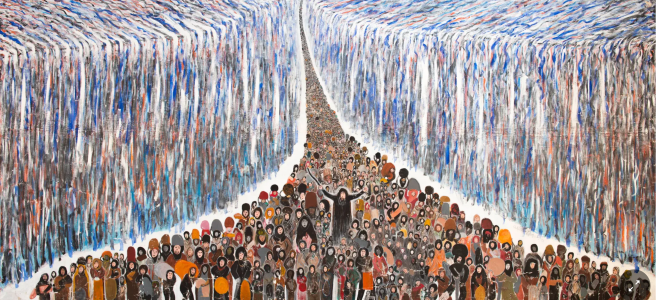
The story told in the book of Exodus of how God liberated the enslaved Hebrew people from the Egyptian empire is exciting, complicated, inspiring, troubling, and extremely important for both Jewish and Christian traditions. Liberation theologians especially like it and pacifists tend to have strongly mixed feelings about it. I know I share both of those orientations.

Was the liberation of the Hebrews due to terrorism?

I was struck recently with how interesting the exodus story is when I reflect on it in the context of considering what is in our day called “terrorism.” Let’s start with a simple (and admittedly imperfect) definition of terrorism: The use of violence to intimidate, frighten, and coerce non-combatants for political ends. I think it is important to recognize that terrorism is a tactic of both formal state-controlled militaries and non-state insurgents, even if in general usage the focus usually is on the latter type of actions.

In what follows I will especially have in mind “terrorism” in relation to non-state actors, especially those who do not have the firepower to directly take on the militaries of states and empires. I have some tentative thoughts that have arisen when I think of the story of the exodus in light of contemporary expressions of terrorism. It does seem as if there may be some parallels between the famous story of the ancient Hebrews and what’s been going in recent history. The Hebrews were an oppressed and essentially powerless group of people in the midst of an exploitive empire. They had little hope of directly bringing major changes. As it turns out, though, they did still try—and their tactics did include a great deal of violence that brought bloodshed and suffering onto the people of Egypt.

From the point of view of the storyteller, it seems clear that the violent actions of the Hebrews and their God were not the beginning of the violence in the story. Rather, the violence was already profound and widespread—the systemic violence of slavery and the more immediate violence of the actions of Pharaoh’s minions to grind the Hebrews into dust. As the Hebrews cried out for justice, the violence of the system bore down on them all the harder. Finally, though, the acts of resistance began to have an effect—which only accelerated the violence from the state.

Continue reading “Was Moses a terrorist? [Peace and the Bible #3]”

Why isn’t Protestantism’s Bible peaceable? [Peace and the Bible #2]

Ted Grimsrud—November 20, 2023

A big question arises for people who believe that the Bible is a book of peace, especially with how it tells the story of Jesus. The question is this: What about Christianity, which for most of its history in most of its manifestations has scarcely been a religion of peace? This is a complicated question and any possible answer will be contested (as, of course, are my assertions that the Bible is a book of peace, and that Christianity is not a religion of peace). In this post, all I will offer is a sketchy set of over-generalizations! I want to test a few thoughts.

The turns toward doctrine and toward Empire

One obvious place to look is at the changes among the Christian churches in the 4th and 5th centuries after Jesus. In a general sense, the early years of Christianity have been seen by many as an era of Christian pacifism (in the sense of non-participation in war). That was drastically transformed in the 4th and 5th centuries into an era where Christianity became the official religion of the decidedly non-pacifist Roman Empire. While Christianity’s status as an official state-religion has come and largely gone, the general sensibility where Christians with few dissenters support their own country’s wars seems as strong as ever.

At roughly the same time that Christianity became pro-Empire, it also established authoritative creeds and confessions as the core definers of the faith—bases for determining formal membership in Christian churches. Not coincidentally, these creeds and confessions easily lent themselves to non-pacifist interpretations and essentially sidelined the gospel stories about Jesus’s life and teaching (notoriously, for example, summarizing the story of Jesus as “born of a virgin” and “crucified under Pontius Pilate” without a word about his message in between).

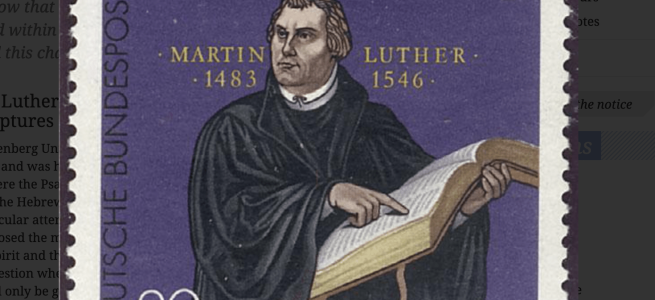
The roughly one thousand years after the establishment of creedal Christianity could be characterized as a long period of churches paying little attention to the peace message of the Bible—or to the Bible at all. We may note the continual emergence of small dissenting Christian groups that did place the story of Jesus at the center (for example, the Waldensians, the Franciscans, and the Hussites and Czech Brethren). However, these groups were often treated as heretics and viciously persecuted—or absorbed into the Catholic Church as monastic orders with little impact on the broader church. This dynamic of marginalizing the Bible did change, though, with the Protestant Reformation in the 16th century. Why, then, didn’t the new churches, as a rule, embrace the peace message of the Bible?

Continue reading “Why isn’t Protestantism’s Bible peaceable? [Peace and the Bible #2]”

Peace and the Bible: How clear is the connection? [Peace and the Bible #1]

Ted Grimsrud—November 17, 2023

As I have evolved in my thinking, my convictions about the importance of peace—saying yes to social justice and wholeness and no to war and domination—have become ever stronger even as my commitment to self-identifying as a Christian has gotten weaker. As a young adult, I started my intellectual journey first as a Christian first and then as a pacifist. A main part of the Christian part was a strong belief in the truthfulness and centrality of the Bible for my belief system. I had to be convinced that the Bible had a peace agenda.

Once I came to see the Bible as a peace book, though, I threw myself into what has proved to be a lifelong project of trying to construct a strong peace theology based on the Bible. Interestingly, as I have become more and more persuaded of the Bible’s peaceable content over the years, I have become less and less impressed with how Christianity has appropriated that resource. That is, my movement away from self-identifying as a Christian has in part been due to the Bible. If I have to choose between the peaceable message of the Bible and the generally accepting disposition toward war of Christianity and Christian doctrine, I will choose the Bible every time.

I remain as interested as ever in wrestling with the stories in the Bible (and the big, over-arching story that I believe the Bible tells) in relation to our current needs for peace convictions and in relation to the troubling warist legacy of the Christian religion. My energy for putting thoughts that emerge from this wrestling into written words ebbs and flows depending on what else I am focusing on. I seem to be feeling more energized about these issues right now, and so I want to spend some time writing a number of blog posts on “Peace and the Bible” in the weeks to come—maybe to end the year with a small burst of creativity (here is a link to the homepage of the series).

In this first post, I will briefly address several of the general questions I have been thinking about lately. In the posts to come, I plan to range pretty widely. I don’t have an ordered agenda of material I want to discuss so much as simply a variety of ideas that have popped into my mind in recent months. Typically, some thought will get my attention, and I will jot a few notes in hopes that at some point in the future I will devote more reflection to the issue. Sometimes I do that; more often I don’t. Here’s a chance to pick up on some of these brainstorms. I think there will be a general coherence to the set of posts, though: The Bible is peaceable and relevant. These will be some of the reasons why and how.

Continue reading “Peace and the Bible: How clear is the connection? [Peace and the Bible #1]”

A political reading of the New Testament (part 2): The apostolic witness

Ted Grimsrud—November 8, 2023

[Back in 2015, I posted a series of short essays in Thinking.Pacifism.net on an anarchistic reading of the Bible. The series included several pieces on the Old Testament and one on Jesus. At the time, I planned to conclude the series with a post on Paul and Revelation. For various reasons, I have only just now completed that post. Here is a link to the post on Jesus, “part one” of the two parts on the New Testament.]

One way to read the New Testament is essentially to go from the beginning to the end, reading the gospels as the main event and seeing the epistles as commentary on the story of Jesus and application of that story to the lives of the early Christians. In relation to our task of reading the Bible for its political content in light of an anarchistic sensibility, we will find that the apostolic witness reiterates the basic political content of the gospels—adding perspective on our reflections on politics as if Jesus matters. This short chapter will only scratch the surface of an anarchistic reading of the apostolic witness of the New Testament. I will touch very briefly on the book of the Acts of the Apostles, discuss a few texts from the Apostle Paul’s writings, and conclude with some reflections on the book of Revelation.

The story of early Christianity

The Acts of the Apostles, attributed to Luke, the same author of the gospel of that name and presented as a kind of sequel to the story of Jesus, has as its main agenda an account of the spreading of the message of Jesus from Jerusalem to “the ends of the earth” (Acts 1:8; in this case, from Jerusalem to Rome). The story reinforces the political message of Jesus—not an overt attempt to replace the Roman Empire with a different territorial kingdom but a political sensibility that de-centers the state and the nations and understands humane politics to involve grassroots, self-organized communities free from state domination that embody generosity, mercy, and restorative justice (these are elements of what I call an “an anarchistic sensibility” regarding politics)—and willingly accept the likelihood of suffering at the hand to authoritarian political and religious institutions.

The general tenor of social life in Acts shows a strong commitment on the part of the early Christians to defy human authority when it stands against the gospel (“we must obey God, not human authorities,” Acts 5:39-42). In Acts, as in the gospels, the “human authorities” who most commonly presented problems were leaders in the institutional religious arena (the Temple authorities and the Pharisees)—but in the Judaism in the period of Acts (the first 70 years of the Common Era) in Palestine operated as the political authorities as well as religious authorities.

The Roman Empire is a somewhat ambiguous presence in Acts. The hero of the book, the Apostle Paul, does at one point declare that he is a Roman citizen when that helps protect him from local authorities. Near the end of the book, Paul makes it to Rome and has not entirely negative encounters with Roman leaders. It appears that the writer of Acts wants to focus on the conflict with the religious leaders and minimize problems with Rome, perhaps to keep the book from being repressed by Roman authorities. However, we have good reasons to believe that Paul himself (along with the Apostle Peter) was executed by the Empire, following the path of Jesus. When read in light of the Jesus story (as well as other New Testament writings and the Old Testament), Acts mainly communicates a general suspicion of human authorities that would implicitly include the Roman Empire. The focus of the book, in any case, is on the constructive model of the early Christian communities as a counter-witness to the ways of authoritarian human structures—empires and oppressive religious institutions.

Continue reading “A political reading of the New Testament (part 2): The apostolic witness”